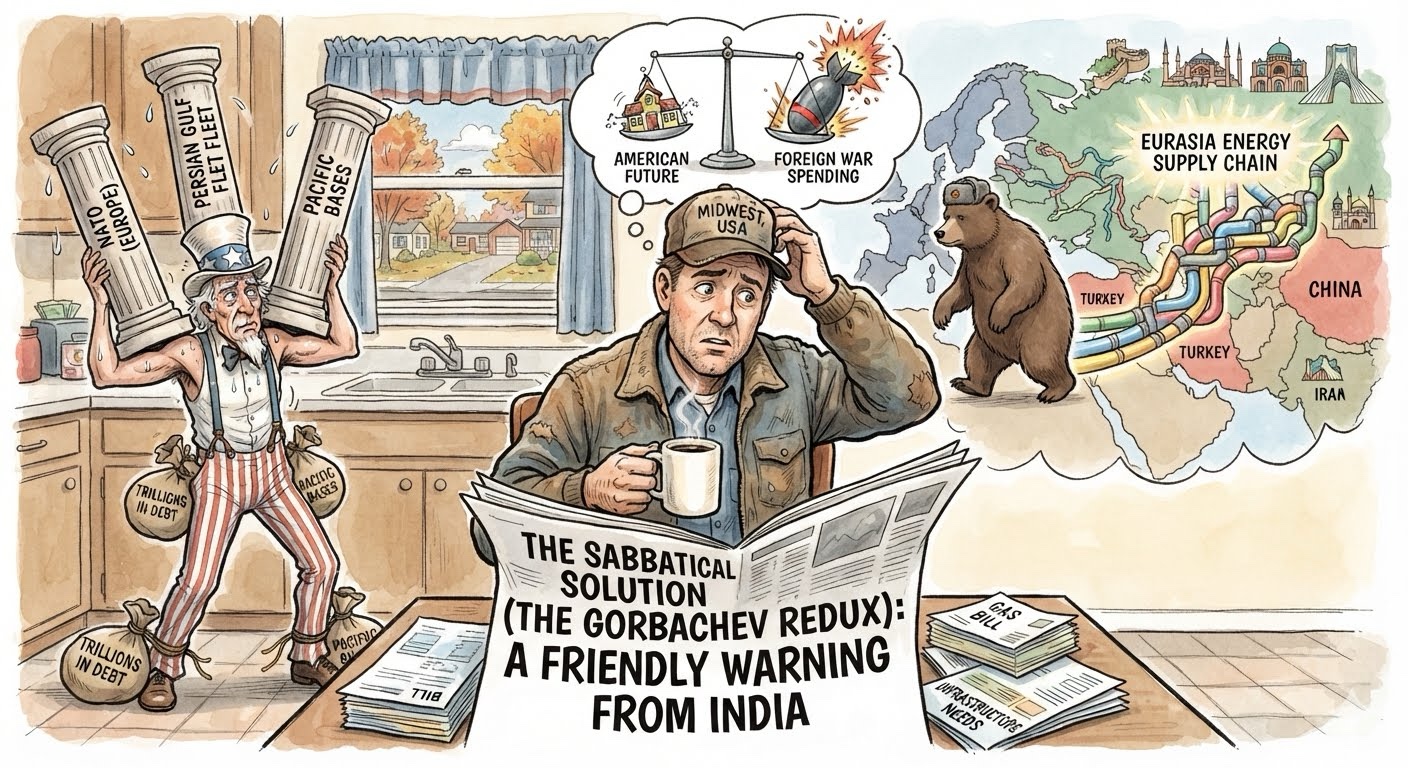
A Friendly Warning from India to the American Midwest
The Sabbatical Solution: An Open Letter to the American Heartland
What if the best way to save the American century is to step off the global chessboard entirely?
Writing as a friend from India, “The Unknown Sri Vaishnava” delivers a blunt, numbers-backed warning to the average American voter. From a $8 trillion receipt for post-9/11 “forever wars” to the explosive 2026 conventional escalation in the Persian Gulf, this open letter outlines why Uncle Sam needs a “strategic sabbatical”—a modern Gorbachev Redux—to rebuild its own foundations before it’s too late.
By: “The Unknown Sri Vaishnava”
Hey Joe,
Pull up a chair. I’m writing to you from across the ocean, here in India. We have never met, and I don’t get a vote in your elections. But like many of my fellow Sri Vaishnavas here, I consider myself a true friend of your country. For decades, the world has watched your home—the towns of the Midwest, the cities, the vast prairies—as the engine of global stability.
But I’m writing to you today because, from where I sit, it looks like you are being asked to run a marathon with a backpack full of lead bricks, and nobody in Washington is telling you why your knees are buckling.
Let’s talk honestly about what is happening in the world, what it’s costing you, and the choice your country is staring down right now.
Part 1: The Blueprint of the “Forever Wars”
Joe, you’ve been told for decades that when the U.S. military goes abroad, it’s a quick, necessary trip to protect freedom. But look at the calendar.
- Vietnam: Your government sent “advisers” in the 1950s, escalated to full war in 1965, and even after the writing was on the wall at the Tet Offensive in 1968, it took another five grueling years to pull out combat troops in 1973.
- Afghanistan: You went in after 9/11 in 2001. Even when it became clear within a decade that a clean victory was impossible, the footprint remained for 20 years until that chaotic exit in 2021.
- Iraq: The invasion began in 2003. Troops left in 2011, went back in 2014 to fight ISIS, and only now, by September 2026, is that formal coalition mission finally drawing to its ultimate, permanent close.
Every single time, the playbook is the same: enter quickly, realize the terrain is a political quicksand, and then spend a decade or two trying to figure out how to leave without looking like you lost.
Part 2: The 73-Year Shadow War is Out of the Shadows
Right now, you are watching the news and seeing your Navy engaged in the Persian Gulf. You might think this war with Iran started out of nowhere on February 28, 2026.
It didn’t, Joe. This conflict is older than you are.
It started in 1953 when the CIA engineered a coup to overthrow Iran’s elected Prime Minister, Mohammad Mossadegh, and installed the Shah as a monarch. In 1979, the Iranian people fought back, overthrew the Shah, and created an Islamic Republic. Washington couldn’t stomach it. Throughout the 1980s, the U.S. backed Iraq in a brutal war against Iran. When Iran didn’t collapse, Washington labeled them part of the “Axis of Evil” in 2002.
For the last twenty years, it was a “shadow war”—fought through cyber-attacks, assassinations, and regional proxies. But here in 2026, the mask is entirely off. It has devolved into a conventional war of attrition.
And here is the catch: Unlike the low-tech insurgencies in Afghanistan, this war is burning through America’s high-tech arsenal. The Pentagon has been spending roughly \$1.8 billion every 24 hours just to replace advanced air-defense interceptors and cruise missiles.
Part 3: The Double-Barreled Gun Staring Down Your Future
While Washington plays global sheriff, let’s look at what’s happening to your house. America is currently staring down the barrel of a financial double-barreled gun: exploding national debt and slowing GDP growth, wrapped up with severe wealth inequality and an aging population.
Let’s look at the receipt for those wars, funded entirely on borrowed money:
- Vietnam: Cost about \$1 trillion to \$1.5 trillion in today’s money, triggering the massive inflation of the 1970s.
- Iraq & Afghanistan: Combined, they cost you over \$4.2 trillion in direct and long-term macroeconomic costs.
- The Post-9/11 Total: Over \$8 trillion has been spent on global military entanglements since 2001.
Because your politicians didn’t raise taxes to pay for these wars—they just put them on the national credit card—the interest alone on that debt is going to swallow your tax dollars for generations. That is money not going to your roads, your schools, your manufacturing plants, or lowering your grocery bills.
Part 4: The Strategy of the “Sabbatical” (The Gorbachev Redux)
So, what is the alternative? If you try to hold onto everything, you will eventually break everywhere.
Think back to the late 1980s. The Soviet leader, Mikhail Gorbachev, realized his empire was hurtling toward terminal decline because it was spending up to 20% of its wealth propping up foreign states and military entanglements. He chose to pull back, shed the expensive outer empire, and focus on the core. It was messy, but guess what? The Russian core survived, consolidated, and is still a major power today. In French, there is a phrase for this: reculer pour mieux sauter—to draw back so you can take a better leap.
What if America took a “strategic sabbatical”?
The boldest place to start would be Europe. If America steps back from NATO and stops underwriting European defense, it forces wealthy European nations to finally step up, pay for their own security, and negotiate a pragmatic peace deal with Russia. That deal would restore the energy pipelines between Russia and Europe, sparking economic growth for both, and lowering the temperature on a dangerous nuclear fault line.
More importantly, if America packs up its bases and leaves the Eastern Hemisphere to the Asians—letting China, Russia, India, Iran, Japan, and Turkey balance one another—a fascinating thing will happen. Without a common American adversary to unite against, their own ancient regional rivalries and border disputes will resurface. They will spend their energy, their wealth, and their focus keeping each other in check.
Meanwhile, back home in the Midwest, America gets a long, peaceful season of strategic tranquility. You get to rest, recover, reinvest those trillions into American technology, balance your books, fix your infrastructure, and rebuild your middle class. You step off the global chessboard today so that by the dawn of the 22nd century, America is strong enough, wealthy enough, and healthy enough to leap forward again.
The Choice at the Polling Station
Joe, your political leadership class today—on both sides of the aisle—lacks the guts and the statesmanlike vision to tell you this. They are trapped in the old 1990s playbook of global hegemony because “business as usual” keeps the defense contracts funded. They will tell you that pulling back is “weakness.”
But real strength is knowing when to conserve your strength so you don’t bleed out.
Next time you walk into that voting booth in your county, and a politician promises to plant your flag in another distant corner of the world, remember the \$8 trillion receipt. Remember the factories that closed while the money flew away to Baghdad, Kabul, and the Persian Gulf. Remember that you cannot protect the borders of every nation on Earth without destroying your own foundations.
Take care of your home first, Joe. That’s how you make a country great.
Your friend,
The Unknown Sri Vaishnava
Joe’s Letter of Thanks in Reply to the Unknown Sri Vaishnava

From: Joe MillerTo: The Unknown Sri Vaishnava

Subject: Re: The Sabbatical Solution (The Gorbachev Redux)

Dear Friend,

I’m sitting here at my kitchen table in Ohio with a mug of black coffee, looking out the window at the old manufacturing plant down the road. It’s quiet out there today. I just finished reading your letter, and to be completely honest with you, I had to read it through twice just to let the math sink in.

You said you’re writing to me from all the way across the world in India, and that you don't get a vote over here. But let me tell you something, pal: you see what’s happening to my home a whole lot clearer than the people we actually elect to go to Washington.

When you turn on the evening news over here, it’s always the same talking heads using big, fancy words like "strategic resolve," "global deterrence," and "forward posture." They make it sound like these deployments in the Persian Gulf or Eastern Europe are just part of the weather—like they've always been there and always have to be. They never talk about the calendar, and they sure as heck never talk about the receipt.

That $8 trillion post-9/11 price tag you mentioned? That knocked the wind out of me. I look at my stack of monthly bills, the price of groceries, and the state of the infrastructure in my own county, and it hits me like a ton of bricks. We’ve been maxing out our national credit card to underwrite the security of wealthy countries half a world away, all while our own economic engine back here in the heartland is left running on fumes.

Your history lesson on Iran really opened my eyes, too. The media makes it look like every conflict we get into just started yesterday out of nowhere. Knowing that this fight goes all the way back to a CIA coup in 1953—before my own parents were even born—makes me realize we are trapped in a loop. Burning through $1.8 billion every 24 hours in a conventional war of attrition isn't "business as usual" anymore. It's a structural trap.

I really took to that French phrase you brought up: “reculer pour mieux sauter”. To draw back so you can take a better leap.

In the Midwest, if a farmer’s tractor is breaking down and his barn roof is collapsing, he doesn't go out and buy up the neighbor's back forty. He pulls back, fixes his own tools, reinforces his foundations, and saves his money until he's strong enough to expand again.
Why our leadership class thinks the laws of basic household math don't apply to a superpower is beyond me.

Your "Gorbachev Redux" idea is a hell of a gamble, but looking down the barrel of our national debt, continuing on this current path seems like a guaranteed disaster. Letting the regional powers in Asia balance one another while we take a strategic sabbatical to rebuild our technology, our schools, and our middle class isn't "weakness." It’s survival.

You took the pains to explain all of this in plain English without talking down to me, and for that, I want to say a genuine thank you. You gave me a grand vision of an uncommon kind—the kind that cuts right through the daily political circus over here.

I’m locking this letter away in my mind. Next time election season rolls around and some politician comes through my town promising to plant our flag in another distant corner of the world while the local factory floor stays empty, I'm going to remember the $8 trillion receipt. I'm going to vote to take care of home first.

Thank you for being a true friend to America, even from across the ocean. If you ever find yourself passing through the Midwest, the coffee is on me.

Your friend,

American Joe

Midwest, USA
(Concluded)
