By M.K.Sudarshan
September 2, 2026: Chennai, India
The selective weaponisation of sectarian polemics in the age of social media
Devdutt Pattanaik’s controversial Facebook post that didn’t get the attention he’d hoped for.

Adi Shanakara was trolled by “satvik” mostly Vaishnava temple Brahmins …. these “Sanskrit scholars and Vedic experts” directed various insults and vitriolic labels at him and his followers. These attacks often targeted his philosophical proximity to Buddhism, his personal character, or his interpretation of sacred texts. The following is a list of historical insults directed at Śaṅkara, along with their sources and the periods in which they emerged…no Sanatani will tell you this as they try to change Bharat History and show Brahmins as “compassionate”…. They used the word “modern” as a slur.
- “Crypto-Buddhist” (Pracchanna-bauddha)
The Insult: This is the most enduring intellectual insult, claiming that Śaṅkara’s non-dualism is merely Buddhism in a Brahmanical disguise. Critics argue his concept of the attributeless (nirguṇa) Brahman is identical to the Buddhist śūnyatā (emptiness).
Sources: Primarily the Viśiṣṭādvaita school founded by Rāmānuja (11th–12th century) and later the Bhedābheda school of Vijñānabhikṣu (16th century).
Period: Emerging as a major polemical point by the 11th century and intensifying in the late medieval period.- Demon Incarnation and “Bastard”
The Insult: These sources present a “demonized” biography, portraying Śaṅkara as the earthly incarnation of the demon Maṇimat. To further dishonor him, they claim he was the bastard son of a widow.
Sources: The Madhva (Dvaita) tradition, specifically the hagiographies Maṇimañjarī and Sumadhvavijaya written by Nārāyaṇa Paṇḍitācārya.
Period: Early fourteenth century.- “Sarpkara” (The Defiled One)
The Insult: A sardonic twisting of his name from Śaṃkara (“the auspicious one”) to “Saṃkara” or “Sarpkara”, which literally means “the defiled one” or “the one who causes confusion”.
Sources: The Madhva hagiography Maṇimañjarī.
Period: Fourteenth century.- Heretic (Pākhaṇḍa) and Propagator of “Teachings of Darkness”
The Insult: Śaṅkara’s Advaita is labeled a heretical doctrine (pākhaṇḍa). His teachings are described as tāmasa śāstra (scriptures of darkness or torpor) intended to mislead the wicked and “destroy the entire world”.
Sources: Vijñānabhikṣu (referencing the Padma Purāṇa), who argued that Śiva taught this “false doctrine of Illusionism” disguised as a Brahmin to lead demons astray.
Period: Sixteenth century.- Loser of Debates and Suicide
The Insult: Contrary to Hindu hagiographies of “victory,” Buddhist accounts portray Śaṅkara as a philosopher who lost his debates and, unable to bear the humiliation after being defeated by the Buddhist scholar Dharmakīrti, committed suicide by jumping into the Ganga.
Sources: The Tibetan historian Tāranātha’s History of Buddhism in India.
Period: Composed in 1608 (17th century), though reflecting much older oral traditions.- Graphic and Violent Literary Titles
Late medieval sectarian pamphlets carried intentionally insulting titles aimed at Śaṅkara’s followers:
Durjanamukhacapeṭikā: “A slap in the face of the wicked”.
Durjanamukhapadmapādukā: “A boot to the lotus mouth of the wicked”.
Sources: Produced by various Benares pandits during heated sectarian disputes.
Period: Seventeenth and eighteenth centuries.- “Modern Thinker” (Ādhunika)
The Insult: Used as a dismissal to strip Śaṅkara of his claim to represent ancient Vedic tradition. By calling him “modern” (ādhunika), rivals implied his views were a recent, unauthorized departure from original Vedānta.
Sources: Vijñānabhikṣu and other realist Vedāntic schools.
Period: Sixteenth century.- “Greatest Heavyweights Among the Fools”
Criticizing the Vedāntin goal of liberation as the “annihilation of the self,” this theologian famously stated that the “greatest heavyweights among the fools” are those who believe the Self is destroyed in liberation.
Sources: The Śaiva Siddhānta theologian Bhaṭṭa Rāmakaṇṭha II in his Paramokṣanirāsakārikā.
Period: Tenth century (Kashmir).
The question behind the list
The above post of Devdutt Pattanaik on his Facebook page prompted a simple question: (a) what is the purpose of cataloguing these insults today? (b) Is the object to suggest that Śaṅkara’s influence was exaggerated? (c) Is it to imply that contemporary Brahmins opposed his rise? (d) Or is it merely to expose the existence of hostile voices within Hindu intellectual history?
The last of these (d) is legitimate. The first two (a) and (b) would require argument, not insinuation. A sectarian insult is evidence that a polemical dispute existed; it is not, by itself, evidence that the target was intellectually insignificant or historically fraudulent.
A further question naturally follows: were such attacks directed only at Śaṅkara? The answer is no. Ramanuja, Vedanta Deśika, and Madhva too were subjects of hostile representation.
Madhva literature portrays Śaṅkara as the demon Maṇimantha reborn, accuses him of propagating Buddhism in Vedic disguise, and represents Advaita as a doctrine that compromises the reality of the individual soul. These claims belong to Dvaita’s theological contest with Advaita and cannot be treated as impartial biography.
The Madhva-vijaya presents Madhva as the divinely appointed corrective to Śaṅkara’s legacy. The two men could not have debated historically, since they lived centuries apart; the literary confrontation is therefore between Madhva and the Advaita tradition inherited from Śaṅkara.
Ramanuja and the Chola memory
The traditional history of Ramanuja preserves a very different but equally important memory of conflict. Śrivaishnava guruparampara accounts identify the persecuting ruler as Kulottunga II, remembered in the tradition as Krimikanta Chola. The associated narrative says that Ramanuja left the Chola country and found refuge in the Hoysala realm, eventually establishing himself at Melukote.
This memory should not be dismissed merely because its sources are later. Nor should it be converted into a simplistic account of an eternally anti-Vaishnava Chola state. The evidence is layered. Saiva courtly literature records the removal of the Govindaraja image from Chidambaram during Kulottunga II’s reign, while inscriptions and temple history also show that Chola rulers and their officials could patronise Vaishnava institutions. The precise chronology and scope of the persecution remain debated, but the Śrivaishnava memory of political and sectarian danger is historically significant.
The proper conclusion is therefore modest but clear: the tradition associates Ramanuja’s exile with Kulottunga II, and this association is supported by a wider record of tension around Saiva and Vaishnava institutions, even though the full narrative cannot be reconstructed from one source alone.
Vedanta Desika’s different exile
Vedanta Desika belonged to a later generation. Born at Tuppul near Kanchipuram in 1268, he became one of the most formidable theologians of Vishishtadvaita and a major defender of the Sri Vaishnava tradition. His movements must not be confused with Ramanuja’s exile.
The traditional account is that Desika encountered a hostile intellectual atmosphere in Kanchipuram, including sharp opposition from Advaitins and Buddhists. This was not necessarily a state-sponsored persecution comparable to the Chola episode associated with Ramanuja. It was, rather, sectarian and intellectual marginalisation: denunciation, polemical attack, and an environment in which a teacher could feel unwelcome or insecure.
For a period, Desika relocated to Tiruvaheendrapuram, where he composed important works and deepened his association with the deity Devanatha. He later moved to Srirangam at the invitation of its Sri Vaishnava community, which needed an authoritative theologian to defend the tradition against rival schools. His later departure from Srirangam is associated not with Chola persecution but with the fourteenth-century invasions and political upheavals that threatened the temple and its community.
The two episodes thus illustrate different forms of adversity. Ramanuja’s exile is remembered in connection with royal pressure under Kulottunga II. Desika’s movements reflect the realities of sectarian contest, intellectual hostility, institutional need, and later military disruption.
The forgotten proportion
The history of Indian philosophy was not a serene conversation among disembodied ideas. It was a living contest among institutions, teachers, monasteries, temples, courts, communities, and rival systems of knowledge. Advaitins, Vishishtadvaitins, Dvaitins, Buddhists, Jains, Mimamsakas, Naiyayikas, Saivas, and others argued over scripture, logic, ritual authority, the nature of the self, the status of the world, and the means to liberation.
Some arguments were subtle and profound. Others were personal, sarcastic, and abusive. A rival could be called a heretic, a concealed Buddhist, a fool, a corrupter of scripture, or even a demon. Madhva polemic could demonise Śaṅkara; Buddhist narratives could reverse the story of his victories; Advaita writers could dismiss rival metaphysics; Saiva and Vaishnava authors could portray one another as scripturally misguided. The polemical record is real, and it should be studied rather than concealed.
But polemics are not the whole history. They are only one layer of it. To present them as the principal meaning of a philosopher’s life is to mistake the quarrel at the margins for the civilisation at the centre. Śaṅkara’s commentaries, Ramanuja’s theological synthesis, Madhva’s realist exegesis, and Desika’s literary and philosophical achievements cannot be reduced to the insults their opponents directed at them.
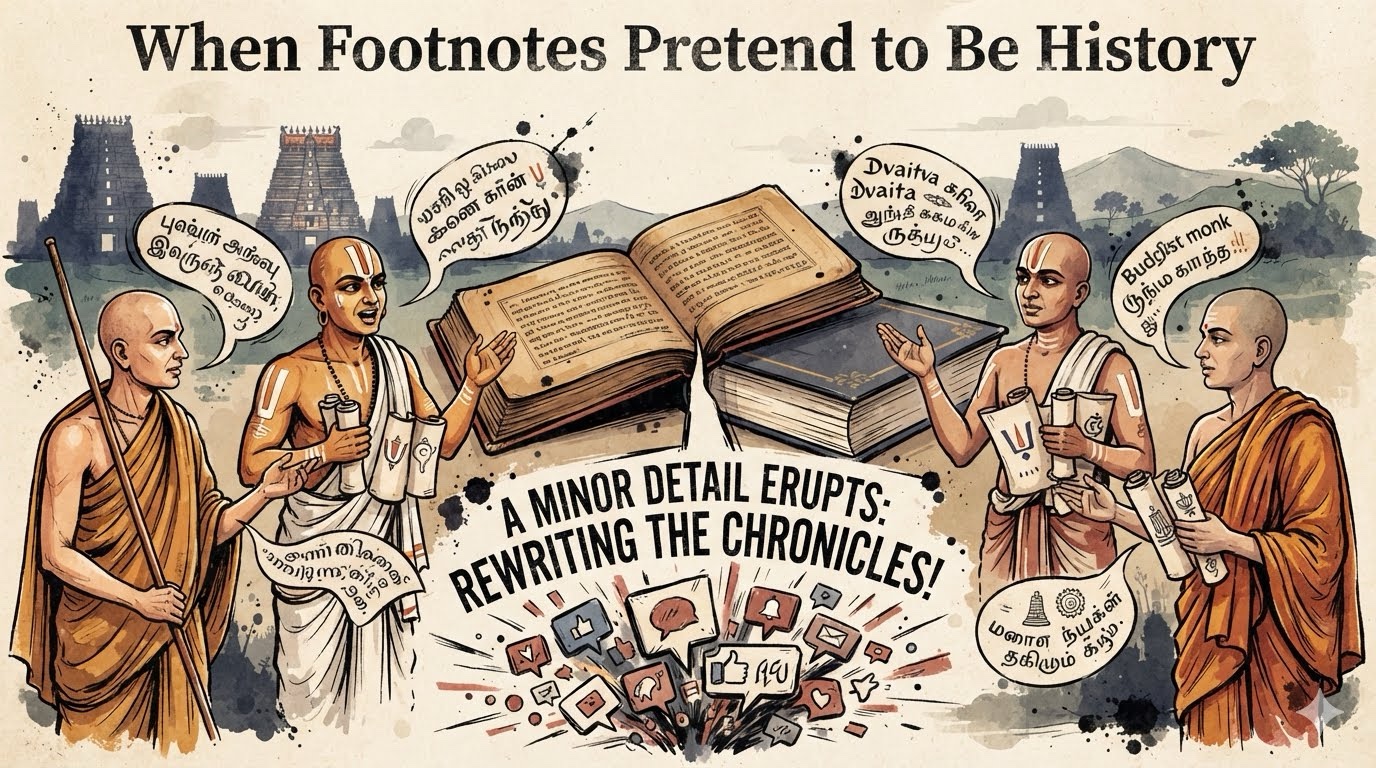
When footnotes become history
This is where the danger of popular historical writing begins.
A sensational anecdote travels more easily than a qualified argument. A phrase such as “crypto-Buddhist,” “demon,” “bastard,” or “modern thinker” can be extracted from its literary context and presented as though it were an objective historical verdict. Social media intensifies the distortion: the footnote becomes the headline, the polemical aside becomes the central fact, and a hostile memory becomes a supposedly definitive biography.
The problem is not that Pattanaik has brought these materials to public attention. Historical scholarship must not suppress unpleasant evidence. The problem is one of selection, framing, and proportion. If hostile accounts of Śaṅkara are repeatedly foregrounded while the larger philosophical and institutional history is pushed into the background, readers may come away with the false impression that the insults are the most significant facts about Śaṅkara.
The same standard must be applied to every tradition. If Buddhist criticisms of Vedic authority are cited, Buddhist polemics against Brahmanical thinkers must also be contextualised. If anti-Brahminical arguments are highlighted, anti-Buddhist, anti-Jain, anti-Saiva, anti-Vaishnava, and anti-Advaita polemics must not disappear from the picture. If a late hagiography is used to discredit one teacher, the hagiographical character of rival traditions must also be acknowledged.
There is a defensible criticism of Pattanaik here. It does not require speculation about his private psychology. Because it rests on his recurring interpretive tendency: the selective use of anti-Brahminical and Buddhist critiques as privileged keys to explain Vedic and Hindu traditions. That tendency can make Brahmanical history appear primarily reactive, oppressive, derivative, or intellectually suspect, while treating the rival polemical perspective as unusually revealing.
The result is not historical balance. It is a redistribution of emphasis in which ancient polemical trivia acquires the authority of settled history.
The real lesson
The real lesson of Hindu intellectual history is neither that sectarian differences did not exist nor that they destroyed the civilisation that produced them. The lesson is that a plural intellectual culture can contain intense hostility alongside extraordinary creativity.
The traditions survived not because they never quarrelled, but because they continued to produce commentaries, counter-commentaries, temples, institutions, poems, rituals, translations, debates, and new syntheses. Their disagreements were often acrimonious; their intellectual achievements were nevertheless immense.
A responsible historian must therefore ask of every sensational claim: What is the source? What is its date? What is its genre? What was its polemical purpose? How representative is it? What does the opposing tradition say? And what proportion should this episode occupy in the history of the person concerned?
Without those questions, a footnote can pretend to be a chapter, an insult can masquerade as analysis, and sectarian memory can be mistaken for the whole history of Indian philosophy. There is the danger of facile and fatuous conclusions being drawn from such distorted reading of history.
That is the Devdutt Pattanaik myth that needs to be unravelled.
(Concluded)