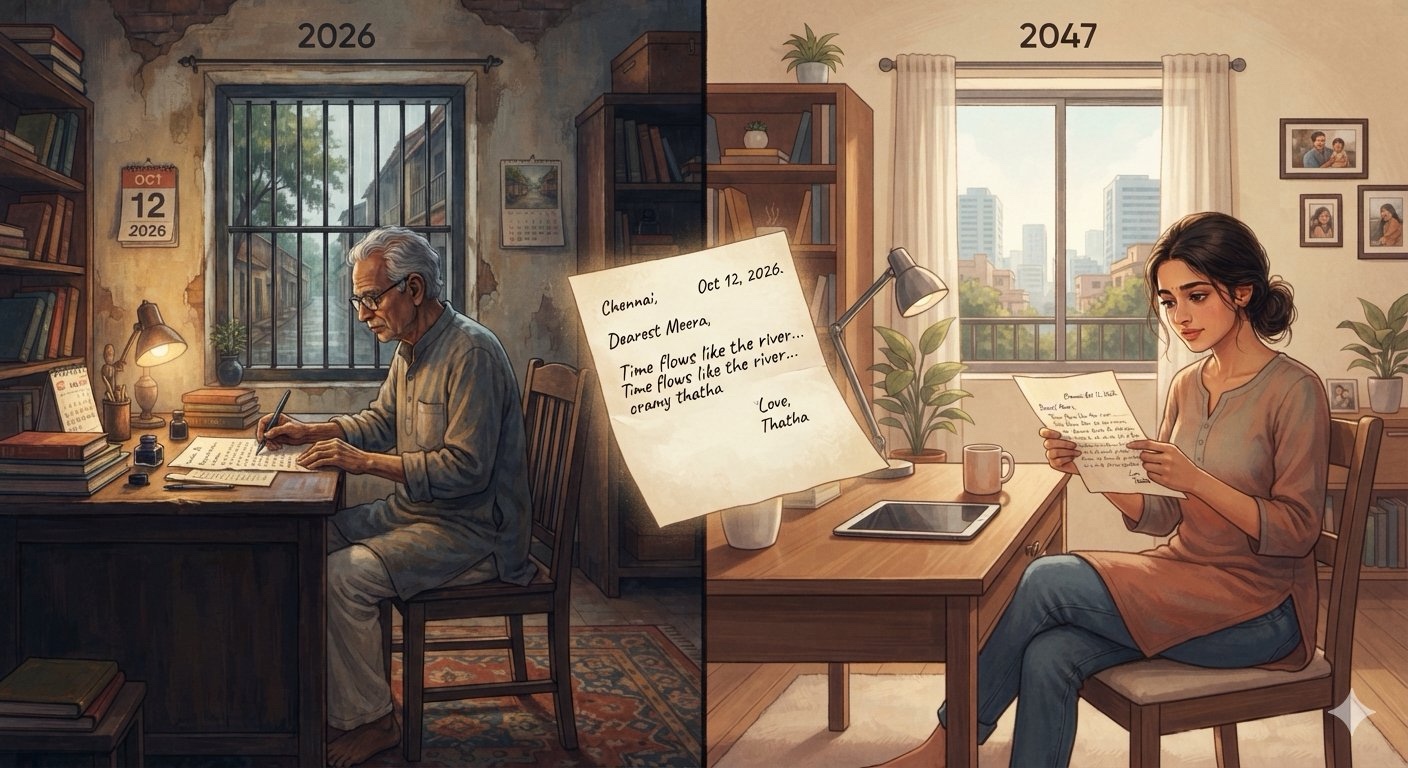
August 24, 2047
On your 22nd birthday

My Dearest Child,
If you are reading this, I am long gone—perhaps for years, perhaps for decades. I am writing to you from September 13, 2026, a Sunday morning in Chennai, when I have just recently turned seventy and you are one year old, barely able to walk, full of that inexplicable light that infants carry into the world.
I have asked your parents to keep this letter sealed until today, your 22nd birthday, so that you might read it as an adult, capable of weighing the words of an old man who loved you without ever knowing the person you would become.
I write not to give you advice—you will have had twenty-two years to gather your own—but to tell you what I thought, in my time, about the India you now inhabit.

The World I Knew
I was born into an India that had been independent for nearly eighty years, yet still bore the deep scars of two and a half centuries of colonial rule. We had thrown off the British, but we had not thrown off the frameworks they left behind: the idea that progress meant catching up to the West, that development meant reaching their income levels, that excellence meant placing our institutions in their ranking systems.
By my seventieth year, the country had embarked on a grand project called Viksit Bharat @2047—a “Developed India” by the centenary of independence. The goals were ambitious: a $30 trillion economy, per–capita income of $18,000, world-class infrastructure, technological parity with the advanced nations. Everyone spoke of it as civilizational resurgence, as the return of India to its rightful place as a vishwa guru—a teacher of the world.
But I could not bring myself to believe the grandiose language. What I saw was not regeneration but refurbishment—a magnificent salvage operation, yes, but one conducted on terms set not by us, but by a so-called interconnected world whose metrics of success we had internalized as our own.
What I Confessed to Myself
Here is what I believed, and what I want you to know:
1. The wholeness was lost, and could not be restored.
Long before the British came, India had been a civilizational whole—not because it was isolated, but because it had the confidence to engage with the world without surrendering its core frameworks.
We absorbed Buddhist, Greek, Persian, and Central Asian influences while remaining recognizably ourselves.
Colonialism broke that confidence. It did not just extract wealth; it extracted the capacity for intellectual self-governance. What remained after independence was not wholeness but fragments—brilliant, resilient fragments, but fragments nonetheless.
2. “Cross-fertilization” is not always organic.
We were taught to believe in the great potential of “cross-fertilization of ideas,” of the “empire of ideas.” But fertilization can be toxic.
When fertilizer is applied extensively in farming, it creates conditions for one crop to thrive at the expense of all others, which are rendered “adventitious weeds.”
So it was with colonial education: it was designed not to enable Indians to “select, translate, and reframe external inputs within indigenous frameworks,” but to replace indigenous frameworks entirely.
The result was what the philosopher K.C. Bhattacharya called the “enslavement of minds“—a feeling of inferiority, an erasure of memory and cultures, an uncritical acceptance of Western ways of thinking as superior.
3. Viksit Bharat was refurbishment, not regeneration.
By 2047, if the vision was realized, India would have achieved remarkable things: hundreds of millions lifted out of poverty, world-class infrastructure, technological capacity in key sectors. But it would not have recovered the wholeness I described.
The goals themselves—GDP targets, per-capita income parity, global competitiveness indices—were borrowed frameworks, not self-defined ones.
We were not regenerating a new India; we were refurbishing the old one, making it larger, richer, more capable, but still operating within systems whose terms we did not set.
4. Honest naming is a gift to the future.
I did not write this letter to belittle the achievements of my generation. Far from it. For your sake, for the sake of your well-being and prosperity, I prayed that the vision would be realised in full measure.
Material progress matters—poverty reduction, healthcare, education, employment. These are not trivial things. But the clearest gift I myself as grandfather could give you was honesty: to call spades spades, to admit that we were not achieving civilizational resurrection but sophisticated bricolage, to name the loss clearly so that you would not be burdened with false pretenses.
A Philosopher from My Time
There was a thinker in my time—Krishnachandra Bhattacharya, who died in 1949, long before you were born—who wrote about something he called “Svarāj in Ideas.” He meant that political freedom was not enough; we had to free our minds from the habit of thinking that Western ways of understanding the world were superior to our own. He called this “cultural subjection”—a subtle, nearly invisible form of intellectual slavery that produced a feeling of inferiority and an uncritical acceptance of borrowed frameworks.
I thought of him often as I wrote this letter. He would not have been surprised by what I call “refurbishment” rather than “regeneration.” He knew, nearly a century before you read this, that the deepest chains are the ones we do not see.
The bemusing irony for me today is that Viksit Bharat’s proponents today likely see themselves as pursuing civilizational restoration. But the metrics of success betray the underlying paradigm: if “development” means reaching Western per-capita income levels, if “excellence” means placing Indian institutions in Western ranking systems, if “innovation” means competing in Western-defined technological races, then the project remains, firmly and undeniably, within the colonial epistemic framework Bhattacharya critiqued.
If you ever want to understand why an old man like me could not bring himself to believe the grand visions of his time, look Bhattacharya up. His words may make more sense to you than they ever did to me.
What I Hope for You
I do not know what India looks like in 2047. Perhaps it has achieved all its targets. Perhaps it has fallen short. Perhaps it has discovered new goals, new metrics, new frameworks that I could not imagine from my vantage point in 2026.
But this is what I hope:
That you will not be angry with us.
We did the best we could within the constraints of a toxified epistemic soil. We built what could be built from the fragments. We were not the regenerators; we were the refurbishers. Do not judge us for failing to be what we could not be.
That you will think for yourself.
Do not accept the frameworks you inherit without questioning them. Ask: Who set these goals? Whose metrics are these? What does “progress” mean, and who gets to define it? If you find that you are still thinking in borrowed terms, do not despair—but do not accept it as fate either.
That you will love India without illusion.
Love this country for what it is, not for what it pretends to be. Love its messiness, its contradictions, its beauty, its pain. Love it enough to see it clearly, to name its losses without flinching, to build what can be built without grandiose claims.
That you will be happier than I was.
I spent much of my life in introspection, in wrestling with questions that may seem abstract to you. I hope you have the luxury of taking some things for granted that I could not. I hope you live in an India where the question of “wholeness” is not a source of anguish but a matter of fact. I hope you are free to simply live, without the burden of civilizational grief that weighed on me.
A Grandfather’s Love
I never knew you as an adult. I never heard your voice, saw your face, knew your thoughts. But I loved you from the moment you were born, and I love you still from wherever I am now—or from wherever I am not.
If this letter reaches you, know this: I wrote it not to burden you with my doubts, but to free you from my illusions. I wanted you to have the truth, unvarnished and unadorned, so that you could make of it what you would.
You are twenty-two now. You have your own life to live, your own India to inhabit, your own questions to ask. I do not expect you to agree with me. I only ask that you think for yourself, as I tried to do.
Go well, my child. Be happy. Be free.
With all the love a grandfather can muster across the silence of years,
Thatha
(Sudarshan Madabushi)
Chennai, September 13, 2026
(A few weeks after having turned Age 70)
PS: “What remains is not restoration but mourning plus improvisation.”
— (Words I wrote in my seventieth year, for you).
Sudarshan Madabushi
