By M.K. Sudarshan
September 23, 2026: Chennai, India
A small WhatsApp exchange is sometimes like a spark struck between three flints: brief in duration, yet capable of lighting a larger chamber of thought.
The conversation from which this piece arose took place informally on the morning of 22 September 2026 among Sri Indira Parthasarathy—Eepa to his friends—Sri Amaruvi Devanathan, and myself.
It began with a quotation attributed to Donna Tartt: that films make voyeurs of us, whereas novels enable us to live from within another person’s soul.
Eepa objected. Amaruvi defended the novel’s special demand upon the imagination. I entered the exchange with sympathies which, I confess at once, leaned closer to Amaruvi’s than to Eepa’s—though not without being checked, enlarged, and instructed by Eepa’s invocation of Satyajit Ray.
The actual WhatsApp messages were brief. The conversation that follows is a literary enlargement of their essential substance. Its principal views, illustrations, objections, and differences of emphasis have been retained; but its form has been imaginatively reconstructed as a parlour discussion before an audience. It should therefore not be read as a stenographic record, nor as a transcript of a formal symposium.
The critical reflections placed in the moderator’s mouth—including references to film theory, literary criticism, spectatorship, and the imaginative difference between words and images—were developed with the assistance of an AI research and writing tool. I have selected, adapted, and woven them into the present piece. Responsibility for the finished argument, its interpretations, and any errors or inadequacies remains entirely my own.
The purpose is not to pronounce a victor between cinema and the novel. It is to allow three different sensibilities to test one another in friendship: one trusting the great film’s capacity to make us participants in another life; another trusting the novel’s demand that we inwardly create its world; and a third—my own—wavering between the two, yet inclined towards the latter.
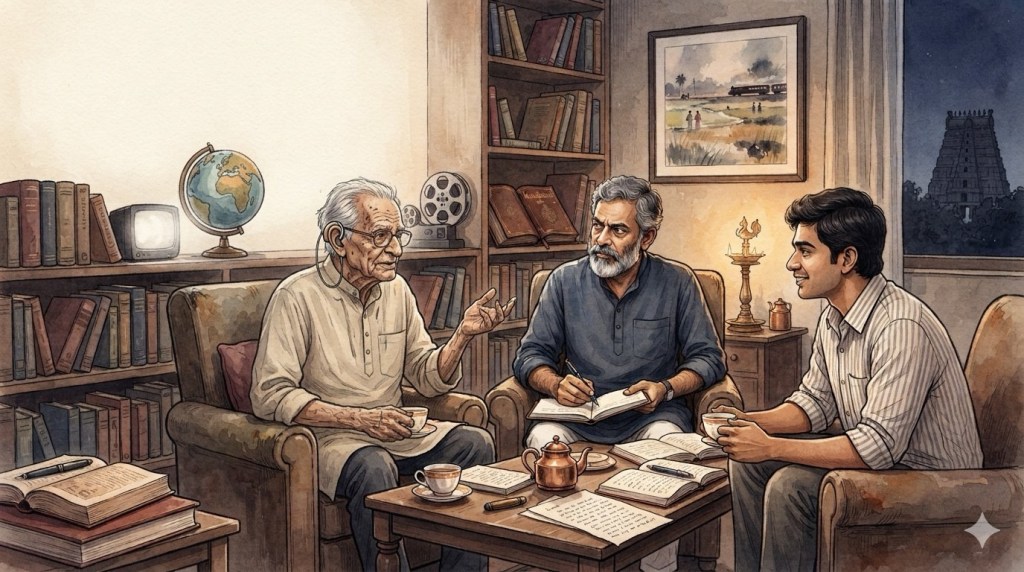
Artistic representation of Eepa, Amaruvi and the Unknown Sri Vaishnava
A Parlour Soirée
“The Unseen, the Imagined, and the Remembered”
Participants:
• The Moderator (“The Unknown Sri Vaishnava”) — essayist and biographer, still carrying within him an unwritten novel.
• Eepa (Indira Parthasarathy, Tamil Sahitya Akademi and Padma Shri Awardee) — novelist, scholar, playwright and defender of cinema’s power to make the spectator inwardly present.
• Amaruvi (Devanathan) — young Tamil novelist and advocate of the imaginative labour demanded by fiction.
• The Audience — readers, viewers, writers, critics, and lovers of both arts.
The quotation
Moderator: Ladies and gentlemen, our conversation this evening begins with a remark by Donna Tartt. It is a formulation at once beautiful, provocative, and—if I may say so—almost calculated to irritate a filmmaker. She says:
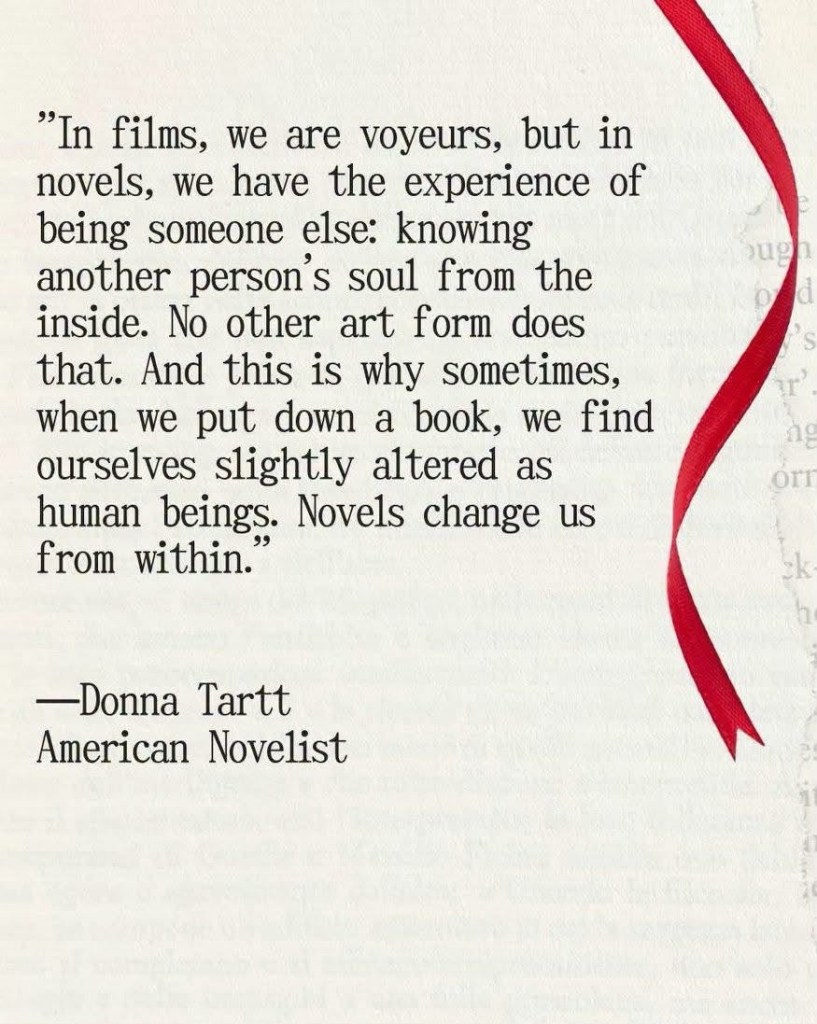
I had thought this rather unanswerable—until Sri Indira Parthasarathy, whom we fondly call Eepa, said simply:
“I don’t agree with it. In a good movie you could be a part of it.”
Eepa Sir, that is a compact sentence. It denies not merely Tartt’s conclusion but the whole distinction on which her conclusion rests. Are we, then, not voyeurs in a good film?
Eepa: Not if it is truly a good film. In a poor film, perhaps we sit outside and watch people move, talk, cry, fight, and die. But in a good film we are not outside. We become part of its life.
Moderator: So the difference is not between cinema and the novel as such, but between superficial cinema and cinema that has found its true artistic language?
Eepa: Precisely. A great film does not merely put pictures before our eyes. It makes us live inside its world.
Moderator, turning to the audience:
That is the first and most important correction to Tartt’s aphorism. She contrasts the novel’s inwardness with film’s presumed externality: novels allow us to become someone else; films leave us as observers. Eepa rejects this division. He argues that spectatorship, in its highest form, is not a passive condition.
A film may show us a face, certainly. But a face is not simply an external object. A face can conceal, resist, plead, accuse, break, wait, remember, and endure. The camera, held in the right place for the right duration, can make a spectator enter an emotional region that dialogue could only diminish.
Eepa invokes Sathyajit Ray
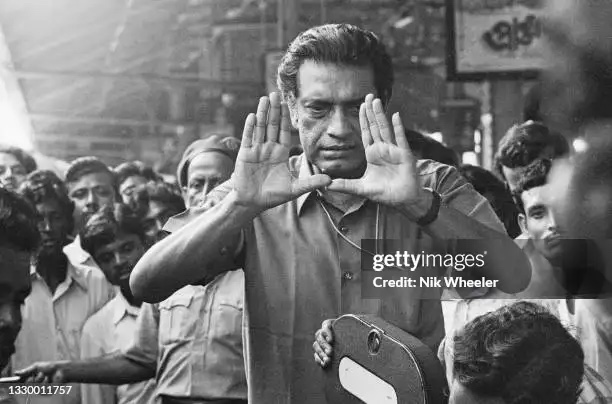
Moderator: You immediately cited Satyajit Ray’s Apu trilogy.
Eepa: Yes. Have you seen it? I was greatly moved. It gave me thought too deep for tears.
Moderator: The phrase itself is a criticism of criticism. “Thought too deep for tears.” One may be moved beyond visible expression.
Eepa: Exactly. And in Apu’s trilogy, the unseen—physically unseen—is much more vivid in one’s mental eye.
Moderator: This needs pausing over. What Eepa identifies in Ray is not an abundance of visual information but the expressive power of restraint. It is not the picture as spectacle; it is the image that points beyond itself.
In Pather Panchali, Aparajito, and Apur Sansar, we are not continually told what to feel. Ray leaves spaces into which feeling enters. A look, a domestic object, a patch of landscape, a silence between family members, a sudden absence from a familiar room—such things may carry the burden of grief without announcing grief.
The Apu trilogy—Pather Panchali (1955), Aparajito (1956), and Apur Sansar (1959)—is frequently recognised for its long human arc, following Apu from childhood through successive transformations and losses.
[One critic notes, for instance, Ray’s handling of the scene in which Harihar learns of Durga’s death: ordinary diegetic sound falls away, the father’s response is allowed to register, and music enters—not as a decorative accompaniment but as a form of unbearable emotional release].
Eepa: Yes. If everything is shown, nothing is left for the mind. Ray does not show everything. That is why he enters the mind.
Moderator: Then, Sir, you are saying something paradoxical: that cinema is powerful not merely because it can show but because it knows what not to show.
Eepa: Of course. The unseen is not absent. It is present in the mind.
Moderator, to the audience:
This is Eepa’s strongest answer to Amaruvi’s later claim that the novel makes the reader work whereas cinema “feeds” him. Eepa’s Ray is not a cinema that feeds. It is a cinema that withholds, invites, and trusts.
The film spectator has to infer the feeling behind the face, the history behind the silence, the sorrow contained in an ordinary object, and the world continuing beyond the edge of the frame. Film theory has repeatedly challenged the idea of the passive spectator: viewers interpret, remember, anticipate, infer, and emotionally complete what cinema only partly presents.
Amaruvi’s challenge
Moderator: At this point, I received a message from my friend Amaruvi Devanathan. He put the counter-case in the plain, compact language in which a novelist sometimes says what a whole seminar would complicate.
Amaruvi, your words were these:
“In a movie you watch. In a novel you take part. Movie—you are forced with visualisation. In a novel, you have to visualize. In a movie you don’t work. You are fed. In a novel you have to work to be part of the novel. That is why novels have that lasting impact.”
That is a formidable claim. You seem to say that the novel’s advantage resides not only in its content or language but in what it asks the reader to do.
Amaruvi: Exactly. When we read a novel, there is no finished face before us. There is no final voice. No house is already built, no village already photographed, no room already lit by somebody else. The writer gives words. The reader must make a world.
Moderator: And that inward making, you believe, is the source of the novel’s lasting power?
Amaruvi: Yes. The reader becomes a participant because the reader has to imagine. In cinema, the director has imagined it for you. Here is the hero; here is the heroine; here is the street; here is the colour of the sky; here is the music telling you what to feel.
Eepa: That may be true of many films. It is not true of all cinema.
Amaruvi: I said “in a movie” because that is the common experience. Of course, exceptional cinema exists. Satyajit Ray is one of the exceptions. But we are not discussing only the rarest peaks of cinema. We are considering the nature of the medium as most people receive it.
Eepa: But why should one judge cinema by its mediocrity and judge the novel by its masterpieces?
Amaruvi: I do not. I say only that even a fine film supplies a completed sensory world. In a novel, the reader must give the words body, colour, voice, sound, rhythm, weather, and space.
Moderator: There is a distinction here which may rescue the conversation from an unnecessary quarrel.
Eepa says the cinema spectator is not passive because great films ask us to interpret what is withheld. Amaruvi says the novel-reader is not merely interpretive but constitutive: the reader must bring the represented world into sensory presence from the prompts of language.
The difference may be stated without insulting either art:
Film asks us to interpret a world made visible.
Fiction asks us to bring a world into visibility.
That is not a minor difference. In a film, I may have to decide why a woman lowers her eyes, why a doorway is held in silence, or why a train is heard before it is seen. But in a novel I must, in some measure, produce the woman’s face, the colour of the doorway, the sound of the train, and the emotional atmosphere through which they are perceived.
The long-standing distinction between the verbal-conceptual operations of prose and the perceptual-audiovisual operations of cinema does not settle the question of superiority; it does, however, clarify why the two arts make different imaginative demands.
The moderator now enters the argument
Moderator: May I now confess my own interest in the case? I am neither as entitled as Eepa Sir nor as qualified as Amaruvi to speak as a novelist. I am better known, if at all, as an essayist and biographer. Somewhere within me there is a novel still conceived and yet misshapenly foetal—perhaps to be born, perhaps destined, to remain only a still-born entry on a bucket list.
Yet I have watched as many films, perhaps, as I have read novels of every kind. I have sat in cinema halls and before television screens. I have known the sudden tightening of the chest, tears in the eye, a tremor in the body, an emotion so swift that one almost feels ashamed of its force.
But when I look back over a lifetime, it is novels—and lives encountered through books—that have settled more deeply within me.
Eepa: You are speaking of your own temperament.
Moderator: Yes, Sir. And that qualification is necessary. I cannot legislate for every reader or viewer. But I suspect that what I have experienced is not wholly solitary.
Cinema can seize us. Literature can inhabit us. A memorable cinematic scene may return as an image: a face, a gesture, a death, a voice, a particular patch of light. But a great novel sometimes returns not merely as a recollected scene. It returns as an inward climate—a sadness, a moral perplexity, a sense of another consciousness continuing somewhere within one’s own.
Amaruvi: That is exactly what I mean by lasting impact.
Moderator: Perhaps. But I would put the matter a little differently from your original phrase “you don’t work; you are fed.” A great film demands work too—of attention, interpretation, memory, emotional responsiveness. Eepa is right about that.
But a novel demands another kind of labour: it makes the reader create the sensory world inwardly, and then inhabit that world over the extended time of reading.
Eepa: That is fairer.
Moderator, to the audience:
Here we should resist an easy binary. The film spectator is not a helpless recipient. The novel-reader is not an entirely free creator. A novel guides imagination through language, point of view, rhythm, description, and narrative selection. A film leaves room for interpretation through framing, performance, montage, music, sound, silence, and what lies outside the frame.
The difference is not between activity and passivity. It is between two kinds of activity.
• The reader’s activity is largely world-making and inwardly visualising.
• The spectator’s activity is largely interpretive, affective, and inferential.
Modern criticism has questioned rigid divisions between word and image, interior and exterior, conceptual thought and bodily perception. Kamilla Elliott, for example, warns against treating such oppositions as self-evident truths rather than inherited critical habits.
On the endurance of emotion
Moderator:
My difficulty with cinema, if I may call it that, is not that it cannot wound or exalt the heart. It plainly can. The difficulty is that the effect is often fleeting.
A scene that devastated us at first viewing may, on replay, not release the same first rush of feeling. We may admire it more intelligently; we may notice its craftsmanship; we may remember why it moved us. But the original emotional tremor can diminish.
With a beloved book, or a passage from a biography, I have often felt something different. On return, the words can awaken almost the same surge of feeling. It is as if one does not merely revisit a stored object but re-enters a living inward experience.
Eepa: That also happens with films.
Moderator: I accept that, Sir. There are films one returns to with deepening response. The Apu trilogy is likely among them.
But I am speaking comparatively, and perhaps temperamentally. For a large number of minds, including mine, literature seems to have a greater power of emotional renewal.
Let me give one personal instance, with which all three of us, being Sri Vaishnavas, can easily relate.

Long ago I read Alkondavalli Govindaraja’s Life of Sri Ramanuja. The chapters concerning the catastrophe that befell Srirangam—the suffering of the Acharya, Kūrattāzhvār, and Periya Nambi—left me deeply depressed and distraught even after I had closed the book. Yet it was not an emotion exhausted by the first reading. Whenever I returned to those passages, I found a lump rising in the throat.
It was not merely that I remembered what occurred. The narration itself appeared to recover its moral and emotional life.
Amaruvi: Because you had made that world part of yourself.
Moderator: Yes. The book did not remain outside me as an object. It became an inward possession.
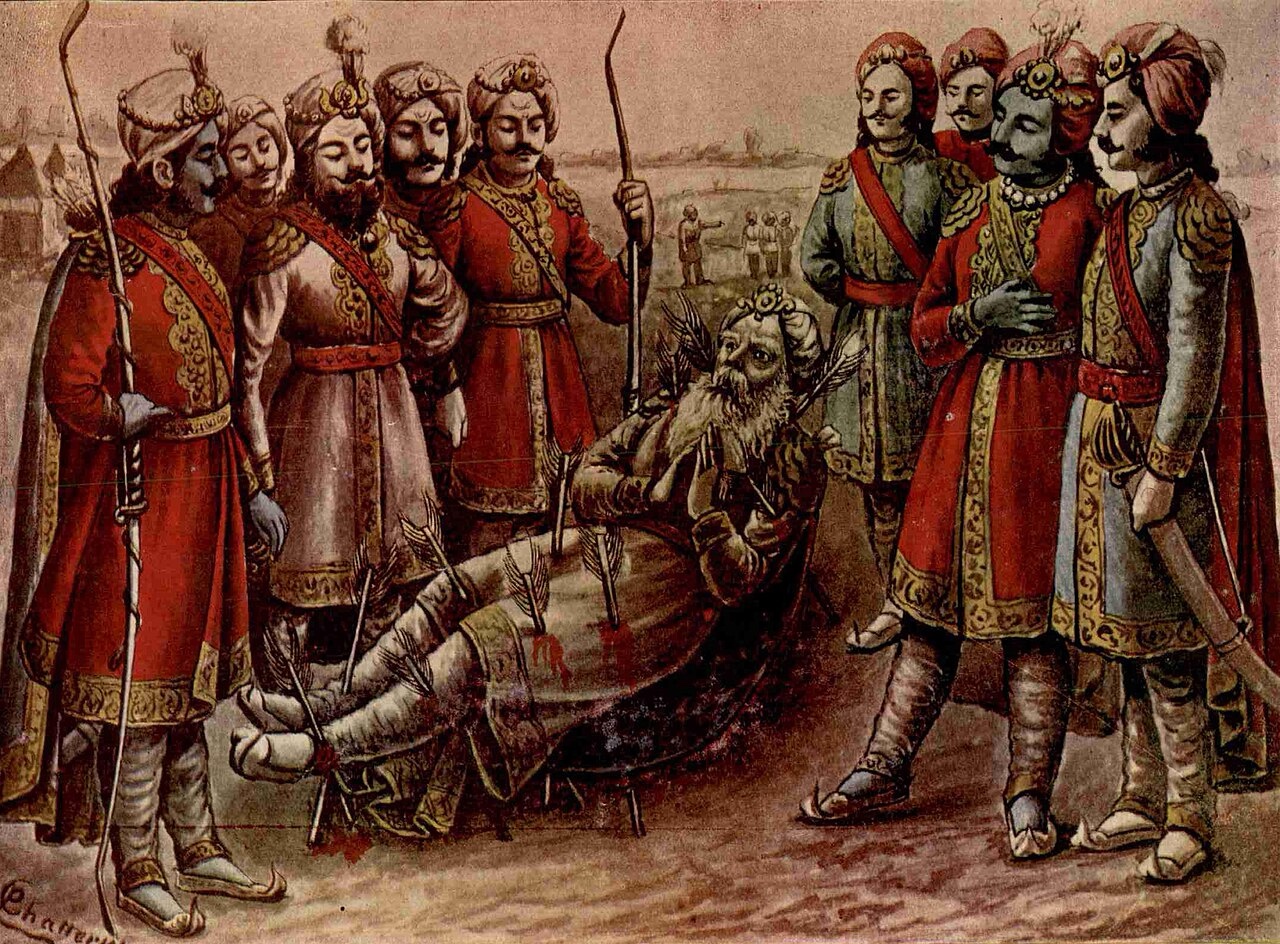
I had a similar but different experience with Bhishma’s death in the televised Mahabharata.

In the darkened or half-darkened privacy of viewing, the scene could moisten the eyes. It carried genuine pathos. But the epic itself, when one returns to it in its written amplitude, gives Bhishma a tragic inward and ethical dimension that no single televised moment can exhaust.
The visual scene presents his death. The epic lets us live with the burden of his vow, his divided loyalties, his knowledge, his helplessness, his grandeur, and his tragic complicity.
Eepa: But a film need not be restricted to a single scene.
Moderator: Certainly not. And the Apu trilogy itself is proof that cinema can follow a life over time. Still, the novel’s duration is of a different order. It can pause inside thought. It can revisit an event through memory, contradiction, reflection, irony, self-deception, or altered understanding. It can remain beside a consciousness in ways that cinema usually approaches by indirect means.
Moderator, to the audience:
The moderator’s claim here must be stated cautiously. It is not that cinema cannot sustain emotion, nor that every rereading is more powerful than every rewatching. Such absolutes would collapse before countless counterexamples.
The distinction is one of recurrence. A film returns with its recorded face, voice, tempo, sound, and image. A book returns as language, which must again become image, voice, tempo, and world within the reader. Rereading is therefore often an act of renewed inward making.
That may explain why certain written passages can reactivate feeling with extraordinary force: the reader does not simply recover a prior experience but partly recreates it.
Eepa’s rejoinder
Eepa: You both speak as though cinema’s images imprison the imagination. But an image need not imprison. It can release.
Look at Sathyajit Ray. You see a face, yes. But do you think the face tells you everything? The image makes you ask what is not said. It makes you feel what cannot be spoken. It is not a photograph in an album. It is an image in time, with silence before it and silence after it.
Moderator: That is an important distinction. The moving image is not the same as a static picture. It lives in duration, relation, rhythm, and sound.
Eepa: Exactly. You speak of the reader constructing a world. Fine. But the viewer of a great film constructs a life out of moments. A child runs through a field; a mother waits; a father returns; a person hears bad news; someone leaves a room. What is shown is little. What we receive is enormous.
Amaruvi: I agree about Ray. But the very fact that we must invoke Ray so quickly proves something. His is cinema of unusual restraint. Most films do not trust the audience. They tell us what to feel with music, dialogue, explanation, and exaggerated performance.
Eepa: Most novels also tell us too much.
Amaruvi: Of course. Bad art exists in both forms.
Moderator: There, perhaps, lies a point of agreement that deserves to be made explicit. Neither the novel nor cinema possesses moral or aesthetic superiority simply by virtue of being a novel or a film. Both can vulgarise feeling. Both can sentimentalise, explain too much, and substitute manipulation for artistic experience.
The genuine comparison must be between the highest achievements of each art, not between a great novel and a routine commercial film, nor between a masterpiece of cinema and a hurriedly written novel.
A major critical temptation is to treat the novel as naturally profound because it uses language, and film as naturally shallow because it uses images. But the opposition is inadequate. Great cinema does not merely display bodies and objects; it can make silence, waiting, absence, and time themselves expressive. Great fiction does not merely tell us thoughts; it can make the unsaid, the unthinkable, and the bodily reality of feeling perceptible through language.
The question of the soul
Moderator: We must return, then, to Donna Tartt’s most audacious phrase: “knowing another person’s soul from the inside.”
Eepa Sir, do you deny that the novel has a special privilege here?
Eepa: The novel can say what a person thinks. That is true. But is a person only what he thinks? Many things are not said even to oneself.
Moderator: That is the strongest philosophical challenge to Tartt. The inner life may not be identical with articulate self-consciousness. A character’s soul can be disclosed in silence, habit, gesture, relation, failed speech, physical vulnerability, or the passage of time across a face.
Amaruvi: But the novel can also show all that. And then it can go further. It can show what the person cannot say aloud. It can show the lie beneath the thought, the thought beneath the lie, the memory beneath the action.
Eepa: It can. But sometimes the novel explains too much. Cinema can leave a human being mysterious.
Moderator: So the difference may be not merely technical but ethical.
The novel offers a privileged intimacy: it can lead us into a consciousness through language.
Cinema offers a different intimacy: it confronts us with the otherness of a person whose inward life is visible only in traces.
The novel says, “Come inside.”
Cinema says, “Look carefully; you will never know everything.”
Neither invitation is morally trivial.
A great novel can make us inhabit a mind. A great film can make us encounter a presence.
In one, empathy may arise through imaginative identification; in the other, it may arise through the patient recognition that another person cannot be fully possessed by our knowledge.
The familiar proverb challenged
Moderator: There is an old cliché: “A picture is worth a thousand words.”
I have never entirely trusted it.
If that were invariably true, novelists would long ago have become extinct. The moving picture, with sound added to it, would have swallowed fiction whole. Yet the novel persists—not merely from habit, but because words do something pictures cannot finally do.
Amaruvi: Yes. A word can enter where an image cannot.
Eepa: And an image can strike where a word cannot.
Moderator: Then perhaps the proverb requires amendment.
A picture may tell what a thousand words cannot tell. But a thousand words may awaken what a picture cannot contain.
Or, if I may risk a slightly more extravagant line:
More things are wrought by a novel than a hundred movies can dream up about.
Eepa, smiling: That is the essayist speaking.
Moderator: Guilty, Sir. But perhaps the filmmaker would respond with an equally extravagant counter-proverb: that a single silent close-up may reveal what a hundred pages of explanation only circle around.
Eepa: That would be nearer the truth.
The moderator’s closing summary
Moderator: Ladies and gentlemen, our evening began with a quarrel over Donna Tartt’s assertion that cinema makes voyeurs of us while the novel lets us become someone else from within.
We conclude with less certainty, but perhaps with more understanding.
Eepa has reminded us that the cinema-goer need not remain outside the film. Great cinema—especially the cinema of Satyajit Ray—does not overwhelm imagination by showing too much. It enters the mind through what it withholds: through silence, gesture, duration, off-screen space, sound, and the unsaid. It can give us not merely tears but, in his unforgettable phrase, “thought too deep for tears.”
Amaruvi has reminded us that the novel makes a distinctive demand. It does not deliver a completed sensory world. It asks the reader to create the face, the room, the landscape, the climate of feeling, and the inward life of the work. Reading is not observation; it is collaboration. The novel lasts, in part, because the reader has helped make it.
And I have argued—subject to Eepa’s justified corrections—that the emotional life of literature often has a peculiar durability. Cinema may strike us with the shock of presence; the written word may settle into us, return through rereading, and recreate its emotional weather within the mind long after the first encounter.
Where, then, do all three of us agree?
• Great art in either medium requires imagination; neither reading nor viewing is simply passive.
• Both the novel and cinema can move us profoundly, morally, and permanently.
• Neither medium is entitled to superiority merely because it is a medium; greatness depends on artistic intelligence, restraint, form, and truthfulness.
• The most powerful works do not explain everything. They trust the recipient to complete what has been left unsaid.
• The deepest artistic experience often begins where mere information ends.
And where does a little sunlight still remain between us?
• Eepa maintains that great cinema can make us participants in another life with a depth that refutes Tartt’s dismissal of film as voyeurism.
• Amaruvi maintains that the novel’s demand for imaginative construction gives its participation a special intensity and endurance.
• I remain inclined to think that the written word, because it must be remade inwardly whenever we return to it, has a distinctive capacity to leave lasting and renewable impressions upon the mind.
Let the final word be neither victory for cinema nor victory for the novel.
Cinema gives us the trembling immediacy of presence: the seen face, the heard voice, the silence after speech, the body crossing a room, the passage of irreversible time.
The novel gives us the inward duration of consciousness: thought before speech, memory beneath action, the secret motion of feeling, and a world that comes fully alive only when the reader gives it habitation.
A great film may make us feel that we have entered an event.
A great novel may make us feel that the event has entered us.
(END of DISCUSSION)
