by M. K. Sudarshan
October 27, 2026: Chennai, India
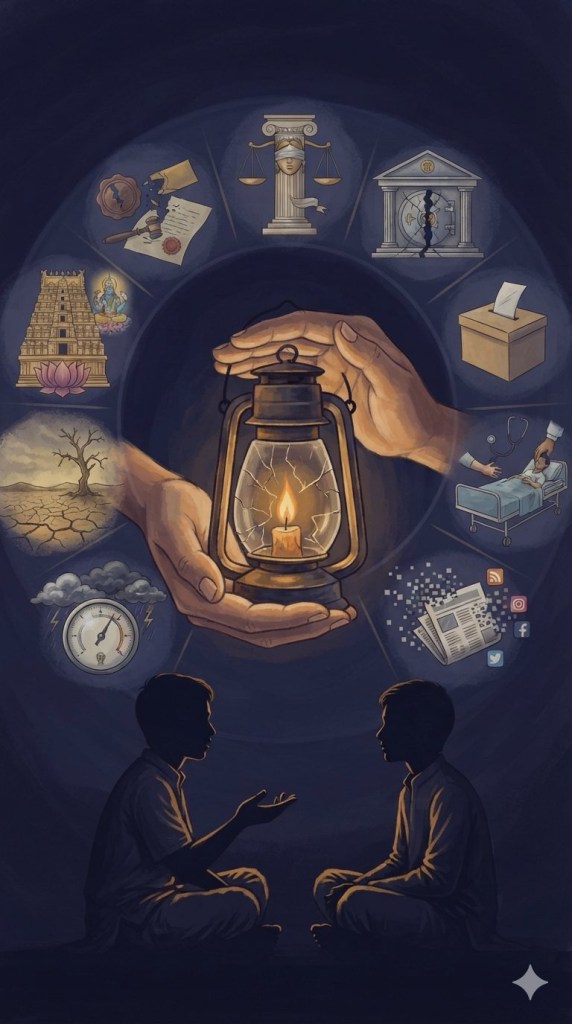
Ānanda: Madhava, suppose trust continues to decline. Suppose people cease to believe governments, banks, courts, hospitals, journalists, and priests. Can institutions still survive?
Madhava: They can survive. But they may survive only as shells.
Ānanda: What do you mean?
Madhava: An institution has two bodies: its structure and its spirit. The structure consists of law, office, building, budget, and procedure. The spirit is the willingness of people to cooperate with it willingly. When trust dies, the structure may remain, but the spirit departs.
Ānanda: Then what holds it together?
Madhava: Fear, habit, self-interest, and force. The citizen obeys because punishment is costly. The employee complies because salary is necessary. The patient visits the hospital because there is no alternative. But obedience is not trust.
Ānanda: So institutions become prisons rather than shelters.
Madhava: Or machines rather than communities. They process people; they no longer protect them.
Ānanda: You once said trust is the counter-force to entropy. Why entropy?
Madhava: In the physical world, entropy describes the tendency of ordered systems to move toward disorder. In human society, distrust performs a similar work. It breaks cooperation into self-defence. It turns neighbours into rivals, institutions into fortresses, and public life into suspicion.
Ānanda: But is not some distrust necessary? Should we trust a tyrant, a fraudster, or a careless surgeon?
Madhava: Certainly not. Distrust is not evil when it is proportionate. It is the immune system of a society. The disease begins when distrust becomes universal, indiscriminate, and self-fulfilling.
Ānanda: How does it become self-fulfilling?
Madhava: The citizen who expects corruption may evade rules. The official who expects evasion becomes rigid. The journalist who expects outrage manufactures outrage. The bank that expects fraud adds surveillance. Each side confirms the other’s suspicion. Soon everyone is defending himself against everyone else.
Ānanda: And the cost?
Madhava: Enormous. More lawyers, more auditors, more passwords, more police, more contracts, more verification. Cooperation becomes expensive. The poor suffer first, because they cannot afford protection.
Ānanda: So distrust is a tax?
Madhava: A hidden tax upon every human relationship. Trust reduces the cost of cooperation; distrust multiplies it.
Ānanda: Then why do institutions not reform themselves?
Madhava: Because reform often requires the very trust that has been lost. To reform, an institution must admit failure. To admit failure, it must believe the public will not destroy it for honesty. But a distrustful public often punishes honesty more severely than concealment.
Ānanda: A cruel circle.
Madhava: Yes, but not an unbreakable one. Institutions have survived catastrophes before. They survive when enough people within them choose fidelity over advantage.
Ānanda: You place great weight upon individuals.
Madhava: Because institutions do not act; persons act through institutions. A clerk who refuses a bribe, a judge who rules against power, an official who tells the truth—these are not sentimental exceptions. They are seeds of institutional renewal.
Ānanda: But one honest clerk cannot redeem a corrupt system.
Madhava: No. But a corrupt system is not redeemed by one cynical citizen either. The question is which accumulation will grow: the habit of betrayal or the habit of fidelity.
Ānanda: You speak as though trust were a discipline.
Madhava: It is. Like health, it cannot be commanded into existence. It must be practised.
Ānanda: Then perhaps the institution’s first duty is not to demand trust, but to become worthy of it.
Madhava: And the citizen’s first duty is not to surrender to cynicism, but to remain capable of recognising trustworthiness when it appears.
Ānanda: Otherwise the honest and the dishonest become indistinguishable.
Madhava: Yes. And when that happens, entropy has won—not by destroying institutions, but by making them empty.
(To be Continued)