By G. Sridharan
November 1, 2026: Chennai: India
Reader’s Note
M.K. Sudarshan- “The Unknown Sri Vaishnava”
This review by an erudite reader who followed the entire nine-part series of dialogues I had blogged here on nine consecutive days following Navarathri Festival: “In God We Trust: The Mother of All Trust Deficits—and the Death and Resurrection of Trust.”
The series began with a simple but unsettling question: why does the modern world suffer so widely from a deficit of trust—in governments, banks, courts, doctors, media, technology, and even religion? Through conversations between two students, Ānanda and Madhava, it moved from the biblical story of Adam and Eve’s breach of trust to the credibility crisis of modern institutions, commercial media, and the measurement of public opinion.
Gradually, the dialogues turned from public distrust to a deeper spiritual question: when human beings and institutions fail one another, where can the soul find a refuge that does not betray? The series found its resolution in the Sri Vaishnava doctrine of prapatti—self-surrender—and in mahāviśvāsam, the soul’s unshakeable trust in the saving grace of Sriman Nārāyaṇa.
The review below is offered as a reader’s response to that journey. It appreciates the series’ central insight—that trust is the invisible infrastructure of civilisation—while also raising a respectful counter-view: that healthy societies need not only trust, but also doubt, scrutiny, accountability, and institutional design.
It is published here now not as a verdict upon the dialogues, but as part of their continuing conversation.
Your nine-part series is a rare achievement: it begins with a contemporary unease—the everywhere-uttered phrase “trust deficit”—and ends in the oldest of spiritual questions: Where shall the soul find a refuge that cannot betray it? Between those two poles, the dialogues move with unusual coherence from public institutions to private conscience, from Eden to the Edelman Barometer, from commercial media to the Bhagavad Gītā, and finally to the Sri Vaishnava doctrine of prapatti and mahāviśvāsam.
The series’ central insight is that trust is the unseen infrastructure of civilisation. Money, markets, laws, marriages, professions, and democracies do not function merely because they are well designed; they function because enough people believe that promises will be kept. When trust erodes, every transaction acquires friction, every promise demands verification, and society pays an invisible tax of suspicion. A society may survive a shortage of money more easily than a shortage of trust.
In that sense, the title is paradoxically exact. “In God We Trust” appears upon money precisely because money itself is a trust instrument. A banknote says, in effect, “Trust this paper.” A deposit says, “Trust this institution.” A sovereign bond says, “Trust this state.” The entire financial order is an architecture of institutionalised confidence. Currencies are printed by governments; trust is minted by character. The greatest bankruptcy is not of wealth but of trust; the greatest wealth is its restoration.
The Audit of the Auditor
Dialogue II performs a necessary act of intellectual hygiene. It asks whether a public-relations enterprise that profits from managing reputation can credibly diagnose the collapse of global trust.
The Edelman Trust Barometer is useful as a fever chart: it records the public mood, traces shifts in confidence across countries, and reveals the direction in which legitimacy is moving. But a fever chart can record a chill; it cannot invent the cure. The thermometer registers the sickness, yet remains indifferent to the patient’s health.
Perception is not reality. It is often the shadow of opinion cast by interest. Counting shadows does not illuminate the room. When the architect of reputation acts also as the referee of credibility, the audit risks becoming another advertisement.
Yet the dialogue wisely avoids the cheaper conclusion—that all measurement is worthless, or that all media is corrupt. That would be cynicism, not discernment. The Barometer may not cure the fever, but it may warn us that the patient is ill.
The Media Paradox
Dialogue III identifies one of the most uncomfortable ironies of our time: commercial media reporting upon the collapse of trust may itself deepen the cynicism it claims to diagnose.
A newspaper, television channel, or digital platform lives by attention. Attention is often easiest to obtain through outrage, fear, scandal, and moral certainty. Thus the very instrument that ought to enlarge public understanding may become an echo chamber that rewards anger and punishes nuance.
But the dialogue rightly refuses blanket condemnation. There is a difference between a publication that names its reporters, corrects its errors, separates news from advertisement, and accepts criticism—and an anonymous feed that repackages rumour for engagement. Both may be called “media,” but they do not deserve equal trust.
The opposite of trust is not always betrayal. Sometimes it is prudent inquiry. The citizen must neither surrender blindly to institutions nor dismiss them wholesale. Trust grows through testing; it endures through truth.
The Primacy of Conduct
The strongest philosophical thread running through the series is its insistence that trust cannot be demanded, marketed, surveyed, or restored by decree. It is the quiet residue of promises kept when betrayal would have been profitable.
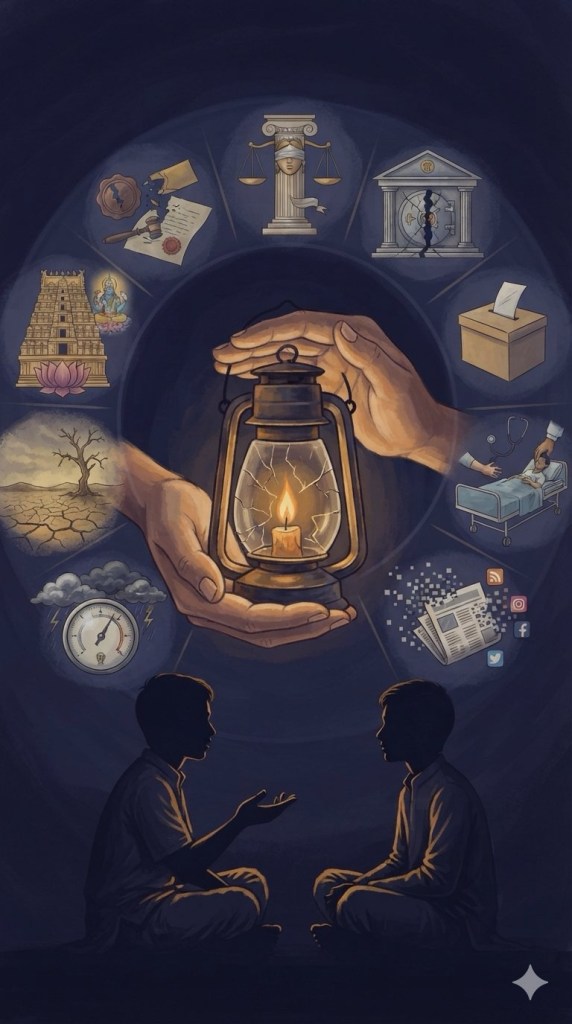
This is why the “candle in the wind” metaphor is so apt. Trust is fragile, but fragility is not futility. A candle need not become the sun; it need only prove that it can stand in the light. One trustworthy act may illuminate another. Credibility is rebuilt locally, relationally, and incrementally before it becomes institutional.
Civilisations are rarely destroyed by one colossal betrayal. They decay through millions of tiny broken promises. Likewise, they are restored through millions of promises kept.
Here the series recalls Václav Havel’s “living in truth,” Gandhi’s insistence that right action matters even when its fruits are distant, and Subramania Bharati’s faith that a small spark may become a conflagration. The candle does not abolish the wind; it demonstrates that darkness does not have the final word.
The Genesis Parallel
The interpretation of Adam and Eve is psychologically powerful. The first sin is presented not merely as the eating of a fruit, but as the first breach of trust. The serpent introduces doubt concerning the trustworthiness of God: “Did God really say…?” Once trust is corroded, disobedience follows; once disobedience begins, blame and hiding follow.
The pattern has parallels within the Indian imagination. In the Mahābhārata, Śakuni first corrodes trust within the Kuru family. In the Rāmāyaṇa, Kaikeyi’s trust is poisoned by Manthara. In political life, revolutions often begin not merely when people become poor, but when they cease to trust rulers.
Betrayal follows suspicion; suspicion follows the whisper that the other’s word cannot be relied upon.
The Boundary of Mahāviśvāsam
The movement from human trust to mahāviśvāsam is spiritually coherent, but it requires a careful boundary. Divine trust must not become a substitute for earthly reform.
If institutions fail, surrender to God must not quiet the citizen’s duty to demand transparency, justice, accountability, and repair. The physician must be trusted, but medicine must also be tested. The judge must be respected, but judgments must remain appealable. The guru may be revered, but viveka—discernment—must not be abandoned.
Trust and scepticism are not enemies. They are coupled, like Gemini twins: trust enough to cooperate; doubt enough to verify. A healthy civilisation requires both.
The series understands this. Its best passages distinguish despair from discernment. We need not trust blindly; neither should betrayal be permitted to become the final truth about human relations.
From Western Inquiry to Tamil Bhakti
Dialogue VII opens a remarkable convergence between Western philosophical inquiry and Tamil devotional mysticism.
Ānanda begins with the paradox that “In God We Trust” may be humanity’s admission that it cannot fully trust itself. Madhava deepens it: the finite self cannot be its own ultimate foundation.
The Tamil traditions arrive at a similar truth through another language. In Śaiva Siddhānta, the soul discovers its bondage to ignorance. Maṇikkavācakar laments the inadequacy of mind, body, and intellect. Nammāḻvār recognises the incapacity of the individual self to attain liberation through its own efforts. The soul’s poverty becomes the beginning of grace.
When Ānanda questions God’s trustworthiness amid suffering, Madhava refuses simplistic explanations. Faith is not an insurance policy against pain. It is a courageous refusal to surrender to nihilism. This echoes the lived spirituality of Appar, Sambandar, and Maṇikkavācakar, whose devotion deepened through adversity. It echoes equally Nammāḻvār’s hymns of separation, yearning, and anguish.
The twin movements of akiñcanyam—“I have nothing of my own”—and ananya-gatitvam—“I have nowhere else to go”—transform trust from an intellectual proposition into total surrender. Grace is not earned; it is received.
Thus the series arrives at a truth shared by Kierkegaard’s “leap of faith,” Gabriel Marcel’s distinction between problems and mysteries, Maṇikkavācakar’s anguished surrender, and Nammāḻvār’s absolute dependence upon divine grace: trust in God begins where trust in oneself reaches its legitimate limit.
Science, Brahman, and the Limits of Reductionism
The later exchange on Einstein, Russell, Hawking, Spinoza, and Vedānta enriches the series considerably. It refuses the easy choice between a personal God who intervenes in history and a purely material universe devoid of meaning.
Science can trace causes within nature. It can explain more and more of the universe’s processes. But it does not automatically explain why there is a universe at all, why it is lawful, or why it is intelligible to human reason. These are metaphysical questions as much as scientific ones.
The Taittirīya Upaniṣad’s definition of Brahman—That from which beings are born, by which they live, and into which they return—offers a different kind of answer. It points not merely to a first cause located somewhere behind the universe, but to the sustaining ground of all existence.
Your example of blood is especially apt. Science may catalogue its chemistry—plasma, haemoglobin, iron, cells—yet it cannot simply manufacture living blood. Blood is not merely a collection of ingredients; it is a dynamic, self-regulating process within a living body.
Perhaps the mystery of the Uncaused Cause need not always be sought through telescopes or abstract metaphysics. Sometimes it is present in the small trickle of blood from a shaving nick on one’s chin—in the body’s quiet, intelligent capacity to heal.
Reductionism can name the parts; it cannot always account for the living whole.
A Respectful Contrary View
If I may offer one respectful challenge, it is this: trust is not always an unquestioned virtue. Excessive trust can become credulity.
History advances not only because some people trusted, but also because some people doubted. Scientists doubted accepted doctrines. Reformers doubted corrupt institutions. Citizens questioned unjust rulers. Philosophers questioned inherited beliefs.
Therefore, trust and scepticism are not necessarily enemies. They are inseparable companions. A healthy civilisation requires trust enough to cooperate and doubt enough to verify.
The realist will say that trust requires enforcement, transparency, and incentives, not goodwill alone: “good fences make good neighbours.” The critical theorist will say that suspicion can liberate, and that appeals to trust may pacify the powerless: “eternal vigilance is the price of liberty.” The game theorist will say that cooperation endures only when it pays: societies must reform incentives, not merely preach fidelity.
You are right that no society can live by contracts alone. Your critics are right that none can live by goodwill alone. The mature ideal is discerning trust: verify power, forgive honesty, and reward proven fidelity.
As the Tamil maxim says: “நம்பித் தள்ளாதே, நம்பாது நடக்காதே”—do not lean blindly upon trust, yet nothing moves without it.
The Final Word
The series’ deepest contribution is its refusal of both cynicism and naïve faith. It recognises that a faceless system may be endured, but only an accountable one can be trusted. It recognises that trust dies when institutions become unworthy of belief, and revives when people and institutions become trustworthy again.
Its most enduring aphorism might be this:
“Every betrayal is a wound in the ecology of trust; every kept promise is a resurrection”.
And in the Sri Vaishnava idiom:
When trust in men collapses, faith seeks God; when faith matures into mahāviśvāsam, even collapse becomes a form of refuge.
Your concluding dialogue rightly shows that trust cannot be revived by nostalgia for institutions or by top-down decrees. It must be rebuilt through kept promises, admitted errors, and the quiet protection of the vulnerable.
The journey of the series—from the first fracture in Eden to the guarded gates and weary institutions of our own age, and finally to mahāviśvāsam—is a dialectical journey of unusual integrity. It does not offer cheap hope. It offers something better: the disciplined conviction that despair is not the final truth, and that every act of fidelity is a small resurrection.
(End of Review)