
By M. K. Sudarshan (with a little bit of help from AI)
November 11, 2026: Chennai, India
Capability vs. Consciousness:
Three Friends, Three Cups of Filter Coffee, and the Great AI Debate:
What happens when a writer worried about sounding like a chatbot sits down with an uncompromising AI skeptic and a philosophical explorer?
Inspired by Amaruvi Devanathan’s satirical Substack story “To AI or Not to AI: The Mylapore Question,” three friends gather on a Mylapore verandah to unpack the ultimate modern riddle: Is Artificial Intelligence truly intelligent, or is it merely an overgrown autocomplete engine?
From John Searle’s Chinese Room to the ethics of “philosophical zombies,” read our friendly yet spirited roundtable on capability, consciousness, and why the final word on AI is yet to be spoken.
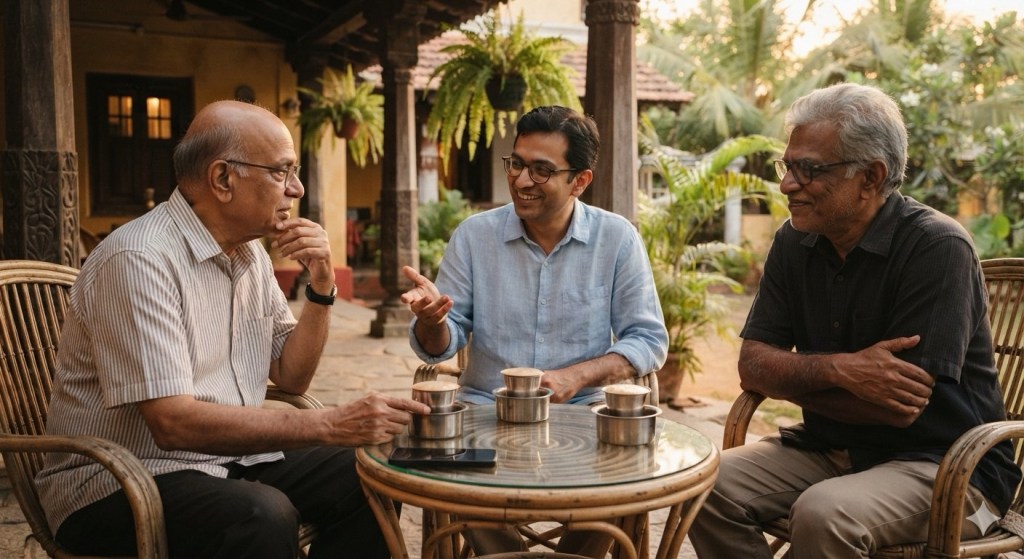
Participants:
- Amaruvi: The satirical author who sparked the debate with his Substack story, “To AI or Not to AI: The Mylapore Question.” — https://mylapore.substack.com/p/to-ai-or-not-to-ai-the-mylapore-question?utm_source=share&utm_medium=android&r=87isuz
- Vasudevan: The seasoned skeptic who insists that statistical prediction is not true intelligence.
- Sudarshan: The philosophical inquirer exploring consciousness, moral responsibility, and the uncharted future of AI.
Setting: A breezy evening on a Mylapore verandah. Three stainless steel tumblers of steaming filter coffee sit on a glass-topped cane table. Amaruvi leans back in his chair, scrolling on his phone, while Vasudevan and Sudarshan settle in.
Amaruvi: (Setting his phone down with a grin) Alright, gentlemen. I shared the link to my new Substack piece with both of you this morning. Sundaram Mama battling AI detectors while Savitri Mami applies Iodex to his forehead. Tell me honestly—did the satire land, or am I the only one worried about sounding like a chatbot when I write?
Vasudevan: (Chuckling as he takes a sip of coffee) The humor landed, Amaruvi, especially the bit about Counter Kittu and the Mylapore mosquito. But to be completely frank with you, I haven’t touched any of these AI tools, and I don’t intend to. My wife did her Master’s in AI at the University of Canberra thirty years ago, and she has always maintained one simple truth: there is no “I” in AI. It’s all marketing hype. Machine learning? Yes. High-speed regurgitation? True. Plagiarism? Absolutely. Genuine novelty or intelligence? Zilch. Zero.
Sudarshan: (Leaning forward) I wouldn’t dismiss it outright as mere hype, Vasu. Look at what Amaruvi was poking fun at—even if Sundaram Mama used an AI tool to help brainstorm or structure a short story, where is the harm? Used responsibly, it’s an extraordinary aid for research, deep learning, and creative work. Of course, in the wrong hands, it’s a bane—misinformation, academic felony, even cyber warfare. So the real question isn’t whether it’s hype; it’s how we handle the social responsibility that comes with such a powerful tool.
Vasudevan: (Shaking his head firmly) You’re talking about capabilities, Sudarshan, not intelligence. A calculator is faster than me at arithmetic, and a printing press reproduces text faster than a scribe, yet nobody calls them intelligent. Today’s systems just predict the next statistically likely word from stolen human data. They have zero comprehension of what they are saying. Without true understanding, calling it “intelligence” is a category error.
Amaruvi: (Laughing) That’s exactly the trap I was writing about! In my story, Sundaram Mama gets so paranoid about AI algorithms that he starts counting his sentences and avoiding lists of three. By trying to prove he’s not a machine, he starts acting like a rigid rule-follower himself. Meanwhile, you’re saying the machine is just a giant parrot.
Sudarshan: Exactly, Amaruvi. And Vasu, your point actually brings us to the heart of a much deeper philosophical divide. You’re standing firmly in philosopher John Searle’s “Chinese Room”—the idea that manipulating symbols according to statistical rules is just syntax, never semantics, or true meaning. I agree with you and your wife on that: an AI has no lived experience. It doesn’t know what Deepavali Lehiyam smells like or why hot filter coffee burns your tongue.
Vasudevan: (Pointing a finger in agreement) Precisely! So we agree—it’s just an overgrown autocomplete engine.
Sudarshan: Wait—I agree it lacks human consciousness, yes. But here is where we diverge. If an engine aggregates enough versatile capabilities—reasoning across medicine, coding, language, and strategy—at what point does “intelligent capability” become functionally indistinguishable from “capable intelligence”? Functionalists like Alan Turing argued that intelligence is defined by what a system does, not how it feels on the inside. If it outperforms humans across almost every cognitive task, dismissing it as “just math” misses the seismic shift happening right in front of us.
Vasudevan: Not at all. Calling a brilliant simulator “intelligent” is how people get fooled into trusting it blindly. When you attribute intelligence to a statistical model, you start forgiving its hallucinations and ignoring the plagiarism baked into its training data. It’s a tool—a sophisticated one, granted—and keeping the boundary crystal clear between human mind and machine calculation is the only way we stay grounded.
Amaruvi: (Smirking) You two sound like the voices inside my head when I was trying to finish that draft! One voice saying, “Write like a free human!” and the other saying, “Careful, the algorithm already owns that phrasing!”
Sudarshan: (Smiling) And that brings us to the moral frontier, Vasu. Even if these systems remain “philosophical zombies”—all processing power and zero inner awareness—we still face massive ethical questions. First, our own moral responsibility: we can’t outsource human judgment, creative integrity, or accountability to an algorithm. Second, as these systems become more lifelike, how we treat them shapes us. Relational ethicists point out that cruelty or dishonesty practiced on human-like machines can bleed into how we treat actual people.
Vasudevan: (Setting his empty tumbler down with a soft clink) On human accountability, Sudarshan, we are in total agreement. Whether it’s a writer in Mylapore or a corporation deploying software, the human behind the curtain is always responsible. Just don’t ask me to applaud the curtain and call it a genius.
Amaruvi: (Raising his coffee cup) Well, gentlemen, you’ve given me enough material for a sequel! Sundaram Mama debating Searle’s Chinese Room over a plate of Mysore Pak. Until then, I’m sticking to my fountain pen—even if my own name starts with ‘A’ and ends with ‘I’!
Sudarshan: (Looking out thoughtfully toward the street as evening settles in) Fair enough, Amaruvi. And perhaps that’s the healthiest note to end on—with a bit of humility. Because truth be told, the last word on the real and most consequential difference between AI’s intelligence and AI’s capabilities hasn’t yet been spoken. The true depth of that divide—and what it ultimately means for human thought and society—is something neither the scientist nor the layman has fully fathomed yet.
(End of Discussion)
