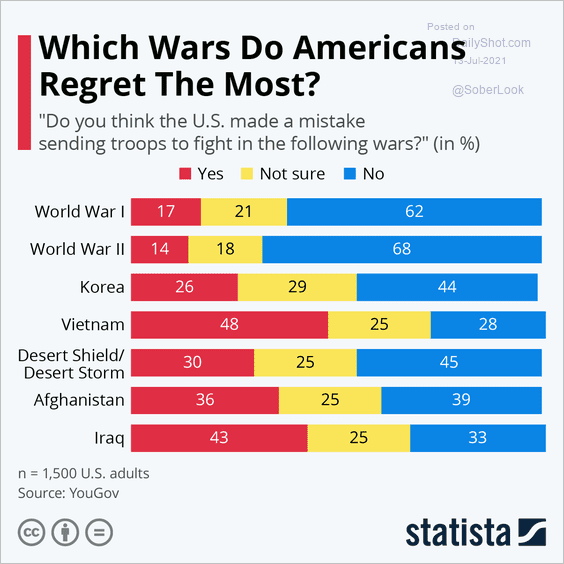
The wars that America regrets are still remembered … but the war America does not regret, long forgotten!

This is such a revealing and insightful chart indeed!

America, make no mistake about it, has had a hand in either instigating, leading or orchestrating almost all wars fought in the world in both the 20th and 21st century so far … And given so many of the present potentially tinderbox-hotspots of geopolitical tension that exist between China and Russia, each with America (in Europe and the South China Sea and Indian Ocean), future wars in the 21st century too are certainly going to see America embroiled and deeply entangled in them.

Already, non-military wars between America and its two formidable enemies, as we know, are being relentlessly waged today — as bitter “trade and currency wars”,cyber-space and outer-space wars”, “culture and propaganda wars”. So, I have no doubt in my mind at all that, given the trajectory of where relations and affairs are slowly heading between these three super-powers inter alia, it’s only a question of time before a proper military war breaks out at some point in future that engages all three of them in this century.

From the Chart above, one gets quite a few interesting insights indeed:

1. The battlegrounds of all wars fought by America were all located overseas … i.e. in the Asian-European hemisphere of our planet… none of them in the American corner of the world (excepting of course the minor and sporadic ones in just a few Latin and South American theatres). The scars of most wars that America fought are thus even today to be seen only in the rest of the world … not in America.

2. All the wars which America waded into were impelled by two simple and clear objectives : gain of territory or dominance over territory .

3. The objective of “gain of territory” or “dominance over territory” was however in all cases effectively camouflaged or garbed by America as being virtuous and titanic ideological battles against “evil” empires or regimes. The definition of Evil, of course, was always a purely American one… and that definition became in good time the very sum and substance of what America began proudly claiming was “American Exceptional-ism”.

4. America’s destruction of enemy territory in the wars in all cases crippled the economy of the defeated country. And the job of “Reconstruction” and “nation building” in the immediate aftermath of war, America made it known to the world, was its “exceptional” moral duty as a world power.

5. America’s “exceptional-ism” it was that then inspired its pious motives to always step forward and volunteer to administer a “helping hand and healing touch” upon the broken defeated country in its struggles to restore its broken economy and society. And to do precisely that, America proselytised its so-called “American way of life” and encouraged the defeated country to embrace the ideals of “life, liberty and the pursuit of happiness”.

5.2. For America Reconstruction meant, in reality, worldwide control and dominance over levers of economic, financial and cultural (“soft”) power encompassing and institutionalising cross-continental Markets through an overarching multinational and multilateral architecture of an imperium of governance functioning from out of Washington DC. The blueprint for such a grand architecture was what was conceived, laid and rolled out as the famous Breton Woods System of 1944, the Supreme Command of Allied Powers (SCAP) of 1945 and then through the Marshall Plan of 1948 …. through which America came to exercise global dominance over most of the world’s trade and commercial markets, capital and financial markets (multilateral, multinational development and commercial banking systems and networks) and, of course, the largest marketplace of all : the marketplace of ideas, dreams and aspirations of global populations at large.

5.3. Dominating the “marketplace of ideas” meant America wielding global influence through the strategy of Acculturation. It is a very profound and powerful weapon more difficult to develop then military hardware or arsenal. To explain it in the most simplistic yet not entirely inaccurate terms, acculturation refers to an effective “carpet-bombing strategy” of “capturing the hearts and minds” of the peoples in the defeated countries with “soft-power” arsenal such as Coco-Cola, MacDonald fast-food, Hollywood box-office “smash-hits”, faded Levi blue-jeans, the jingle-jangle medley of “hard-rock”, jazz, blue and country music and then, last but not the least, “fast and furious” Ford Mustangs and Chevys.

5.1 It must be noted that “acculturation” means essentially the transfer of values and customs from one nation to another… i.e. from the victor to the defeated nation resulting in the modification of the culture of the latter as a result of deep, subliminally subservient cultural contacts with the former. There are four different and insidious “acculturation strategies” that America skilfully employs to gradually infiltrate and enslave the “hearts and minds” of the people that it defeats in military wars as mentioned in the Chart above viz.: assimilation, separation, integration, and marginalisation.

Given all the above insights that even someone like me, a very ordinary spectator and mere bystander, with only limited knowledge and understanding of the history of American engagements in the modern world-history of Wars, is able to glean from the above Chart, I do wonder what probably could be the range, depth and relevance of criteria and considerations upon which the 1500 All-American sample-group of enlightened citizens who were randomly surveyed did actually base their answers in the category of “YES”, NOT SURE” or “NO”.

What exactly did they have in mind when they chose to say that they either regret or don’t , or else are unsure, whether they should or not be regretful of America’s great wars abroad listed above? I wish I knew so that I could better understand how the collective mind of America — the most belligerent society and warlike nation on earth today — truly looks within itself its soul, how that mind works and why…

Now, letting all the above as it may, what I found so very strange and so very monumentally and singularly ironic about the above Chart is that while it does provide insight into America’s several wars, it is absolutely silent on one great unasked question … and whether deliberately or not, I cannot guess, it does seem to conceal, ignore and forget! That one question is this:

Does America regret the mother of all Wars it has fought since?

I mean the War it fought for well over a 100-odd years all over the vast expanses of the magnificently virgin, continental land upon which the Pilgrim Fathers stepped on the soil they at once called the “New World”, and the one they discovered looking out from on board their the ship, the Mayflower, on which they had set sail from the shores of Europe as desperate, fleeing immigrants.

Does America even remember … let alone regret … the wars it fought against the native Indians of the land it went about conquering ?

Does America regret the mass-slaughter of a large part of the whole race of the brave, aboriginal people of America?

How many of the 1500 Americans who were surveyed, and whose classified responses are charted vividly in the info-graph above , know that today only some 2 million “American Indians” inhabit the United States, less than 1% of the nation’s population?

How many of the respondents probably knew that the origins of the native aboriginal Indians in America have always been viewed by all Americans only through the narrow prism of no more than a 500-year perspective i.e. from the point of view of the Europeans who “discovered” the New World? And yet that the true story of American Indians begins some 17,000 years ago?!

Americans today cannot be expected to give any sort of informed or meaningful responses to either express “regret”, or the lack of it, over a War that has long been forgotten. Therefore, it does not and should not, in fact, matter that the memory of that war has been all but extinguished from the collective consciousness of ordinary Americans. After all, the native aboriginals themselves have been so very properly and thoroughly “acculturated” by America today, haven’t they? So wheres is the need to express “regret” for a people that America has, over two centuries, already successfully rendered duly “separated, assimilated, integrated or marginalised”?

Of all the sad lessons to be learned by us from human affairs and condition, the saddest one is certainly this : Long before forgotten Memories get dumped into the dustbin of History, make no mistake about it, Regrets have have already vanished into it without a trace.

Sudarshan Madabushi

What generally goes on inside the United Nations General Assembly… is little more than the assembling of cacophonous generalities

I guess inside the United Nations General Assembly all confabulations finally end up sounding a lot like this ?!!

Sudarshan Madabushi

PAKISTAN: “THE SICK MAN OF THE INDIAN SUBCONTINENT”

The Friday Times, Pakistan

Below is an Op-Ed piece by an anonymous writer in the Friday Times (Pakistan) . I read it twice fully and I must confess I was at once afflicted by so many mixed feelings about everything this extraordinary correspondent has penned in his almost elegiac piece (so much redolent of the famous one of Thomas Gray’s Elegy Written in a Country Churchyard). I felt part self-righteous self-vindication, part pity, part commiseration… and yes, I daresay it, a wee bit of Schadenfreude too .. which I couldn’t really help. But then let me recommend that you must first read yourself what the Pakistani gentleman has written below and perhaps, after you’re then done reading it, you may wish to go on to read about my own “mixed feelings” that follows further on below ? I shall leave that to you to decide… Sudarshan Madabushi

The Friday Times

Pakistaniyat

Imran Khan has exhorted “Pakistanis” to consciously absorb and practice “Pakistaniyat” to redeem respect and honour in the international market place of independent and sovereign nations. An exploration of this notion or concept, however, leads to troubling questions rather than easy answers. What, we might ask, are the salient, unique or distinguishing features of “Pakistaniyat” for Pakistanis at home and abroad? How do these square with foreigners’ perceptions of “Pakistaniyat”?

To be sure, we are not Indians. But then the rest of the world isn’t either. So there’s nothing unique about that.

Of course, we are Muslim. But then there are a billion other Muslims out there, over 400 million in the rest of South Asia. So this isn’t a distinction of identity. Nor have we managed to create a unique “Islamic state” that separates us from other nation-states and provides some sort of political marker, like for instance Shiite Iran or Wahabi Saudi Arabia.

There is nothing unique about the colour of our skin, dress or food either. We are part of the “brown” people of the world. The shalwar-kameez of our women is the staple of nearly all of India while our men are variously decked out. The irony is that our wonderful cuisine is served in “Indian” restaurants outside Pakistan. And our Sufi music, to which we lay claim so proudly, is rooted in classical Sub-continental gharanas.

If we were situated at any historic or civilizational crossroads, we could claim some identity or appreciation on that score. But we are still far from becoming the gateway to the natural riches of Central Asia or a conduit for oil and gas to the rest of Asia, let alone the world.

We definitely have calm oceans and sandy beaches and majestic mountains and great rivers and verdant valleys of incredible beauty. But where are the leisure retreats with dollar-rich tourists?

We might have tried to become a centre of higher educational excellence like India. Or offered affordable specialist facilities for “medical” tourists. But our graduate degrees are an acute embarrassment, our PhDs are not recognised anywhere in the world and our post ops nursing care is amongst the poorest in the world.

We were among the top cotton producing areas of the world. Yet our industry hasn’t significantly added value. Indeed, “Made in Pakistan” garments are a rarity amidst quality clothes from dozens of other similar countries. In fact, we hardly manufacture anything industrial that can compete internationally. That is why our high value-added imports are twice as much as our low value-added exports and we face a perennial balance of trade and international debt crisis.

Our reputation isn’t built on pillars of trust, accountability and public service institutions of democracy and justice that could elevate us to the ranks of upright nations and industrious peoples. Our Tax:GDP ratio is among the lowest in the world because we cheat and launder money with an air of respectability and self-righteousness. Indeed, our ruling elites are heavily invested in the very West that they decry so hypocritically at home.

Our language, Urdu, has fortunately progressed to the stature of a national language, despite violent hiccups in its journey among the other “nationalities”, regions and languages of Pakistan. In fact, the more India consciously tries to abandon or Sanscritise it, the more it acquires a unique Pakistaniyat status, at least in its literature and culture. But misplaced state attempts to Arabize it at the expense of its essential Persian roots have diluted its power no less than its “democratization” by the influx of English words and terms. The fact that Pakistani Pashtuns, Sindhis and Baloch still clutch at their native languages in everyday discourse and culture suggests that language is not central to “Pakistaniyat”.

Unfortunately, however, much of the influential world has rather negative perceptions of “Pakistaniyat”. Our green passport is the 4th most distrusted and least acceptable passport in the world. Over 250,000 Pakistanis are annually deported from the West and Middle East because of fraud or criminality. Since our ruling classes formally embarked in the 1980s on the mission of “Islamising” state ideology and societal consciousness, we have invoked extremist versions of militant, jihadist Islam that have destabilized not just our own Pakistan but also the region, threatening societies, cultures and geographies far beyond our own. If Osama bin Laden is a “martyr” in Pakistan, if the Taliban are perceived as “Made in Pakistan” strategic assets, if we are shielding Hafiz Saeed from the FATF, if the nuclear weapon in our basement is an Islamic Bomb, if the rucksack that explodes in a subway in London or New York or a knife attack on innocent bystanders is subconsciously attributed to some Muslim with Pakistani origins or links, what does that say of “Pakistaniyat”?

Some of us who are as old as Pakistan may recall a very different Pakistan from the one in which we live today. Time was when Pakistani women wore a simple dupatta over their heads for modesty but not a hijab or niqab for political identity or statement. Time was when the Pakistani passport didn’t require any visas for global travel. Time was when Pakistanis didn’t much care about how they were identified, when Sunnis, Shias, Qadiyanis, Deobandis, Barelvis, etc., were purely religious denominations instead of political ones. Time was when the state was ideologically neutral and Muslims, Christians, Parsis and Hindus lived peacefully together. Time was when a BA degree qualified a graduate to be fluent in English and Urdu instead of being lost in both. Time was when PIA was internationally lauded for being “Great People to Fly With” rather than a pariah airline flown by pilots with fake licenses. Time was when Pakistaniyat was defined by modesty, moderation and peaceful coexistence rather than arrogance, false pride, double-dealing, extremism and aggression. In fact, “enlightened moderation” was a password in the first three decades of Pakistan which subsequently failed to turn back the transformational tide of 1980s history.

If truth be told, the old Pakistaniyat barely survived the break-up of Pakistan in 1971 but the post 1980s Pakistaniyat is leading us into violent political and religious upheavals at home and isolation and hostility abroad. It’s time to stop deceiving ourselves and put Pakistaniyat in right order if we truly love Pakistan. END

My mixed feelings on reading about “Pakistaniyat”

The above piece of writing is a heart-broken cry of sheer despair straight from the soul of Pakistan… Just Imagine! Even after almost 75 years, Pakistanis are today still groping about and searching for a national identity and can’t define one even for themselves!

As a an Indian citizen and knowing that my country has fought 3 bitter wars with Pakistan — in which so many jawans of India sacrificed their lives — I am sorry to say that I cannot bring myself to feel sympathy for even this kind of an honest-to-god, conscientious and genuinely introspective Pakistani coming out into the open unabashedly and sobbing his heart out on the shoulders of anyone he hopes might perhaps happen to read his elegy for Pakistan.

But then after all when I realise that once upon a time in history, when the peoples who today call themselves Pakistanis were actually Indians , I feel I should perhaps out of common humanity and decency be able to at least express a little commiseration towards them when they rue their present fate and condition in the larger comity of nations of the world…. in the manner this Pakistani gentleman has done.


If you ask me I sincerely believe this acute “Pakistaniyat” angst has its root deep in the colonial history of the Indian sun-continent… to a famous Resolution of 1940 called the Lahore Resolution passed by the Indian Muslim League whose leader was a wily lawyer and astute politician, the greatest rival of M.K. Gandhi, a man called Muhammad Ali Jinnah, who the citizens of independent Pakistan later hailed as the “Father” of their nation.


The Indian Muslim League was a unique political outfit that, on the one hand, was in league with the Indian National Congress of Gandhi, Nehru et al , riding piggyback on it in the common struggle for freedom from British imperialistic rule , while on the other hand, pursuing in parallel, an agenda more important to it viz. carving out of the new, emergent India an independent and “separate Muslim nation”.


During the entire period of the freedom-struggle, ever since 1936 when Jinnah became the tallest leader within the Muslim League, the Father of future Pakistan never had had any clear idea of broad nationhood for the people whose cause he championed in the subcontinent. It was always his feeling that the Muslims of British India were never really Indians in a pan-nationalistic sense. They were ex-rulers of India and thus in a new independent India that the British were eventually going to leave behind, the Muslims could never be ordinary fellow citizens of Hindus who after all had been mere subjects of Muslim sultans and emperors for centuries in history.


It is interesting to recall that within the mind of Jinnah (and his Muslim League’s) the concept of a Muslim State was not even fashioned out of fundamental concepts of nationhood such as common shared history, common brotherhood, common historical experiences or memories of a people, or any other kind of self-consciousness born of personal or cultural identity.

Pakistan in Jinnah’s mind was actually only a wishful acronym! It had first been adopted in the early 1930s for a greater Muslim homeland consisting of P(unjab), A(fghania I.e. NW Frontier), K(ashmir), I(ran), S(ind), T(urkamenistan), A(fghanistan) and Baluchista(N)!


The above pipe-dream defined through a mere acronym was applied to the famous 1940 Lahore Resolution of the Indian Muslim League which Jinnah drafted and it read famously as follows:


QUOTE: “In recognition of the fact (what fact?! whose recognition?!) that Muslims represented a separate nation (since they were ex-rulers of Pre-Independent India?) the Indian Muslim League calls for a constitution whereby areas in which Muslims are numerically in a majority (in the sub-continent), as in the North-Western and Eastern zones of India, should be grouped to constitute “Independent States” in which the constituent elements( meaning, the Muslims) shall be autonomous and sovereign.” UNQUOTE

Jinnah was fighting for a nation based not on any ideas of broad cultural or historical identity but simply on the ridiculous notion of “numerical majority” in geography.!


The British of course who by then were war-weary from WW-II and had had enough of ruling India, were only too happy to encourage Jinnah’s pipe-dreams to further and feather their own imperialist nest, self-interest and designs in a post WW world. They betrayed a clear willingness to appease Muslim nationalism by endorsing the possibility that some, if not large parts of India might eventually secede from it.


In 1947, the Pakistanis in an act of almost suicidal theocratic nationalism went and forcibly cut asunder the geography of the subcontinent, recklessly and unwisely, paying no heed to its long history which actually had kept it and millions of its peoples tied and knit together in a pan-Indian cultural bond for centuries.

On what then the Pakistanis were prizing and preening about as a Muslim lifeboat called Pakistaaniyat, they chose to set sail and row themselves away from the large mother-boat of greater India and into the high, stormy and choppy seas of modern global history as it was unfolding in the post-Independence eras…


And today in 2021 where has that lifeboat of Pakistaniyat brought them to?

Not certainly to any Islamic Paradise on Earth or any theocratic El Dorado, for as this chastened and sombre Pakistani voice from somewhere out there in the wilderness of Pakistan has himself said— “post 1980s Pakistaniyat is leading us into violent political and religious upheavals at home and isolation and hostility abroad.”… And going by what is his very own account from inside Pakistan, it’s only getting even worse :Our green passport is the 4th most distrusted and least acceptable passport in the world.” !


Oh Pakistan! O Pakistaniyat! Where now shalt thou, the “Sick Man of the Indian Sub-Continent”, go forth from here?

Sudarshan Madabushi

PM Modi’s new cabinet has 42% ministers with criminal cases, 90% crorepatis: ADR report— OK, so what ?!

https://www.hindustantimes.com/india-news/pm-modi-s-new-cabinet-has-42-ministers-with-criminal-cases-90-crorepatis-adr-report-101625883618891.html

Hindustan Times 10 July 2021

The Hindustan Times (HT) is another newspaper in India (much like the HINDU of Chennai and the rest of its tribe) that specialises in agenda-driven news transmogrification.

The HT quotes a report of the ADR (Association for Democratic Reforms) that has come out with the finding that “33 ministers (42%) in the new cabinet of 78 have declared criminal cases against them. Of these, 24 ministers (31% of the total number of members) have declared ‘serious’ criminal cases against them — which includes counts of murder, attempt to murder, or robbery.”

If you read the article fully you will wonder what exactly is the point that the HT reporter or analyst is trying to make. It would have made much more sense if the analysis included a comparison either with a prior cabinet, or else, with the cabinets in every government in the last 70 years of Independence. It would have made even greater sense if the comparison had been made against the Cabinets presently ruling all the 29 States in the country.

Merely giving a snapshot analysis of how many members there are in Modi’s new cabinet with criminal charges (not convictions) and ongoing cases against them is an exercise in asinine sterility. It only reveals HT’s biased and malicious intent : to somehow paint the new cabinet in black as if to say it is some it’s some kind of den of criminals. And that is news-transmogrification indeed.

This new Cabinet mind you is headed by a prime minister who not long ago (in connection with the Godhra riots in Gujarat) was himself charged with criminal conspiracy. He then fought fair and square in the courts and got himself acquitted. But when he was still facing those grave charges in court, it must be remembered that Modi was under intense political pressure, in the run-up to the elections to the 2014 Lok Sabha elections, to “apologise” for his having condoned if not abetted the very crime he was accused of. His reply then in an interview was classic:

“I am convinced that if there is even a grain of truth in the allegations, I feel for India’s bright future and traditions, Modi should be hanged in the street square. There should be such exemplary punishment that no one dares to commit such a crime for 100 years… If he has committed a crime, Modi should not be pardoned. What is this system of pardoning people through apology? There should be no apology. Modi should never be pardoned,” he told in an interview to ANI telecast

Today, HT is living in an arrant fool’s paradise to think that it’s analysis about “42% of Modi’s Cabinet members having criminal cases against them” is going to make Modi feel the least bit apologetic about the criminal shadows that hang over his cabinet colleagues. For all we and Modi know, everyone of the 33 members referred to by HT might ultimately come finally out of the courts acquitted as fully as Modi himself had been … Who really knows, indeed?!

So, my question to the HT and to its analysts is simply this : So what?!

Another piece of jejune analysis put out in this HT report is this ridiculous bit about “Moreover, around 90% members of the new Union cabinet (70 ministers) are millionaires, i.e. they have declared total assets amounting to over ₹10 million (one crore), the ADR report pointed out.”

Again, Mr. HT, so what ?! Is there a law in the country against being a “crorepati”? Is it a crime to be one? Why must you presume or imply that every crorepati must necessarily be a suspected criminal too? Why are you insulting the hundreds of other crorepatis in India who have earned their wealth by dint of honest work and are loyal tax paying citizens too?

Be that all as it may, I think there is however one important albeit unstated point that one has to concede the HT article does indeed rightly allude to. It is this and it focuses attention to the failure of our country’s judicial system whose wheels creak and are creaking so grindingly slow that those amongst our MPs and Ministers in the political class who are fighting charges in the courts for criminal and civil offences do not get either acquitted in good time nor convicted.

As a result what happens is that their reputation, no matter whether or not they hold public office, remains perennially under a shadow and even when they are innocent otherwise they are nonetheless, and invariably, deemed to be guilty by the irresponsible but free press we now have in India and of which HT is perhaps the most egregious example.

This brings me now however to boldly level a piece of serious criticism against our Hon’ble PM Sri Narendra Modi who I remember, so well and vividly, made a solemn promise once to the nation with regard to precisely this matter — i.e. of “justice delayed is justice denied” — way back in 2014 but then till date has done absolutely nothing about it .

Modi went on record to proclaim that if elected to power, he would urge the Supreme Court to appoint special court to try cases of MLAs and MPs and Ministers, of course, against whom criminal cases are pending and deliver a verdict a within a year!! Those convicted will lose their seats and the vacancies can be filled by those without criminal charges, he said. Modi went on to say:

Everybody says this but nobody does it. But I have decided to do so. But if there is a better way I will look into it. I do not want that cases against politicians be dragged for long,” he said adding he wanted the credibility of institutions be enhanced.”

(https://www.livemint.com/Politics/1J8Qm5kmOgXqr1HXJjwolN/Hang-me-if-I-have-committed-crime-no-apology-Narendra-Modi.html)

Well, well, well … Mr Prime Minister, you made that promise in April 2014 … We are now in July 2021! Where are your “fast-track” courts to try MPs and Ministers charged with criminal and civil or “grave” offences?

If it is going to be said, and rightly too, that justice continues, sadly, to be denied to your 33 fellow cabinet colleagues, Mr Modi, who now still face pending criminal cases, isn’t it because you have caused it yourself to be delayed by your own inaction?

Sudarshan Madabushi

Creative Accounting that helps Central Banks of the world (starting with US Fed) window-dress Balance-Sheets with their “Stimulus Funding”

The chart below explains it all!

Longview Economics

Sudarshan Madabushi

Go Roger… Go !

Good ol’ Roger Federer should now gracefully retire … if he still wants to remain GOAT in my esteem.

Last evening watching him on TV play at Wimbledon made me squirm in my seat and start eating my shirt-sleeves out in embarrassment…. I just couldn’t bear to see him lose a final set 0-6 and then bow out of the tournament like some battered, bloodied ageing boxer carried off the ring with his great pride all intact but not his jawbone and nose.

And then a cousin of mine in Houston, another passionate RF fan, sends me on WhatsApp the above meme of the GOAT … just to rub it into me…. Hoo boy! What empathy indeed! What a great way to commiserate and cry on each other’s shoulders… for Gawd’s sake!

But then I tell myself it’s OK …. After all, the great Bradman in his last ever innings got out for a glorious duck 🦆, didn’t he ?

Does that make Bradman any the less Bradmanesque?

Isn’t it sad that most great champions fail to time their exit from the game … at least not certainly as exquisitely as they were known to do while playing it at the very peak of their career.

Sadder still am I 😔!

Sudarshan Madabushi

The harmony of natural urge and ethical aspiration: Islamic “misyar” marriage

https://www.straitstimes.com/world/middle-east/marriage-without-strings-saudi-arabia-confronts-rise-of-misyar

Straits Times 4 July 2021

I had shared the above news link via email with a few of my friends abroad one of whom is a lady citizen of Germany of Turkish origin. After having read the article on “misyar” “no-strings attached” so-called Islamic “marriage arrangements” that now reportedly are rife even in orthodox and traditional Saudi Arabia, she emailed me her comment : “Actually not surprising – faith, religion, whatever version, easily covers up anything the ordinary follower would normally not think of.”

My reply to her was not to disagree with her but to look at the matter in a more nuanced way and with a little bit of broader, philosophical understanding of human nature no matter to which religious persuasion it might belong in the world. Religion is not to be made the real issue here … it is actually human nature.

My response to her via email is reproduced below:

You’re right, Frau Angelika … traditional societies often do make use of convenient loopholes and exceptional proviso in Faith only to obtain public legitimacy for strictly private intention and deeds — especially in the matter of marriage and sexuality. That’s because in traditional societies like Saudi Arabia there is no separation in the laws of the land — as there is as we know in secular countries such as in the West and in “modernising” countries like India too — between the general constitutional law of the nation and purely religious or customary norms of communal or local societies that live within.


In India for example “live-in relationships” between any consenting adults (man, woman or LGBT) are legal under the secular Indian Constitution. However, under the traditional or customary “laws” of Hindu, Muslim or Catholic faiths, such “live-in” arrangements are strictly proscribed. But then people know that it is the general secular law of the land that will prevail over the “law” of religious faith and hence there is nothing that can prevent adults from carrying on “live-in relationships” freely and, in fact, in and out of as many such arrangements as they wish to have during a lifetime. Sexual promiscuity is given legitimacy under the secular Constitutional laws of India which in this regard are very similar to those in western societies.


But in Saudi Arabia (where I have lived and worked for 6 and half years in Riyadh) , there is no such separation of religious and civil law. There is only one law and it is Sharia under which marital relationships must be forged and conducted.

The sharia laws are very strictly conceived, enacted and enforced in terms of responsibilities and accountability imposed on both men and women who consent to marry. Those “responsibilities” and “accountability” are what modern Saudi society — which today, being so demographically youthful, that it is increasingly beginning to ape western secular ways of thinking and living — find extremely restrictive and at times oppressive. So, what next happens is that Saudi society at large starts exerting pressure on the religious establishment (i.e. the Grand Mufti , the ulemma or on the larger Islamic community called “the sunna”— to invent creative religious devises to get around the strict sharia laws relating to marriage and consensual sexual mores without however in any way seeming to be violative of the larger and more substantial tenets of Islam.

The scriptures and doctrines are then revisited by the religious priests and judges and after their review and deliberations, conducted under severe societal pressure, some kind of vague consensus is then arrived at by which a “fatwa” (religious edict) gets issued by the holy nexus that exists between religious and political authority in the country to provide at least some kind of social “release valve” for the social “pressure cooker” environment that builds up force and hence compels them to do what they end up having to do.

As a result what begins to gradually happen then is that various degrees of latitude (you may wish to call them convenient loopholes) in interpreting and enforcing religious law hitherto taboo suddenly becomes permissible. It’s like a bit of “tweeking” age-old religious tradition. Such latitude then becomes the legitimate basis that provides both relief and freedom to people to enter into quasi-marital arrangements such as those that have been reported recently as “misyar” marriage between consenting adults.


Human Sexuality is 90% biology and is only 10% ethics. In other words, it is natural individual expression pitted versus social collective restriction. In all societies of the world and in all history, civilisational progress is achieved only when the laws of the land are able to succeed in harmonising Ethics and Biology. Where uninhibited Biology triumphs there results only breakdown of social structures and institutions like Family, Wealth and Public Health. Where however Ethics triumphs over Biology, and in fact overwhelms it, the result is often pathological suppression of natural human love between the sexes, basic human freedoms, gender oppression and the festering of large-scale mental disorder and unhappiness amongst ordinary peoples.


As in everything else that we see in Nature , it is always difficult for societies anywhere in the world … and not only in tradition-bound Islamic countries … to be able to strike, achieve and maintain that fine harmonious balance that must ideally exist between the power of instinctual urge and the power of ethical aspirations in life.

Sudarshan Madabushi

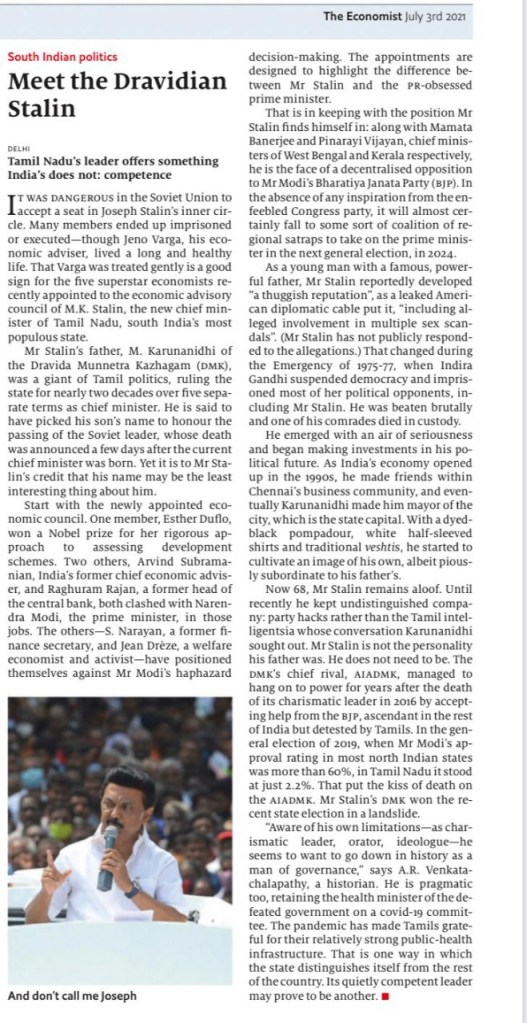
How much does THE UK ‘THE ECONOMIST’ charge clients to carry PR-stuff?

In the article above, the Economist pits the new Tamil Nadu Chief Minister Stalin against Narendra Modi as possible rival of sorts when it’s time for the 2024 General Elections in India.

One may ask why the Economist believes Mr.Stalin is fit person to emerge as a contender for an all-India leadership role?

The Economist makes no secret of its reasons but adduces them in a rather circumlocutory way.

Firstly, the Economist hails Stalin with the glorious ethnic epithet “Dravidian” as if that alone qualifies Mr. Stalin to take on Narendra Modi just as his father (late) Mu. Karunanidhi, the arch-Dravidian of all who took on Indira Gandhi and all later PMs that succeeded her. For any leader from TamilNadu to be a reckoned as a force of any political substance in North India, it is sine qua non to possess credentials and more importantly, the image of being “Dravidian” and a rabid one too at that. That’s the wind in the sail without which the boat won’t sail. It’s also an identity that stems from the trope of David Vs Goliath—- the Tamil Dravidian is David and all North Indian PMs are Goliath. And the Economist which points out to the fact that “Modi is detested in Tamil Nadu” albeit his party, the BJP, admittedly is on the “ascendent in the rest of India”, believes it makes Mr.Stalin eminently suited to don the mantle of the new “little Dravidian David” from the south going out to slay the giant Aryan ogre of the North.

Secondly, the Economist thinks that because Mr.Stalin has retained as his consultants the team that he has just appointed that by itself, in fact, makes Tamil Nadu “distinguish itself from the rest of the country”! Duh?! The Economist does not however explain how the state “distinguishes” itself by the very act of this appointment?! The world’s best consultants, as the whole world knows, are all for sale and for a few dollars more even Tamil Nadu can hire a few of them. What is so “distinguished” about it?

The Economist however does explain that Esther Duflo, John Dreze, Raghuram Rajan and Arvind Subramanian , not to mention S.Narayan (another Dravidian?) , all but the last mentioned of whom are known to “have clashed with either Modi” in their previous “jobs” that they held in the GoI (i.e. Rajan and Arvind) or had gone about town advocating economic policies and nostrums that struck no sympathy at all with the PM. So, Modi simply gave them all short, swift shrift. Now, that Mr.Stalin has recalled them out of the wilderness of academe into which they had withdrawn after Modi had banished them, and has rehabilitated them in Tamil Nadu, the Economist sees that as some great masterstroke of political cock-a-snook: Mr.Stalin hiring a galaxy of international economists not on the basis of the real work they are expected to do for Tamil Nadu or to usher in fresh economic reforms but only because Mr.Stalin expects them to work to effectively expose and discredit Modi , the “haphazard decision maker” . The scope of the consulting assignment that Mr.Stalin has handed out to this highly paid team of advisors seems thus to be simply this: find ways before 2024 elections to do an effective hatchet job on Modinomics.

And lastly, the Economist makes an observation whose delightful irony, it’s such a pity, is lost on itself: The appointment has been made “to highlight the difference between Mr.Stalin and the PR-obsessed Prime minister”. Now, if Mr. Stalin had not made the appointment of this international bunch of Modi-baiting economists, would the UK Economist have ever deigned to give this Dravidian from nowhere land in TamilNadu in a far corner of India, the few columns worth of print-space it now has given him in its international edition? Now, isn’t that in itself a PR triumph for Mr. Stalin? Who is more PR-obsessed?

And how much do you charge clients, Mr UK Economist, to publish this sort of PR-stuff?

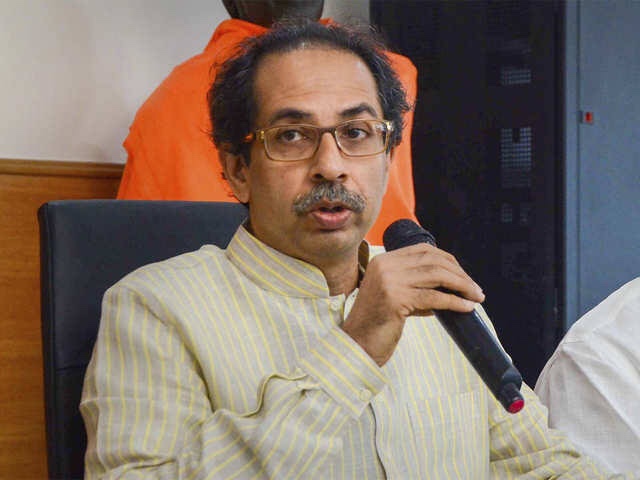
The choice of an auspicious trope to fit BJP/Shiv Sena tango: Bollywood Vs Hollywood ?

BJP/SHIVSENA : : AAMIR KHAN/KIRAN RAO

Sanjay Raut has gravely erred in the choice of a Bollywood trope instead of a Hollywood one…

Sanjay Raut compares the relationship between Shiv Sena and BJP that ruptured more than a year ago with the one that Aamir Khan and Kiran Rao, who a few days ago divorced after more than a decade of marriage.

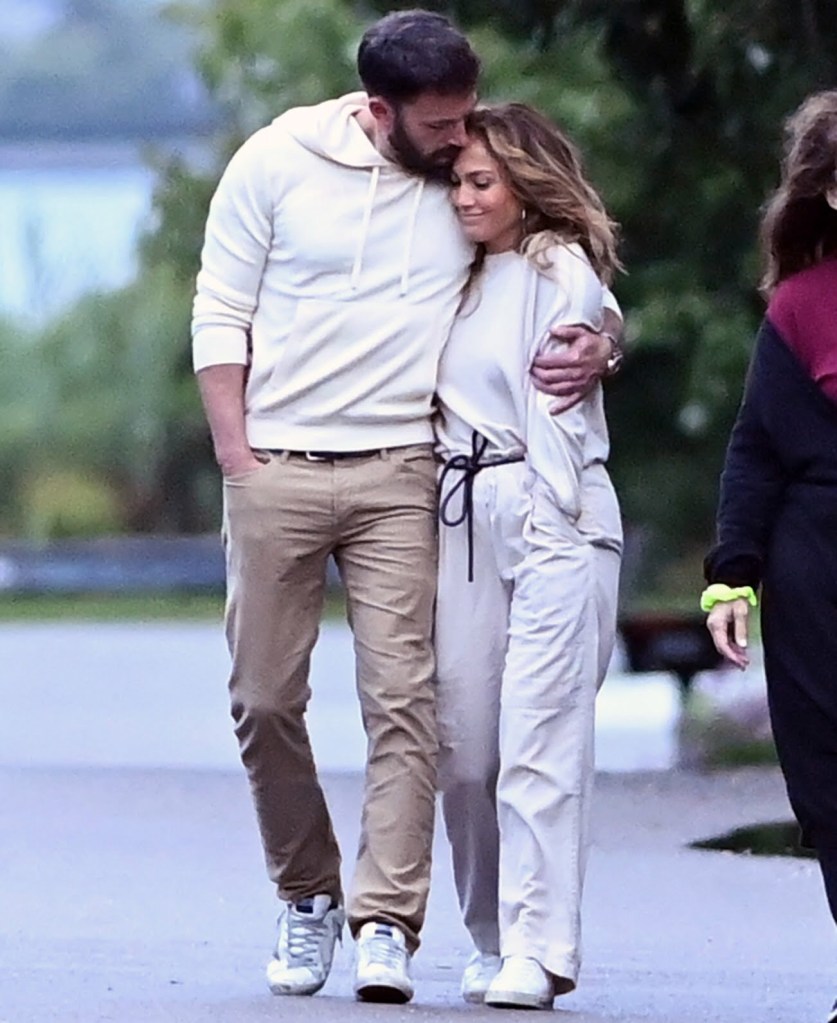
The more accurate … more auspicious… comparison would’ve been Jennifer Lopez and Ben Affleck who after years of separation are rumoured to be getting back together again.

If the BJP and Shiv Sena are going to be mending their fences they ought to choose the auspicious examples of uniting couples rather than divorcing couples to characterise their coy efforts to come together again and tango.

And BTW, Sanjay Raipur-ji, don’t you know that in Maharashtra people are no strangers to the celebrity world of Hollywood, and are in fact as enamoured of it as they are of the tinsel world of Bollywood?

Sudarshan Madabushi