Just look at her in the pic and try if you can please to imagine for a moment her life and the conditions of existence for that little baby seen inside the rough cloth-crib dangling behind her back !
That’s the stoic world in which millions of migrant workers from rural India who move from city to city, and from project site to project site, work as peripatetic on-site construction workers…. And even during a pandemic.
It is amazing to imagine — for me at least, yes — how quietly and without a fuss this heroic woman goes about doing her job!
She goes neither whining nor moaning about being a “harassed, almost martyred home-maker” doubling up as breadwinner nor is she flaunting herself as being any kind of superwoman of the comics-strip galactic kind! (And without meaning to sound disrespectful to her urban sisters across all of India, I just can’t help, within my own mind , comparing her own uncomplaining fortitude with that I know is normally exhibited by the far more educated, suave and privileged city-dwelling womankind).
A woman like this asks for no “child day care centres” , no maternity leave nor allowance, no child-support, nor any sympathy from anyone … We see her just making do with the portable daycare centre she herself carries around on her own back , for no more than the meagre daily wage she earns!
She lives in just a poor makeshift, ramshackle hovel but then it is she who helps build sprawling, opulent mansions for the rich of the land!
Sometimes I think to myself, if it were not for the hard work this lady does and for the copious sweat of her brow, the GDP of India — of which they say the Real Estate sector is a very important, “core” and “bell-weather” component — couldn’t be kept chugging along higher and higher, could it?
Our economists and our governments tell us that the health of this nation’s economy depends a lot on the health of the construction-sector … a sector that’s cared and nurtured for indeed by millions of women like the woman in this picture. Without her, the real-estate world would not thrive and the GDP-growth too would stay stunted.
With all the above thoughts swirling inside my mind which this one stark, dark picture aroused and evoked in my mind, I couldn’t help recalling the famous, proverbial words of the American poet that I had learned in school 50 years ago … words that the poet was moved to pen down in heart-melting verses :
“Blessings on the hand of women! Angels guard its strength and grace. In the palace, cottage, hovel, Oh, no matter where the place; Would that never storms assailed it, Rainbows ever gently curled, For the hand that rocks the cradle Is the hand that rules the world.
“Woman, how divine your mission, Here upon our natal sod; Keep – oh, keep the young heart open Always to the breath of God! All true trophies of the ages Are from mother-love impearled, For the hand that rocks the cradle Is the hand that rules the world. — William Ross Wallace. (“The Hand that Rocks the Cradle”)
In the case of this poor mother in the picture, she can’t even rock the poetic cradle … for on her back is the cross that she must bear even as she toils all through the day for the bread it will win her and her baby, at dusk.
God bless the Mothers of the world like this woman … She is just one amongst the millions like her in this country who live, work and pass away— Mute, Unseen, Unknown, Unsung and Unremembered …
Words of Wisdom from Srimad Azhagiyasingar the 44th Pontiff of Sri Ahobila Mutt:
“daaney dvishantho mithraa bhavanthi”
(Translated into English from Sri Azhagiyasingar’s Tamizh discourses -“arul mozhigal”)— by M.K.Sudarshan
HH the 44th Srimadh Azhagiyasingar Peettadhipathi of Sri Ahobila Mattam
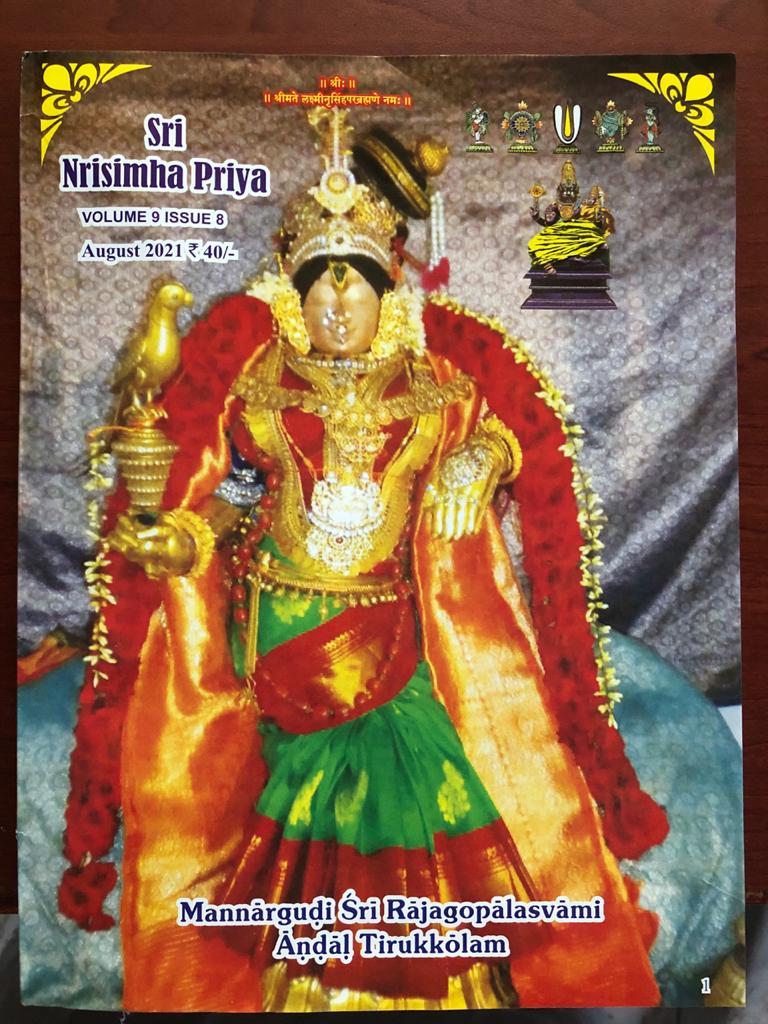
(This article has been previously published in edited form in the August 2021 issue of “SRI NRISIMHA PRIYA” (English Edition) — the official magazine of the Sri AHOBILA MATTAM, INDIA)
Few in this world realize the blessed quality of charity. But from whatever I have learnt about it from the words of our wise forebears, I shall now write about and share with you in the hope that you shall then be sufficiently urged to engage in generous charity in life, each in accordance with your own means and capacity.
Try imagining a lake or a pond whose water-level is rising to dangerous levels due to incessant inflows. What do you think the person responsible for its safe upkeep ought to do about it? You would all say he should immediately see to it that a channel is cut to allow excess water from rising levels of the lake drain out slowly, and thus prevent breaches in the lake’s embankment resulting in far greater loss of its precious waters. Similarly, we can say, that as the levels of the wealth we go on earning begin to rise steadily as we progress in life, we must let it percolate out little by little through the channel of generous charity. Otherwise, there is every possibility that we might end up losing a greater part of it through sudden, unfortunate vagaries, mishaps or accidents in life such as theft, taxes or expropriation. Therefore, we must understand that both spending and giving in charity, in generous measure, do go a long way in life to not only help retain but also protect our larger stock of wealth.
A wise man once said this: When we neither spend our Wealth in living well ourselves nor do we give it in charity for the wellbeing of others, the Wealth very soon gets reduced to naught —
Yo na dadaathi na bhunkthe tasya tritheeyaa gathirbhavathi.”
People often ask, “How is charity to be given? What is the proper way?”
The answer is short and sweet: “Whenever done, any act of Charity firstly must be made with a pure heart? What does that mean? It means when I give in charity I must feel that the act itself is verily the fulfilment of my life”.
I am often asked this too: “To whom must be charity done and in what proper ways?”
Listen then to the answers I shall give you now:
First and foremost, one should proceed with an act of charity if it is known for certain that what is about to be given away in charity to a person will in turn get used by the latter, either directly or indirectly, but solely and surely for true, godly purpose only (bhagavathaaraadanam).
Next, persons who have studied and imbibed well the Vedic and Vedantic body of knowledge as well as those who do no more in life than sport a tuft on their crowns (kudumi), and are satisfied with performing no more than the ‘sandhyaavandanam’ rite, are both deserving of charity but then the former should get the first priority and the latter the last.
Charity should also be timely and made appropriately… It has been said in the Bhagavath Gita:
“paatrey anupakaariNey”
If one gives to another in charity with the tainted thought “If I gift this man now at this time, I can expect him to owe me something valuable in return at a later time”, then such charity carries really no merit at all.
Secondly, one must know that to be able to give in charity from out of one’s wealth, one must know first the means of its proper enjoyment. Merely possessing wealth means nothing if one knows not the means to experience delight out of it. No delight ever accrued to a man of wealth who simply wore it on his sleeves and strutted about. Real delight is derived from one’s wealth only when it is enjoyed collectively with one’s kith, kin and friends. But greater is the delight derived when it is put to use for godly purposes – for “bhagavath tiruvaaraadanam’, for preparing varieties of delicious and wholesome food-offerings to “bhagavaan” and thereafter enjoying them (as prasaadam) in the holy company of other devotees… that is certainly one form of delectation to be derived from one’s wealth.
Another way of putting to use one’s wealth in a wholesome way and derive delight from it is to regard oneself, one’s own family members and one’s own community at large as though they were all temples or places of worship. Thus when one’s wealth is spent in providing them all with all material wherewithal and good things in life, it is can be likened to spending generously on erecting festive festoons to the temple, and lavishing rich clothing, finery, jewelry and other ornaments and embellishments for the Deity and the sanctum.
However, on the contrary, spending one’s wealth for nothing more than self-gratification in so many profligate ways that are sinful, ungracious and are prohibited too by ‘saastras’ as being the cause for “bhagavaan’s” displeasure is indeed the surest path to perdition and can in no way secure any kind of delight or wellbeing to the owner of such wealth. The perils of squandering away one’s wealth in such fashion is severely condemned by the “paasuram-s” of the holy “prabhandhams” well known to us such as this one for example:
….“vambulaankoonthal manaiviyyai toorandhu…”
To contribute through charity towards the celebration of temple ‘utsavam’ (public religious festivity) and to be able to enjoy the fervor and fanfare is indeed one of the ways to delight in the use of one’s wealth. So is being able to offer beautiful and lavish floral tributes to temples and enjoying the sight of the Deity adorned with them. Similarly, donating a bit of one’s wealth towards organizing the temple-kitchens to provide sumptuous and wholesome food-offerings to “bhagavaan” and then having it all distributed to vast assembly of devotees and pilgrims (bhaagavatha goshti) can also be a source of immense mental pleasure and fulfilment for the donor.
Just as one spends one’s wealth in the periodic renovation and refurbishment of one’s dwelling, and then he is able, along with his family, to feel tremendous pride and pleasure from simply watching the new surroundings, so can a man of wealth who uses a part of it to gift it to the temples of our deities like Rama, Krishna, Ranganatha or Lakshminrisimha and others then able to savor the great delight of witnessing their precincts renovated and beautified with his donation and beginning to shine and sparkle again with new life and energy (“jeernOdhaaranam”).
There is yet another source from which springs very great satisfaction and enjoyment for the man of wealth: when he decides to gift a part of his wealth to arrange for young boys from underprivileged families to undergo the ritual investiture of “upanayanam” or to conduct the weddings of daughters (“vivaaham”, “kalyaanam”) hailing from such very poor families.
It is through the vehicle of such charity as described above that one may ensure that what is given away through generosity or philanthropy ensures in turn that what remains as wealth thereafter continues to be a fund worthy of respect and honor. It is akin to water inside a well. If the copious store of water inside the well is not periodically drawn out from it for use in a variety of ways in domestic, household life, the well is sure very soon to turn turbid and the water will begin to smell putrid. Likewise, we can say that periodic drawing out of excess wealth that accumulates with us and given away partly in charity helps to render the residual wealth free from the taint of sinful selfishness and the stigma of miserliness.
A great message on the subject of Charity was once conveyed by Sri Krishna to Yudhishtira in the following words (in the Mahabharatha):
“daridra Bhara kowntheya maa prayaccheshvarey dhanam,
“O Dharmaputra! Take it upon yourself as duty to give generously in charity to ‘saadhus’, ‘yogis’ and “bhaktas” who suffer silently in dire poverty… And there is no need at all for you to gift anything of any value to those who are already well to do.”
What Sri Krishna meant in the above shloka was this:
“The gifts of charity must be made in favor of those who are truly needy and in utter poverty for the much the same reason why medicines are administered to the grievously ill — the medicine relieves their suffering and cures them. What is the purpose of giving medicines to perfectly healthy persons?! Far from curing them, it might actually create in them only disease or affliction, will it not? Likewise, when one bestows charity on persons that are already well-to-do, the surfeit of beneficence at their disposal might only end up tempting them to either misuse or even abuse it to their own detriment.”
Even today all of us hear about and cherish in our hearts the glory of King Mahabali’s act of extraordinary charity in giving away everything he held as his empire to Vaamana bhagavaan who came to him disguised as a poor “brahmin brahmachaari” begging alms and made a demand for just 3 yards of land. The king’s royal counsellor, Sukraachaariar, when asked his opinion, voiced his suspicion and warned Mahabali not to give away the gift the boy was demanding and told him that it would mean the loss of his entire kingdom, crown and all his wealth. But Mahabali as a benefactor, even knowing fully the impending consequence of his charitable deed, went on still to confer the gift of “daana” on the boy and lost everything… Such is the glory of Mahabali and his exemplary generosity!
Have we all also not heard about the famous legend of Karnan (in the Mahabharatha) whose act of charity was magnificent and simply takes our breath away? And that when asked to be given it, he did not hesitate even a moment to rip out from his chest the coat of protective armor which had been conferred upon him at birth as a divine boon and gave it away in charity!
Then isn’t there also the legend that we all know of about how King Sibi Chakravarthy, in order to save the life of a mere winged creature, a poor pigeon, did not hesitate to slice out with his own hand a piece of flesh from his body to give the bird a lease of life?
A wise man once illustrated through a very telling analogy indeed how the many acts of genuine daana or charity by a person all raise him to very great heights of status and nobility. He compared the oceans and the rain-bearing clouds in the skies in this context. The waters of the vast seas are always held down by it and never given away for any great use by the rest of the natural world. Whereas the rain-bearing clouds shower down every bit of the moisture that they are laden with in such abundant measure upon all creatures and life on earth. And so we find that it is the clouds which for their self-less charity, get rewarded with a place of great prominence in the lofty heights in the vast skies of the heavens… and why too, the selfish oceans that do never part with their waters, get relegated to such a lowly, earth-bound status in nature.
Another wise man had this observation to make about Charity:
A man’s wealth is much like the stream that springs forth from the high mountains. That stream empties itself incessantly by letting its waters gush down the slopes of its meandering course. Does anyone need to spell it out to anybody at all as to what great dangers might arise if the mountain stream did not drain itself of its waters that way constantly? And instead if it stored or dammed itself up somewhere high up there in stagnant condition on the mountain slopes?
It is much the same with Wealth… even as it springs up and accumulates, so must it also be continually drained through charity. If it is allowed instead to amass and stagnate, such wealth only ends up attracting unwanted attention of covetous people including taxmen and other authorities. It then becomes difficult to account for such disproportionate accumulation of wealth and the mode of its disposal. (These days we hear often about some people, caught unable to properly account for their wealth, being hauled away from their cozy homes to live out their days in other very “specially protected and secure kind of homes”, don’t we?)
On the other hand, when a part of wealth is wholeheartedly given away in charity — to the needy, the orphaned and to the destitute men of learning (such as learned Vedantins) of this world — such large-heartedness yields unseen but very certain blessings to one.
Thus, when all is said is done, a prudent man of the world will ensure that a third of all his income and wealth is put away as his savings, a third is spent well in enjoying the pleasures of all good things in life together with family, relatives, friends and community; and finally, a third will be earmarked for charity to be given for worthy causes described above as ‘daanam’. At the same, without first accumulating a basic corpus, he should never begin to freely spend his earnings and wealth.
One of the blessed qualities of Charity or “daanam” is that it has the power to turn even foes into friends. Those who harbor any sort of enmity or rivalry against a man known well otherwise for his philanthropy usually end up making light of the rancor and making much more instead of his generosity. Charity (of the kind with no strings attached) indeed conquers all and that is why it is said (in the Veda):
“daaney dvishanto mithraa bhavanthi”
The Upanishad also goes on to say this of Charity:
“daaney sarvam pratishTitham”
I.e. All good things in life that a charitable man may desire get realized by him, sooner or later, by virtue of those very own charitable deeds of his. Many indeed are the gifts of “daanam” which are revealed to us by our ancient “dharmasaastras”:
foodgrain (daanyam), apparel (vastram), meals (annam), utensils (paathram), milk (ksheeram), yoghurt (thadhi, or thayeer), a son for adoption (puthradaanam), a bride in marriage (kanyadaanam), jaggery (vella daanam), salt (uppu daanam), cows (go daanam), land (bhu daanam), cereals (tila daanam), gold (swarnam), butter (aajya daanam), silver, property, trees or grove (vruksha daanam), temple elephants (gaja daanam), horses (ashva daanam), camels (ushtra daanam) etc.
Amongst the many “daanams” one can give as a gift of spiritual knowledge (intellectual property), the most priceless is that of “Sri Bhaashyam” (the commentary of Sri Ramanujacharya on the Brahma Sutra of Bodhaayana), “bhagavath-vishayam” (the commentary of Sri Kurugoor Piraan Pillaan on Nammazwar’s “tirvoimozhi”), Srimad Ramaayanam, and books on the sacred Stotra works of great Vedic and Vedantic Acharyas. The exposition by very learned men of the deep meanings and significance of such great works can also be deemed to be very valuable intellectual gifts given away by them. Some people of learning out of sheer vanity keep hoarding valuable books in their private libraries and gloat about it without sharing their treasure with others. In time, those libraries used by none become moth-eaten and waste away. Rather than let such intellectual treasures decay, books of knowledge should be given away as gifts to young students and sincere seekers of knowledge.
I must now dwell a bit upon an important aspect of charitableness:
Imagine a father of his only child, a beloved daughter, saying, “She is the only child I have! How can I give her away in marriage (kanya daanam)? Should my home not be blessed with the presence of at least one loving child of mine?” Irrespective of such paternal sentiments, one must yield to our ‘saastra’ which stipulates that a father soon after his daughter attains age of puberty must seek out a worthy brahmachaari groom for her; one who belongs to another “gotra” (genetic group); is able bodied, well-educated; and the father should then dutifully confer all ceremonial honors on such a groom — with gifts, flowers, perfumed offerings and to the sound of mantra-chants for the occasion — and forthwith give away his daughter’s hand in marriage to such a worthy man. Such a gift of nubile daughters (“kanya daanam”) must be performed whether a father has only one or fifty daughters! If a father fails to perform the sacred duty of “kanya daanam” in a timely manner, and instead continues to keep her in his own paternal custody indefinitely at home, he is deemed by the dharma-saastras to be guilty of such heinous sins as “bruNa hathya (feticide), “maathru hathya” (matricide), “pithru hathya” (patricide), “brahmahathi” (slaying Brahmin), homicide, thieving, felony, crime, and social treason.
A daughter born to a father ought to be parented with love and care as a child. But the day she attains the age of puberty, it is the duty of the father to gift her away in marriage to a worthy groom; no delay in the matter for any reason should be brooked. That duty when performed in a timely manner is said to please all the gods (devataas), sages (rshi-s) and men of Vaideeka ancestry (i.e. I mean the venerable persons of our past who were wedded to the Vedic way of life). It is so common these days to blame the secular laws for the late marriage of our daughters — and thus marriages get postponed to even ages far advanced as 30 and 35 years. Lack of financial resources is yet another excuse for postponing marriage of our daughters. There is also the pretext of the evils of the dowry system. And then these days, we also come across nubile girls in our community who baulk at the prospect of getting married to grooms who are of orthodox mien and demeanor (such as wearing the traditional kudumi)! Anyway, so long as the daughters (kanni-s) in our community are married in time, that in itself should be a cause for happiness, and welcomed and encouraged as a form of ‘daana’, an act of good charity. At least, let us hope that the groom is one who believes in and knows how to offer “daily worship” to his household deity (‘saalagraama poojai’ or “tiruvaaraadanam’).
Then there is the gift of “anna daanam” to be spoken about. It is the gift of feeding masses of common people. How is this to be done by a man of wealth? This “daana” must be made only for the benefit and heartfelt satisfaction of those poor people who truly know and have experienced the pain and pangs of hunger and have no other reliable or sustainable means of providing themselves at least one square meal a day. Food given as gift to such people provides instant relief and sustenance to them, energizes them, makes them active and in turn enables them to offer thanksgiving and prayers to “bhagavaan”… Hence, the merit of such “daana” accrues and arises immediately and in abundant measure too to the “anna daatha”, the donor.
The gift of cows – “go daanam” – can be made to worthy men devoted to Vedic learning (vedaviths). But such gifts should be given only to those who can be expected to protect and husband the animal and enjoy the copious milk it yields. The donor must ensure that the recipient of “go daana” is not negligent in protecting the cows. Also, once the gift of the cow is made, the donor should never, later on, try to regain or claim it back for any reason whatsoever. Several scriptures condemn it as heinous sin. Again, no man should make a gift of a cow to vedaviths knowing it to be frail of health, sick, decrepit, disabled, infecund or unproductive of milk. Such gifts only earn for the donor all manner of ill fate in life.
Giving away one’s son by way of gift to foster parents for purpose of legal adoption is “puthra daanam” and it is approved by our saastras. But such ‘daana’ is best made when the adoption is accepted (sveekaara) by one’s own kith (gnyaathee-s). Next in order of preference, the gift of adoption may be given to relatives belonging to the same “gotra” lineage. The least preferred mode of “puthra daanam” is to arrange for adoption of a son on mere pecuniary considerations.
Another praiseworthy mode of gifting particularly to temples and religious monasteries (mattam) is what is known as “gaja daanam”, elephants. But the gift of these magnificent animals were once made only by maharajas and noblemen who had both the resources and willingness to make such munificent endowment.
Then there is also the custom of gifting to great temples massive accessories for use in the temple festivities (utsavam). Such accessories are great big umbrellas known as “kudai”. They are ceremonially carried to provide shade and cover to the idols of the deities when they are taken out in procession – with all attendant pomp, pageantry and parade – and are admired and witnessed by delighted, awe-struck crowds of teeming devotees thronging the streets along the way. There have been a few great donors who have spared no cost in gifting these gigantic umbrellas to the Kanchipuram Sri Varadarajaswamy Perumal Temple on the occasion of the annual “Garuda sevai”. Likewise, for the Sri Veeraraghava Perumal temple in Tiruvallur too. We know that the temple administrators (devasthaanam) of these big temples also regularly lend out the service of these magnificent festive-accessories to other smaller temples and shrines in and around the province… which is a matter of pride indeed since it is good use of the “daanam’ made in the first place. Another similar kind of daana is made with temple horses too.
Finally, the ‘daanam’ that reigns supreme over all other “daana” is what is called “rathnadaana” — the gift of priceless diamonds. But then even amongst such invaluable “rathnadaana”, there is one that stands unequalled and unrivalled by any other and it is called “jeevarathnadaanam”.
What makes this “jeeva rathna daanam” unique and exceptional? Why are other forms of daana — whether it is “go-daanam, bhu-daanam, kannika daanam, sri-moorthy daanam, Sri Kosa daanam, vastra daanam” – all never at par with “jeeva rathna daanam”? It is because all of them, while capable of yielding “phalan” of the highest order viz.: blessings, benediction or exquisite states of happiness in the realms of the highest heavens (such as “brahma lokam”, “svarga lokam”), their phalan nonetheless is tainted by the defect of impermanence and “dukkhaanubhavam” or ultimate grief that inevitably follows such a condition and must be experienced.
On the contrary, the resultant “phalan” which “jeeva rathna daanam” promises is one that is eternal, limitless and capable of bestowing “aanandam” or ceaseless pure, unalloyed bliss in the realm called “Sri Vaikuntam”. Having reached that state, there is no question of returning to mortal or mundane existence ever again through endless cycles of rebirths. It means everlasting blissful coexistence with the Supreme One who has deigned to receive and accept such “jeeva rathna daanam”.
Now who is this recipient of such a gift called “jeeva rathna”? To whom should one be ready to make a gift of one’s “Jeevan”? Let me explain:
Many are the different kinds and forms of “daana” that have been listed above. It should be understood that in making such several types of “daanam”, certain rules and procedure are to be abided. The gifts are to be made at the proper time, in the proper place and settings, with proper pre-qualifications and pre-conditions etc. This “jeeva rathna daana” (Atmadaana), on the other hand, is a gift to be made solely to our Lord Sriya: pathi Srimann Naaraayanan, the only one who is fit and able to receive and accept such a supreme gift. It is He who being ever solicitous of the well-being of our Atmaa or soul, awaits expectantly, and constantly too, the moment when we ourselves are ready to go forward to make the final gift of “jeeva rathna daana” to Him and ascend to his abode in Sri Vaikuntam to thereafter enjoy eternal bliss in His Company. Such mortal souls are not differentiated in any manner at all: it is utterly immaterial to Him whether we mortals are men, women, belonging to either this or that caste, sect or denomination. So long as we truly make the ultimate gift of our “Atma” to Him, he is ever ready to accept the offered “jeevarathna” of ours and bestows upon us everlasting experience of “mukthaanandam” or the Bliss of “moksha” upon us.
He who seeks “moksha” and is willing to make the supreme gift of “jeeva rathna daana” should understand that it cannot be made to gods other than Srimann Naaraayana who alone can bestow “moksha phalan”. Offer of “daana” to please other deities such as Rudra or Brahma may at best secure for one the heavenly delights abounding in Brahma-loka or Kailaasa-loka. But then even those realms are impermanent and subject to “pralaya” or ultimate cosmic dissolution. The Creator of all the fourteen realms of all mortal existence (i.e. heaven and earth, matter and spirit, all spatio-temporal existence), the scriptures reveal to us, is none other than Naaraayana into which all gets finally subsumed.
To make the gift of such “atma samarpaNam” or “jeeva rathna” there is really no specific time or place designated, no occasion, personal status or qualification is required; no age is barred, nor is wealth or social standing a criteria; it does not matter whether one is healthy or afflicted by disease or disability; nationality does not matter nor does one’s faith or even if one is atheistic… So long as one is possessed of a soul that finally recognizes Sriman Naaraayana as the one and only Ultimate Reality, and has gained true “gnyaana” of that Reality; and so long as such a soul has realized too that it is by gifting itself as “jeeva rathna” at the feet of Naaraayana it absolves itself of all taint and traces of sin, infirmity and defects, it gets welcomed and admitted into the company of the celestials and liberated souls who have already performed “jeeva rathna daana” to the Almighty; and together with all of them it delights in Sri Vaikuntam.
It must therefore be realized that nothing stands as obstacle between us and the deed of “jeeva samarpanam”: not religion, not caste, not country, not age, and nothing… no bar or exclusion of any kind! Just never forget that there is none other who can receive your final gift of “jeeva rathna” than this Sriman Naaraayana.
There is one other matter that must be underscored here:
Gifts are effected by a donor to the recipient usually through designated intermediaries who aid in the proper conveyance of the object of gift. In the case of the many aforesaid “daana” (such as go-daana, kanya daana etc.), the intermediaries are elected persons with sufficient competence in terms of good knowledge of saastra, mantra and ritual. For the gift of “jeeva rathna daana” those intermediaries may not possess the requisite qualifications or experience. So, one must be aware that one needs a proper and genuine guide and mentor, “upaadhyaya” or “Acharya”, who alone can show the way for one to effect the great and profound gift of one’s Atma through mantra, ritual and saastra-based procedure. By doing so, he who completes the “jeeva rathna daana”, secures release from all mortal bondage (of “sukha” and “dukkha”) and ascends to the supreme state of bliss and liberation. This is what is vouchsafed in that great doctrine called Saranaagathi.
To conclude, whatever may be the fruits of one’s charitable deeds that one may expect to reap in life, one must realize that it is only through renouncing them – ‘bharannyaasam’ – that they ultimately all get realized. But if it is “moksham” (or liberation from the eternal cycle of mortal rebirth) that one is seeking, then performing “bharannyaasam” alone is not sufficient. Sriman Naaraayanan bestows the grace of eternal salvation only on souls that have gifted him with renunciation of both the deed and as well of the fruits of the deed.
Sri.B.S.Raghavan is a very distinguished and venerable nonagenarian who lives in Chennai, India. B. S. Raghavan joined the West Bengal IAS cadre in 1952 and was the Commissioner of various Departments. He also served as the Chief Secretary of Tripura. He was Director, Political and Security Policy Planning in the Union Home Ministry and the Secretary, National Integration Council during the period of the first four Prime Ministers. He was a US Congressional Fellow and Policy Adviser to UN (FAO), and Chairman of three UN Committees. He has been chief executive of four major public sector enterprises. He is now a columnist and author, connected with social service and educational organisations.
I was both flattered and honoured indeed when I received the email below from him with a comment on my blogpost yesterday on the subject-line. I reproduce below the correspondence between us.
Shri Sudarshan: Very often, our English education and proneness to succumb to the spell of imported phrases and concepts emanating abroad become an impediment to exercising clear thinking. So also is the case with phrases like Liberals and Conservatives. You say there is NO pious middle path. There is,if you realise that no Deva nor Asura is wholly 100 percent that: There is a bit of Asura in every Deva and Deva in every Asura. We have many examples in our epics, puranas and itihasas, as you very well know. The middle path is, in realisation of that, NOT to take a dogmatic view of anything but, as Thiruvalluvar said 3000 years ago, குணம் நாடி குற்றமும் நாடி அவற்றுள் மிகை நாடி மிக்க கொளல். Lord Krishna in Gita lays stress on swadhyay — looking within ourselves, self-introspection, to reduce our brute component and enlarge our human component. In short, to know that there’s no absolute black nor absolute white, no either-or. Then the middle path will automatically emerge. B S Raghavan
Dear Sir, Thank you for freely sharing your thoughts upon reading my blog . Sir, Your wisdom shines through and so does your faith in the goodness of humanity. I salute you. 🙏
While like you, I too am a long-term optimist , at times when I witness the contemporary events of our world … such as the ongoing “culture wars” both in India and abroad that I speak about in my blog … I cannot sometimes help feelings of both outrage and despair overwhelming me. Not everyone who is a combatant in the Culture Wars of world is aware of the presence, as you said, of both Asura and Deva forces within oneself. If they did, they wouldn’t be fighting the war in the first place.
Sir, whether it is the classic Western battlefields where Liberal and Conservative are engaged in an epic battle with each other, or, whether it is Kurukshetra War in modern India between Religious and Secularist/Irreligious/ adharmic ideologies that we see clashing amongst us almost daily in some incident or other flaring up somewhere in our land, the antagonists on one side look upon the adversary as pure Asura — their own side however they see as pure Deva only. For the Devas on this side of the cultural battlefront, it is always the other side that is evil Asura. This constant “othering” is, in fact, the main reason why the Culture War in India is descending into unprecedented belligerence being shown by both sides which stoutly deny giving any quarter to each other. This is both in the national theatre of war as well as in the regional arenas like my own state of Tamilnadu.
In a situation like this when there is so much polarisation in ideas and ideals, institutions communities and regions — why, even inside the very mindset— amongst us all, Culture Warriors, even the sane and sensitive ones who might otherwise be seeking the Deva within oneself and striving to overcome the Asura lurking within their hearts, find that they can no more adopt the “Middle Path” than the Pandavas did against the Kauravas.
There comes a time, Sir … and it is indeed sad, unfortunate and tragic when it does …when it becomes clear just as it did in the Bhagavath Gita, which Krishna, in fact, explained to Arjuna in 700 shlokas and 18 Chapters, that black is black and white is white … and simply contemplating upon the grey is not going to be the final solution to the Culture War at hand but fighting it certainly is.
In the war of Kurukshetra, the victors emerged finally as Devas and the vanquished were Asuras. Such is the nature of all Dharma Yuddha … and the Culture Wars being fought now in India today are not an exception.
“Dharma Kshetre, Kurukshetre….!”… with those very stirring words does the famous war scene in the Bhagavath-Gita open in the epic Mahabharata! They herald the titanic struggle between the forces of Dharma and Adharma, Righteousness and Unrighteousness, between eternal Good and eternal Evil!
Kurukshetra, the killing fields of bloody but righteous wars, is perhaps the best metaphor to describe the civilisational India of the past that is to be found in our great epics and puraanas. Those were the Cultural Wars where Devas (virtuous gods) ceaselessly fought the Asuras (un-Dhaarmic daemons).
Today too in India, we see Cultural Wars being fought constantly in the hearts and minds of the peoples … It takes place in many theatres — in political and civil engagement, in schools and universities, in the pages of newspapers and in the wide open cyber-spaces of social and electronic media. As a foreign observer of Indian Cultural Wars , Koenrad Elst, writes: “In India, the culture wars that get the most attention … mainly concern religious and national symbols, the definitions of Hinduism and Secularism, caste, history and … the school curriculum”. He then goes on to say this about the way Indians fight their culture war … “the warring parties foam at the mouth and even indulge in ‘divisive’ or ‘anti-national’ activities that can ultimately cause civil war and the nation’s disintegration”. (“Hindu Dharma and the Culture Wars (2019).
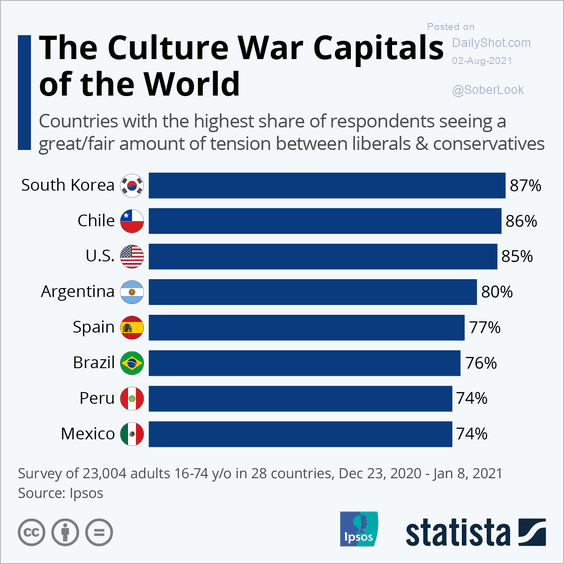
I used to be once only a rather disinterested spectator myself of the Culture Wars in India. But with every rising day in these times, I have grown greatly concerned about the virulence and frequency of these culture battles amongst the hostile camps in our country. I have been entertaining the thought that nowhere else in the world is the intensity of Culture Wars felt more strongly and painfully than in India. And that is why this info-graphic chart below that I chanced upon today leaves me aghast with disbelief! Please do take a good look at it.
I was all along under the impression that the KURUKSHETRA of all Culture Wars was here in India !
Now, I feel I have been robbed of a distinction I thought belonged to India, my country … i.e. as the Dharma-Kshetra where the clash of Devatas and Asuras was pitched on a truly magnificent Olympian scale.
I am wrong . We seem to have strict competition from 8 other formidable countries of the world!
It is no surprise at all, however, that in atheistic, dictatorial and non-democratic countries (where perhaps Asuras reign supreme?) like China and Russia for example … or within out-and-out Islamic countries like Saudi Arabia and Iran … there are hardly signs of any Culture Wars, at least not in the strict sense of the term.
Be that all as it may, one thing should indeed become very clear to us: Wherever we are in this world, there is no escaping from the individual choice we have to make as citizens of our own respective countries : Are we going to be on the side of the Liberals or the Conservatives? Unfortunately there is no pious middle path to take and no way to duck the cultural partisanship that we must confront — for, please believe me, Devas are Devas and Asuras are Asuras , and never the twain shall meet …
This whole business of Untouchability, in my opinion, has been rather overdone and overexploited in our country by clever politicians posing as social reformers and by cynical godmen masquerading as sanctimonious soul-saviours and they all come in all “varna-s”… Let me hasten to add that by “Varna” I mean “of all hues and shades of groups in society” … I am not referring to any caste or community.
BTW, I ask myself often these days if the Wuhan Virus hasn’t made Untouchables of us all without any exception? If you were to pause a while to think deeply and calmly about it, without a prejudiced or indoctrinated mind, you too, I would reckon, be asking yourself this: aren’t “social distancing”, “vaccine nationalism”, “Covid passports”, “serological profiling” … all now the latest forms of “தீண்டாமை”, “theendaamai” or Untouchability that is now being practised, or being practised reticently, all across the world?
These days, I also have begun to perceive and reflect upon Untouchability less and less as a social issue and more and more as profoundly philosophical conundrum. I confess that in the way the whole world appears to me today, the Untouchability question seems to be really far more aboutonly levellinginequality amongst human societies … and precious little about actually creating equality. And elsewhere outside human societies that I see, Nature seems to take both equality and inequality in its stride without kicking up too much of a fuss, frenzy or fracas about either of them.
We humans invented Democracy so that, as a system, it might serve us as a political leveller; we then devised Taxation systems so that they would act as an economic leveller; and now, unimaginably so, it is Covid, an invisible and pathogenic virus, that has come around into our lives and, lo and behold! our great doctors and medical scientists have effectively turned it suddenly into a worldwide social leveller! But then I ask myself, “Are these great human systems truly levellers of inequality or its accentuates”?
And, finally, I also ask myself, in moments of introspection, who can ever deny that it is only Death that is the ultimate leveller? Death indeed levels all equalities and inequalities of every mortal kind and, so, when we die, we all turn Untouchables indeed, don’t we? Nobody ever wants to touch the dead… ! Isn’t that the raw, naked truth about the universality of Untouchability?
So, looking at the whole subject in an unusually philosophical way, I am beginning of late to find myself wistfully wishing that no Man would, for God’s and humanity’s sake— not just for now but for all times to come— go on and on, continuing with this nasty business of making such a big needless fuss and frenzy about Untouchability. “Touch-me-not-ism”, in truth, is really nature’s way of immunising itself against itself … against the pathogens that exist within nature. And that, for all I know, is perhaps the greatest lesson that the Wuhan Virus has taught this puny, vulnerable world, the home in which we all live and which we call Planet Earth. Will we listen to it and heed the lesson?
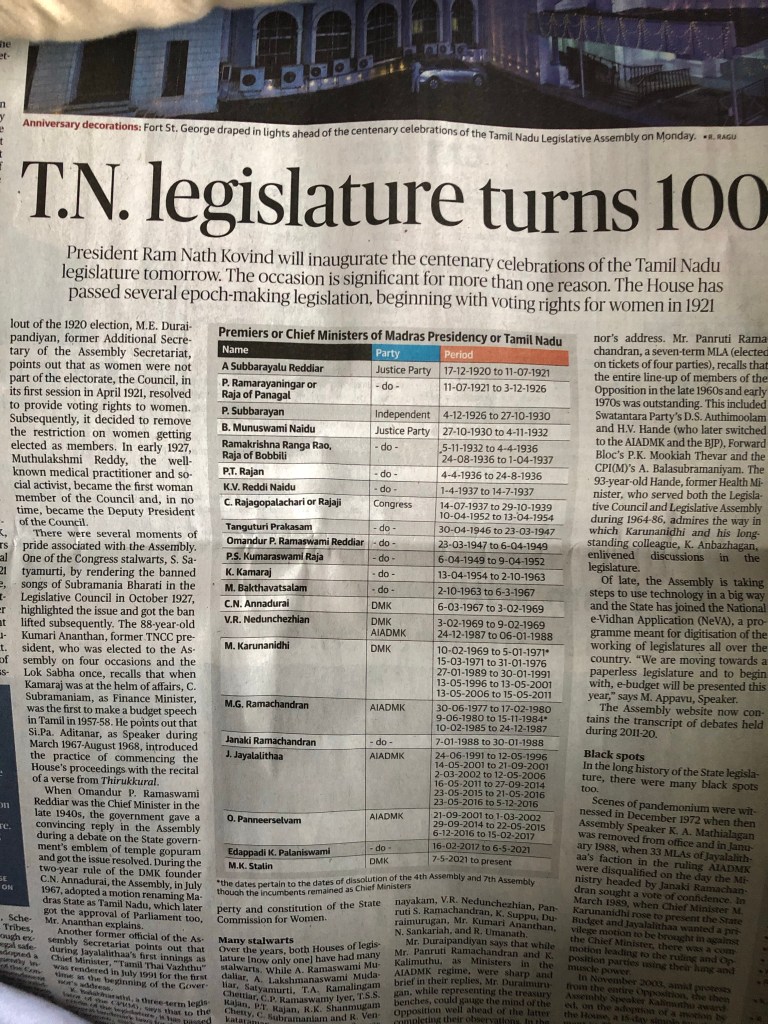
Please zoom in and take a hard look at the above 2 JPEG pics…
In the last 100 years, only 2 “Tambrahms” have been either Chief Minister or else Speaker of Tamil Nadu Legislative Assembly or Council! (C. Rajagopalachari and J. Jayalalitha; Sri Prakasam was not a Tambrahm)
And yet, according to an outrageous canard that over the last 100 years in our blessed Tamil land has been masquerading constantly as the epicentre of all political discourse, it is the Tambrahm community that dominated all these years the entire political and social landscape of the State, and that it continues to wield and enjoy, even today, political power, clout and influence far in excess and disproportionate to its size!
These 2 pics, revealing the list of office bearers who headed both the executive and legislative branches of government in Tamil Nadu, clearly reveal the cruel irony, the utter falsity and the malicious myth of all political discourse and agenda planned and executed in our State in the last one hundred years! The Truth certainly has a knack of revealing itself in the most unusual and unexpected of ways … if only we are all prepared to look!
This morning a very dear friend and ex-colleague of mine and I happened to exchange some views on India and China and their relative achievements as a people in contemporary times. This is what my friend wrote to me:
QUOTE: “I strongly believe in (this line of reasoning): No Kingdom without Army. No Army without Wealth. No Wealth without Material Prosperity. No Material Prosperity without Justice. (Therefore) My personal opinion is that; China is practicing all (of the above) except Justice. India is (practicing) all of the above but none either completely or perfectly. (As a nation, don’t we hence) Need to overcome the weakness ASAP???” UNQUOTE
My friend’s message provoked in me very deep and troubling thoughts about the comparison between China and India … I tried to recall to mind — in a nutshell, of course — everything that I had read about in the history of both India and China and tried to glean from what I little I knew from it, the reasons why India compares rather unfavorably with China in my friend’s estimate. Finally, I could come up with no other response more genuinely felt by me —I tell that to myself — than the one below which I decided I would send him for whatever it was worth … and which, now, I share below with you all, too, my dear readers … again, for whatever it is worth:
“Sir, you are right in the broad point you make — that in the case of India, it seems to be a case of “operation successful, but patient is dying”, and in the case of China, it is a case of “surgery was pretty bloody but the patient, miraculously, has been restored to pink of health”. However, I only wish you had also offered a suggested explanation for why India compares so unfavorably with Chinain the specific terms that have been framed by you. Let me therefore offer you my own suggestive answer to that important question missed by you.
India in ancient times used to be a knowledge society based on meritocracy alone where members were rewarded purely on basis of true, original achievements, not contrived or imitative ones.
There used to be clarity in our peoples’ minds about what their duty and mission in life were and what level or standards of excellence had to be equaled or exceeded while going about doing their respective duties and obligations, connected with aspiring to earning or deserving outstanding recognition in life.
Historically, we can say that Recognition for Exceptional Achievement did not come to anyone in India on the basis of only birth, caste privilege, community “quota reservations”, political affiliation or family background… or other such kinds of criteria or considerations that we see in play today in our society almost everywhere. Whether it was the Aristocracy or the Proletariat, in historical India, people knew and understood that their place or status in society was founded, clearly and firmly, upon a certain established order of meritocracy … nothing else. One therefore could earn only what one deserved through sheer dint of work and achievement … not through operation of a “socially engineered” scheme of aspirations and entitlement … i.e. not by what one desired. That was the fundamental Dharma that our society used to abide in for many centuries in the past.
All that changed. After Independence our Constitutional values, ideals and priorities changed fundamentally.
In the name of so-called “social levelling” and championing the “remedying of past discriminations and injustices”, and in seeking the utopian goal of “creating equal opportunity for all” in society, our traditional Indian ways of life that depended solely on the value called Meritocracy to create and craft social structures, edifices and matrices— viz.: of individual duties and rights, effort and reward, justice and equity — all of that vanished or got substantially eroded. Today, no direct link seems to exist that people are able to perceive clearly and with which to connect merit with recognition in Indian society.
In China , there is sheer brutality, no doubt, in imposing the Communist social order on the people by the government. But as far as I can see there is no confusion at all in anyone’s mind about how and where meritocracy is placed as a societal value or ethic: It is always being positioned front and centre and high above democracy and even above autocracy. That is why the Chinese nation has succeeded in whatever it has endeavored to do in the last 75 years. Let me hasten to add that I’m not for a moment holding up the Chinese Communist model of governance. I’m only underscoring the element of faith in Meritocracy that is evident in it . I am also drawing attention to the crucial fact that Meritocracy is, plainly and simply, a Value that will brook no ideology or “-ism”. It is an overarching Value that a society can embrace irrespective of its predilection for either this or that political or religious belief-system… At the same time, Meritocracy is a Value that a society can choose to sacrifice , and quite easily too, at the altar of any ideology… just as the history of India tells us she has indeed done.
Take a look at American society at the other end of the comparative spectrum. As we all know, in terms of ideology, American society is the antithesis of the Chinese one. America once used to be a truly democratic meritocracy. That is why it became a great nation of many proud achievements in 200 years. But in the last 50 years, and again in the name of neo-liberal left-wing politics, and in the name of “creating equal opportunity for all”, American society too has been riven by societal divisions of late (with income and wealth-inequalities, in spite of so-called “affirmative action”, being the greatest source of such divisions) and gradually, even there, true meritocracy has suffered a steep fall… And that’s why we all see how the decline of America in many spheres of human activity is beginning to show up.
India once used to be a country ruled by great monarchies through several centuries. But the kings and dynasts, even though they might have been foreigners, understood clearly that no matter what style of governance they adopted, or whatever ideology they preferred (and no matter how many wars they fought amongst themselves), the common cultural trait and basic structure of traditional Indian peoples would always reserve a very high place and a very high value upon Meritocracy. Thus, the rulers ensured that they, or their administrations and governing policies, did nothing to upset or disrupt in any way the delicate social stratification and social ethic or order that had been already in-built into the very fabric of society… that same fabric, in fact, out of which the peoples themselves, for centuries, had stitched and had woven the rich and vast tapestry of Indian achievements — in arts, sciences, crafts, skills and even pre-modern technology — for which India was renowned throughout a millennia and a half after and before the Christian Era.
Sir, given all that I have said above, I have no hesitation to add further, that in my humble (or not so humble) opinion, the very first casualty of the Indian Constitution— the fountainhead of our country’s Justice system — that was first imposed upon the people of India in 1950, and as amended extensively since then in many respects, is what, once upon a time long ago, used to be the Indian people’s Dhaarmic attitude towards Meritocratic values.
To conclude, Sir, in your question posed above, you hold Justice to be the first link in the long chain of nation-building that leads from material prosperity to wealth to army to kingdom or State. So, if we the People of India want change, we should know we have to start right at the beginning — the Constitution of India.
This morning a very dear friend and ex-colleague of mine and I happened to exchange some views on India and China and their relative achievements as a people in contemporary times. This is what my friend wrote to me:
QUOTE: “I strongly believe in (this line of reasoning): No Kingdom without Army. No Army without Wealth. No Wealth without Material Prosperity. No Material Prosperity without Justice. (Therefore) My personal opinion is that; China is practicing all (of the above) except Justice. India is (practicing) all of the above but none either completely or perfectly. (As a nation, don’t we hence) Need to overcome the weakness ASAP???” UNQUOTE
My friend’s message provoked in me very deep and troubling thoughts about the comparison between China and India … I tried to recall to mind — in a nutshell, of course — everything that I had read about in the history of both India and China and tried to glean from what I little I knew from it, the reasons why India compares rather unfavorably with China in my friend’s estimate. Finally, I could come up with no other response more genuinely felt by me —I tell that to myself — than the one below which I decided I would send him for whatever it was worth … and which, now, I share below with you all, too, my dear readers … again, for whatever it is worth:
“Sir, you are right in the broad point you make — that in the case of India, it seems to be a case of “operation successful, but patient is dying”, and in the case of China, it is a case of “surgery was pretty bloody but the patient, miraculously, has been restored to pink of health”. However, I only wish you had also offered a suggested explanation for why India compares so unfavorably with Chinain the specific terms that have been framed by you. Let me therefore offer you my own suggestive answer to that important question missed by you.
India in ancient times used to be a knowledge society based on meritocracy alone where members were rewarded purely on basis of true, original achievements, not contrived or imitative ones.
There used to be clarity in our peoples’ minds about what their duty and mission in life were and what level or standards of excellence had to be equaled or exceeded while going about doing their respective duties and obligations, connected with aspiring to earning or deserving outstanding recognition in life.
Historically, we can say that Recognition for Exceptional Achievement did not come to anyone in India on the basis of only birth, caste privilege, community “quota reservations”, political affiliation or family background… or other such kinds of criteria or considerations that we see in play today in our society almost everywhere. Whether it was the Aristocracy or the Proletariat, in historical India, people knew and understood that their place or status in society was founded, clearly and firmly, upon a certain established order of meritocracy … nothing else. One therefore could earn only what one deserved through sheer dint of work and achievement … not through operation of a “socially engineered” scheme of aspirations and entitlement … i.e. not by what one desired. That was the fundamental Dharma that our society used to abide in for many centuries in the past.
All that changed. After Independence our Constitutional values, ideals and priorities changed fundamentally.
In the name of so-called “social levelling” and championing the “remedying of past discriminations and injustices”, and in seeking the utopian goal of “creating equal opportunity for all” in society, our traditional Indian ways of life that depended solely on the value called Meritocracy to create and craft social structures, edifices and matrices— viz.: of individual duties and rights, effort and reward, justice and equity — all of that vanished or got substantially eroded. Today, no direct link seems to exist that people are able to perceive clearly and with which to connect merit with recognition in Indian society.
In China , there is sheer brutality, no doubt, in imposing the Communist social order on the people by the government. But as far as I can see there is no confusion at all in anyone’s mind about how and where meritocracy is placed as a societal value or ethic: It is always being positioned front and centre and high above democracy and even above autocracy. That is why the Chinese nation has succeeded in whatever it has endeavored to do in the last 75 years. Let me hasten to add that I’m not for a moment holding up the Chinese Communist model of governance. I’m only underscoring the element of faith in Meritocracy that is evident in it . I am also drawing attention to the crucial fact that Meritocracy is, plainly and simply, a Value that will brook no ideology or “-ism”. It is an overarching Value that a society can embrace irrespective of its predilection for either this or that political or religious belief-system… At the same time, Meritocracy is a Value that a society can choose to sacrifice , and quite easily too, at the altar of any ideology… just as the history of India tells us she has indeed done.
Take a look at American society at the other end of the comparative spectrum. As we all know, in terms of ideology, American society is the antithesis of the Chinese one. America once used to be a truly democratic meritocracy. That is why it became a great nation of many proud achievements in 200 years. But in the last 50 years, and again in the name of neo-liberal left-wing politics, and in the name of “creating equal opportunity for all”, American society too has been riven by societal divisions of late (with income and wealth-inequalities, in spite of so-called “affirmative action”, being the greatest source of such divisions) and gradually, even there, true meritocracy has suffered a steep fall… And that’s why we all see how the decline of America in many spheres of human activity is beginning to show up.
India once used to be a country ruled by great monarchies through several centuries. But the kings and dynasts, even though they might have been foreigners, understood clearly that no matter what style of governance they adopted, or whatever ideology they preferred (and no matter how many wars they fought amongst themselves), the common cultural trait and basic structure of traditional Indian peoples would always reserve a very high place and a very high value upon Meritocracy. Thus, the rulers ensured that they, or their administrations and governing policies, did nothing to upset or disrupt in any way the delicate social stratification and social ethic or order that had been already in-built into the very fabric of society… that same fabric, in fact, out of which the peoples themselves, for centuries, had stitched and had woven the rich and vast tapestry of Indian achievements — in arts, sciences, crafts, skills and even pre-modern technology — for which India was renowned throughout a millennia and a half after and before the Christian Era.
Sir, given all that I have said above, I have no hesitation to add further, that in my humble (or not so humble) opinion, the very first casualty of the Indian Constitution— the fountainhead of our country’s Justice system — that was first imposed upon the people of India in 1950, and as amended extensively since then in many respects, is what, once upon a time long ago, used to be the Indian people’s Dhaarmic attitude towards Meritocratic values.
To conclude, Sir, in your question posed above, you hold Justice to be the first link in the long chain of nation-building that leads from material prosperity to wealth to army to kingdom or State. So, if we the People of India want change, we should know we have to start right at the beginning — the Constitution of India.
In the attached PDF file, all the pictures show the truly magnificent temple-architectural wonders to be clear testimony to our country’s glorious heritage . But why in all these years after Indian independence hadn’t they caught — forget the world’s — but even the attention and imagination of our own millions of citizens in our country?
How many of us even know these fabulous structures existed and are worth visiting at least once in a lifetime as at least a tribute to be paid to our ancestral generations that created them ?
On the other hand, we all do know about, and have watched so avidly indeed, several Bollywood and Hollywood movies, of past and present, that that have only caricatured and mocked these ancient temples of India …. The Indiana Jones, series, the James Bond movies and our own Vittalaacharya B-Grade movies were perhaps the most egregious examples of how these ancient temple-structures of our land were projected to the whole world as some kind of garish, grotesque, ridiculous and antediluvian relics of pagan peoples and their pagan past.
It’s time to change the national course and discourse … It’s time for India to restore pride and self-respect back to these great monuments of India’s past. Each one of these ought to be a candidate indeed for world recognition as a UN World Heritage Site that deserves to be preserved and cherished on earth as long as mankind survives upon it.
COVID-19 origin – China’s bogeyman! Dragon, full of bile, may trigger cyber-warfare!
TIOL – COB( WEB) – 774 JULY 29, 2021 By Shailendra Kumar, Founder Editor
EVEN as the world has petrifyingly turned into a ‘Delta’ of swingeing infections, origin of COVID-19 continues to be a riddle, mystery and enigma! It also tends to pose a funny paradox of geopolitical ground realities! Though the community of virologists and epidemiologists does admit that tracing back the origin is critical to look into the likelihood of the future pandemics, but a large swathe tends to believe that it is a natural spillover until there is evidence to prove it otherwise. The most accepted theory is that the ‘spongy’ virus jumped from animals to humans at a wet market in Wuhan. But the city is also home to two labs – Might it have sneaked out of one of them?
The WHO has stated that investigations into the lab-leak theory have not been sprawling enough, and a fresh probe may throw light on such a hypothesis. So, WHO officially sought cooperation from China to conduct the second investigation. And China which follows zero tolerance policy towards any spurt in fresh infections (reported 71 fresh cases on Tuesday), seems to have extended the same zero tolerance response to any demand for fresh study. And its politically-tutored boffins loudly uttered that the issue was being politicised after the Biden Administration expressed its hunches about a possible leak from the research lab. They also scoffed at WHO’s lack of respect for common sense and an arrogant attitude towards science. Though the WHO’s Director General has made a fresh appeal for audit of its labs and pertinent data but China sees it as US-pedalled ‘Fraudit’ and favours no change in its recalcitrance towards second phase of probe.
The White House has termed the Chinese blackballing as ‘irresponsible and dangerous’.
Reacting to the WHO’s fresh appeal, the spokesperson of the China’s Ministry of Foreign Affairs Zhao Lijian has tweeted: “If labs are to be investigated, the WHO experts should go to Fort Detrick.”
Fort Detrick is a high-tech bio-lab housed at the military base at Maryland in the US. The issue of fresh WHO study was raised by the US delegation led by the Deputy Secretary of State Wendy Sherman with the Chinese Foreign Minister Wang Li at port city of Tianjin last Monday but, going by the China’s official statements on a raft of bilateral and geopolitical issues, the expressions ‘cooperation’ and ‘transparency’ were conspicuously missing in their diplomatic plate!
The Chinese spokesperson Mr Lijian said that China has asked the US to immediately “stop interfering in its internal affairs, stop harming its interests, and stop stepping on the red line, stop playing on the fire and stop orchestrating group confrontation under the guise of values”!
For the US, apart from the COVID-19 origin cause célèbre , many global and other issues have riled its bilateral relations with China. Institutionalisation of Quad, a grouping of India, Japan, Australia and the US, has also miffed China in a big way.
What has caused fury in the West are the growing number of cyberattacks on large companies and government organisations from China- sponsored non-State actors. The US, the UK, the EU and NATO have recently warned China on this issue.
Though the latest diplomatic efforts were geared to pave the pathway for a critical Biden and Xi meeting at the G7 Summit in October but their relations are apparently going downhill and geopolitical tensions are mounting. Taiwan figures prominently as the rope in the on-going tug-of- war. China has often violated its air space by sending military planes. America had earlier sent its Naval Warships but has now decided to send more than two dozen F-22 stealth fighters to an exercise in the Western Pacific. They will be deployed at Guam and Tinian Islands for Operation Pacific Iron 2021. Even as such showboating continues and China goes for overt pushback on many issues, a sort of covert war is already on in the Wild West of cyberspace.
COVID-19, a phiserman’s friend, has proved equally convenient for cyber-bandits from Mainland China. Taiwan is on record that it has faced 20 mn to 40 mn cyberattacks every month during the pandemic from China. Even the FBI in May month admitted that cyber-actors affiliated with China tried to steal COVID-related data and IPR from America. China’s close ally North Korea is known to have gone after cryptocurrency stores. China’s new ally in the Middle East, Iran, is known to have second largest cyber army in the world and they recently targeted American drug makers. Russian ransomware outfits like REvil only recently hacked critical public utility service providers and collected huge amount of ransom from the America entities like Colonia Pipeline and JBS.
Page 1 of 3
In a nutshell, China which has hugely ramped up its digital infrastructure and also recruited a large army of cyber scientists-cum-indoctrinated- nationalists to work with the cyber command of the PLA, has almost girded its loins to launch a full-fledged cyberwarfare. Or, should one say that the Third World War is going to be fought in the Fifth Domain – Land, Air, Sea & Space being the conventional four!
Although China has significantly enhanced its military might along with aerial prowess and naval strengths coupled with easy-to-launch nuclear warheads but it would first prefer fighting a battle against the US, the NATO, the UK, the EU, Australia, Japan and India in the cyberspace. With the COVID-19 facilitating rapid expansion of digital economy worldwide, China-affiliated cyber-thugs have been busy testing the waters by hacking critical infrastructure and health services in the West.
In 2014, the Obama Administration had indicted five members of China’s armed forces for hacking into American companies. The larger question is – Is the US-led Western Grouping or Quad equally prepared to ward off or ‘defend forward’ in case of more destructive Cyber World War? But why Cyber-war rather than Nuclear or conventional war? It is largely because it does not promise mutually-assured destruction! Cyber-weapons are cheap and lend strength to militarily-disadvantaged and weak adversary. Another inherent advantage is – there is a blurred line between criminality and war! China is, beyond the pale of doubts, fully-prepared to heap ‘cyber explosives’! Its close allies, Russia, North Korea and Iran, are quite adept at launching spine-chilling cyberattacks. They possess proven skills if one goes by a number of incidents in the past 10 years. China has put in place a cyber-warfare doctrine which does not aim at attacking America but disrupting its forces of development and stealing its intellectual property. Not long back, China had cyber-attacked America’s key F-35 defence contractor Lockheed Martin and even Google in 2009. China specialises in stealing high-tech knowhow but not as subtly as Russia does from the West. China and Russia also have highly-trained cyber- hackers to focus on military computer networks which may defuse even missile launch from the NATO! In a war-like scenario, China may unabashedly shut down critical power and gas supply grids, telecom services, water supply pipelines, airport control towers and even speeding vehicles on the road as most of them are today internet-connected!
What about the US? As per the Belfer Centre at Harvard University which evolved a new National Cyber Power Index, America tops the chart. Its cyber-security budget for 2020 was USD 17 billion. A glimpse into its awesome scale of digital espionage was provided to the world by Snowden leaks. Pentagon houses cyber-command centre but its cyber-warfare is believed to be a bit befuddled and secretive. The Biden Administration is now working on a new set of rules for offensive cyber-warfare. One vulnerable area for America are the private sector software which need to be brought under the ambit of audit by the revamped command centre. President Biden yesterday urged critical private sector companies to enhance their cyber defences.
The White House may soon be the home for a new cyber-warfare Director attached to the President and a new permanent Senate Committee. The realisation has dawned on America that it has to go for a reset of its policies in the cyberspace at the earliest. Mr Biden while addressing the Office of the Director of National Intelligence (ODNI) yesterday, acknowledged the growing cyber threats from China and Russia.
China is ranked second but is known for its voracious appetite for cyber-espionage. China is also good at camouflaging its real intent. One good instance could be its recent overture to expand its nuclear missile silos but it may be fortifying its cyber capabilities to bite terabytes of pricey Western data! The UK occupies third position. On November 19, 2020, the Boris Johnson Government announced the biggest investment in defence since the Thatcher era. With a budget of 46.5 billion pound, it became the second highest military spender in NATO. The Government also announced that it would set up a new agency for artificial intelligence (AI).
It is committed to enhance nation’s cyber capability in a big way. Russia is ranked fourth and has a large army of dangerous hackers who had allegedly interfered with the US Presidential polls in 2016. The fifth is the Netherlands. Israel is ranked low despite its much-talked about hacking abilities and it is perhaps because of its secrecy. The Western countries do have cyber prowess which may be tested in the new emerging international order. China would prefer responding to the new cold war tantrums, first in the cyber-world and then in other domains.
What about India which is one of the founders of the Quad? Undoubtedly, India has also put in place a command centre in its army intelligence division but it needs to be more aggressively ambitious. With the process of digitalisation of the economy getting hefty nudge from the COVID- 19 and the Digital Mission of the Government, India needs to put in place a forward-looking cyber-warfare command architecture. Ideally, the Prime Minister, Mr Narendra Modi, should first create a dedicated Department of Cyber Policy and Administration by divvying up the Ministry of Electronics and Information Technology and also create a Special Secretary-level post in the PMO for all-round coordination with civil as well as military establishments. Indian political leadership needs to realise that India has no choice but to invest oodles of money in the cyber security sector if India has to grow as a confident digital economy worth USD 10 trillion in 10 years. India cannot forget the scare of a malware in one of its nuclear plants, installed by the North Korean hackers who were looking for a detailed blueprint for their own use! The ISRO has also gone through similar bouts of jitters! Let’s not forget that India is the butt for more than half a million cyberattacks every quater, three-fold rise during the pandemic period and it costs a fortune to repair a system even if hackers fail to steal data. The latest IBM Report underlines that data breaches cost companies an average of over USD four million. In India, it averages about Rs 16.5 Crore in 2021 – a jump of about 18% from 2020. It is high time that the Union Budget of the Central Government as well as State Governments should annually earmark certain funds for the cyberspace if digital assets are to be protected.
Ideally, the Government should also go for a uniform and standard security protocol for all critical civilian infrastructure and other vital services
Page 2 of 3
so that India as a Nation is not held to ransom or kneecapped by hostile state actors! In 2019, the Indian banking, financial and insurance sectors spent about USD 500 mn on cyber-security and it may jump to USD 800 mn by next year. India as a whole may spend over USD three billion by 2022. With a crystal-eyed policy in place, all such investments with a foresight may help build towers of impregnable fireballs and also a set of rules to launch counter-offensive in case of a full-fledged cyber-warfare!
The COVID-19 has indeed done both – an incendiary catalyst for the rapid digitalisation of the global economy and also much wider aperture for exposure to cyber-criminals and agents of cyber-warfare! In the eventuality of any sort of cyber-war launched by a country, the frontliners are likely to be civilian organisations – an easy prey to hackers!
The negative perception about China has grown manifold during the pandemic and squirmy Mr Xi has turned into a ‘desperado’ to tee himself up for his place as a major global power alongside the US, the UK and Russia.
At the 100th Anniversary of the CCP on July 1, 2021, Mr Xi indulged in tub-thumping and warned China’s competitors – “will find their heads bashed bloody against a great wall of steel’! Voila! Mr Xi really sounds braggadocious and monstrous to the world, inviting spleen from all quarters! He himself is beleaguered by the unmanageable weight of his own ambitions, political dichotomy in the CCP and the greying population. He is also in fear of rising heft of his own tech companies whose global stocks have completely sunk owing to his crackdown. Profit-making educational companies follow suit as Mr Xi wants to regulate the content by making it non-profit sector – a sign of autocratic governance by the CCP. He also seems to be despaired by his ‘Wolf Warrior’ diplomacy which failed to cash in on the golden era of ‘America First’ Trump and could not win over any of America’s allies to his side! Going by China’s reckless military-cum-foreign policy, world is indeed headed for a period of intense rivalry, acute uncertainty and regionalisation of international trade! Page 3 of 3