The bias is against Indian scientists … They get dismissed as “outlandish” because an Indian is not supposed to know better than a white westerner …
Remember back in 2007 an Indian economist Raghuram Rajan warned US economists about an impending financial meltdown that was about to happen. Larry Sunmers and other Western economists and Nobel laureates dismissed him as a “fearmonger” out of his depths in their august company. One year later in 2008 the US economy crashed and took down the world economy along with it.
The western academia and intelligentsia doesn’t realise that they ignore the Indian intelligence and wisdom at their own peril.
In November 2019, the Supreme Court of India pronounced a grave warning to the People of India in these words:
“Let every person remember that the “holy book” is the Constitution of India, and it is with this book in hand that the citizens of India march together as a nation, so that they may move forward in all spheres of human endeavor to achieve the great goals set out by this “Magna Carta” or Great Charter of India.
“The Constitution places a non-negotiable obligation on all authorities to enforce the judgments of this Court. The duty to do so arises because it is necessary to preserve the rule of law. If those whose duty it is to comply were to have a discretion on whether or not to abide by a decision of the court, the rule of law would be set at naught.“
That was Chief Justices M/s Nariman and Chandrachud signing off on a judgement they together gave upon a public interest petition made to them to review another landmark verdict that had been earlier given by their own senior Bench colleagues, Chief Justices M/s Ranjan Gogoi, A.M Khanwalikar and Indu Malhotra, the latter one delivered in connection with what we all know is the vexatious social issue of a centuries-old canon of the Sabarimalai Temple in Kerala that prohibits entry of women into its hallowed precincts.
What were Chief Justices Nariman & Chandrachud talking about? In very unambiguous terms they made it clear to the People of India:
“Today, it is no longer open to any person or authority to openly flout a Supreme Court judgment or order, given the constitutional scheme as stated by us hereinabove. It is necessary for us to restate these constitutional fundamentals in the light of the sad spectacle of unarmed women between the ages of 10 and 50 being thwarted in the exercise of their fundamental right of worship at the Sabarimala temple. Let it be said that whoever does not act in aid of our judgment, does so at his peril – so far as Ministers, both Central and State, and MPs and MLAs are concerned, they would violate their constitutional oath to uphold, preserve, and defend the Constitution of India”.
Let’s pause Kerala for a moment and go back to 2006 and see what happened in Tamil Nadu.
A government order issued by then Dravida Munnetra Kazhagam (DMK) regime allowed “any Hindu” with “requisite qualification and training” to become an archaka in Tamil Nadu where hitherto only members belonging to either a certain caste or denomination was qualified. The Order was challenged before the Supreme Court. After hearing extensive arguments over nine years, the court held (again it was Justice Gogoi) that priests can be appointed only in consonance with the Agamas wherever applicable, but also went on say that constitutional parameters and non-discrimination should also be respected. Two important aspects had to adjudicated on.
On the one hand, to ascertain if the government order violated the freedom of religion enshrined in the Constitution by being invasive in essential practices vital for the survival of the particular religion.
Second, it had to ascertain if the Agamas, which the petitioners insisted had to be devotedly followed in the appointment of priests, violated Articles 14 and 15 (right to equality) and 17 (abolition of untouchability). Article 17 came into play as Agamas invoke the concept of defilement and pollution of the idols in case its rules are violated and it clearly states untouchability in India stands abolished and its practice in any form is forbidden.
The Court accepted the fact that Agama rules for archaka appointments are not always necessarily caste-based since even some sections of Brahmins are not allowed to enter the sanctum sanctorum for the performance of pujas. But a certain religious “denomination”, the more important eligibility criteria for priesthood, is more sharply defined, such as membership in a particular gothra. So, Justice Gogoi averred that “denominations” are not necessarily caste- or class-based and hence if the Agama laid down that only a member of such “denomination” was eligible to serve as temple archaka, then that would not be violative of Article 14, 15 or 17.
It is on the strength of the above Supreme Court judgement that, in fact, today in the famous Chidambaram Nataraja Temple in Tamil Nadu, only members of the Chidambaram Deekshita denomination are eligible to serve as its archakas in the sanctum.
Today, the question in Tami Nadu is “What about Women serving as Archakas?”
Unfortunately, the question was largely ignored in the judgement delivered by Justice Gogoi. In the entire 54-page judgment of his, the word “women” finds mention only once, that too in a citation. However, it was even at that time then quite common knowledge in public domain that in several small non-AgamaAmman temples in Tamil Nadu and other southern states, women were being appointed and serving as Archakas there!
That fact led one Justice of the Madras Court (Justice K. Chandru) to remark in the case of an Amman temple he was adjudicating: “Fortunately, the present temple is not trapped under any Agama sastras. The sub-cultural deities established in the southern parts of India are freed from the norms of Manu Smriti and hence women being subordinated to home-making alone was not warranted.” In practice, women have been systematically kept out of priestly roles with menstruation often cited as the reason. In none of the major Agama temples in Tamil Nadu would one find a woman archaka. In fact, it is only in the absence of the Agamas that women have achieved entering the “holy of holies”, as the sanctum sanctorum is claimed to be.
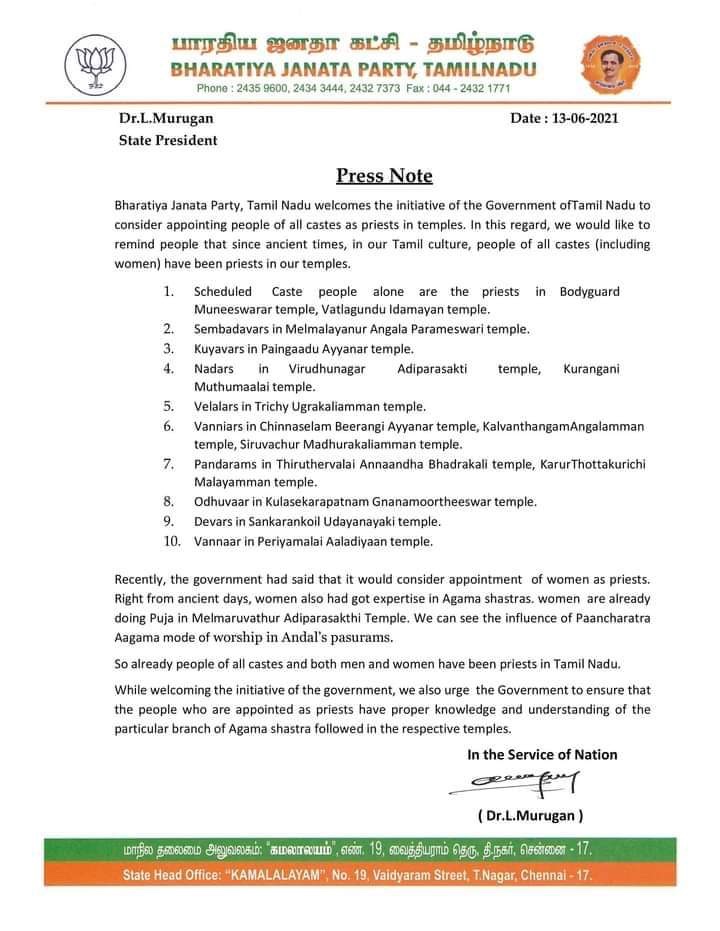
It is in the overall context of Supreme Court pronouncements and utterances above that today in June 2021, with the advent of the brand new DMK Government that has been elected back to power again after a hiatus of 10 years, that the question now of appointing women as archakas even in Agama-compliant temples in Tamil Nadu now raises its head again. The Minister for Hindu Temples and Religious and Charitable Institutions announced last week that around 200 archakas of all castes (not otherwise designated as denominations) having been trained in Agama saastra in government-sponsored institutions will be ready to be appointed as priests in temples. At the same time, he has announced a few days ago that Women in Tamil Nadu — who can as a class be designated neither as caste or a denomination — can also be trained to become temple Archakas if they so aspired to be so occupied in exercise of their right to equality under the Indian Constitution.
In the wake of all that has happened and is happening now, the writing on the wall is becoming clearer by the day for Hindus: the Legislature and the Judiciary are moving in a seemingly planned pincer movement against the ancient Temple Agamas of our land. In Agama temples, so-called denominations (not Brahmin castes) can reserve for themselves the exclusivity of archaka appointments but will have to allow women-priests to function too alongside them. And in non-Agama temples, any Hindu man or woman can serve as archaka. With such a far-reaching reform in temples being ushered in, it is believed that, at least in Tamil Nadu, social equality at last will be realized in the old caste and male dominated bastion of brahmins — the temple of God.
The temples in Tamil Nadu are now openly regarded even by the Judiciary as being “trapped” in Agama “saastras” fundamentally inimical to the provisions of the Indian Constitution. The Judges of the Supreme Court have categorically stated that the Constitution of India is the country’s only “holy book” and is holier than the Hindu Agama derived from the Vedas. Their Lordships have further said to the People of India.. rather to the Hindus of India… that it is the writ of the Supreme Court which will prevail over all other laws, even those of the Hindu temple called Agama. And the same Judiciary has further warned the Executive of the day not to forget its “non-negotiable obligation” “… to enforce the judgments of this Court. The duty to do so arises because it is necessary to preserve the rule of law. If those whose duty it is to comply were to have a discretion on whether or not to abide by a decision of the court, the rule of law would be set at naught.”
So, dear Hindus, please tell me now, isn’t the writing on the wall clear for the Agamas?
The Constitution of India, by which the Legislature of the Land swears it is acting, is against them; the Judiciary and the Executive are against them. With all three great and formidable pillars of the State arrayed against the the ancient codes of the Hindu Temple, are we not beginning to see happening the slow consigning of all but the empty shell of the Agama Saastras to the dustbin of History?
When I posted the above Thought on my Facebook Page wall yesterday and shared it with many friends of mine, I was reminded immediately by way of a cautionary call to be careful about my politically incorrect utterances which I received from a dear old friend and ex-professional colleague of mine who long ago emigrated to Canada.
He sent me a sweet message which I thought was as misinformed as it was well-intentioned:
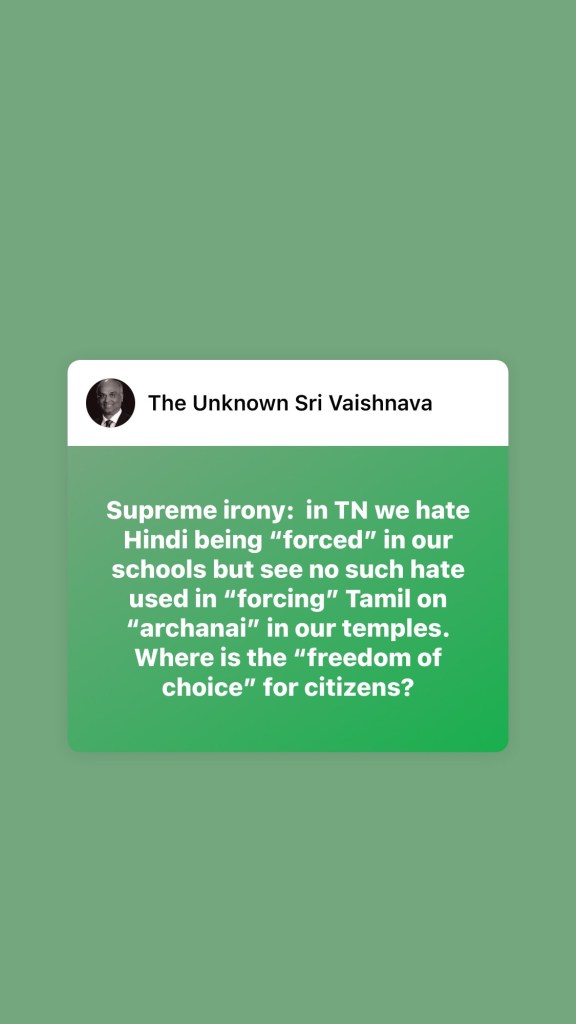
“ Isnt Tamil front and centre of the state whose name begins with Tamil in its name ?? Isnt reaching more people and getting more of them to go to temples a good thing in the long run ?? Isnt Considering “Hindi” and “Tamil” as one and the same in Tamil Nadu, the “Ultimate irony” ? I am a dumb guy. I just like to ask dumb Questions.
Since he and I have a friendship going back 30 years, we often like to argue and engage in banter with each other vigorously at times … So, I responded to him rather candidly as below:
“Tell me then is Tamil archanai going to suddenly begin drawing more record crowds of devotees to temples than those that we see already going there now?! Is there any Hindu peoples survey-finding to show that there are millions of Tamil people who don’t go to temples for worship because Archanai is not in performed in Tamizh language?
What rubbish !
“Your question is course the politically correct one and it is the anodyne stand to take in present-day TamilNadu given its prevailing political and social atmosphere .. But my politically incorrect thoughts on the matter are these which in my free country I have a right to hold and give voice to:
1. Let me remind you that it is in this very same land of Tamil Nadu that for thousands of centuries temples had “archanai” and ritual were always performed in the Devabhaasha which both Tamil and Sanskrit were regarded to be during all those ages … It was tradition embraced by people since time immemorial ..
2. Tamizh language did not suffer in any way through those ages here in Tamil Naad because Kovil archanai was performed in Sanskrit . At least common people here did not think so. In fact , they knew that Tamizh flourished through the millennia in this land .. You only have to you look at the examples of Naayanmars and Azhwars … Not to mention the sangham Tamil literature centuries before them! And please tell me, how was Tiruvalluvar’s Tirukkural in any way affected during his own times by archanai in kovil being conducted in Sanskrit? Has he ever said or uttered a word against the use of Sanskrit in temples? And don’t we all know well that the “book launch event” of the greatest Tamizh epic of Kamba Ramayana was in fact held within the precincts of the Sri Rangam temple where there was no Chola Raja imposition against Sanskrit ?! And may I remind you again that even in modern times none can ever establish that Sanskrit archanai in Kovil had in any way stood as any kind of obstacle to the development of modern Tamil language . After all, wasn’t Ponniyin Selvan, a modern Tamil classic, written at a time when there was no mischievous, manufactured conflict or binary choice in the State between Tamizh and Sanskrit ?
3. So in my opinion, it is all arrant bunkum to say that imposition of Tamizh archanai in Kovils should be mandated by law and only then the great Tamil language will flourish . Tamil and Sanskrit have lived happily together and enriched each other for 1000s of years … so please spare us all the specious malicious anti-Sanskrit propaganda.
4. Let me also tell you that in the last 85 years, in Tamil Nadu , nothing substantially has really been achieved by way of developing the rich literary traditions of Tamil amongst the common people on the streets. We have today amongst us young generations of Tamil society who have scant if not pathetic knowledge of Tamil . Most of us here in Tamil Nadu now speak only the pidgin or cockney version of Madras or Kollywood cinema or “gaana music” Tamil. Stop any Tamil on the street today and ask him anything you might know about classical Tamil literature … and you’ll get only dumb stares back at you. Once on a TV show I watched an anchor went around on the streets of cities in Tamil Nadu picking young persons at random and asking them to name the 12 months of the Tamizh calendar year … guess what? … Nine out of ten such people could not do it … they knew only the names of the months in a year only in English !
5. It is pure malicious propaganda, post-truth and puerile bunkum to say that by introducing Tamil archanai in kovils great social change and equality will be ushered into this land. It is nothing but part of the vote-bank propaganda that politicians in the State time after time in election after election have perfected and employed as a most effective tool to divide the people of TamilNadu along the lines of hateful ideology stitched together with false narratives surrounding race and ethnicity .
There are 290 million users of the Facebook social-media platform like me in India ….and you’ll be surprised to know that in America, to which the above chart applies, there 100 million fewer users.
If in America , Facebook is now earning $16/- per user through advertiser-revenue, then that translates into earnings of roughly $ 3 billion annually. And by the same yardstick , one might estimate Facebook’s revenues from India to be roughly $5 billion!
So, why is Facebook then not willing to abide by the IT Laws of the Government of India?
If Facebook continues to hum and haw about compliance with the IT Law, why isn’t the Government of India not reading out the Riot Act to the Company?
You watch the Video above and I’m almost sure you’ll say to yourself: “Gosh! And so finally it all boils down to this ancient grain of wisdom again … ?!”
It’s never going to be snazzy modern Technology that is going to be revealing the Truth to you … it has always always been and will always be good old Philosophy and Ethics that you have to fall back upon to protect yourself from what is false and everything fake in worldly existence.
Bhagavath Gita Ch.2. 16:
Na AsataH Vidyate BhaavaH Na AbhaavaH Vidyate SataH | UbhayoH Api DruShtaH AntaH Tu AnayoH Tatva-darshibhiH ||
‘‘The unreal has no being and the real has no non-being; and the truth about both has also been seen by men who know the reality.’’
The past few days have had moments when I found myself — as an Unknown Sri Vaishnava — intensely absorbed in avidly following and pouring over current, trending news doing the rounds in both press and social media in the State of Tamil Nadu and it is all regarding public interest litigation over upkeep and maintenance of Hindu Temples as Heritage Sites.
Firstly, I was thrilled to read the much awaited Order of the Madras High Court that finally after 18+ months of hearings that came out on 7 June 2021…
MADRAS HIGH COURT ORDER 7 JUNE 2021 on the working of the Hindu Religious & Charitable Endowments Commission of the Tamil Nadu State Government
Then I also watched the following Video-clips related to the same subject and that one can find uploaded onto YouTube by two very well-known public activists who have been prime-movers in more cases than one of class-interest PILs (Public Interest Litigations) lodged against the State’s HR&CE Dept. complaining and seeking redressal of gross mismanagement, corruption and malfeasance in administering Hindu temples in the State, of undue interference into purely religious affairs of such Temples and of negligence and utter dereliction of duty in setting right such lapses.
Then to get further ahead and gain a grasp of the genesis and antecedents of all the above complaints which eventually became PILs in the Courts, and a basic understanding as well of how and why the matters became sub-judice, I watched an excellent presentation on the subject by the young and notable Supreme Court of India constitutional lawyer, Sri Sai Deepak ….
Since I am a Sri Vaishnavite from Tamil Nadu, like all other Sri Vaishnava laity, I too am a devotee of the great and ancient Temple of Sri Ranganatha Swami at Sri Rangam, Tiruchi. For many years now, I was off and on following the “activist” activities of a native of that temple-town, Sri Rangarajan Narasimhan, whose background and antecedents I thought were very interesting since it seemed to be not dissimilar to my own in some minor respects. He is well educated from a good university in a modern discipline, worked abroad (in the USA?) for corporates for some years and then returned home to his native Sri Rangam and became deeply involved with the temple affairs. Over the years what he witnessed as goings-on inside and outside of the temple turned him into a committed and indomitable activist fighting for the cause of sweeping reforms and improvements in the administration of the temple. Very soon, Sri Rangarajan’s activism began to clash with various vested interest-groups not only in Sri Rangam but also elsewhere in the State wherever competing religious, business, political and sectarian group-interests got affected in direct and indirect ways. He had to then face several formidable adversaries on several fronts, legal, inter-communal and political fronts. The cause, his activism and his adversaries thus became the casus belli for his taking his battle to the highest court of the State via PILs. After a long-drawn battle over several years, at last, his voice got to be heard by the higher echelons of the judiciary . The result finally was out on 7 June 2021 in the form of a 224-page Order of the Hon’ble High Court of Madras… an Order which I find it very difficult to exactly describe as anything other than a comprehensive White Paper on the Pathos of Hindu Temple Heritage Administration in Tamil Nadu – 20th and early 21st century CE.
Anyone who reads through the 224 pages of the Court’s Order is bound to be appalled by the “rotten state of Denmark” (to use a famous Shakespearean metaphor) that has been caused to descend upon and afflict Hindu temples in Tamil Nadu over the last half of the 20th century and the first two decades of the 21st. It is a pathetic saga of governmental inaction, bureaucratic inefficiency and negligence, of political power-games, petty and rampant venality and last but not the least, the sheer apathy of the average Hindu temple-goer who throughout the said period remained mute and watched with nothing but indifference the grim pathos of the condition of his Deities and their Temples all across the length and breath of the State — a total of about 38,000 of which more than 400 are magnificent and could easily have qualified to be regarded as UNESCO World Heritage Centers if only their antiquity, originality and sanctity had all been preserved, venerated and cherished in the manner in which they deserved to be but sadly were not….
I am a very small and nondescript member of the Sri Vaishnava community in Chennai (as I said, I’m only an Unknown Sri Vaishnava...). All the great issues of Constitutional law, politics, administration etc. actually interest and concern me only in so far as I see them impacting in some way the larger matter of preserving and protection of the eternal cultural heritage and values of greater India. On such weighty and pan-India matters, therefore, I shall not venture to give any opinion or share any thoughts of mine especially when I know I lack the requisite competence to do so.
But there is however one matter of great importance on which I feel even an undistinguished Unknown Sri Vaishnava like me does possess sufficient locus-standi within the community to go public with my feelings, thoughts and views. That matter is what I am indeed very happy to see, in the two YouTube videos below , Sri Rangarajan taking pains to highlight. It is the matter of the Apathy of the Hindu Temple-goer.
IN his videos below, Sri Rangarajan speaks in Tamizh, and therefore for the benefit of those who don’t understand the spoken language very well, I paraphrase briefly below the three main themes he covers in his presentations:
(1) the State Police Dept. failing in duty to even register common public complaints (FIR or CSR) made against temple administrations for any alleged irregularities, delinquencies and offences, whether cognizable or non-cognizable by law.
(2) Laxity and inefficiency in the HR&CE officialdom to address and redress such complaints and failure to coordinate with the Police Dept. i..e to investigate such complaints and redress them appropriately within the time laid down under law.
(3) Unwillingness, timidity and/or sheer apathy on the part of Hindu laity and temple-goers to come forward and volunteer, not necessarily pro-bono, to serve as Trustees of the Board which the HR&CE Dept. is bound to duly constitute under the law and which in turn must oversee, govern and supervise the respective Hindu temples in their respective localities, villages, towns and neighborhoods.
Of the above 3 issues highlighted by Sri Rangarajan, there is little left for anyone like me to add by way of comment to the first two.
But on the third issue he has underscored viz. the apathy and lack of any robust volunteerism spirit amongst temple-goer communities across Tamil Nadu, much indeed can be said even by me since I am as much witness to their Apathy as I am guilty of it as every other Sri Vaishnavite I know personally.
One of the reasons that has been adduced for how and why Hindu temple administration came to be so pathetic as it is today is the institutional failure of the temple Board of Trustees to do its job.
Why?
Because in many temples no Board of Trustees exists.
Why?
Because the HR&CE is unable to appoint proper persons to the Board of Trustees.
Why?
Under law, members of the Hindu community and/or laity of the temple are required to apply voluntarily to HR&CE Dept. expressing their ability, willingness and readiness to offer their services to act as temple Board Trustees. It is then up to the HR&CE to scrutinize such applications from such persons and upon due diligence assessment of the fitness of such applicants for Trusteeship, proceed to appoint them in the position under relevant terms and conditions of appointment service-rules. Unfortunately however, no such voluntary applications in sufficient numbers are ever received from members of the laity or community at large. Hence no Trusteeship appointments are ever possible to be made by the HR&CE.
Under the circumstances, and as per the Act, the HR&CE Commission in most cases has no other alternative but to go ahead and unilaterally appoint what are designated as “Fit Persons”in lieu of a Board of Trustees to assume responsibility for and to perform all the functions related to temple administration which otherwise is the responsibility of a duly constituted Trusteeship.
But then, as matters turn out to be in most cases, such “Fit Persons” who normally are supposed to act in office only as and under “temporary, stop-gap or interim administrative arrangement“, continue merrily to occupy the position in perpetuity. They invariably then turn out to be wholly “unfit persons” to occupy such position since they have neither competence nor the trustworthiness required for the job.
The High Court Order observes that it is in fact such unfit “Fit Persons” who, having been given unfettered powers of Trusteeship by default — and with the HR&CE Department either turning a blind eye to their working or being in connivance with them — it is they who have been found in many instances to have committed all manner of both sins of commission and omission while in office in the the temple.
Here is where finally, thus, lies the root cause, the “Gangotri”, of the entire problem: the Apathy of the Hindu temple-goer.
The questions that I as an Unknown Sri Vaishnava ask myself now are these:
Why are members of the Hindu community — or more specifically, members of the respective intra-community denomination in whose geographic location the temple happens to be situated — so hesitant, reluctant or outright unwilling to volunteer for Trusteeship in temples of the State?
Has anyone within our own Hindu community and sectarian groupings ever taken serious efforts to conduct an objective, grass-roots, statistically verifiable field-survey into this question?
If not, is it not worth undertaking such an effort for and on behalf of the entire Hindu community?
Will not any State University Department of Sociological studies find it a fit subject-matter of academic importance to sponsor such a survey project?
Or else, if a University cannot undertake such an academic effort, would it not be possible for any of the Saiva, Vaishnava and Saaktha Mutts and or other religious foundations of the Hindus of Tamil Nadu come forward to jointly sponsor such a survey?
I ask myself the above questions only because without hard data available with us, how can we in the Hindu community today merely speculate on the real reasons for our abject Apathy as temple-goers in volunteering for trusteeship of temples? Are we to simply believe the glib and convenient reasons often adduced and given by ourselves in the living-room discussions in our homes for our own private consumption and satisfaction?
Let me now however, even in the absence of hard, verifiable data and information, try to speculate on the matter as I see it by drawing lessons from the conversations I have had with many people within the Hindu circle of my own family, relatives, friends and fellow-members of the laity at large.
The reasons often cited by ordinary members of the laity as a reason for their apathy are principally the following:
1.Temples administration is a very complex subject. A trustee must possess knowledge and training in aspects of managing religious places of worship and that can range from knowing Agama scripture, practices and ‘saastra‘, some aspects of iconography, architecture, epigraphy, temple history, then in-depth acquaintance with rituals, customs and traditions, together with reasonable familiarity with secular laws of the State relating to temple-governance, financial control and HR best practices. Now, this is a rather tall order. It is simply not possible to find easily members inside our Hindu community possessing such a broad-range of knowledge and skill-sets who will also be willing to volunteer to place it at the disposal of temple-administration as trustees. If ever anywhere such persons are to be found at all, it would be very rare indeed to expect them to serve pro bono either full-time or part time in trusteeship positions.
2. Time for individuals goes at a very high premium these days. People have jobs, careers, professional priorities to deal with besides having to bear the burden of family commitments, parenting children, caring for old parents and a hundred other nameless little tasks and errands of life to attend to which leaves them little time to offer for voluntary services in temples. Such members of the community — especially the younger generations of highly-educated, professionally-occupied upwardly-mobile Hindus –are ready and willing to support temples through periodically voluntary pecuniary donations but that is about all that they can afford. The inability to give off their precious time is perhaps the most compelling reason most Hindu temple-goers might cite as the cause for their general Apathetic attitude toward volunteerism for a social cause such as temple-administration.
3. Temple Administration is fraught with politician and governmental interference. Ordinary members of the community and laity are, by and large, very simple-minded, honest-to-God and gentle-mannered people. In their perception (or misperception?) trusteeship of a temple is fraught with risks of having to engage and deal with authority, officialdom and the interference of the State. And that in itself is seen as a daunting if not intimidating prospect. “Sir, we do not want to be having to deal with the might and officiousness of State-appointed or otherwise self-appointed commissars during the course of we going about quietly doing our business as trustees of the temple“, is a very familiar refrain that I have heard these simple folks of the Hindu community voice.
4. Intra-community and inter-sectarian tensions. In Tamil Nadu, the Hindu community over several decades has been vivisected if not polarized by the politics and polemics of identity arising from propagation of specious, downright scurrilous ideologies of the basest forms of sub-nationalism and plain hate that can be imagined. Let me be very clear here about what I mean: I mean the divisive nature of the differential equations and complex calculus of internecine societal relationships that have been built up based on language, crass regionalism and narrow provincialism, conceived, promoted and normalized by the political classes for many decades now. “Sir, if I offer myself as Trustee in a temple that does not belong to my “sampradaayam”, will I be allowed to function freely and fearlessly or will my motives and actions always be suspect? If there is no trust in me, how can I function as trustee?” is a question that many good-hearted Sri Vaishnavas have asked me. Similarly, and more pointedly and candidly, I have been asked this too: “Sir, doesn’t my caste-identity either serve as credential or the lack of it, for trusteeship positions in temples? Why would I, in such a toxic environment, wish to involve myself with temple administration?”
Everyone of the 4 reasons I have speculated upon above as probable causes for the Apathy of the Hindu temple-goer in Tamil Nadu seems valid and undeniable.
So, the question therefore I ask myself is: What do we do? Do we all as Hindu Community of Tamil Nadu just throw in the towel and let the status quo remain to continue as usual with only some marginal and cosmetic changes made here and there to it in the name of temple reformation? Will Apathy continue to rule us?
It is here exactly at this point in my submissions that I must confess that I have to let my own personal dreams begin to start taking over the discourse while, temporarily, I must let my sense of reality go on snooze-mode a bit.
In some rather poor imitation of Martin Luther King Jr. , the American Black American civil rights leader, who once made a famous speech which even today the world remembers as the “I have a dream” speech, let me also try and give voice to my own dreams in this situation with regard to this matter of Hindu Volunteerism Vs Hindu Apathy:
I have a dream that our present-day Heads of ALL Hindu religious institutions (Saiva, Vaishnava, Saktha, Vedantic, New Age etc.) will join forces to conceive a unique and historic educational institution — unaffiliated with any governmental or non-governmental authority or entity — solely for the purpose of building a generation of men and women into an all-India cadre called “Hindu Temple Administrative Services”... known by the acronym “HTAS”.
You may ask what is this HTAS? My answer is this:
Think of it as if were a non-governmental service-cadre of trained Hindu temple administrators who possess all the necessary all-purpose, generalist “religio-secular-scientific” knowledge and training that would be required to preserve, protect, maintain, administer, strengthen, galvanize and catalyze Hindu temples across the length and breadth of India, of any size, any location, belonging to any sect or denomination or any particular theological “darsana“.
2. In other words, think of the HTAS as a sort of IAS, IRS or IPS….! What does, after all, the IAS officer or the Indian Railway Officer really do? At the very core of his services is the mission to protect and operate the country’s assets to sub-serve national purpose. Now, if the vast number of temples in India, with all their vast belongings of assets aggregated were to be valued at current market prices, would they not in sheer financial terms almost equal if not exceed that of, say, the Indian Railways today?
3. So, if the government of this country can and has indeed for decades instituted an all-India IRS cadre to run and maintain a national asset such as the Railways, why can it not be possible for the vast numbers of Hindus in India join hands to conceive, blueprint and create a similar educational establishment that will produce capable men and women of the HTAS that will in professional and upright manner run and maintain an asset-base of the nation that perhaps is no less if not more valuable than the Railways … viz. the Hindu Temple with all its vast financial, rich cultural and non-cultural assets?
4. In my dream, I see that the Hindus of India, and more specifically of Tamil Nadu, failed miserably to administer their temples properly simply because they failed to appreciate that with the advance of time the importance of what in the language of business is called “scaling up” can never be overemphasized. Let me explain this below.
5. All the great temples of our land were built in the last millennia or in the first half the the second millennia. The size and geographical density of Hindu populations today is vastly different from what they were 1000 years ago. And the very nature, character and scale of the social purposes that temples once served in the times of Maharajas, Sultans and Viceroys of India’s history have undergone seismic and paradigmatic change because of the sheer and massive increase in the temple-going, temple-revering Hindu population… In simpler words, our population has grown by a factor of 10X whereas the cultural and non-cultural infrastructure of the Hindu temple to cope with such exponential growth has not kept pace with such such social change… Or, to put it differently, generations of Hindus in India did little to anticipate the challenges that “scaling up” would throw up as time advances and therefore were caught napping and thus today, are woefully incapable of protecting, preserving and keeping their temples intact as vibrant institutions of both social conservatism and social change which they once undeniably used to be across several centuries.
6. In Tamil Nadu itself there are about 38,000 temples today each with its own asset-holdings and local HR& CE administrative set-up. However, not all of these temples command the same what one might call “star rating” in terms of popularity, numbers of pilgrims, architectural grandeur, epigraphical value, size and sustainability of income-streams etc. Not more than a score amongst these temples in Tamil Nadu would be rated truly as “5 Star“. About 60% of the others would fall probably in the category of only “3 or 2 Star” temples in terms of pilgrim patronage and income. And the remaining c.30%-35% of the temples would fall in the sorry, “starless” category of “languishing” temples that are either on their way to decay and ruin if not already left to dilapidate on their own.
7. So, one can easily imagine how greatly different is indeed the nature and gravity of problems, challenges and hardships that each “Star-category” of temples might be faced with. It is not as if the problems and challenges faced by the Sri Ranganatha Swamy Temple at SriRangam are the same as those faced by the Sri Ranganatha Swamy Temple, at Tirumayyam. Each temple administration therefore has indeed to deal with the peculiarity of wide-ranging “scaling up” issues in a different manner depending on its very own set of circumstances. Each temple therefore demands Administration that is deeply sensitive to its condition, both historical and that which presently obtains.
8. What demands that Temple Administration makes on Hindu society today is indeed vastly different from that which was made of our societies in the times of, say, the Gupta, Chola, Pandya, Chalukya, Hoysala or Vijayanagara kings. The pathos of the Hindu temple today therefore is that the Hindu temple-goer failed miserably in “scaling up” appropriately, adequately and smartly and keeping pace with the march of time and History.
9. It is this context of “scaling up” that, in my vivid dreams, I see the Acharyas of ALL Hindu religious institutions — the “mattaadhipathis”, the gurus and acharyas, the new-age Hindu spiritualists and their Foundations — all getting together on their own collective behalf and using a mere fraction of their combined all-India resources, wealth and income, and with the least possible dependence on governments, setting up an outstanding institute of excellence that will produce for generations to come numberless HTAS cadres of men and women (with no considerations given whatsoever to caste , sectarianism or regionalism) who would serve the nation’s temples anywhere and everywhere as top-class Temple Administrators.
In my dream again, I look at the matter from this one other angle too:
10. We have today specialized Institutes that train young men and women as Catering Technologists, Fashion Designers and Cinematographers! Why not a pan-India religious institute be created, blessed and accredited by a body of ALL-India Hindu Religious Heads? Won’t such an institute … if properly and wisely conceived and instituted … be able to train and produce hundreds of young, competent and able Administrators of Temples and Temple Trusteeships? And also, who in good time will be able to effectively relieve and replace State Governments (including Tamil Nadu) from shouldering responsibility for the upkeep of temple assets and cultural heritage in India?
As a mere Unknown Sri Vaishnavan I must say I have temerity to dream … and dream as big perhaps as Martin Luther King Jr. himself! The dreams that Martin Luther King had for his people in his country however, to this very day, very sadly remain unrealized and unfulfilled to a great extent…
I have to admit that right now I do wonder if my dreams for my sacred temples in Tamil Nadu, India, might suffer the same fate…
The Court’s Order is 224 pages long . It is almost a comprehensive White Paper on the present condition of the 42,000 Hindu temples in the state . As far as Hindu temples in Tamil Nadu are concerned everything (to use a Shakespearean expression from Hamlet) “is rotten in the state of Denmark!”…
I read the entire Order today… Much of it I quickly flipped and sped through … but the parts and passages in it that really caught my eye … and which I think are absolute zingers … I have reproduced below : Every Hindu who is a temple goer and who believes in the institution of the temple should read this High Court Order ! It is an education!
Sudarshan Madabushi
The HR&CE Department is the custodian of most of the temples and the properties including the idols belonging to them. It is their primary duty to protect, maintain and safeguard the temples and its valuable idols/antiques, which, this Court with great anguish, expresses that the department has failed to do. The protection of the temples would, without saying, go on to imply protection of the temple lands as well as all the activities associated with the temple and its tradition. It is startling to find that the HR&CE department with all its income from major temples has not been able to maintain historical temples and safeguard the Idols, which in market, have antique value based on their age. Some temples in the state have also been recognised by the UNESCO as heritage sites. Many temples constructed at least 2000 years ago or much before, recognised by UNESCO, are in ruins. Neither the Archaeology Department nor the HR&CE Department has shown interest to identify and protect them. This has also come to the advantage of the miscreants, who have laid their hands on the Idols. Some of the officials are only interested in reaping the benefits of their position in the department, without adhering to the task entrusted to them with devotion.
The Tamil Nadu Hindu Religious and Charitable Endowments Act, XXII of 1959 came into force with effect from 28th April, 1960. It has been 61 years and yet, the HR&CE department has not even taken inventory of the idols, properties, jewels and other Articles gifted to and owned by the temples. Further, the department has not computerised the details of idols, jewels and properties of the temples and provided adequate ICON Centres with surveillance to keep safe custody of the valuable idols in the centre and in the temples. This has led to the advantage of the culprits, who have aided in smuggling the Idols out of the country. As the theft of Panchaloka idols worth crores kept on increasing, the Idol Wing, CID, vide G.O.Ms.No.2098, Home (Police IV) Department, dated 07.10.1983, a first of its kind, was created to investigate and recover the Idols, but, the steps taken by the department to arrest the theft, are unsatisfactory. Now, the wing is also effectively ineffective.
A duty is cast on the Commissioner under Section 23, to ensure that such temples and endowments are properly administered and that their income is duly appropriated for the purposes for which they were founded or exist and therefore, whenever any order is passed, the object of the endowment is not to be forgotten. Section 29 of the Act lays down the preparation of register for all institutions by the Commissioner. That apart, the Joint Commissioners are clothed with the power to retrieve the temple lands from the encroachers by exercising the powers under Sections 78, 79 and 80. But, the officials have not properly exercised the power conferred on them and they are in dereliction of duties and responsibilities assigned to them. At least from now, the HR&CE Department should act diligently to retrieve all the properties under the encroachments.
“….. role of the state department is to protect the monuments by carrying out appropriate repair works without damaging the original structures. It is also the duty of the state to ensure that all illegal encroachments and constructions are removed.
Similarly, it is the duty of the officers of the central Government to ensure that appropriate action is taken to protect the monument or sites. Section 30C of the Ancient Monuments and the Archaeological Sites and Remains Act is an exhaustive provision and when read together with Sections 30A and 30B, it not only empowers action against any officer of the central department, who has failed in his duty, but also indirectly enables the officer of the central department to take action against any person, be it even an officer under the state who has acted in detrimental to the interest of the monument or site in collusion with the perpetrator and any officer of the central Government. However, the report filed by the UNESCO team referred to above would clearly indicate that both the central and state departments have failed in its efforts to safeguard the sites and remove the encroachments and illegal constructions in and around many temples and sites of archaeological importance including Mamallapuram and hence, they are liable to be prosecuted under Section 30C.
31.18 Though the Rules relating to custody of jewels and valuables are in vogue, proper inventory is not maintained. There is no central registry, wherein the details of all the valuables, jewels and documents are maintained, so as to make cross verification and put culpability on individuals handling them.
32.5 Based on documentary resources and physical inspection of the temples, the mission has provided a detailed assessment report for each of the 10 listed temples. The major issues observed in conservation of temples as stated by UNESCO in its report, are extracted hereunder:
“1.HR & CE neither has the capacity nor the qualified experts to carry out conservation works at such large scale and number. 2.There is no appropriate system or process being followed as per conservation norms for documenting, assessing, reporting, tendering etc. of heritage works. There is no empanelment of experts at various levels or qualified heritage work contractors for such specialised works. 3.The quality of most of the current regional and local sthapathy’s is questionable as most of them were found incompetent on site. And this point was also accepted by the Chief Sthapathy of HR & CE. 4.Some of the HR & CE staff members (few JCs and juniors) seem sensitive to heritage and show potential for being trained as Heritage Managers for future. However, majority of them lack essential qualification and expertise and seem totally misfit for such a responsibility. It needs to be recognised that the HR & CE officials are primarily in place to manage the day to day affairs of the temple and do not hold any qualification to oversee technical works like conservation. This is part of the TN HR & CE Act as per the Commissioner, HR&CE. However, at times they go beyond their mandate to take decisions regarding works in the temples, in some cases even overruling their own expert committee members’ opinion. 5.The quality of conservation works at the temples assessed during the mission varied to a large extent with some good examples, some mediocre works and some truly shocking scenes of demolition and massacre of historic temples. Details of each temple assessment and visuals are included in Section 3 of this report. 6.Despite involvement of experts such as ASI, Ex-ASI archaeologists, Chief Sthapathy, Structural experts; it was found that HR & CE is not following the reports of their own experts at ground level. A detail of expert reports for each temple and deviations made are recorded in the individual assessment for each temple under Chapter 3 in this report. 7.Inputs from Agama Shastras are not to be seen in any of the conservation projects. Consultation with Agama Experts and justification from religious perspective for the intervention, be it demolition, conservation, new construction is missing in all temples inspected. In fact, from HR & CE perspective there seems to be a disjunction between Agama Shastras and Shilpa Shastras failing to realise that Shilpa is just and extended arm of the Agama Shastra. Hence, all that is observed is a very limited attempt to adhere to the Shilpa Shastras.
8.Maintenance of record of existing, proposed drawings, historic research and historic layering of temples is completely missing in most cases. It is the most essential part and forms the base for any future conservation works. 9.A Comprehensive Conservation Plan and / or a Detailed Project Report for the temples are missing, which is essential in any conservation works. Many decisions for interventions seem to be taken at the site by few individuals without any holistic process to assess the urgency, necessity, severity and justification for the intervention.”
32.6 Quoting Agama Shastras, reference to Shilpa Shastras, Alignment with Conservation Guidelines as per ASI Policy / ICOMOS Charter (Venice/Athens/Burra/Nara Document of Authenticity etc.), adherence to National and State Acts, Scientific Procedures such as Structural Analysis, Surveys and Detailed Reports for each action and a completion report after works and also the need for communicating the Conservation Approach, the mission made final recommendations, as per which, the temples being handled by the HR&CE Department are unimaginable and unless a very coherent operational structure along with an army of experts, skilled stapathis and craft persons are available on hand, the task of simultaneously conserving / managing repairing temples is not feasible. (xvii) There are certain documents relating to the estimates for works undertaken in the Srirangam temple between 2014-16 at Rs.5,66,90,801/-. But the total amount of funds spent by the temple during this period according to Board Resolution, is Rs.20,90,98,368/-. Apart from this, the temple has spent more than Rs.25 crores for conservation work of Rampart walls on the 5th, 6th and 7th prakaras and hence, the temple has spent in excess of Rs.50 crores during 2014-16. There are documents depicting the fact that the Board of trustees of the said temple, have resolved to spend temple funds for non essential works, which show the depth of corruption by the trustees appointed.
(xxii) It is asserted that the HR&CE Department have a total extent of 478462.46 acres of land. However, the land records were not produced to audit and the correctness of the figures and the custody of the land in possession of temples could not be ensured. Hence, it is necessary to furnish the information relating to the extent of land to which pattas are to be transferred to temples from private persons, the extent of land pattas to be restored in the name of temples in computerized chitta from private persons, the extent of lands to be cleared from encroachment and to be restored in the name of temples, etc.
36.6.1 Reiterating the averments made in the latest affidavit filed on 11.01.2021, Mr.M.Karthikeyan, learned Special Government Pleader (HR&CE) submitted that there are about 44,121 religious institutions under the control of the HR&CE Department, out of which, 1966 are Mutts, Charities and Endowments, 42155 are temples in which nearly 8450 temples are ancient one, which are built before 100 years; and it was found that nearly 21000 temples need to be renovated and Kumbabhishegam to be performed in the upcoming years.
36.6.2 Adding further, the learned Special Government Pleader (HR&CE) stated that from the database so far collected for 40695 temples, 32935 are stated to be in good condition, while 6414 temples are considered to be having damages that are needed to be repaired; 530 temples have been identified as partially dilapidated; and 716 temples have been identified as severely dilapidated; and steps have been initiated to restore/renovate all the 1246 dilapidated temples in a phased manner and a unique ID for all the dilapidated temples has been created in the Tiruppani module of Department website to give priority for the restoration process.
…, the statistical record reveals that out of 5.25 lakh acres of land, only 4.78 lakh acres are available as of now and the balance acres of land are in the hands of encroachers. It is significant to mention here that the HR & CE department is the custodian and administrator of the temples and its properties. But this department, to the knowledge of this Court, has not purchased even a small portion of land for the benefit of any temple. As administrator, the role of this department is much more responsible and the officials are culpable and liable to be punished in case of breach of their responsibility. The administrative right to deal with the temple properties is only to preserve and augment more revenue, implying that the temple lands ought not be alienated or given away. It is to be noted that the Government cannot claim right over the temple lands and the same cannot be a part of any Government scheme, otherwise, the very object of the creation of the HR & CE department would get defeated.
Another important contention that is often raised is non appointment of a “Trustee” and managing the temples with department staff appointed as “Fit Person”. As per the provisions of the HR & CE Act, the Commissioner is empowered to appoint a fit person to administer the temple in the absence of a Trustee and the same cannot be resorted to as a matter of routine exercise. The word “Fit” is synonymous to “Appropriate”. The intention of the legislature is to appoint a person not only with impeccable integrity, devotion, sincerity, honesty and belief, but also a person with some basic knowledge in agamas, tradition and administration. The appointment cannot be mechanical, but it has to be made with application of mind in a transparent manner. Similarly, only a theist can be permitted to occupy any post in the temple or in the department as the occupation of any post not only requires sincerity, but also an interest and belief to augment the object of the Act. It is needless to state that the trustees so appointed must also be worthy to such appointments. Mere political recommendation or a person capable of making huge donations cannot be a criteria for being appointed as a Trustee. A true donor would be a person, who makes such donations in pursuance of his philanthropic or spiritual ideology but not for a quid pro quo appointment as a Trustee. Therefore, the trustees must also satisfy the requirements as mentioned above.
The HR&CE Department shall file a report before this Court within a period of eight (8) weeks listing out the number of temples without Trustees, the duration of such vacancy, the particulars of the persons appointed as “Fit Person” and the steps taken by the Department to appoint trustees. (55) If no hereditary trustees stake claim, then steps must be taken to appoint non-hereditary trustees. The non-hereditary trustees must be from the religious denomination, to which the temple belongs to, without the political background.
BERLIN : German Chancellor Angela Merkel said on Saturday she was opposed to waiving patent protections for COVID-19 vaccines as this could jeopardise the quality of shots against the disease. 08-May-2021
Angela Merkel on Vaccine Waiver
The U.S., Germany and other countries will take up debate over the idea in the coming weeks via the World Trade Organization, pitting the idea of sharing proprietary know-how against the need to boost global supplies, especially in developing countries that have struggled to get their populations inoculated. Merkel’s position shows she’s sympathetic to the argument of drugmakers such as Mainz, Germany-based BioNTech, whose vaccine with Pfizer Inc. uses cutting-edge messenger RNA technology.
***********************
The above pictures tell me exactly and very graphically how the world and world leaders’ mind-sets and philosophy has changed since 1945 …
In the above Op-Ed that Minister Palanivel writes, he does make a powerful case indeed for reform of the GST (VAT) law of India. The graven of his argument is that the basis of sharing the central pool of tax-revenues collected by the Union (Federal) Govt. does no justice to States that contribute most to the pool whereas it provides for vastly disproportionate share to States that in fact contribute far less to thr central kitty.
So far Mr.Palanivel’s argument is flawless . The tune he sings is right.
But then the Minister says something that strikes a rather jarring note … he gets his rhythm suddenly go a tad awry. And that is when he writes this:
Quote:
“This is the scenario in which the “one state one vote” model (each state, regardless of its size or contribution to the GST pool has one vote in the GST Council) causes further grave injustice….. The “one state one vote” structure under GST is untenable and coming undone.
Unquote
I can’t help thinking thinking PTR is talking through his hat when he advocates the scrapping of the “one-state , one-vote principle” in the GST Council . He says he’s championing for the rights of states that contribute more to the central pool of taxes than other states in the country . That’s a feudal argument which smacks more of separatism than of federalism .
The Minister seems to have deficiently understood the federal concept that the “central pool of taxes” is an asset owned by the entire union of India . Every state of India has an equal stake in it. Every state therefore has a right of say in deciding how the asset must be used or disposed of. How much share of the pool each state must get is a different matter altogether but then the right to decide upon that mode of sharing or disposal in itself cannot be based other than on the fundamentally democratic principle of “one-state one-vote” …
If Mr Palanivel’s contentious view to scrap the “one-state one-vote” principle is to be accepted as good then nothing prevents it from being extended also to all forms of voting rights of legal ownership. Under Companies Act , to take only one example, every shareholder in a General Assembly has one vote irrespective of the size of his shareholding in the company . Are we going to now say it makes sense to change the law or principle there too by asserting that voting rights ought to be dependent on number of shares owned ?
Why don’t we go even further then and also demand extending the Minister’s view on the same principle to citizens electoral voting right also?! i.e. Those citizens who contribute more to the aggregate income-tax revenue-pool should be entitled to more votes than the only one at the ballot-box they presently have?
Small state or big state, Mr Palanivel, every State of the Union has to be treated as an equal citizen of India. Which is why the Goan State FM I feel was quite right in protesting your specious line of reasoning on the “one-state one-vote” matter at the last GST council meeting …
To my mind, while Mr Palanivel’s demand for a more rational system of revenue sharing of central collection of taxes with States inter alia is certainly justified, his shrill views about scrapping the “one-state one-vote” seems iniquitous, undemocratic … and above all unpatriotic.
Minister sir, you’d do well to please correct your “thappu thaaLam”.