While the editorial published in the May 2022 issue of “The Voice of Sri Vaishnavas” (“vainavan kural“) dealt with the question of present-day Sri Vaishnava identity in polite, gingerly, and rather very general and superficial terms, the c. 1960s pamphlet of M.A Doraiswamy Iyengar titled “Sri Ramanuja and Sri Vaishnavas” was far more nuanced, forthright even to the point of being blunt and extremely critical in both letter and spirit. The well-meaning intentions of both writers however cannot be doubted at all.
Doraiswamy Iyengar squarely blamed the Sri Vaishnavas themselves for their steady “Decline and Fall” over 200+ years of colonial and post-Independence history. He traced the causes to the following:
- Undesirable aspects of the Sri Vaishnava way of life.
2. Concoction of undesirable biography of Ramanujacharya.
3. Failing to effectively repel hostile calumny and criticisms by other schools of Hindu religion against Sri Vaishnavism.
4. Spurious worship of Ramanujacharya more as a populist cult-figure than as a giant of a Vedantic philosopher and spiritualist.
*********************************
Undesirable aspects of the Sri Vaishnava way of life
Doraiswamy Iyengar highlights 5 aspects of Sri Vaishnava way of life very clearly:
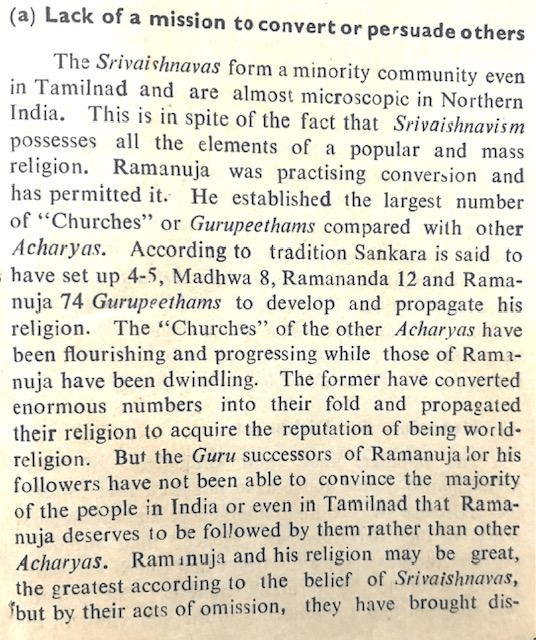
a. Lack of clear vision and mission: abject inability to persuade or inspire others
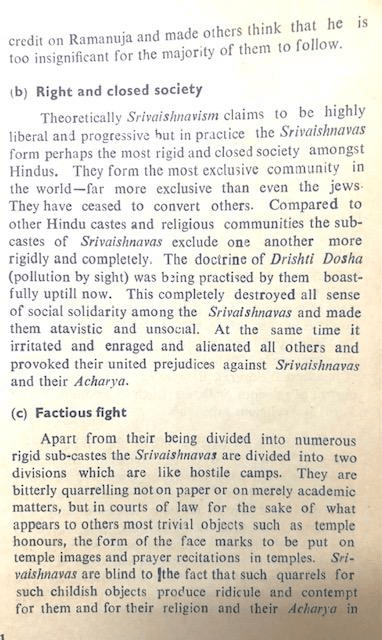
b. Insularity as a community — “closed society“
c. Factionalism within
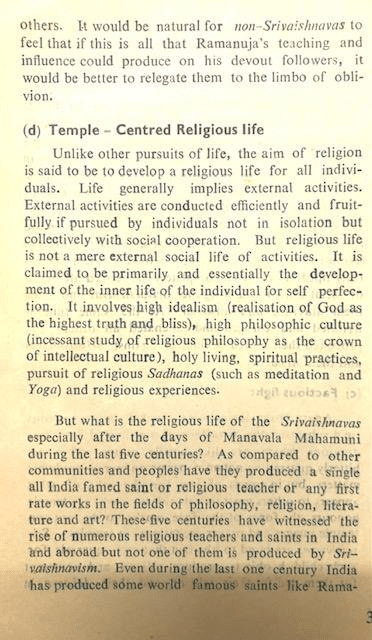
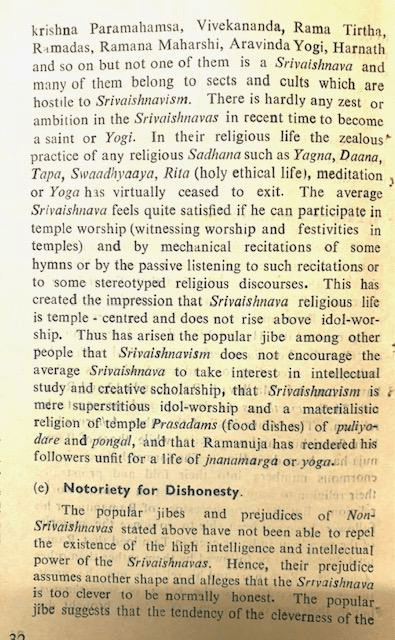
d. Temple-obsessed religious life and thinking; specious “anti-intellectualism” and “pseudo-emotionalism” in the name of Bhakthi
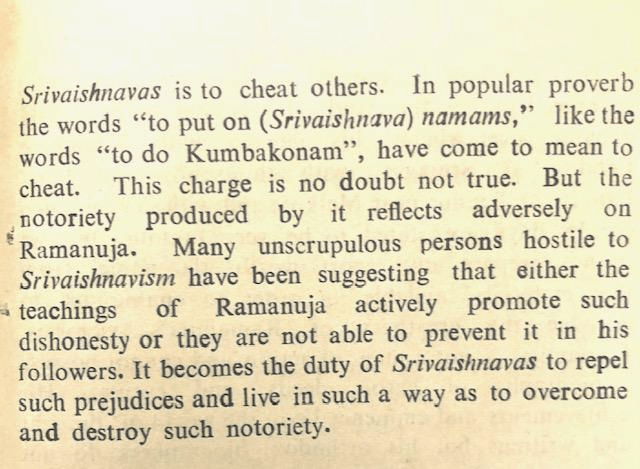
e. Notorious dishonesty.
Before going on to elaborate each of the above criticisms, Doraiswamy Iyengar however makes it clear in a preamble that they are more in the nature of deep, honest and genuine self-introspection rather than judgmental superciliousness.
QUOTE: “It is … (my purpose) … to indicate that while Sri Vaishnavas sincerely want to glorfy and reverence Ramanuja, and critical study suggests that certain aspects of their life and conducts and beliefs produce an ignominious treatment of Ramanuja. Some of the elements of this treatment are no doubt unintentional and unconcious.
The nature of this criticism must not be misunderstood. Its scope is strictly limited. It does not seek to deal with the Sri Vaishnava way of life or with its theoretical side, but sekks to deal with some aspects of its practical side and there too with those aspects of the way of life in which Sri Vaishnavas are living today as they appear to others.
According to … the Sri Vaishnava (“sampradaaya”)… Ramanuja was an incarnation of God himself…
It is evident that the reverence that must be shown to a personality of such a high and transcendental status must be equally superlative. Sri Vaishnavas believe that their conduct towards Ramanuja is fully commensurate with his high status because they have given practical effect to their faith in Ramanuja being an incarnation by installing his idol in all Sri Vaishnava temples and in all their household shrines ever since his own times and are offering worship to his image as verily unto God. ….
“Worship is undoubtedly the highest kind of honor and reverence that we can show to men or God. Sri Vaishavas feel that they have done their full duty to Ramanuja by establishing and practicing his worship like unto God through idols and images…..Many Sri Vaishnavas proudly point out that followers of other Acharyas like Sankara, Madhwa, Chaitanya …. (only) imitate the Sri Vaishnavas (by similarly worshipping their images)… and therefore this matter is… high compliment to the religious wisdom spiritual accomplishments of Sri Vaishnavas themselves….
“This type of supine self-complacency may satisfy medieval minds of taamasik beings or sect-imprisoned persons. But the modern Sri Vaishnava youth has to live in and face the challenges of scientific rationalism, democratic socialism and cosmopolitan eclecticism. He is forced to critically examine the validity of his homage to Ramanuja by deification and idol-worship. He also finds that mere sectarian glorification of Ramanuja is not sufficient and that it is his duty to strive for glorification of Ramanuja by non-Srivaishnavas. ….
“…. Modern rationalism may oppose the deification and idol-worship of Ramanuja as mere superstition ad may brand his eminence as fallacious if merely based on myth and miracle… If Reason does not justify the belief in Ramanuja’s greatness, it will wither away sooner or later. … This challenge imposes a sacred duty in fact on the faithful Sri Vaishnava followers of Ramanuja to reconctruct as far as possible the edifice of his glory on critical reason, and not merely on tradition, faith and superstition, or on myth, legend, and miracles.” UNQUOTE
**********************************************
Concoction of undesirable biography of Ramanujacharya.
By far the most vehement and severest criticism brought against Sri Vaishnavas found in the Doraiswamy Iyengar-pamphlet is the great body of the community’s literature that was written, in Sanskrit, Mani Pravalam and Tamil languages, perpetuated and propagated over half-a-century since the time of Ramanujacharya, Vedanta Desika and Manavaala Maamuni. This vast body of hagiographical literature that has come to be associated with the very identity of the Sri Vaishnava today is in many parts, according to Doraiswamy Iyengar, full of fanciful excesses, bizarre exaggerations, much myth and legendary fables galore.
This trenchant criticism of Sri Vaishnava hagiography will be examined next in Part-53.
(to be continued)
Sudarshan Madabushi