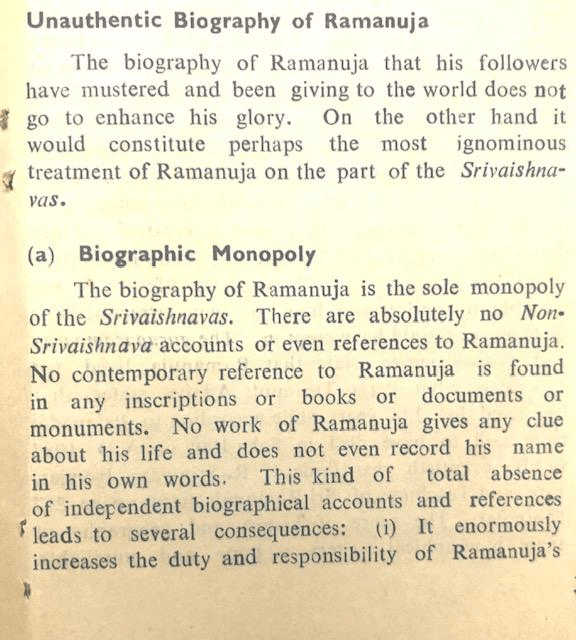
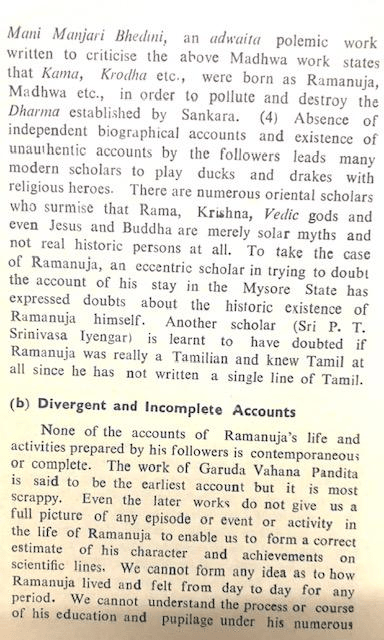
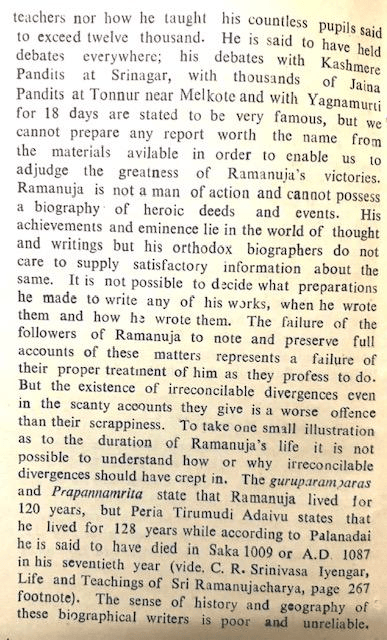
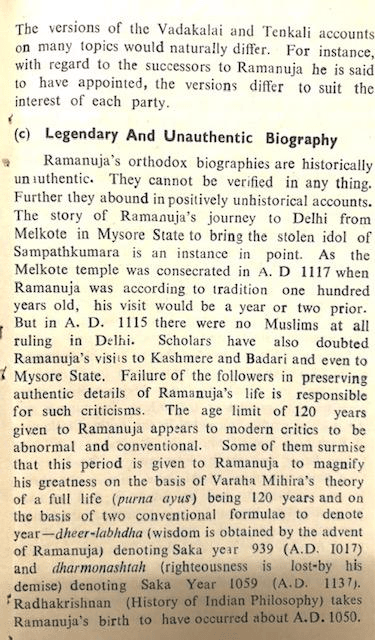
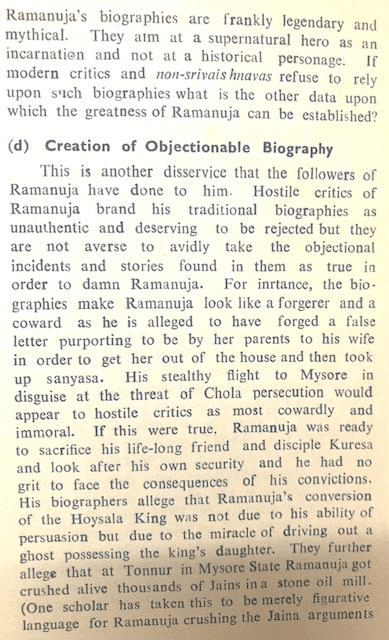
Concoction of undesirable biography of Ramanujacharya.
The harshest criticism against Sri Vaishnavas found in the Doraiswamy Iyengar-pamphlet has been reserved for vast body of the community’s canonical literature developed and written over half-a-century since the time of Ramanujacharya, Vedanta Desika and Manavaala Maamuni. The literature is available even today in Sanskrit, Mani Pravalam and Tamil languages but about which most Sri Vaishnavas in the present-day are largely ignorant about or apathetic towards.
All Sri Vaishnavas define themselves as ardently faithful followers of Sri Ramanujacharya. Without Ramanujacharya, Sri Vaishnavism itself, in fact, cannot claim to any distinctive historical identity. The traditions or “sampradaaya” of “ubaya-Vedanta” all owe their origins and inspiration only to the life and works of the great Acharya of the 11th century CE. The vast body of rich philosophical, theological and religious literature which indeed one might say is the true intellectual capital of Sri Vaishnavas bears the authoritative stamp of Sri Ramujacharya — i.e. in terms of ideas, tenets and doctrines — all found in brilliant commentaries, exegesis and treatises he wrote during his lifetime.
What however followed in times after Ramanujacharya for several centuries from the 13th century CE onwards were hundreds of works of hagiography in Tamil, Sanskrit and Manipravalam. With perhaps the exception of Vedanta Desika’s own contributions to Sri Vaishnava sampradaaya literature (in the 13th century CE), most hagiographical accounts authored by legions of followers of Ramanuja in Tamil Nadu, Karnataka and Andhra Pradesh were simply high and effusive praise of the personality and legend of Ramanuja more than they were continuing development of his school of thought or scholarly critique of his original works. Primarily and essentially, they were highly emotional “bhakti” sodden panegyrics on Ramanuja the popular guru of the masses rather than Ramanuja the path-breaking Vedantic philosopher and outstanding theologian-preceptor that he was.
When effusive hagiography trumps honest biography it often inevitably results in the production of copious cultic literature filled with fanciful excesses, bizarre exaggerations, apocryphal anecdotes, much myth and legendary fables galore. According to the Doraiswamy Iyengar-pamphlet, this is what had happened to much of the vast body of Sri Vaishnava literature too.
Therefore, given now what Sri Vaishnava traditional or “sampradaaya” literature has become, Doraiswamy Iyengar went on to argue in his pamphlet, it only distorts, detracts from and at times, in fact, renders great injustice to Sri Ramanujacharya’s very own persona, stature and identity…. And since, it is Ramanujacharya’s very own identity that came to be claimed by his large following as their own defining profile and persona, whatever said and written about the Acharya’s life-events also only redounds, unfortunately in more than equal measure and effect, to typifying the public image of the whole community.


*************************************
Failing to effectively repel hostile calumny and criticisms by other schools of Hindu religion against Sri Vaishnavism.
Yet another facet of the modern Sri Vaishnava identity as captioned above by Doraiswamy Iyengar will be described next in Part-54.
****************************
(to be continued)
Sudarshan Madabushi