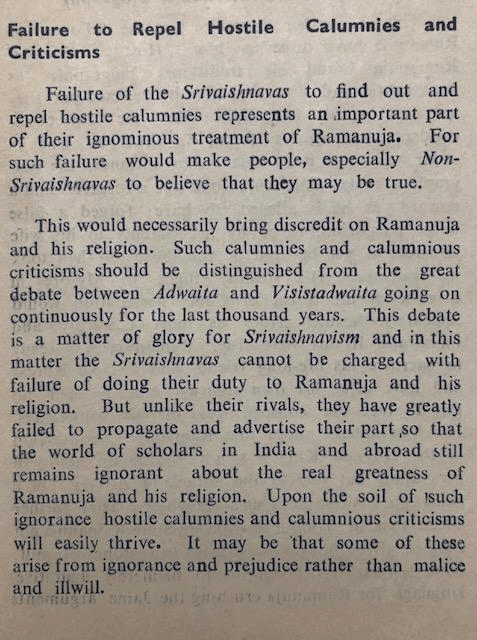
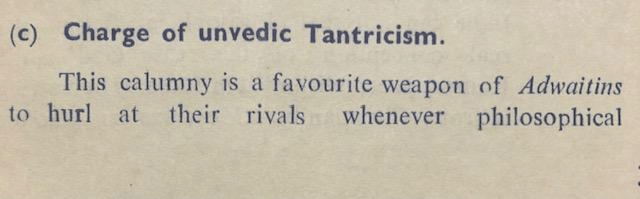
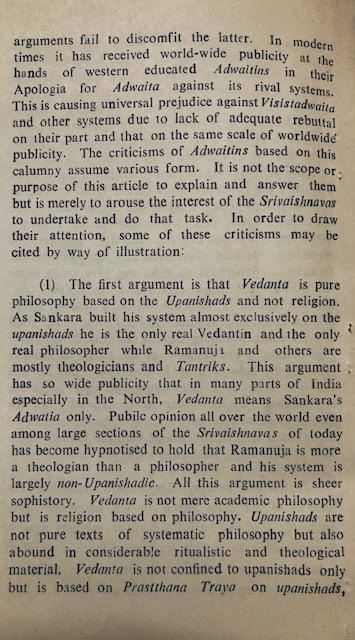
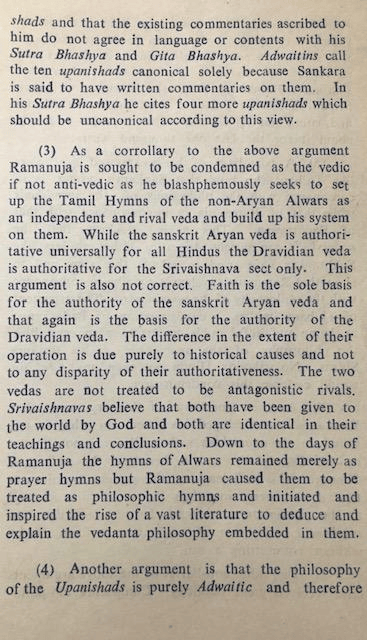
Failing to effectively repel hostile calumny and criticisms by other schools of Hindu religion against Sri Vaishnavism.
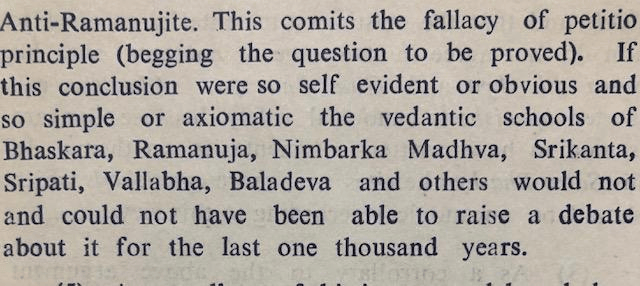
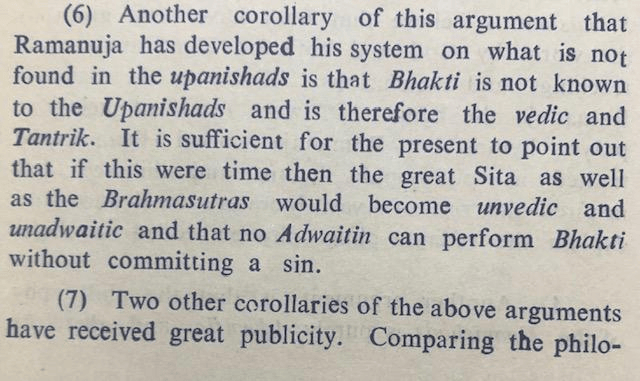
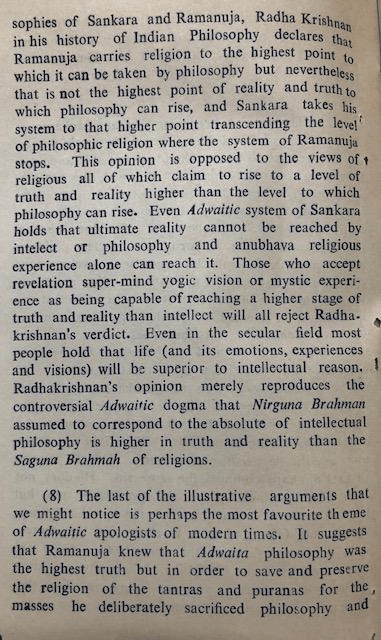
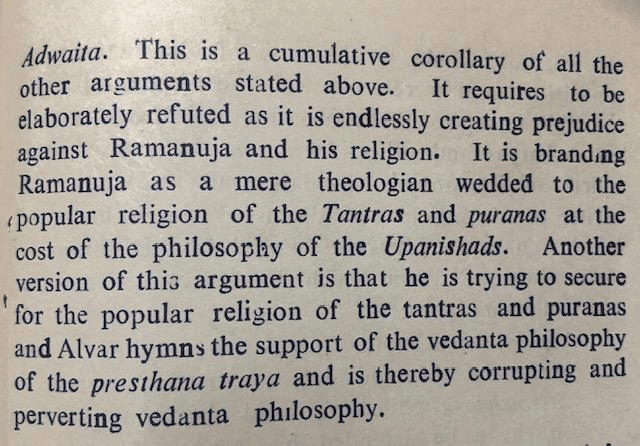
In this section of Doraiswamy Iyengar’s pamphlet titled “Ramanuja and Sri Vaishnavas”, another facet of “ubaya-vedanta” in the post-Indian Independence era gets critically examined.
Lest the passages written by Doraiswamy Iyengar are misunderstood or misinterpreted, I offer below an explanatory preamble as background to what exactly he sought to convey.
*******************************
For several centuries in the history of the vast land called India, philosophical discourse amongst scholars and seekers of truth and within different schools of thought had always been a continuous, ongoing occupation. The intellectual traditions of Indian civilization were in fact the mainsprings of inspiration for those that later became the Greek, German and far-Eastern Buddhist philosophical traditions.
During Ramanujacharya’s times the space for philosophical or intellectual discourse in India was an overcrowded, highly competitive and active bazaar of thought, ideas and ideals. In Tamil Nadu itself, Ramanuja had to contend with rivaling the dominant schools of Advaitins and Jains/Buddhists. Ramanuja’s principal works of philosophy — such as Vedaartha Sangraham or Vedanta Deepika, for instance — served mainly to advance his mission to capture for his own school of Visishtadvaita a significant if not dominant place in the Vedantic discourse of his times.
Through tireless efforts, debate, all-India travel and voluminous works and tracts, Ramanujacharya was able to establish the outstanding credentials of his very own school of Vedanta. It became perhaps the most eminent of a host of other schools then ruling the roost in his times. He won over many scholars and influential thinkers of his times who belonged to rival schools of philosophy… his own cousin who had turned Advaitin was brought back into the Vishistadvaita fold through intellectual and moral persuasion. Many kings and chieftains of his times in far flung geography also became convinced of the soundness of Ramanuja’s system of theistic Vedanta and converted to Sri Vaishnavism from Jain, Buddhist and Advaita schools. Princes and noblemen patronized the Ramanuja school. So powerful was the influence of Ramanujacharya on the philosophical discourse of his time that he came to be regarded as a serious challenger to the school of Advaita which until then had prevailed over much of the intellectual landscape of India.
In the post-Ramanuja centuries i.e. the 12th and 13th centuries CE, the flag of the Visishtadavaita school continued to be held aloft high by Vedanta Desika (1268-1368 CE) who was a prolific and formidable defender of “ramanuja-darsana” and “ramanuja-siddhaanta”. Almost singlehandedly in his lifetime, he proceeded to finish the unfinished mission of his Acharya, Sri Ramanuja, to render and position the principles and foundations of Visishtadvaita on a virtually unassailable footing and made it almost impossible to refute by any rival Vedantic school. Vedanta Desika was a philosopher-dialectician and polymath extraordinaire… and his polemical skills were so formidable that in debate and exposition he could decimate on any day any advocate or proponent of the 15 Vedic and anti-Vedic or heretical schools of thought in India viz. “lokaayatheeya”, “madhyamika”, “yogaachaara”, “sowthaanthreeka”, “vaibhaashika”, “pracchanna-bowdha”, “jaina”, “bhaaskara”, “vyaakarana”, “vaiseshika”, “naiyyaayika”, “neereeswara-meemaamsaka”, “saankhya”, “yoga-siddhaanta”, “paasupatha”. The great Advaitic scholar Appayya Deekshita (1520–1593 CE) — a performer of yajñas as well as a redoubtable expositor and practitioner of the Advaita Vedanta school but with a focus on Shiva or Shiva Advaita — once openly acknowledged that but for the works of Vedanta Desika on Vishistadvaita philosophy and dialectics, it would have been quite easy for him to demolish its whole edifice of thought.
The post-Ramanujacharya and post-Vedanta Desika eras in Sri Vaishnava history — and certainly the post-Indian Independence decades — however saw the more robust intellectual traditions of “ubaya-vedanta” generally waning. Increasing focus and emphasis began to be given by the Sri Vaishnava Acharyas on the more appealing “bhakthi” traditions or the emotionalism of Ramanuja’s theology and temple-orientated, Agama-centric traditions of worship which were all underpinned by the mystical and poetic Tamil outpourings of the Azhwars. Ramanujacharya firmly placed the Tamil “divya-prabhandhams“ of the Tamil mystic saints on a high pedestal and equalized them with the larger, primordial institution of Sanskrit Veda.
In effect, as the centuries rolled by after Ramanuja and Vedanta Desika, the emotionalism of Tamil “bhakti” traditions began to take increasing precedence over the more intellectually pre-disposed discourse of Vedantic thought which had always been conducted for thousands of years only in the Sanskrit language.
The temples and seminaries of the Sri Vaishnava community gradually began to ring louder with the “bhakti–laden” strains of Tamil hymnology and less and less with the sonorous chant of the Sanskrit Veda. It is indeed historical fact that while Vedantic mysticism expressed itself in full measure only in the glorious poetic literature of the Azhwar’s exquisite Tamil hymns, when it came to Vedantic discourse, the bulk of all philosophic pan-Indian literature was to be found only in the Sanskrit language. Tamil “bhakti” spoke in poesy while Vedantic prose spoke in Sanskrit only.
As the centuries rolled by after Ramanuja and Vedanta Desika, the long lineage and generations of Sri Vaishnavite Acharyas, seers and muttaadipathis began increasingly exhibiting religious propensities and predilections in favor of popular “bhakthi” traditions and began even discounting the Vedantic “intellectualism” of Visishtadvaita. They began stressing and emphasizing increasingly upon Bhakti as the cornerstone of “ramanuja siddhaatham”. The extolling of Tamil mystic inspiration and the large-scale adoption of Agamic liturgy and sacraments within Sri Vaishnava temples (especially some of the tantric-like rites of the “paancharaatra-agama” that Ramanujacharya himself inducted into temple worship) further resulted in the regressive “de-intellectualization” of Sri Vaishnavism.
In the post-Indian Independence era, the works of Sri Vaishnavism being authored continued in the same vein. Sri Vaishnava Acharyas, pontiffs and spiritual leaders began veering off into two distinct forks on the road that they had to travel… One fork branched off into Tamil mystic bhakti tradition while another led the way into the more cerebral traditions of Vedantic discourse in Sanskrit. This veering off of two forks on the road travelled in Sri Vaishnavism marked, in fact, the historic apogee of the Tenkalai Vs Vadakalai sectarian divide. Alas, Ramanujacharya’s own overarching vision of only one road to be travelled by all Sri Vaishnavas — i.e. the road of “ubaya-vedanta”, paved on one side by Sanskritic traditions of Vedanta and on the other side by Tamil bhakti-traditions of the Azhwars – thus fell far short of being realized in the modern day.
As Sri Vaishnavism became more and more a popular form of “bhakthi” cult, its de-intellectualization quickly began to cede space and primacy once again to its old rival, Advaita Vedanta. While the Acharyas and Jeeyars of the “ubaya-vedanta” school did however their best to preserve the Sanskritic tradition of Vedantic discourse, it was carried out however within the cloistered and elitist conclaves held inside their own small exclusive seminaries where Vedic pundits assembled in forums known as “vidwat sadas“. In these “vidwat sadas” none other than Sanskrit pundits and scholars could be admitted to participate in any meaningful manner. The subjects of discourse too were so arcane and focused on the most abstruse, almost pharisaical aspects of theological doctrine which ordinary Sri Vaishnavas in the laity could neither relate to nor comprehend what exactly was being discoursed upon. In time, Visishtadvaita became effectively disconnected from the real world of academia as it began to yield prime intellectual space to mainstream Advaita which soon gained international recognition as being the only true and important representative of all Indian philosophic thinking, past and present. The works of the internationally respected Indian philosopher, and former President of India, Dr. S.Radhakrishnan served as excellent academic brand-ambassador of Advaita Vedanta all around the academic world.
Furthermore, in the last half of the 20th century CE, Visishtadvaita Vedantic discourse was also completely overtaken and totally eclipsed by the rise of new institutional variants of Advaita-Ashram philosophy and by the emergence of a new generation of jet-setting New-Age Gurus that began to propagate worldwide attractive hybrid and heterodoxic forms of Advaitic and Yogic Vedanta. In such two broad categories fall indeed the well known Yogis, scholars and guru-jis who came from Sri Ramakrishna Math (the tallest and most famous Advaitin amongst whom was Swami Ranganathananda), Swami Chinamayananda, Swami Dayanand Saraswati, Maharishi Yogi, Bhaktivedanta Srila Prabhupada of ISKCON… followed in the 21st century CE by other similar yogis and new-age international Vedantists such as Swami Parthasarathy of Vedanta Academy, Sri Sri Ravi Shankar-ji, Gurudev Jaggi Vasudev et al….
Against the intellectual prominence and international recognition gained rapidly by the old orthodox Advaitin schools (most notably that of the Sringeri and Kanchi Sankaracharya Muttams) as well as the New Age heterodoxic international Advaitin guruji-s, the Sri Vaishnava spiritual leadership could present only a saintly but rather pale, inward-looking and lackluster contrast. Contemporary Sri Vaishnava Acharyas, Jeeyars and Heads of “muttams” or seminaries were disinclined to, or baulked at embarking upon a serious engagement with other schools of thought in the post-modern world. And it is only in that limited and narrow sense that the Doraiswamy Iyengar’s pamphlet also insinuates that Sri Vaishnava religious leadership has disguised its incompetence behind a veil of spiritual arrogance and superciliousness … “a typical attitude” which the well-known writer Rajiv Malhotra (in his book “Being Different” Pg. 345) describes as being QUOTE: “summed up in their statement: “The truth is with us, so why should we bother to study others’ ignorance?”. Others betray an egoistic display of exaggerated humility by asking: “Who am I to study other people’s religion?”. Still others have retreated out of despair, being overwhelmed by the challenge of confronting” (their rival “darsanas“)….” UNQUOTE
It is in the general context of explanations stated above that one must proceed to read and understand the passages reproduced below from Doraiswamy Iyengar’s pamphlet describing Sri Vaishnava spiritual leaders’ failure to “effectively repel hostile calumny and criticisms by other schools of Hindu religion against Sri Vaishnavism”.
*********************************

(to be continued)
Sudarshan Madabushi