I am a layman. My knowledge of Medical Sciences is less than microscopic… certainly, it is zilch when it is anything at all about microbiological research.
Nonetheless, like many millions in the world who read it this morning, I too was certainly very excited by the news about the 2024 Nobel Prize for Medicine being conferred on two outstanding doctors for their pathbreaking research into cracking the mystery of how genetic dysfunction, at the deepest human cellular level which they call as the “miRNA gene level“, causes such nearly incurable diseases in humans as “cancer and autoimmunity”, “disorders of sight, hearing, and skeletal growth.”
The discovery of how the miRNA cell acvitity behaves and gives rise to deadly bodily ailments now opens up horizons on clinical or surgical fronts… It raises the opportunity for medical science now to intervene at the genetic level and actually “regulate” micro-cellular activity so as to either prevent outbreak of disease, arrest it or cure it….
What a marvellous breakthrough indeed!
Thankfully, without too much use of medical gobbledygook, a short editorial that I read in the Hindu newspaper explains to me, a layman, what the “miRNA regulation” is all about. It is so fascinating to read that it is worth reproducing below:

The “dysregulated miRNA”, as described above is what it is now understood is the cause for what is also further explained to be “abnormal transcriptional control” of the “…biogenesis machinery” of human body cells.
For a layman like me, the “abnormality” of “transcriptional control” of “dysregulated miRNA” is not only a mouthful of medical jargon but also rather mind-boggling mystery.
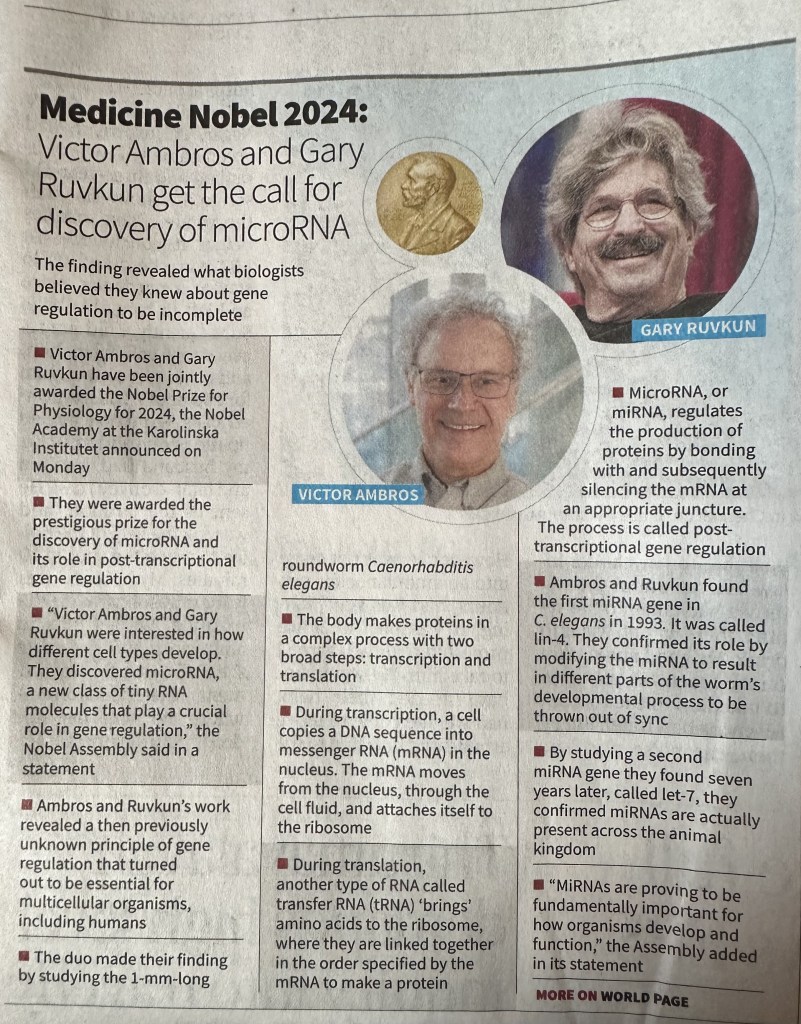
The HINDU news report helps a bit in dumbing down the whole matter for my sake — or the likes of me. In the following table of summarised box-item on the front page it has tried its best to de-mystify the subject a bit. Which is what makes it worth reading by reproducing it below verbatim:
*************
When I read and absorbed the above summary of the Nobel-winning research-findings — as duly dumbed down by THE HINDU editorial staff for the sake of uncompreheding readers like me — I was astounded to know that it all began with experimental microbiolgical studies into the roundworms!
The two doctors, Ambros and Ruvkun, spent years studying the cellular profiles and mysteries of a humble 1-mm sized worm called “cenorhabditis elegans”! It was the roundworm’s cellular activity that turns out to have provided the researchers the crucial clue to how human disease is caused or, in other words in what in their own medicalspeak, is “abnormal transcriptional control” of the miRNA gene leading to “defects in the biogenesis machinery” in human beings.
Even if one is a complete medical ignoramus as I know I am, still one ought to take the trouble to read through all the boxed-summary items abov … one by one very patiently … just so to be able to gain at least a little understanding of how “defects in the human biogenesis machinery” develops and metastasizes into pathology.
Let’s recapitulate the processes as described in each box above:
(1) It has been discovered that the human body generates some special kinds of proteins in a complex process in 2 broad steps: Transcription and Translation.
(2) Transcription process: DNA sequence of the human cell is copied into messenger RNA which moves through cell-nuclear fluid and attaches itself into what is called a Ribosome deeper inside.
(3) Translation process: Parallely, another RNA called tRNA brings aminoacids into the same Ribsome.
(4) the combined process of transcription and translation ends up in a resultant special type of Protein.
(5) But the above process is not without its inherent risks of destability, dysfunction and un-control… Disease is caused when the protein production at the end of the process goes all awry… or out of parametry, and which does and can happen at any time during the lifetime of the host body.
6. So that is precisely why, there arises the paramount need for another RNA called microRNA or mRNA to act as regulator or controller! This regulatory function, according to the amazing research finding that has just won the Nobel Prize in 2024, consists primarily in being able to “bond with and subsequently silence the errant mRNA at an appropriate juncture” during the complex process of Transcription and Translation.
WoW !! What a fantastic piece of research discovery, indeed! They say it all took more than seven long years of scientific labour before, finally, the crucial connection was eventually made between roundworm cell and human cell!
But then, equally, we might all want to exclaim a collective Whew!!… For what mind-boggling complexity indeed of microcellular biological processes can we ever imagine, silent and unseen by us, are all actually underway, both deep inside the body of ours as well as that of the humble roundworm !
Now that indeed does make a layman like me begin also to ponder over another mysterious thing:
As a species, says the Darwinian theory, homo sapiens evolved from homo simian … but now this new medical research-finding is telling me that at a microcellular level, there is nothing to distinguish between homo sapiens and “cenorhabditis elegans”?!
**********
The 2024 Nobel Prize awarded to the scientific discovery of miRNA will no doubt open many more grand vistas of medical research in the future.
The medical world will now of course build upon it… Surgical practices will improve; Pharmaceutical research now will pursue newer frontiers; Doctors and surgeons will now be encouraged to find new procedures and medications to treat such deadly diseases as cancer and diabetes and worse….
A brave new world perhaps, who knows, might open up for the worldwide medical-care industry… so, yes, Good luck and God Speed indeed to all of them!
**************
Be that all as it may, as a layman, even after all the excitement aroused in me by this medical breakthrough begins to slowly fade … and fade soon it will … I cannot help for the moment, however, to put to myself some searching questions. But they are questions that do not belong in the realm of science or medicine. They arise instead from the common urge of all ordinary men belonging like me to the Vedantic tradition which drives them invariably towards deeper philosophic inquiry beyond science.
I ask thus these questions after having acquainted myself with the broad facts of the above spectacular medical research-finding:
- The two Nobel Prize winning doctors have observed that the human body generates some special kinds of proteins… This is scientific observation, of course. But then what actually causes such proteins to get generated in the first place ?
- Transcription and Translation process: why must DNA sequence be copied into mRNA? What triggers it to go and attach itself to a ribosome? Why does it behave the way it does?
- Why must another tRNA cell too arrive at the scene at the same time when the ongoing process is in progress, bringing along with it, quantities of amino-acids?
- How and wherefore is the miRNA created?
- What is exactly happening during the process called “miRNA regulation”? What is impelling it? And why?
- Lastly, if the microbiological process taking place at the ribosomic level within both a human body and a roundworm is the same … then why does “abnormality of biogenesis machinery” in a roundworm not cause cancer, pathogenetic disorder or other such autoimmune-antibodies in its 1-mm long body but which on the other hand, it’s now known that it does cause inside the human one?
Maybe, the medical researchers do have some answers to the above laymen questions of mine but my own hunch is that they would turn around and tell me:
Look our research is limited to the observation of microcellular behaviour which hitherto was unknown to science. It now stands revealed. To go beyond observation and to delve into causative explanation as to why the cells behave the way they do, however, is entirely another frontier of medical research to be crossed sometime in the future.
**********
None of us knows what the future of medical science is going to be. The answers to my questions may perhaps be discovered, or maybe never at all … who knows…?
Meanwhile, all that I will and can do for now is simply to rest content in the the thought that the answers I seek are provided in fact — at least by way of Vedantic theory — through a simple tale found in the Hindu itihaasa… And, oh yes! let me tell you, it too begins with a mere worm....! It is the story of Sage Vyasa, the author of the Mahabharatha and his dialogue with an itihaasic earthworm.
Here below is the brief story and, more importantly, a glimpse into its deeper Vedantic significance.
If you have had the patience to read all about the Nobel-winning story of the miRNA that I have sketched above, surely, you will not grudge some time to read the story below too. If you do, and if you let it soak into your mind and you think it over deeply, you will perhaps be able to draw your own conclusions about why “miRNA” cells in the human body behave the way the Nobel Prize winners say they do.
“Kitopakhyana”—The argument between Vyasa and a worm
Kitopakhyana (kita-upakhyana) is seen in the Mahabharatha sub-canto of the Danadharma canto of the Anushasanaparva.
Many warriors had died in the war of Kurukshetra in two ways, willingly and unwillingly.
Yudhishthira asks Bhishma what their fate will be.
Then Bhishmacharya says that insects and microorganisms came to this world in a state of imperfection as well as perfection, inauspiciously and auspiciously too. Regarding this, he tells the story of how an argument between Rishi Vyasa and an earthworm is illustrative.
Once Vyasa saw a worm running away to avoid an oncoming bullock cart. Vyasa then asked the worm why it was running. The worm said that it has the capacity to hear the noise of the cart and the cart driver. But many other worms do not have that capacity. It said it was trying to get that fear off its mind. For the insects death is a sad affair. Their life is very brief and weak. That is why it was running away. It did not want to meet with sorrowful Death leaving behind the joy of Life.
Vyasa then rather condescendingly told the worm that death for it would actually be more preferable than living. You were after all born in a crooked womb and so how will you know and appreciate the pleasures of noise, touch, taste and smell or colour?
The worm protests and then tells Vyasa “why don’t you know that a creature, whatever might be its surroundings, lives in conformity and communion with its dwelling place? Therefore it likes living where it was born. It wants to live. Whatever its body needs for life, it is present in it”.
The worm continued:
“I was a human being in the previous life. But I was hated by others because I was cruel. I used to steal the property of others and I mistreated my guests. I was also a glutton. I never gave rice for the rituals for the deities and my ancestors. I did not give alms to the poor. I did not offer shelter to refugees. When I saw the prosperity of others, I used to be filled with jealousy. I wished to see their ruin and see them begging in the streets. I did what all I could to make them suffer. Although I did some good things they were not effective. I revered my old mother and I honoured the Brahmin. Once I treated my guest well. So I remembered my previous birth. I am trying to do good things so that I can again get a good life.”
Vyasa understands what the worm is talking about . He is sorry to have had a prejudiced view about the lowly creature .
He then tells the worm that it became a worm only because of such gross sins committed (what we may think of as analogous with the “abnormalities of biogenesis”). The deities and angels enjoy the result of their good deeds on earth. In humans, all their desires are the results of their karma ( analogous again to the complex processes that “regulate and control” all the multitudinous “transcriptions” and “translations” of life…. as it were ! …)
The worm now expresses its longing to do anything which will help it to advance and evolve. And to ultimately acquire divinity.
So the worm stood still where it was without moving away even when a big cart came by trundling. The worm was crushed under the wheels of the cart and it died. But through his yogic power Maharishi Vyasa showed the worm the path on which it began taking a series of rebirths.
It became a porcupine, a mongoose, an animal, a bird, a Pariah, a Shudra, a Vaishya, a Kshatriya and so on…. In all these births it had lingering reminiscences of its past life.
As a Kshatriya king, finally, it met Rishi Vyasa again and fell at his feet and sought his blessings.The Kshatriya then said to Vyasa,
“I was once a mere worm. In this birth I have become a Kshatriya, a Rajaputra. The sin I committed earlier won’t be completely forgotten.”
Vyasa then blessed him saying that one day in another life he would become a Brahmin.
According to the counsel of Vyasa, the Kshatriya King ruled righteously and looked after the welfare of all his subjects in the empire, and according to the dharma.
In the next birth he was born as a Brahmin.
When Vyasa met Vipra again, he said to him,
“Never deviate from the right path. If you do well, you will get a virtuous birth. If you sin, you will be born into a sinful womb. Depending on the intensity of the sin, the birth also would be hard. You were a worm before and now you don’t have to worry about death. You should be worried only about the breach of dharma. Therefore, perform the ideal dharma.”
The worm said,
“It is because of you I have now an opportunity to attain spiritual bliss. Because of the dharma I have held so steadfastly to, I have received grace and I have now been liberated from my sins.”
According to the counsel of Vyasa, the worm achieved state of Brahman ultimately. It was possible because it lived faithfully following the path of dharma.
Bhishma thus narrated the story to Yudhishthira to whom then it became clear that all those who had died heroically in battle at Kurukshetra had achieved salvation…
-End of story-
Sudarshan Madabushi