The pursuit of spiritual progress often means ploughing a lonely furrow. It can very often mean journeying through landscapes of dark, mental desolation.
Trying to connect — and furthermore to also remain strongly connected — with one’s own divine self can be a very trying and frustrating religious experience indeed.
Practitioners of “saadhana” or spiritual practices will often midstream in their respective journeys up the slow stream of life, begin to find steam and stamina running out of themselves and rapidly waning too, leading invariably to an appalling sense of boredom, disinterest and even deep disillusion in continuing perseverance with religious exercises.
Rites and rituals, hitherto faithfully observed, will suddenly turn terribly, unbearably repetitive, empty and meaningless.
The healthy habit of daily Prayer will inexplicably cease to have any purpose. Worship as a means of commune with God will suddenly seem ridiculous, in fact.
The study of religious literature or scriptures will suddenly no longer hold any thrall of inspiration.
Fraternizing with fellow spiritual-seekers — fellow pilgrims — and their very company (‘satsangham‘) that otherwise one normally always found spiritually uplifting or salubrious, no longer seems pleasant or worth earnestly seeking.
Indeed, an oppressive, great pall of spiritual lethargy descends from out of the blue, as it were, upon one’s soul then and darkens it. The mind would then, all at once, for no clearly discernible reason, go blind and blank, sinking into some dark, sterile space of emotional morass, aridity and paralyzing sloth.
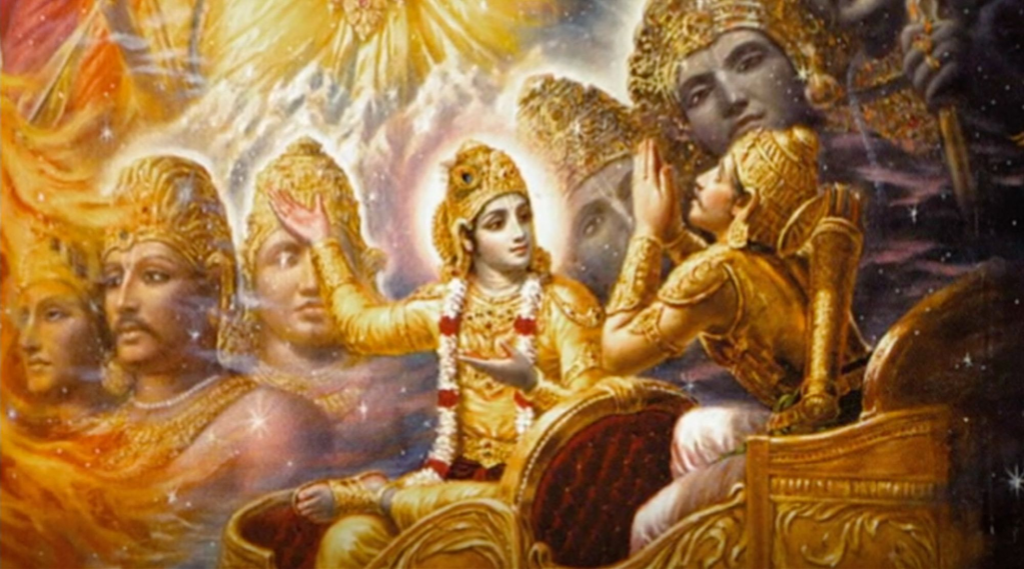
Precisely into such a mind-numbing and brain-fade apathy did Arjuna on the battlefield of Kurukshetra plunge, and in the very opening scene of the very first chapter of the Bhagavath-Gita.
It was a mental condition that, surprisingly, he was able to self-diagnose with remarkable, clinical objectivity, and describe it too then quite accurately to his mentor, Bhagavan Sri Krishna. These were his words:
कार्पण्यदोषोपहतस्वभावः
पृच्छामि त्वां धर्मसम्मूढचेताः ।
यच्छ्रेयः स्यान्निश्चितं ब्रूहि तन्मे
शिष्यस्तेऽहं शाधि मां त्वां प्रपन्नम् ॥ २-७॥
kārpaṇyadoṣopahatasvabhāvaḥ
pṛcchāmi tvāṃ dharmasammūḍhacetāḥ
yacchreyaḥ syānniścitaṃ brūhi tanme
śiṣyaste’haṃ śādhi māṃ tvāṃ prapannam
(Ch.2-7 Bhagavath Gita)
“My heart is now sunk in emptiness; my mind has gone blank. I am utterly confused; what must I do? I ask Thee! Tell me what is good for me. Look upon me kindly as your disciple. Instruct me. You are my only refuge.“
The Sanskrit word Arjuna uses to describe his mental or spiritual condition is “kaarpanya-dosham”. It’s a word that really has no perfect equivalent in English translation.
A person who is afflicted with “karpanya-dosham” is said to be a kṛpaṇā — i.e. a helpless, utterly destitute person. Arjuna refers to himself thus as a spiritual destitute i.e. one with “ati-kṛpaṇa-buddhiḥ“— whose intelligence has gone dull because of a sudden paralysis of mental will.
Therefore, Arjuna slunk in hopeless despair, beseeches Bhagavan Sri Krishna to lift him out of his state of spiritual morass, and relieve him of “kaarpanya-dosham”.
One of the attributes of Sri Krishna in the Mahabharatha is that he is “kṛpaṇa-vatsala”— i.e. He who heals fallen souls mired in self-ignorance. Krishna dispels the dark, heavy pall of “kaarpanya dosham” which is a certain sick state of the human mind, possibly the least inaccurately described by a term used in Christian theology. It is known as “Acedia”.
What is Acedia?
(to be continued)
Sudarshan Madabushi