It is rather too facile to translate the Sanskrit word for the mental affliction of “kaarpanya-dosham” into its near-equivalent Tamil, “மனத் தொய்வு” which, again in a very facile fashion, gets often roughly translated into the English “despair“, “mental depression” or “faintness of mind”.
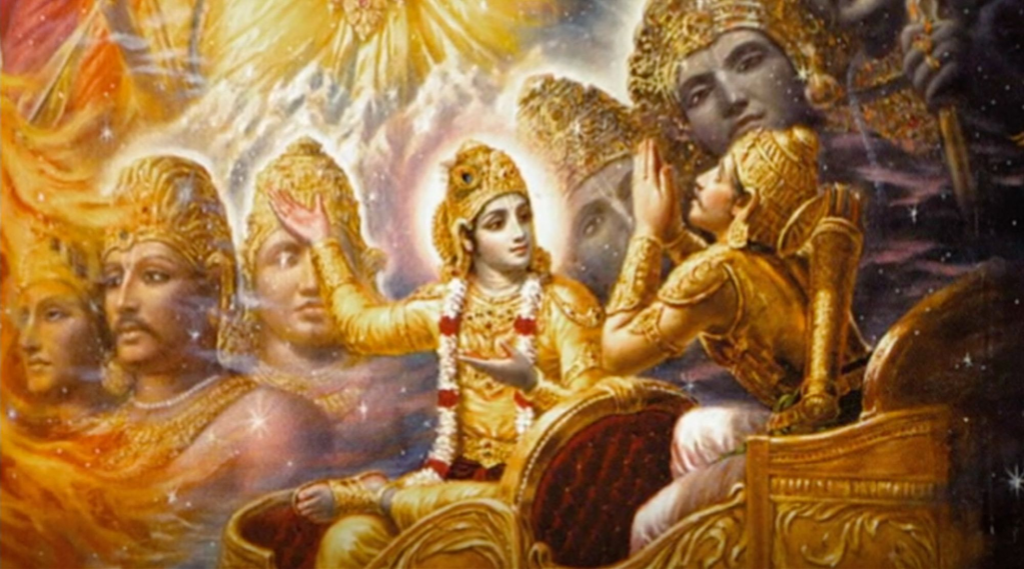
Overall however, as the Tamil literary doyen and my revered friend, Sri. Indira Parthasarathy suggested to me, in fact, (in a private Whatsapp message to me after reading Part-1 I had penned yesterday) “மனத் தொய்வு” encapsulates much broader complexities of mental health within Tamil literary discourse than overly straight-forward or simplistic translations of the term.
Arjuna’s pain finds similar echoes in several works of great Tamil saints, poets and mystics over many centuries. They are expressions of human struggle with spiritual poverty, existential crises, and disconnection. Poet-saints like Manickavachagar indeed underwent such struggles and one easily glimpses it through their poetry e.g.:
Manikkavachagar in Tiruvaasagam: “உறுப்புடையேன், உயிருடையேன், உணர்வுடையேன்” (“I have a body, I have life, I have consciousness, but I am not aware of Your presence“); “தன்னை மறந்து தாழ்ந்திட வேண்டும்” (“I have forgotten myself and sunk low”); “உள்ளம் உருக்கம் இல்லாத” (“My heart is without passion or longing”). A modern poet, Kavi Mani Desiga Vinayakam Pillai: “மனம் தளர்ந்து மயங்கி” (“My mind is weakened and confused”).
Arjuna’s “kaarpanya-dosham” was a very complex state of mind — a deeply disturbed, even deranged one. Only Bhagavan Sri Krishna himself could quickly and most accurately diagnose it and attend at once to the crisis of his dear friend’s (“sakha“) spirit.
Arjuna’s condition was not caused by a momentary loss of mental imbalance alone. It was more. Nor was it just sudden, last-minute funk or cold-feet he developed when he considered the prospect of going to war — a bloody fratricidal one to the finish — at Kurukshetra. Sri Krishna was so quick indeed to size up Arjuna’s condition to be far more serious and profound. He saw that it was a full-blown existential crisis of extraordinary pain and intensity. And so he knew it needed an extraordinary effort in moral counselling to prevent the man’s spirit go spiralling into a free-fall…. whereby friend Arjuna would lose the war, lose his kin, lose a kingdom and above all … lose his soul….
Sri Krishna’s Bhagavath-Gita of 700 “shloka-s”, thus, truly represents a testament of the Divine Will: an extraordinary effort on the part of Bhagavan to live up to his vaunted name and reputation of being “kṛpaṇa-vatsala“— i.e. He who rescues, and heals, fallen souls floundering in existential crisis.
**********
On the battlefield of Kurukshetra, Arjuna’s crisis crippled him … physically, mentally, morally and spiritually …
Although the Bhagavath-Gita as a scriptural text of Hinduism does stand out as an all-time classic case-study of human existential crisis, Arjuna’s case is not all that unparalleled. The affliction called “kaarpanya dosham” is nearly universal condition of mankind which is what makes Arjuna such a singularly illuminating case-study of human psychology of such enduring interest to us all. The literature of the world is so full of similar or comparable case-studies.
So prevalent is the psychopathology of “kaarpanya dosham” in the world that Literature abounds in various descriptions and expositions of it. In Western civilization, famous literary or dramatic characters who struggled with similar feelings of spiritual poverty, listlessness, and disconnection can be listed:
1. Shakespeare’s Hamlet: His famous soliloquy “To be or not to be” reflects a sense of existential crisis and spiritual poverty.
2. Dostoevsky’s Underground Man: A character in it struggles with feelings of alienation, spiritual poverty, and disconnection.
3. Albert Camus’ “L’Etranger” (The Stranger): Merseault, is a character who embodies a sense of absurdity and spiritual listlessness.
4. Dostoevsky’s Brothers Karamazov: Ivan is a character who grapples with the existence of God and the meaning of life, reflecting a sense of spiritual poverty and doubt.
In Western philosophy, there were thinkers like the few below who too grappled with the theme of “kaarpanya dosham“:
1. Jean-Paul Sartre and Albert Camus: Explored the concept of “existential despair” and the human condition, which can be seen as related to Kaarpanya dosham.
2. Martin Heidegger: Discussed the concept of “Being-in-the-world” and the human condition, which touches on themes of spiritual poverty and disconnection.
3. Søren Kierkegaard: Wrote about the human condition, faith, and the struggle with spiritual poverty and doubt.
Then there was this famous American philosopher, William James who wrote a classic work, “The Varieties of Religious Experience: A Study in Human Nature“ (1901-2), in which he used the word “acedia” to denote existential crisis of the sort that Arjuna experienced as “kaarpanya dosham“. This book concerned itself with the psychological study of individual private religious experiences and mysticism, and used a range of examples to identify commonalities in religious experiences across traditions. Soon after its publication, Varieties entered the Western canon of psychology and philosophy and has remained relevant for well over a century.
In “The Varieties of Religious Experience“, William James describes Acedia as a state of spiritual dryness and listlessness. Some extracts that describe Acedia inform us that the term is perhaps a close enough translation of the Sanskrit “kaarpanya dosham” to give us some glimmers of insight into the state of Arjuna’s mind in the Bhagavath Gita:
– “A feeling of emptiness and irreligion, as if the subject were hung in a void, and had no connection with the divine” ;
– “The worst of it is that the individual feels as if he were losing his hold on spiritual reality, and were becoming a mere hollow shell”;
– “The state of mind is one of emotional flatness, of inability to feel or respond to the usual stimuli of devotion”;
In his book of lectures on the subject, William James also quoted from the writings of Christian Catholic mystics, such as Saint Ignatius Loyola, who describe Acedia as a “desolation” or “aridity” of the soul, characterized by a lack of spiritual consolation and a sense of being disconnected from God.
When Arjuna threw away his weapons and sank to the ground at the feet of Sri Krishna on the battlefield of Kurukshetra, his behaviour exhibited almost exactly all the symptoms above that are described as Acedia… He was in the closest possible proximity to the presence of a Divine avatar who stood right under his nose, as it were! — “bhagavath saakshaat-kaara” — and yet Arjuna behaved as if God was absent. He seemed to have no idea that he actually had a visible, virtually palpable “connection with the divine“… So perturbed was he however with his own “state of mind ….of emotional flatness” , that Arjuna found himself simply lost in an overwhelming “feeling of irreligion“, a terrifying “sense of being disconnected from God“.
There was the famous novelist and English philosopher, Aldous Huxley who too described Acedia as a state of “spiritual sloth” and “emotional numbness“, characterized by a lack of interest, motivation, and passion for spiritual or intellectual pursuits.
Huxley wrote about Acedia in his book “The Doors of Perception” (1954), noting that it is a state of being “cut off from the divine” and experiencing a sense of “inner emptiness” and “desolation“.
Huxley saw Acedia as a major obstacle to spiritual growth and self-realization. He was, in fact, echoing another mystic-poet, William Blake’s similar sentiments on how Acedia — Arjuna’s acute symptoms of “kaarpanya dosham” — imprisons man from waking up to the presence of divinity right within himself. Blake (1757-1827) had written:
“If the doors of perception were cleansed every thing would appear to man as it is, Infinite. For man has closed himself up, till he sees all things thro’ narrow chinks of his cavern“.
In Kurukshetra, Bhagavan Sri Krishna had to go to the great trouble of delivering a long 18-Chaptered sermon of the Bhagavath-Gita only to “cleanse” Arjuna’s “perceptions” that had suddenly all closed up and he could see nothing else in his existence except “thro’ the narrow chinks of his cavern”.
************
Acedia — our nearest and least inaccurate English translation of the Sanskrit “kaarpanya dosham” — also finds mention in Christian Theology as clearly as it finds mentions in our own Vedantic scriptures.
Thomas of Aquino (c. 1225 –1274) was an Italian Dominican friar and priest, the foremost scholastic thinker, as well as one of the most influential philosophers and theologians in the Western tradition. He was from Sicily. Thomas was a proponent of natural theology
Thomas Aquinas defined acedia as the “sin of sorrowing over the divine good, which is friendship with God“…. a friendship or “sakha” in the same sense in which Arjuna looked upon Sri Krishna as his bosom-friend and alter-ego.
Thomas Aquinas wrote that though an acedic person may long for God, they ultimately find the longing too costly to sustain: in the battle of flesh against spirit, flesh prevails. And, thus, they fail to continue in friendship with God. They no longer delight in him and cease responding to his overtures of love with their own acts of love. This reminds us immediately, of how Sri Krishna volunteered to serve Arjuna as his charioteer in battle at Kurukshetra, stand beside him firmly in the heat of war and ever support him, through thick and thin… And yet, in that moment of crisis when he began to have sudden, grave second thoughts about going to war to do his duty or dharma, Arjuna simply forgot Krishna’s “overtures of love”.
Aquinas wrote that Acedia’s symptoms may consist of a lack of desire for spiritual reading and prayer, a general sense of frustration, and even sleepiness or ill-health. Such are the symptoms that the more modern word—sloth—describes. About “sleepiness” or what we may call “spritual torpor“, we will discuss more in Part-3. But, as Thomas Aquinas notes, acedia also may be typified by restlessness, a (hyper-)activity born of desperation to escape the difficulties and humdrum sameness of the life of faith. Arjuna, as a kshatriya-prince, was indeed beset by a sense of desperation, a loss of his identity and duty (dharma) that made him want to “escape the difficulties and humdrum sameness of the life of faith” that Sri Krishna, through the Gita, was so hard pressed indeed to instill into him.
***********
St. John of the Cross (1542-1591) was another outstanding Christian Theologian in the Medieval Ages in Europe. He was a Spanish Roman Catholic priest, mystic. Even today he is regarded as a major figure of the Counter-Reformation in Spain, and he is one of the “37 Doctors of the Church”.
John of the Cross is known for his writings. Both his poetry and his studies on the development of theological doctrines are considered the summit of mystical Christian literature and among the greatest works of all Spanish literature.
John of the Cross, describes acedia too. His discussion is particularly interesting in light of what he also has to say about “dark night of the soul” from a theological standpoint. In Part-3, we will visit briefly the subject of “dark night of the soul“, but here it is enought to note that for John of the Cross, acedia is a withdrawal from the work of prayer. The believer feels weariness in their practice of spiritual exercises and so largely lets their prayer habits slide because their efforts give them no pleasure. In making such a choice towards passivity in prayer, they betray the fact that their joy, which is opposite to acedia’s sadness, is not in God but rather in the pleasures he gives.
With joy in God gone, sadness and weariness may take root and may even, John says, become an aversion to submission to God. The passivity in prayer that acedia produces, then, is a kind of faithlessness, a choice no longer to wait for God in the tension of a presence that feels like absence.
This is exactly like the sense of “kaarpanya dosham” Arjuna experienced at Kurukshetra. His “sadness and weariness” took root as a “kind of faithlessness“… And in that moment of crisis, Arjuna felt Sri Krishna’s presence, in fact, more as absence.
(to be continued)
Sudarshan Madabushi
Brilliant!