A very senior and highly distinguished IAS officer (retired) –whose name I shall not disclose here since I respect his privacy — is a good friend of mine for whom I have great respect, knowing as I do his yeoman services rendered to the Goverment of India in his career heydays as a top-bureaucrat.
This morning (after Rama Navami Day yesterday), and right out of the blue, he suddenly emailed to request a clarification from me on the subject of “bhagavath avatara” — the phenomenon of divine descent into mortal realms on earth. This was his question to me:
“Why did not the vedas and upanishads refer to Ram. Secondly, was Ramayana written first or Mahabharata?“
From the way he framed the two questions to me, I was able to surmise that he — someone whom I knew was already a learned and well-read person — had probably given much thought to the questions, but then had, probabaly, been able to come up only with rather vague, poorly substantiated answers. So, what he was really seeking from me was “pramaanam” — i.e. exact scriptural authenticity or authority — for those half-baked answers, and he was hoping that I might be able to help him in the matter.
To my mind, many of the best minds like my IAS friend’s, for example, often find themselves in the same predicament viz. they are unable to wrap their minds completely around the reality of what in conceptual Vedanta is known as “bhagavath avataara”.
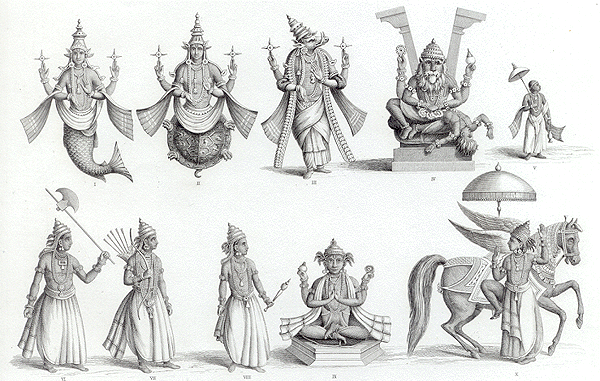
There are volumes and volumes of scriptural commentary that are available today in Vedanta Literature (in vernacular and in English and online too!) but then people hardly have the time, energy or the patience to delve into those information-sources…. Hence, they find themselves, utterly at sea when challenged to substantiate their deep beliefs in Vedantic concepts with the support of Veda or Vedantic “pramaana“… indisputable and conclusive in nature. Which is the reason why they find they are unable to gain mental clarity regarding fine and subtle concepts such as “bhagavath avataara“. Anticipating fully well that precisely such would be the general befuddled condition of the mind of common mankind, the Bhagavath-Gita itself (Chapter 4) referred to the truth of “bhagavath avataara” as “avataara rahasya” — i.e. esotericism of divine avatar …. a truth which will keep eluding comprehension by even the best of human minds .
**********
To the first of my friend’s question, my answer was as follows:
Sir, both questions of yours are great and I will provide an answer to the best of my knowledge and ability.
Let’s take up your first question.
At the outset, it must be made clear that Upanishads and Veda are believed to be “apaurusheyam” …. i.e. they are not authored by any human agency and they are ageless . They were intuited (discovered) as pure, cosmic and primordial sound in the first place…. “shabdha svarupa” i.e. as mantra … by bicameral minds having enormous mental powers of perception, assimilation, retention and articulation that many ancient Rishis of yore, who walked our great land, did possess. It was only much later in time, i.e. after language script came to be devised by Man, that those primodial sounds (phonemes) came to be symbolised through textual representation.
Having said all that, let it be known very clearly the Veda and Upanishad do refer, in fact — in both a general and specific way — to the reality of Divine Avatar — a reality that came to be described elaborately at a much later time in history when the Mahabharata and Bhagavath Gita were authored by Vyaasa Maharishi .
The Purusha Sooktam of the Rg Veda mentions Avatara in a general yet categorical sort of way . :
pra̠jāpa̍tiścharati̠ garbhē̍ a̠ntaḥ । a̠jāya̍mānō bahu̠dhā vijā̍yatē ।
tasya̠ dhīrā̠ḥ pari̍jānanti̠ yōnim̎ । marī̍chīnā-mpa̠dami̍chChanti vē̠dhasa̍ḥ ॥
(Thaithireeya Aranyakam 3rd Prasnam 13th Anuvaakam 40th and 41st Dasini)
The Lord of the universe,
Lives inside the universe,
And without being born,
Appears in many forms,
And only the wise realize and intuit his real form,
And those who know the Vedas,
such as rishis
like Mareechi.
The expression “a̠jāya̍mānō bahu̠dhā vijā̍yatē… without being born, Appears in many forms”…. refers only to divine avatars.
A Gita commentator has elaborated on the above by showing that what was written in the Bhagavath Gita by Maharishi Vyaasa came much later after the Vedas (i.e. in the Bhagavath-Gita) and is but an echo of what already had been intuited by Rishis and articulated in the mantras of the Purusha Sooktha.
QUOTE: “In chapter four of the Bhagavad Gita, Shree Krishna stated: “Although I am unborn, the Lord of all living entities, and have an imperishable nature, yet I appear in this world by virtue of Yogmaya, my divine power.” (4.6) This means that not only does God possess a form, but He also descends in the world as an Avatar.
Since we souls have been taking births in the world from time immemorial, it is plausible that we were present in the human form on the earth when a previous descension of God was present on the earth. It is even possible that we saw the descension. However, the limitation was that God’s form was divine and we possessed material eyes. So when we saw Him with our eyes, we were unable to recognize the divinity of His personality.
The divine nature of God’s form is such that His divinity is perceived by each person only to the extent of his or her spiritual power. When those who are influenced by sattva guṇa see Him, they think, “Shree Krishna is a special person. He is very competent but is definitely not God.” When those under the spell of rajo guṇa see Him, they say, “There is nothing special in Him. He is very much like us.” When those dominated by tamo guṇa see Him, they think, “He is egotistic and characterless, much worse than us.” It is only the God-realized saints who can recognize Him as God, since they have received divine vision by His grace. And so, Shree Krishna says that the unaware materially conditioned souls do not know Him when He takes an avatar in the world.
**************
Now, next to the specific references in the Veda to the reality of “bhagavath-avataara”.
The Narayana Upanishad (one of the principal Vaishnava Vedic texts belonging to the Krishna Yajur Veda) foretells/hints clearly in one of its several passages to the Krishna avatara which would take place … which of course it did aeons later :
“… brahmaṇyō dēva̍kīpu̠trō̠ brahmaṇyō ma̍dhusū̠danōm । …”
The son of Devaki is Brahmam. The Madhu Sudhana (he who killed asura, Madhu) is Brahmam.
The expression “Devaki putra” above refers specifically to Krishna, son of Devaki.
**********
Finally, to address your next question to me: “Was Ramayana written first or Mahabharata?“
This question is a “no-brainer” really since it is well-established historical fact that Rishi Valmiki’s Ramayana was written ages before Vyasa Maharishi wrote the Mahabharatha. And the proof of this fact is self-evident since there are several references and allusions in the latter epic to the former.
Even a simple search-prompt on the worldwide web will reveal to us the relevant citations and references from the Mahabharata that relate to the earlier Ramayana:
1. Indrajit-Vadha-Lila and Related Events:
– The Mahabharata does not directly narrate the slaying of Indrajit (Ravana’s son), but it often alludes to the Ramayana’s events. For instance, in the Drona Parva, warriors like Bhima and Arjuna are compared to Rama in their valor, indirectly recalling episodes like Indrajit’s defeat.
2. Nature of Keshava:
– In the Vishnu Sahasranama, Krishna is referred to as “Keshava,” highlighting his divine powers and multifaceted nature. There is glorificatory verses on the name of Kesava in the Ramayana which the Mahabharatha verses repeat almost verbatim:
“Just as rainwater falling on earth reaches the ocean, all offerings made to various deities ultimately reach Keshava” (- Mahabharata: Anushasana Parva, Chapter 149)
This underscores Krishna’s supreme nature as an incarnation of Vishnu.
3. Vibhishana’s Coronation:
– Vibhishana’s coronation after Ravana’s death is referenced in the Mahabharata as an example of dharma prevailing over adharma. In the Shanti Parva of Mahabharatha, Bhishma recounts how Rama upheld dharma by crowning Vibhishana, Ravana’s righteous brother, as king of Lanka.
4. Vibhishana’s Arrival and Relationship with Rama:
– The Mahabharata mentions Vibhishana’s arrival in Rama’s camp as a pivotal moment of loyalty and righteousness. In the Udyoga Parva of Mahabharatha, parallels are drawn between Vibhishana’s alliance with Rama and other acts in the Ramayana of characters seeking refuge with him under “saranagathi dharma“.
All the above examples illustrate how the Mahabharata integrates themes and characters from the Ramayana, creating a shared mythological framework. It also proves that the Ramayana pre-dated the Mahabharatha.
Sir, I do trust I have answered your questions satisfactorily.
***********
Sudarshan Madabushi