
On the intriguing subject of “finding meaning in life”, last week on a WhatsApp exchange of messages, back and forth, with Sri Eepa (Indira Parthasarathy, now 96 years old, who lives alone in Athulya Assisted Living Home), we had a very interesting conversation which I take the liberty of sharing here with you . Eepa, the doyen of Tamil literature, has a mind as sharp and percipient as ever and it is what won him accolades for several of his published novels and the dozens of his stage plays. ((Last year I translated into English his novel “வேதபுரத்து வியாபாரிகள்” — “The Middlemen of Vedapura” (Blue Rose Publishers) available online on Amazon and FlipKart)).
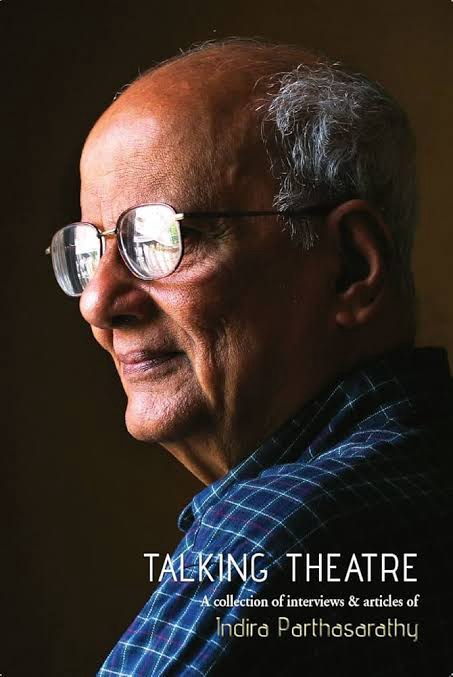
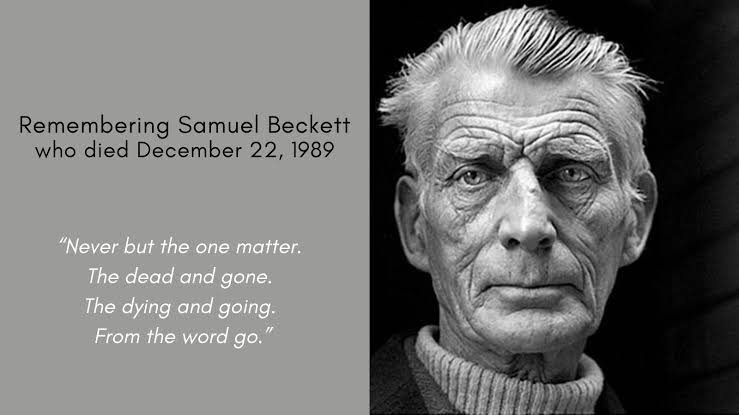
Our conversation started off when I asked Eepa what he thought about the English avant-garde play “Waiting For Godot” by Samuel Beckett . I forwarded to him the below short critique of the play and asked him to comment:
*Waiting for Godot* by Samuel Beckett, 1953 – the play where “nothing happens, twice.”
### *Plot in 30 seconds*
Two tramps, *Vladimir (Didi)* and *Estragon (Gogo)*, wait by a tree on a country road for a guy named *Godot*. He never comes.
*Act 1*: They wait. Talk nonsense. Consider hanging themselves. Meet *Pozzo* and his slave *Lucky*. A boy arrives: “Mr. Godot can’t come today but surely tomorrow.”
*Act 2*: Basically Act 1 again. Same tree, same wait, same Pozzo & Lucky but now Pozzo is blind. Same boy: “Mr. Godot can’t come today but surely tomorrow.” They don’t leave. Curtain.
### *Who/what is Godot?*
Beckett refused to say. When asked, he replied: “If I knew, I would have said so in the play.”
Popular interpretations:
1. *God* – Go + dot = God. Didi/Gogo = disciples waiting for salvation that never arrives.
2. *Death* – The only certainty, but it’s always “tomorrow.”
3. *Meaning/Purpose* – We wait for life to explain itself, but it won’t.
4. *Nothing* – Godot is just a name they invented to pass time. The point is the waiting itself.
### *Core themes*
Theme How it shows up
**The Absurd** Life is repetitive, illogical, and purposeless. They wait for meaning that never comes, but keep waiting. Pure Camus vibes.
**Time & Memory** “Nothing happens, nobody comes, nobody goes, it’s awful.” They can’t remember yesterday. Was it the same boy? Did Pozzo come before? Time is a loop.
**Language fails** They talk constantly to fill silence. Dialogue is circular, full of non-sequiturs. Words don’t connect to action.
**Dependency** Didi & Gogo can’t leave each other, even though they drive each other nuts. Pozzo & Lucky are master/slave, but both trapped. We need others, even when it’s hell.
**Hope as torture** “Let’s go.” “We can’t. We’re waiting for Godot.” Hope keeps them stuck. If Godot came, the play would end.
### *Key moments*
1. *The tree*: Act 1 it’s barren. Act 2 it has 4-5 leaves. Only sign time passed. Or did it?
2. *Lucky’s speech*: The one time Lucky speaks, it’s a 3-page word-salad about God, academia, and tennis.
Shows language/knowledge as total noise.
3. *The boots*: Gogo struggles with his boots the whole play. Small, pointless suffering that fills time.
4. *”Let’s go.” / “We can’t.” / “Why not?” / “We’re waiting for Godot.”* – Ends both acts. Nothing changes.
### *Why it matters*
It’s the defining *Theatre of the Absurd* play.
Beckett stripped drama of plot, character development, and resolution to show human existence raw: we wait, we suffer, we distract ourselves, we die.
Critics hated it at first. Then it became the most important play of the 20th century. Prisoners at San Quentin reportedly understood it instantly: “That’s what it’s like, waiting.”
### *Beckett’s stage directions are law*
1. Two men, desolate road, one tree.
2. Must be funny. Beckett called it a tragicomedy. Vaudeville meets philosophy.
3. Gogo and Didi are not clowns, but they wear bowler hats and act like them.
*Camus connection*: Albert Camus said Sisyphus is happy. Beckett shows us Sisyphus _while_ he’s rolling the rock. No conclusion, just the endless, ridiculous effort.
*1-line takeaway*: We’re all waiting for our Godot — a job, love, death, meaning — and the waiting _is_ the play.
************
I asked Eepa : Sir, is the above a correct critique of Waiting For Godot ?
And his reply was : Waiting for a non-existent god to give life its meaning. Begins as such:
‘One is saved’.
‘Fifty Fifty’.
One thief praising condemned Jesus gets salvation and the one abusing Jesus does’nt. ‘Fifty Fifty’.
You are broadly correct.
Again I pressed him : Sir, philosophically , how do you, as a playwright yourself, view Beckett’s Waiting for Godot? Does it differ from how you view it now as an avowed Sri Vaishnava?
Eepa replied : I don’t know. When I read it in its pale Irish prose, it didn’t convey anything. But I saw the play in Delhi when once it was done by a British troupe . It made sense —- that we all need to give life its meaning drawn from our own experiences.
So, I posed Eepa yet another question: Sir, “finding meaning” is thus not a passive act, like just “waiting” in life …. twiddling our thumbs, so to say, right?
In Sri Vaishnava philosophy , finding meaning is at the very core of the doctrine of Artha Panchakam.
The play’s protagonists’ futile wait for the absent Godot mirrors a misguided form of upasana—lacking surrender, ritual, or divine assurance—highlighting existential absurdity absent in Vaishnava certainty.
The “meaning” we all search for in life cannot be the absurd “waiting” for Godot . Meaning cannot arise from absurdity. Nor can Meaning ever arise from the void.
Sri Vaishnava Siddhantham posits the concept of Sath … that which exists always (Tat Tvam asi) and is never absurd but is in fact verily the Meaning that must be relentlessly sought.
Eepa wrote back at once: Convincing. Yes, we all need to ourselves find and give our life a meaning.
That terse yet profound confirmation coming as it did from a physically frail 96-year old but very strong intellect, assured me that Waiting for Godot actually is but a distant echo of the poetic lines below that end with the word “Wait” :
THE PSALM OF LIFE : Henry Wandsworth Longfellow
Tell me not, in mournful numbers,
Life is but an empty dream!
For the soul is dead that slumbers,
And things are not what they seem.
Life is real! Life is earnest!
And the grave is not its goal;
Dust thou art, to dust returnest,
Was not spoken of the soul.
Not enjoyment, and not sorrow,
Is our destined end or way;
But to act, that each to-morrow
Find us farther than to-day.
Art is long, and Time is fleeting,
And our hearts, though stout and brave,
Still, like muffled drums, are beating
Funeral marches to the grave.
In the world’s broad field of battle,
In the bivouac of Life,
Be not like dumb, driven cattle!
Be a hero in the strife!
Trust no Future, howe’er pleasant!
Let the dead Past bury its dead!
Act,— act in the living Present!
Heart within, and God o’erhead!
Lives of great men all remind us
We can make our lives sublime,
And, departing, leave behind us
Footprints on the sands of time;
Footprints, that perhaps another,
Sailing o’er life’s solemn main,
A forlorn and shipwrecked brother,
Seeing, shall take heart again.
Let us, then, be up and doing,
With a heart for any fate;
Still achieving, still pursuing,
Learn to labor and to wait.
************
End of the conversation.
Sudarshan Madabushi