– Part 2 –
How One Blends into the Other
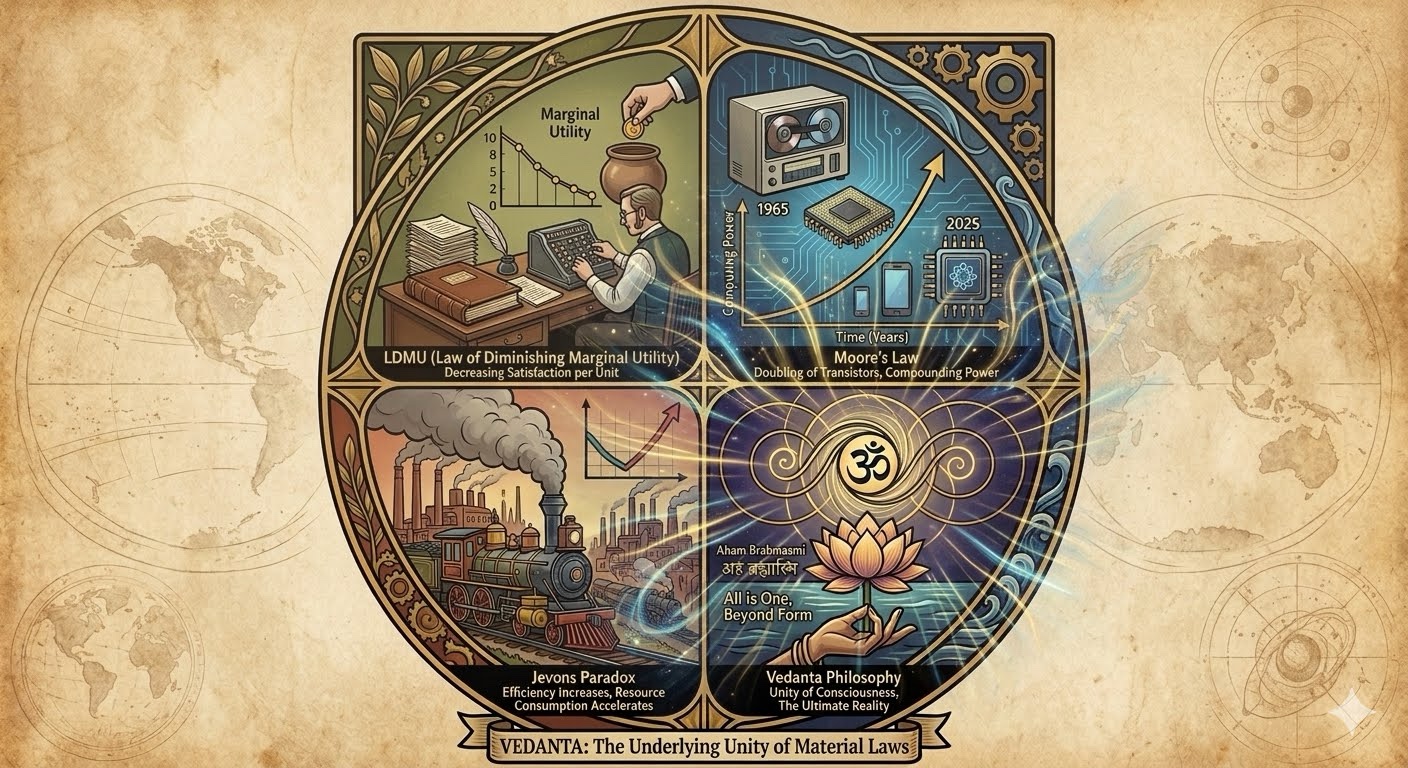
At first sight, Jevons’ Paradox and Moore’s Law seem to march in tandem while the law of diminishing marginal utility trails behind, like a conservative chorus whispering, “Beware of excess.” But the deeper one looks, the more the three form a subtle choreography.
Start with Moore’s Law: as each generation of hardware becomes cheaper and more powerful, the effective price of technological capability falls. This is not just a technical fact; it is a behavioural invitation.
Firms that once could not afford certain kinds of automation, students who earlier could not dream of owning a capable computer, now find that “more tech” fits within their budget. The resource—technology as such—becomes more accessible, more attractive, more thinkable.
Here, Jevons’ Paradox enters the stage. Efficiency gains in technology, especially computation, lower the cost of using that resource, so demand swells. The temptation to deploy yet another AI model, yet another data pipeline, yet another layer of automation is not merely a whim; it is a structural consequence of the fact that each additional unit of tech‑resource costs less and delivers more. The result is not a gentle tapering off, but a renewed wave of adoption: more data‑centres, more sensors, more connected devices, more “smart” infrastructure.
Where, then, is LDMU? It is not absent; it is simply postponed and disguised. The standard formulation—that each additional unit of a good yields less satisfaction—is still true micro‑psychologically. But Moore’s Law keeps redefining what the “marginal unit” is: each new chip‑cycle delivers not merely “one more unit,” but one more unit with more capability, more speed, more features. So while the intrinsic marginal utility of “yet another gadget” still diminishes, the effective marginal utility per rupee can remain high for a long stretch, because the quality of the unit keeps rising.
Below are two conceptual sketches of the interplay among LDMU, Jevons’ Paradox, and Moore’s Law. The descending curve shows diminishing marginal utility; the stepped or oscillating rising curve represents the cycles of Jevons‑type demand surges; the upward exponential line captures the price‑performance rhythm of Moore’s Law.

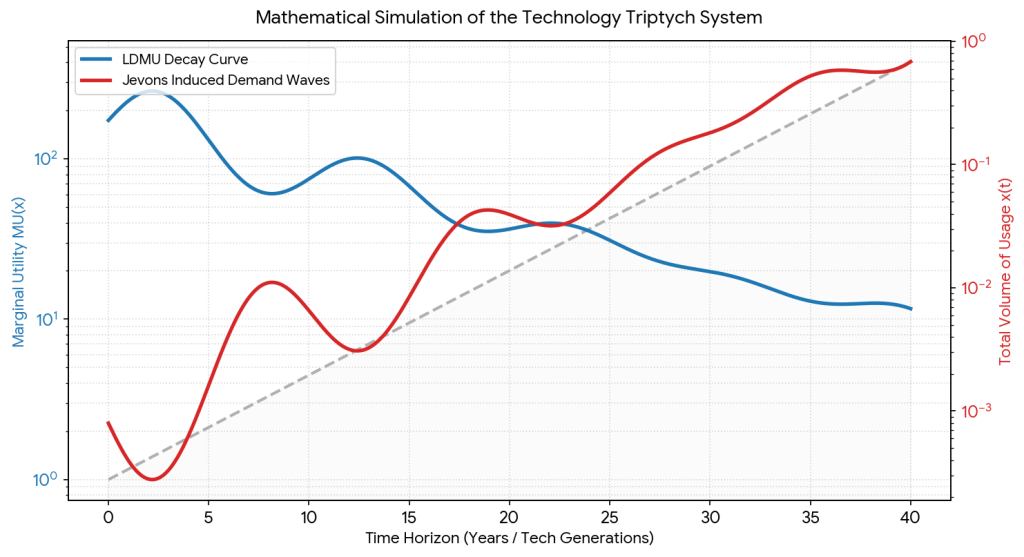
In the diagrammatically represented way, Moore’s Law amplifies Jevons’ Paradox and delays the felt bite of LDMU. The economy cycles through waves of enthusiasm: new use cases emerge, old thresholds are breached, and society forgets, for a while, that human appetite has its limits. The technologies are not endless; but the illusion of limitlessness is sustained by the rhythm of the three laws playing out in sequence.
(To be concluded)
Sudarshan Madabushi