Human Nature, LDMU, and the Search for “Parama Puruṣārtha”
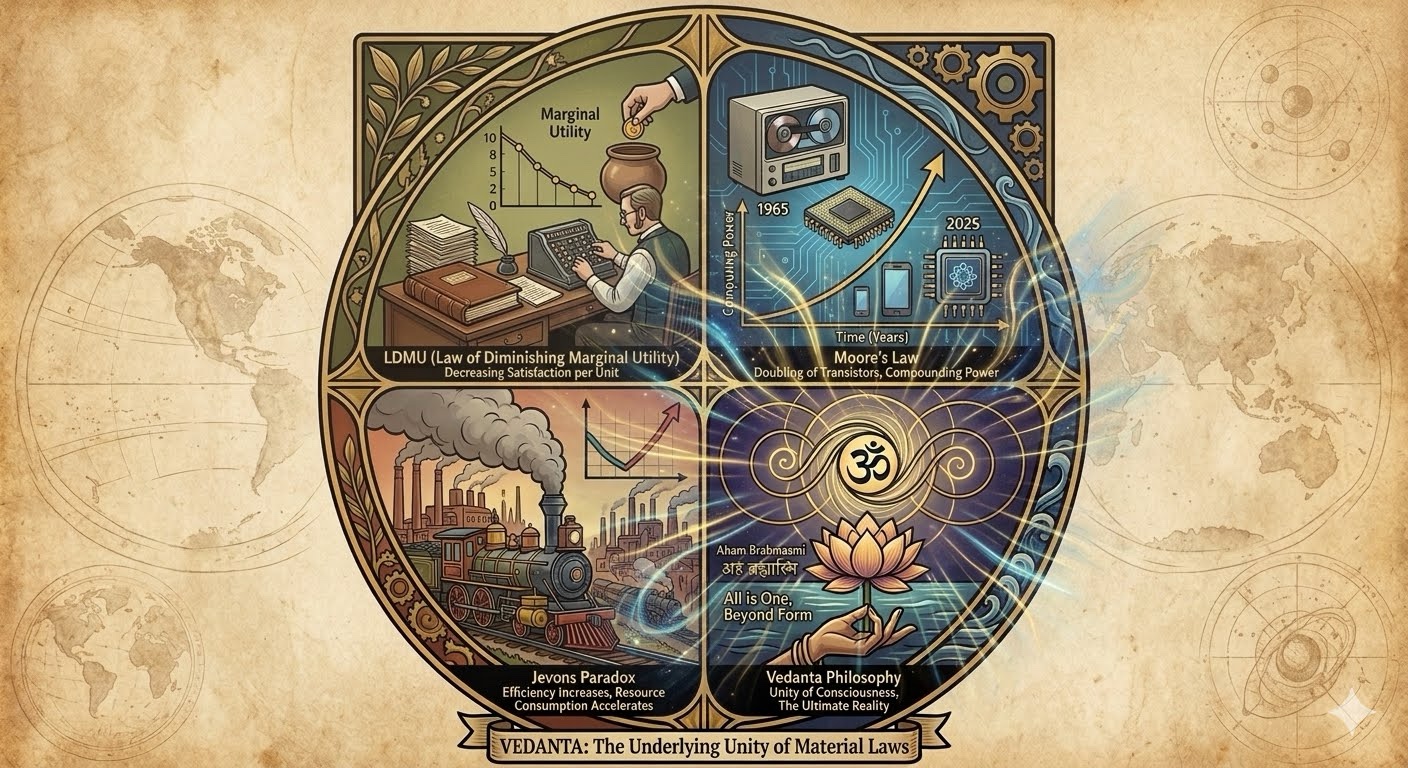
Yet that sequence cannot go on forever. For all the empirical power of Moore’s Law and of Jevons’ Paradox, there is a deeper, more stubborn constant: human nature itself. And human nature, as the law of diminishing marginal utility suggests, is wired for satiation, for a point at which “more” no longer feels like progress.
At some threshold, the thrill of the latest upgrade, the latest algorithm, the latest interface, begins to fade. The marginal joy of an extra gigabyte, an extra AI model, an extra app, is not zero, but it is small. The resource‑costs—energy, attention, cognitive load, ecological strain—begin to outweigh the incremental benefits. Society may not declare it in a formal statement, but there is a quiet, collective realization: enough is enough.
This is not the abandonment of technology, but its demotion from a sacred project to a background infrastructure. The world does not stop innovating, but the assumption that more innovation is always better begins to crack. The existential question then shifts: if material abundance and technological prowess are no longer the primary measures of a good life, what is?
Here one enters the perennial philosophical terrain that the economic laws do not, and cannot, answer. The law of diminishing marginal utility hints at a limit to instrumental satisfaction; Jevons’ Paradox and Moore’s Law describe the machinery of how we reach that limit so quickly. But the question of what lies beyond—what “What next?” means in the fullness of human life—belongs to philosophy, ethics, and religion.
In the Sri Vaishnava Vedantic tradition, this horizon is named parama puruṣārtha: not merely release from suffering, nor mere escape from the world, but the realisation of one’s true nature as an eternal, non‑separate part of the divine whole, abiding in svarūpa‑sukha and nitya kainkaryam. It is the final answer to the restless question that technology, for all its power, can only ever postpone.
So, in the end, human nature and LDMU do not cancel Moore’s Law and Jevons’ Paradox; they frame them. The technological surge is real, vivid, even exhilarating. But it is ultimately a means, not an end. The deeper current of human desire—beyond gadgets, beyond efficiency, beyond endless novelty—is the search for eternal truth and meaning, for a parama puruṣārtha that neither Buddhist duḥkha nor Christian anomie can capture, and that no chip‑cycle can finally replace.
It is thus that today, as a septuagenarian post‑retirement social observer, that I have come to appreciate the three laws not as mere abstractions, but as a quiet invitation: to let technology mature, to let innovation slow, and to turn, at last, toward the perennial question—what is the true end of a human life?
(Concluded)
Sudarshan Madabushi