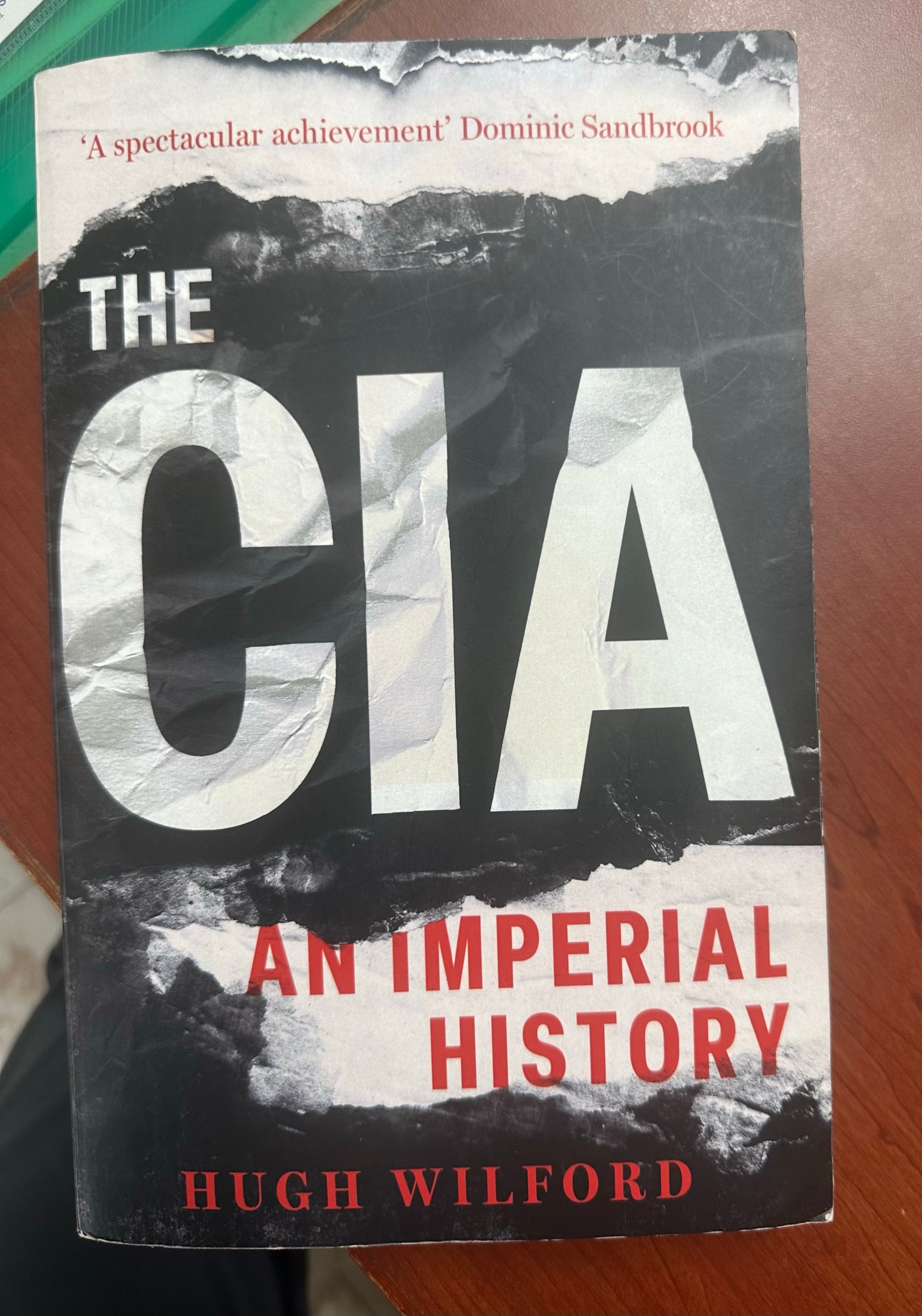
Hugh Wilford’s The CIA: An Imperial History shows that the Agency’s most dangerous weapon was never a gadget but a story: an imperial literary imagination — Kipling, Lawrence, Greene, Hollywood — that taught America how to see, intervene in, and narrate the world.
I’ve just finished reading the book and I now understand the CIA is not merely a secretive bureaucracy (“deep state”) but is heir to Anglo-European spymaster traditions — a shadowy arbiter whose cinematic glamour masks a long, pernicious — perhaps at times even malevolent — inheritance of empire.
*********************
An institution shaped by stories
Hugh Wilford’s The CIA: An Imperial History is less a catalogue of cloak-and-dagger episodes than a cultural and intellectual excavation of the Agency’s soul. Wilford compels the reader to see the CIA not only as an instrument of state power — coups, covert action, surveillance, subterfuge and the “enhanced interrogations” and deniable political assassinations that darken its record — but as an institution shaped by a particular literary imagination and an imperial habit of mind. This is a book about politics and policy, yes, but also about reading: about how novels, memoirs, and travelogues supplied models, metaphors, and moral vocabularies that helped make the Agency what it became.
A revisionist genealogy
Hugh Wilford offers a revisionist genealogy of the CIA: its operations and doctrines are best understood through the cultural world occupied by its founders and senior officers. Instead of treating Central Intelligence as a purely bureaucratic or technological product of the Cold War, Wilford traces the agency’s instincts to a classically imperial formation — men groomed in elite Ivy League schools, steeped in Anglo-European travel literature, and literate in the narratives of adventure, secrecy, and civilizational mission. This alone makes his book valuable: it redirects our attention from gadgets, spyware and top-secret memos to literature, posture, and imagination.
Literature as operational model
Wilford’s central theses are lucid and persuasive. He shows how founding figures of the CIA and its early leaders — such as Sherman Kent, Kermit “Kim” Roosevelt, Edward Lansdale, James Angleton, and others —,were animated by the same texts that shaped nineteenth- and early twentieth-century imperial officers: Rudyard Kipling’s tales of frontier cunning, T. E. Lawrence’s Seven Pillars of Wisdom, the moral ambiguities in Graham Greene’s novels, the biting satire of Eugene Burdick and William Lederer’s The Ugly American.
These literary works supplied templates for conduct, helped normalize forms of intervention, and furnished metaphors — “civilizing mission,” “native management,” “hearts and minds” — that translated comfortably into covert operations.
Iran and Guatemala
The historical record shows how this mentality operated in practice.
In Iran, Kermit “Kim” Roosevelt Jr., grandson of President Theodore Roosevelt (who btw, loved Kipling novels) played a central role in the 1953 coup that removed Mohammad Mossadegh from power.
In Guatemala, the overthrow of Jacobo Árbenz was bound up with the interests of the United Fruit Company, whose threatened banana import business empire helped turn land reform into a target of covert action.
These episodes reveal how closely intelligence, empire, and corporate power could work together in the postwar world.
Cultural specificity
The book’s particular strength is its cultural specificity. Wilford does not merely assert influence; he documents it. He recounts how Lawrence’s book served for a time as required reading, how Graham Greene’s Quiet American functioned as a cautionary mirror to American interventionism, and how popular novels and films both reflected and reinforced CIA self-understanding.
The result is an argument that the Agency’s imperial tendencies were not accidental by-products but partly cultivated dispositions with deep aesthetic roots. Angleton’s intimate friend and sounding board of ideas was Ian Fleming, creator of James Bond.
CIA and popular culture
Wilford also shows the reciprocal circulation between the CIA and popular American culture.
The Agency fed fiction and cinema as much as it consumed them. From Angleton’s murky sympathies with literary modes of conspiracy to the later Hollywood-CIA rapport that produced celebrated blockbusters, the book maps a two-way flow: the CIA shaped representations of espionage even while those representations legitimated certain kinds of action in the eyes of the common masses.
Films such as The Manchurian Candidate and the Jack Ryan and Jason Bourne sequels of thrillers belong to this wider atmosphere of intelligence-driven paranoia, where espionage became both political reality and cinematic grammar.
Archival depth and limits
The book’s archival work is commendable. Wilford draws on declassified documents, memoirs, and correspondence to make his cultural claims concrete. He avoids romanticizing the literary influences; his account is clear-eyed about the human costs of covert action. Where the book cannot fully answer every causal pathway between reading and doing, it nonetheless supplies enough evidence to make the connection plausible and troubling.
A necessary caveat
A few caveats are worth noting. Wilford’s focus on the Anglophone literary canon risks underplaying other vectors: the organizational dynamics of U.S. foreign policy, interagency competition, domestic political imperatives, and technological innovations that also guided CIA practice.
In some chapters the literary thesis occasionally reads as the dominant explanation when a more plural account might be closer to the truth. Yet this is not a fatal flaw; rather, it is the deliberate trade-off Wilford makes to illuminate an understudied dimension of the Agency.
Why the book matters
For readers like me interested in literature, history, and postcolonial studies, and even the cultural life of American imperialism, The CIA: An Imperial History is fascinating. It reframes familiar episodes — coups in Iran and Guatemala, Vietnam-era interventions, the shadow wars of the Cold War, the Global War on Terror (GWOT)— as episodes that owe as much to imagination and narrative habit as to geopolitics and strategy.
The book helps explain why the CIA’s practices often felt at home in the landscapes of empire: because its leaders had learned to narrate portrayals of foreign peoples and places in precisely those imperial idioms… those bequeathed by the likes of Lawrence of Arabia and Graham Greene.
India, empire, and memory
As a reader here in India, with indelible memories of a long history of colonial rule and the suppression that accompanied it — much of which was enabled by the British Empire’s intelligence apparatus (that today is known as MI6 — I found Wilford’s thesis especially resonant. The CIA, in large part, is truly an inheritance and imitation of that Anglo-European spymaster-ship. Its nefariousness flourishes today not only because of covert capabilities but because American literary traditions, amplified by Hollywood, have made the Agency into an unacknowledged legislator and a shadowy arbiter of world affairs. After all and as we all know it only too well, the hidden hand that works the levers behind the scenes in both the Russo-Ukraine and the US-Iran Wars is the CIA.
Closing assessment
In sum, this is a stimulating, well-documented, and richly argued study. It will interest historians and political scientists, but also literary buffs, film historians, and anyone curious about how stories — and storytelling — shape great power.
The CIA emerges from this book’s pages not merely as a machine of secrecy, but as an ensemble of adventure-story readers and writers who turned imperial narratives into modern instruments of espionage, intelligence work, into covert meddling and purveying policy for projecting great power and international influence around the world — and in doing so, made the United States’ postwar interventions not only possible, but narratable.
I had never imagined that the CIA, of all places in the world, would be the place where Literature met Imperialism in flesh and blood. This book opened my eyes anew to an old truth: the pen can indeed be mightier than the sword.
Sudarshan Madabushi