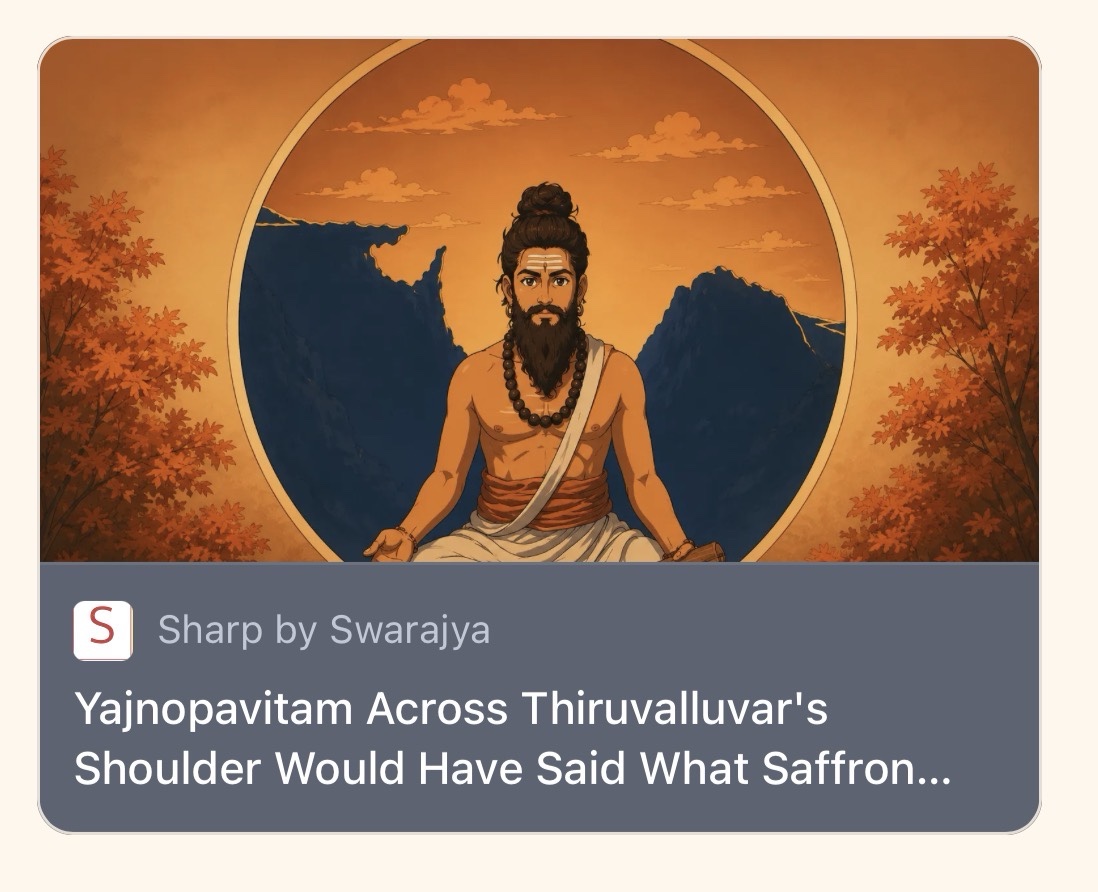

QUOTE: “The honest reclamation is available, and far more powerful. Tamil tradition holds that Valluvar belonged to the Paraiyar community, and that Valluvar itself designated the priestly and astrological lineage within it.
Gustav Oppert documented in 1893 that the Valluvar Purohits wore the yajnopavitam by right, performed Sanskrit ceremonies at Paraiyar and Pallar weddings, and were respectfully consulted by Brahman families on matters of astrology.
The anthropologist Michael Moffatt, working in Tamil Nadu in the 1970s, found the same continuity intact. The sixteenth-century text Gnana Vettiyan, attributed to Thiruvalluvar himself, asserts the community’s right to the sacred thread and the inner dignity it signifies.
What the (Tamil Nad) Governor’s office should have done, with care and scholarship, was to restore the yajnopavitam to the portrait.
That single change would have carried a historical claim no saffron robe ever can. It would have shown, in quiet visual truth, that the highest ethical voice in Tamil civilisation emerged from a community once labelled outcaste by colonial reduction, and that the community has been a full participant in Hindu sacred life all along.
What is at stake reaches beyond the colour of a robe. The question is whether Hindu cultural reclamation can rise to the seriousness of the inheritance it claims to defend. The yajnopavitam across Thiruvalluvar’s shoulder would have answered that question, and answered it without spectacle”. UNQUOTE
—— Excerpts from Aravindan Neelakandan’s OpEd in “The Swarajya”
************************
This OpEd piece of deep scholar and Hindutva ideologue Aravindan Neelakandan makes an important contribution to reclaiming Thiruvalluvar’s Hindu identity, but it risks overgeneralizing the yajnopavitam ritual across all Hindu communities in ways that obscure crucial historical complexity.
Based on the historical evidence and Dharmashastra sources that I have been able to access myself and to the best of my knowledge there are important nuances to be appreciated regarding the sacred yajnopavitam.
Three key points of nuance:
1. The Dharmashastra Divide
The upanayanam ceremony with brahmopadesam and Gayatri mantra upadesa was explicitly restricted to the trividha (three upper varnas: Brahmins, Kshatriyas, Vaishyas) per classical Dharmasutras and Manusmriti. Others were prohibited from this Vedic initiation. When non-Brahmin communities in Tamil Nadu wore the sacred thread, this was primarily under Kāmika Agama (5th–8th century CE Shaiva scripture), not Vedic Dharmashastra.[1][2][3][4]
2. Ritual Form vs. Vedic Initiation
Historical evidence reveals distinct practices:
- Brahmins: Full upanayanam before age 8-11, Gayatri upadesa, 3×9 strand thread[5][1]
- Non-Brahmins (Vellalars, Saiva Mudaliars, artisans): Wore thread during funerals/rituals only, typically simpler 3-strand thread, without Gayatri upadesa[6][7]
The Sanatkumara Samhita explicitly provides two forms of upanayana: Vedic form for Dvijas, and “antric agnimukhaM” for women and Shudras permitting ritual rites but not full Vedic Pancharatric brahmin rites.[8]
3. Hindutva’s Broad Brush vs. Historical Reality
The attempt to apply yajnopavitam uniformly across Hindu society—Thiruvalluvar, Nayanmars, Vellalars, Reddys all wearing “identical” sacred thread—reflects contemporary Hindutva ideological synthesis rather than historical practice. Medieval Tamil Shaivism developed a parallel ritual pathway for non-Brahmins that was Agamic (Shaiva temple tradition), not Vedic.[9][10]
4. The Colonial Mirror We Must Not Become
There is a sharp irony here that warrants careful attention:
The colonial era, during which India’s long history was rewritten wholesale by European Indology and Oriental Studies to serve imperial narratives, should not become the same model on which the post-Narendra Modi era of Hindutva versions of Indian history are beginning to be reconstructed.
History of India must remain faithful to the highest standards of scholarship—as a chronicling of history that resists both colonial distortions and contemporary ideological syntheses. This is precisely the standard Aravindan Neelakandan himself has always adhered to in all his major published works on Hindutva. His scholarship has consistently demonstrated nuanced engagement with textual evidence rather than broad ideological assertions.
Applying yajnopavitam uniformly across Tamil Hindu society in the name of “reclaiming” Hindu identity risks replicating the very methodological flaw we criticized in colonial Indology: imposing a pan-Indian prescriptive framework that ignores regional, textual, and community-specific variations.
Why this nuance matters:
Recognizing this distinction doesn’t diminish Thiruvalluvar’s Hindu identity (many communities revere him as 64th Nayanmar ), but it prevents us from substituting one oversimplification (colonial Dravidian atheist Thiruvalluvar) with another (post-colonial universal Vedic yajnopavitam).[11]
The more accurate historical claim perhaps ought to be stated as follows:
Thiruvalluvar belonged to the Tamil Shaivite bhakti tradition that developed distinct from Sanskrit Vedic orthodoxy, with its own ritual markers adapted for Sat-Shudra communities like the Vellalars.[12][11]
This nuance strengthens, rather than weakens, the Hindu reclamation—by grounding it in actual Tamil religious history rather than pan-Indian Vedic generalizations.
True intellectual integrity in the post-colonial era means resisting the temptation to reconstruct history through ideology, regardless of which ideological lens we use.
Sudarshan Madabushi
Sources
[1] Upanayana | Sacred Thread, Vedic Rituals & Brahmins https://www.britannica.com/topic/upanayana
[2] HistoriCity: How caste evolved in ancient India https://www.hindustantimes.com/opinion/historicity-how-caste-evolved-in-ancient-india-101744641413484.html
[3] Kamika Agama – Wikipedia https://en.wikipedia.org/wiki/Kamika_Agama
[4] Kamika Agama: Shaiva Scripture of Ritual & Architecture https://shastradeep.com/agamas-tantras/shaiva-agamas/kamikam
[5] Varnashrama Dharma https://www.wisdomlib.org/hinduism/book/the-narada-purana/d/doc57537.html
[6] The sacred thread, or poonool, is often associated … https://www.facebook.com/sharmalan.thevar/posts/the-sacred-thread-or-poonool-is-often-associated-exclusively-with-brahmins-but-t/10169068147010153/
[7] Some interesting stuff about the practuce od wearing the sacred thread in Tamil Nadu and Andhra Pradesh https://www.reddit.com/r/Dravidiology/comments/1pjvmhu/some_interesting_stuff_about_the_practuce_od/
[8] Mantras to Change Poonal – Sacred Thread | Yagnopaveeta Dharana Prayoga | Yajur Smartha & Rig Veda https://www.youtube.com/watch?v=w-Cj-27isOg
[9] The making of Tamil Shaiva Siddhānta – Ginette Ishimatsu, 1999 https://journals.sagepub.com/doi/10.1177/006996679903300304
[10] Draft:Saiva Mudaliar – Wikipedia https://en.wikipedia.org/wiki/Draft:Saiva_Mudaliar
[11] Thiruvalluvar – PMF IAS https://www.pmfias.com/thiruvalluvar/
[12] Vellalar – Uncensorable Wikipedia on IPFS https://en.wikipedia-on-ipfs.org/wiki/Vellalar