
Overview
In contemporary political economy, entrepreneurship is often presented as a morally elevated force of innovation, risk-bearing, and social progress. Yet the structure of the modern corporate economy suggests a different interpretation: entrepreneurship functions largely as the legitimating language through which capital organizes production, appropriates profits, and normalizes an unequal distribution of national wealth.
Across advanced economies, the modern corporation has become the central institution through which resources are allocated, labour is priced, and profits are consolidated. The key question is therefore not whether entrepreneurship exists, but whose interests it serves, how its rewards are distributed, and what political order secures that distribution.
Capital and Labour
In classical political economy, labour denotes human productive activity: the physical, technical, and intellectual effort that creates goods and services. It also denotes the social class that depends primarily on wages, salaries, benefits, and other forms of compensation for subsistence.
Capital denotes accumulated wealth deployed in production, including plant, machinery, financial assets, and ownership claims over firms. Socially, it denotes the class that owns productive assets and receives profits, dividends, retained earnings, and capital gains by virtue of ownership rather than direct productive effort.
This distinction remained central for both Adam Smith and Marx, though they interpreted it differently. Smith treated capital as stock advanced to employ labour and raise productivity, while Marx treated capital as a social relation through which owners of the means of production appropriate value created by workers.
Entrepreneurship
Entrepreneurship is usually defined as the activity of organizing production under uncertainty: combining capital, labour, technology, and managerial judgment in order to produce for profit. In modern economic discourse, the entrepreneur is praised as innovator, coordinator, and risk-bearer.
In the actual corporate economy, however, entrepreneurship is rarely a free-floating social force. It is embedded within corporations governed by boards, major investors, state authorities, and shareholder expectations, so the entrepreneurial function is ordinarily subordinated to the imperatives of capital accumulation.
For that reason, entrepreneurship is better understood not as a third force standing neutrally between labour and capital, but as a strategic and ideological function largely exercised on behalf of capital. It is the active intelligence of ownership, even when carried out by managers who are not themselves the ultimate owners.
The Corporate Order
The corporate world, whether privately owned or state owned, dominates the global economy because it controls the main channels through which investment decisions, employment structures, supply chains, pricing, and retained earnings are organized. Large firms do not merely respond to markets; they help structure the very conditions under which markets operate (e.g. “BigTech”, “BigPharma”, “OPEC”, “BigBanks” etc.)
This gives corporations extraordinary influence over the distribution of national wealth. By deciding how much revenue is paid as wages, how much is retained, how much is distributed as dividends, and how much is reinvested or redirected toward financial objectives, corporations act as practical arbiters of resource allocation within national economies.
That power is amplified by political leverage. Trade regimes, labour law, tax design, financial regulation, competition policy, and campaign finance rules all affect the relative bargaining strength of labour and capital, and the empirical record shows that declining union density and increasing globalization have shifted the balance toward capital.
Profits, GVA, and Surplus Value

A crucial conceptual distinction is the one between corporate profits and gross value added. Gross value added is the total new value generated by production and then divided among wages, profits, interest, and taxes, whereas profits are only the residual accruing to owners after labour and other costs have been paid.
This means labour does not receive a share of profits as such; labour receives compensation out of total output before profits are calculated. Capital, by contrast, claims profits in the forms of dividends, retained earnings, balance-sheet appreciation, and implicit shareholder wealth creation.
In Marxian terms, the ethical issue appears at the level of surplus value. Workers produce more value than is returned to them in wages, and that unpaid excess is appropriated by capital as profit, interest, and rent. What appears in modern accounting as lawful return on ownership appears in Marxian analysis as unpaid labour.

The ideological usefulness of entrepreneurship lies precisely here. It converts the appropriation of surplus into a moral drama of initiative, genius, and risk-taking, thereby obscuring the more basic relation between those who work and those who own.
Present Distribution
The best broad empirical estimates do not show labour receiving part of profits; they show labour receiving a larger share of gross value added, while capital receives the entirety of profits. Across many economies, labour’s share of total income or value added has often been in the rough range of 55 to 65 percent, while capital’s share has often been around 35 to 45 percent, though these ratios vary by country and period and have generally moved in capital’s favour in recent decades.

Within that overall split, profit itself belongs to capital. Research summarized in discussions of corporate income distribution shows a rising pure profit share and a notable increase in retained earnings, meaning that gains are not only paid out as dividends but also stored within firms in ways that enhance shareholder wealth and net worth.
The long-run trend across industrial democracies has been especially important: compensation has weakened relative to profits, and globalization, weaker unions, and market concentration have all contributed to this shift. In that sense, the central contemporary fact is not merely that capital receives profits, but that it has increased its claim over the social surplus over time.
Why the Scale Tips to Capital
The distribution is skewed because the scale of justice is never purely economic; it is political from the start. Ownership rights, contract enforcement, the legal form of the corporation, tax privileges, intellectual property protections, and the permissible scope of collective bargaining are all political constructions that shape how market outcomes are produced.
If labour and capital met on genuinely equal terms, the distribution of the surplus might be different. But labour typically enters the market needing wages for survival, while capital enters with reserves, mobility, legal protection, and stronger access to the institutions of the state, including lobbying, campaign finance, and regulatory influence.
The consequence is that justice does not fail accidentally; it is structurally tilted. The scale appears economic on the surface, but the weights placed upon it are political, and those weights are usually supplied by capital.
Economic and Ethical harness
At the economic level, entrepreneurship in modern corporate capitalism is best understood not as a neutral productive factor but as the language and practice through which capital directs production and legitimates its appropriation of profit. Even where entrepreneurship involves real coordination, creativity, and uncertainty-bearing, those functions are institutionally harnessed to shareholder value and capital accumulation.
At the philosophical and ethical level, the glorification of entrepreneurship often serves as virtue-signalling for an order centered on large-scale profit-taking and shareholder-class wealth creation. It presents unequal appropriation as merit, dependence as opportunity, and structural power as moral desert.

The larger implication is that politics will always trump economics, whether the framework is Smithian, Marxist, liberal, social democratic, or authoritarian. Every economic order depends upon prior decisions about property, coercion, law, representation, and institutional power, and for that reason the final arbiter of distribution is political struggle rather than impersonal market reason.
In both democracy and autocracy, the contest over wealth is therefore a contest over power. Under present conditions, capital usually enters that contest with the decisive advantage, while labour bears the burden of productive effort without commanding the institutions that govern the surplus it creates.
A Win-Win Rebalancing of Entrepreneurship
The critique of corporate capitalism need not be framed as a zero-sum assault on entrepreneurship, nor as a mere revival of class war in Marxist form. In a country such as India, where inequality is already severe and the consumption base of the economy remains fragile, the more urgent question is whether entrepreneurship can be reimagined as a socially productive compact rather than an extractive claim over surplus.
If a portion of corporate profit is redirected toward labour in the form of wages, benefits, pensions, and secure employment, the result is not simply a transfer from capital to labour. It is also an expansion of aggregate demand, a strengthening of domestic consumption, and a broader social base for growth. Labour’s increased purchasing power becomes capital’s expanded market. In that sense, redistribution is not the destruction of entrepreneurship but its macroeconomic stabilization.
The deepest mistake of modern corporate ideology is to treat every clawback as a loss to capital. In reality, capital prospers most when labour has enough income to buy, sustain, and reproduce the economy’s output. A profitable corporate order that rests on weak mass consumption is ultimately self-defeating. Entrepreneurship therefore becomes most defensible when it accepts that part of social surplus must circulate back to labour, not as charity, but as a condition of durable prosperity.
This is why the issue is not whether India should choose capital or labour, but whether it can construct a distributive order in which capital’s gains are no longer purchased at the expense of social exhaustion. A less unequal economy is not necessarily a less entrepreneurial one. On the contrary, it may be the only form of entrepreneurship that can remain legitimate, stable, and growth-generating in the long run.
Final Coda: The Permanent Corporate Order
The deeper truth revealed by this analysis is that the corporate order is precisely what contemporary intellectuals, politicians, and global rulers are defending when they speak of a “new world order.”
Whether framed as globalization, digital transformation, sustainable capitalism, AI-driven economy, or climate-responsive governance, the project is not to dismantle corporate capitalism but to reorganize it under new banners while preserving its structural core.
The “new world order” discourse is virtue-signalling at the geopolitical level, parallel to how “entrepreneurship” functions at the corporate level. Both serve as ideological covers that make extraction appear as innovation, dependence as opportunity, and power as moral desert.
What the “New World Order” Preserves
Surface Narrative Structural Reality


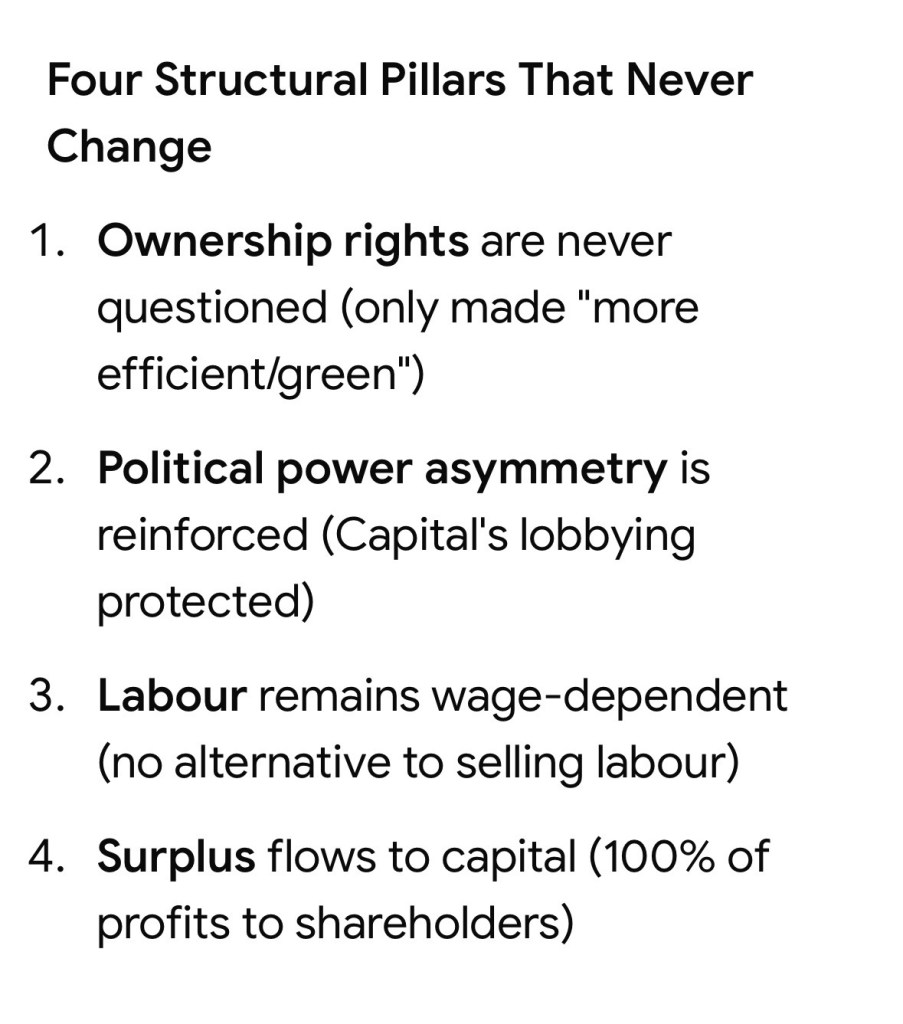
The Unspoken Truth
What rulers and intellectuals never say openly:
“We are not building a new order. We are maintaining the old corporate-capitalist order while changing its labels, tools, and technologies.”
The “new world order” is the same edifice with renovated facades. The winner remains Capital. The loser remains Labour. The scale of justice never tips because the political weights are owned by Capital.
The Final Conclusion
The corporate order is not merely economically dominant — it is politically permanent. All “new world” discourse is its legitimizing mythology. This is the structural truth that both Adam Smith’s liberal framework and Marx’s critique unmistakably reveal, even though they disagree on whether this structure is desirable.
Politics dictates distribution, not markets. And politics is the game where Capital always wins — in democracy and in autocracy alike. This is the basic structure on which the edifice of modern humanity is built.
There is no escaping it through market reforms, technological innovation, or moral rhetoric. The only question is whether this structure will ever be confronted directly, or whether humanity will continue to legitimize its own subordination through the virtue-signalling language of entrepreneurship and the “new world order.”
Sudarshan Madabushi