by M.K.Sudarshan
Chennai, India
June 20, 2026
The Orient Express was the world’s most famous luxury passenger train service, operating from 1883 to 2009. it famously connected Paris to Istanbul (then Constantinople). It became a global icon of glamour, diplomacy, and intrigue, forever immortalized by Agatha Christie’s 1934 novel, “Murder on the Orient Express”.
There’s a new Orient Express today that will perhaps run from Teheran east to Islamabad and west to Istanbul.
******************
The sudden emergence of the Islamabad Memorandum of Understanding (MOU)—signed from the gilded halls of Versailles by President Donald Trump and synchronized with President Masoud Pezeshkian in Tehran—has sent shockwaves across the global geopolitical architecture. To its champions, the 14-point framework is a masterful, transactional masterstroke that instantly defused a 110-day war, re-opened the economically choked Strait of Hormuz, and threw a lifeline to global oil markets. To skeptics, however, the agreement carries the distinct, unnerving scent of September 1938.
The historical parallels are hard to ignore. Much like Neville Chamberlain’s fateful “Peace for our time” deal in Munich, the 2026 MOU relies heavily on front-loaded concessions. By immediately lifting the naval blockade and issuing Treasury waivers for Iranian crude, Washington has traded its most potent economic leverage upfront in exchange for a highly volatile 60-day negotiation window.
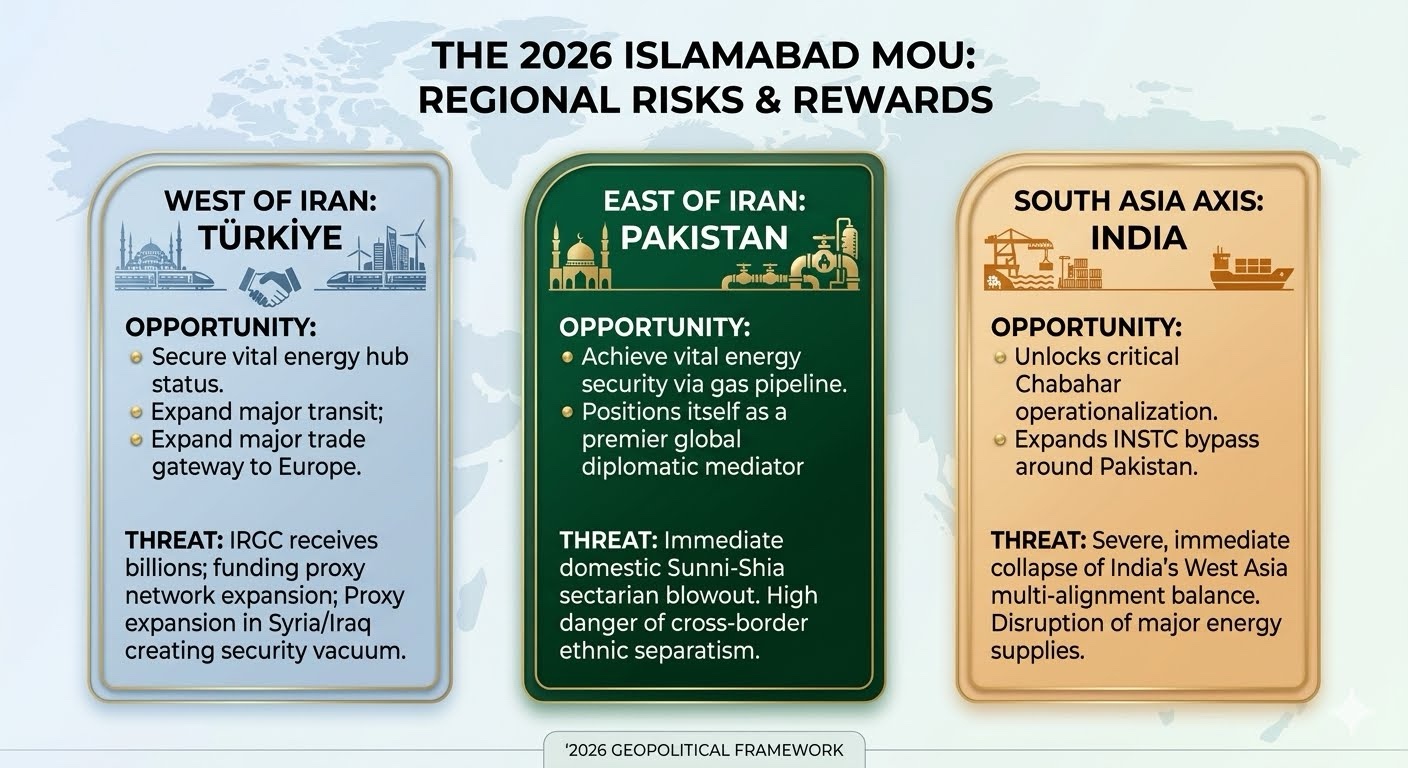
But history rarely repeats without a twist, and the true gravity of this truce lies in the sweeping “ponderables” expanding across the Eurasian landscape. For the regional heavyweights flanking the Islamic Republic—Türkiye, Pakistan, and India—the agreement represents a high-stakes gambling table where the potential windfalls are massive, but the downside risks are existential. And the gambling table are inside what may be imagined to be a new Orient Express that will soon run from Teheran westward to Istanbul and east to Islamabad.
The View from the West: Türkiye’s Calculated Pragmatism
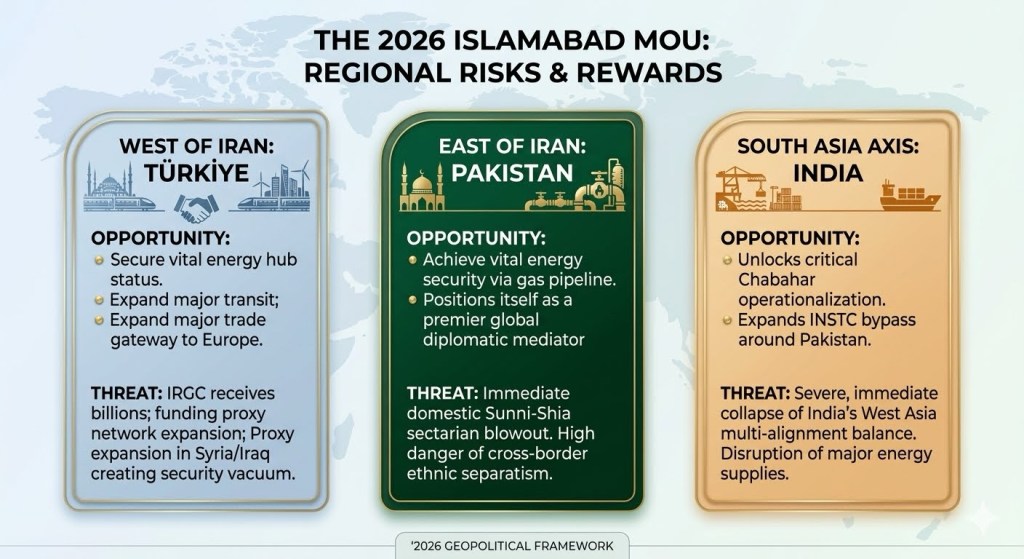
For Ankara, the potential containment of a wider war and the corresponding deceleration of the “Greater Israel Project” offer a historic geopolitical opening. President Recep Tayyip Erdoğan has long positioned Türkiye as the ultimate vocal defender of regional sovereignty against Anglo-American-Zionist imperial architectures. A permanent freeze on Israeli regional expansion validates Ankara’s soft power across the Arab street.
Structurally, it also blunts Western-backed “buffer state” theories that rely on a partitioned Syria or Iraq. Economically, an un-sanctioned Iran turns Türkiye into the absolute premier transit hub for Eastern energy flowing into Europe.
Yet, Turkish defense planners are far from celebrating. Sanctions relief means an immediate, massive infusion of capital directly into the coffers of the Islamic Revolutionary Guard Corps (IRGC). Ankara is fully aware that a wealthy, emboldened Iran is a direct competitor. Tehran could quickly utilize its unfrozen billions to heavily reinforce its proxy networks in northern Iraq and Syria, actively squeezing Turkish military footprints.
Furthermore, if the U.S. uses this MOU as a pretext for a rapid military exit, Türkiye will be left holding a live wire—forced to police a chaotic Syrian border vacuum alone.
The View from the East: Pakistan’s Strategic Paradox
If Türkiye views the deal with cautious optimism, its eastern broker views it with sheer vertigo. Pakistan achieved an unprecedented diplomatic victory by serving as the neutral intermediary that quietly managed the backchannels for the framework. The immediate economic rewards are clear: with U.S. waivers secured, Islamabad can finally construct its portion of the long-delayed Iran-Pakistan (IP) gas pipeline, avoiding a crippling $20 billion penalty while solving its internal energy starvation.
However, Pakistan’s domestic ground realities make it uniquely vulnerable to any sudden unraveling. The country sits squarely on the region’s most explosive ethnic and religious fault lines. In Balochistan, an unstable border shared with Iran remains vulnerable to cross-border separatist insurgencies. To the north, a volatile relationship with the Afghan Taliban complicates counter-terrorism efforts.
Most dangerous of all is the internal Sunni-Shia dynamic. Pakistan relies heavily on billions in financial backing from Saudi Arabia, and its military leadership has quietly promised Riyadh it will defend Gulf sovereignty if Iranian proxies push too far. If the 60-day Switzerland talks collapse and regional proxies resume attacks on Gulf oil infrastructure, Islamabad will be trapped in an impossible choice between its economic patron and its immediate neighbor—a choice that could instantly ignite violent, domestic sectarian polarization.
The South Asia Axis: India’s Continental Gamble
Beyond Pakistan’s borders, India watches the 60-day tightrope with acute strategic anxiety. For New Delhi, Indo-Iranian relations are the gateway to Central Asia and a vital counter-weight to China’s regional influence.
- The Success Scenario: If the MOU holds, India stands to gain immensely. Permanent relief from U.S. secondary sanctions allows New Delhi to aggressively revive its 10-year operational lease of Iran’s Chabahar Port. A sanctions-free Iran fully operationalizes the International North-South Transport Corridor (INSTC), granting India an uninterrupted, land-based trade highway to Central Asia and Russia that completely bypasses Pakistan. Furthermore, the return of Iranian oil imports offers India a critical option to diversify its energy basket away from over-reliance on Moscow.
- The Unraveling Threat: Conversely, a sudden collapse of the MOU would shatter New Delhi’s delicate West Asian balancing act. India has spent the last decade painstakingly building deep strategic and technological partnerships with Israel (via the I2U2 mini-lateral framework) while simultaneously investing in Iran. If the truce fails and the region descends into a larger war, India’s multi-alignment strategy will implode. Forced to navigate a hot conflict, New Delhi would face the immediate disruption of its trade routes, massive energy price spikes, and a severe threat to the 8.5 million-strong Indian diaspora sending critical remittances back from the Persian Gulf.
The Verdict: A Fragmented Architecture
The structural flaw of the grand geopolitical architectures designed by Wall Street, London, or localized actors is the illusion of top-down control. Today’s reality is highly fragmented. Even as global markets demand a pause to curb runaway inflation and prevent maritime paralysis, independent actors maintain their own sovereign red lines. The Israeli military’s continued heavy airstrikes in southern Lebanon—which have already triggered a postponement of the technical talks in Switzerland—prove that localized actors can easily disrupt the designs of global capital.
Ultimately, the Trump-Pezeshkian MOU is not a definitive resolution, but a high-stakes breathing spell. It is a tactical pause where the economic survival of the international system has temporarily taken precedence over ideological territorial expansion. Whether this 60-day window yields a permanent security matrix or serves as a brief interlude before a much larger, catastrophic explosion depends entirely on whether regional actors choose to exploit the immediate opportunities, or trigger the hair-keys of the unravelling threats.
The Sino-Russian Shadow Over Eurasia
As the powers of West and South Asia navigate the shifting currents of the Islamabad MOU, the two continental titans overlooking this geopolitical landscape—China and Russia—are already recalibrating their own ambitions. For Beijing and Moscow, the potential stabilization or fragmentation of Iran’s borders is not a localized crisis, but a strategic variable in their broader campaign to dismantle the post-Cold War, U.S.-led global hierarchy.
China: The Architecture of Economic Integration
For Beijing, the Middle East is the vital western bridge of the Belt and Road Initiative (BRI). China views the 2026 truce through a strictly mercantile and energy-centric lens.
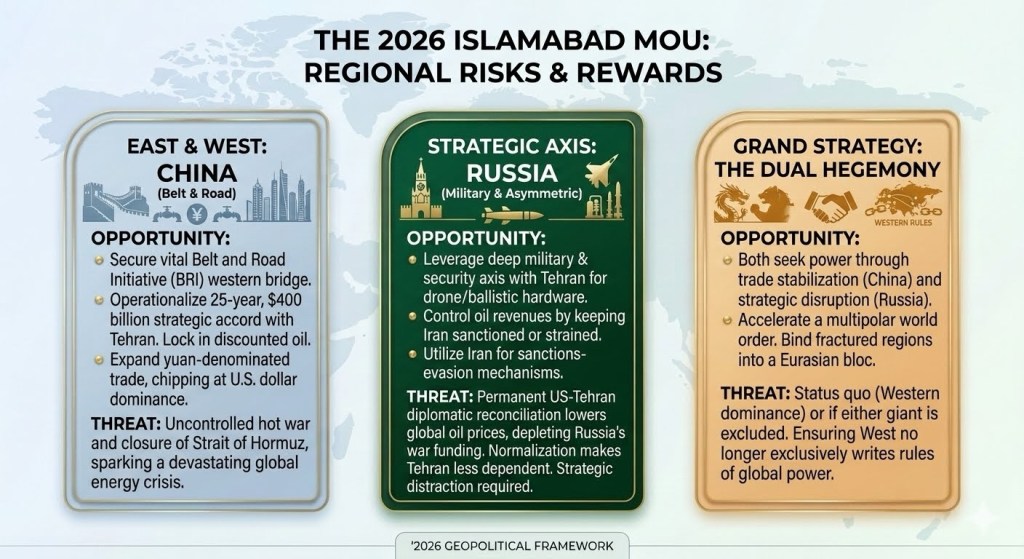
- The Success Path: If the framework holds, China is poised to be its ultimate economic beneficiary. A stabilized, un-sanctioned Iran allows Beijing to fully operationalize its 25-year, $400 billion strategic accord with Tehran, locking in massive quantities of discounted oil and expanding yuan-denominated trade networks that chip away at the dominance of the U.S. dollar. Beijing can secure its commercial supply lines across the Persian Gulf without the financial burden of acting as a regional military policeman.
- The Threat of Chaos: China’s primary fear is an uncontrolled, hot war that closes the Strait of Hormuz. Such an outcome would spark a devastating global energy crisis, threatening China’s domestic economic growth and disrupting its intricate infrastructure investments across Central and South Asia.
Russia: The Premium on Strategic Distraction
Moscow’s calculus is starkly different, driven by asymmetric warfare and geopolitical survival. Over the past several years, Russia and Iran have forged a deep military and security axis, turning Tehran into a critical pipeline for drone technology, ballistic hardware, and sanctions-evasion mechanisms.
- The Risks of Peace: A permanent diplomatic reconciliation between Washington and Tehran carries hidden risks for the Kremlin. A normalized Iran, fully integrated into Western energy markets, would lower global oil prices—directly depleting the oil revenues Russia relies on to fund its military campaigns in Europe. Furthermore, a diplomatic breakthrough could give Tehran less incentive to remain a dependent junior partner to Moscow.
- The Utility of Friction: Consequently, Russia’s interest lies in a state of controlled tension. If the MOU unravels into a larger conflict, it serves Moscow’s grand strategy by permanently diverting Western military resources and diplomatic attention away from the European theater.
The Dual Hegemony
Ultimately, while China seeks to build power through trade stabilization and Russia seeks to project power through strategic disruption, both giants view the 60-day window as a moment to accelerate a multipolar world order. Whether the Trump–Pezeshkian deal succeeds or shatters, Beijing and Moscow are quietly binding the fractured pieces of West and South Asia into a larger, interconnected Eurasian bloc—ensuring that whatever happens next, the rules of global power will no longer be written exclusively by the West.
(Concluded)