How retirees buy consolation instead of doing the work of the Self
By M.K. Sudarshan
Chennai , India : June 21, 2026
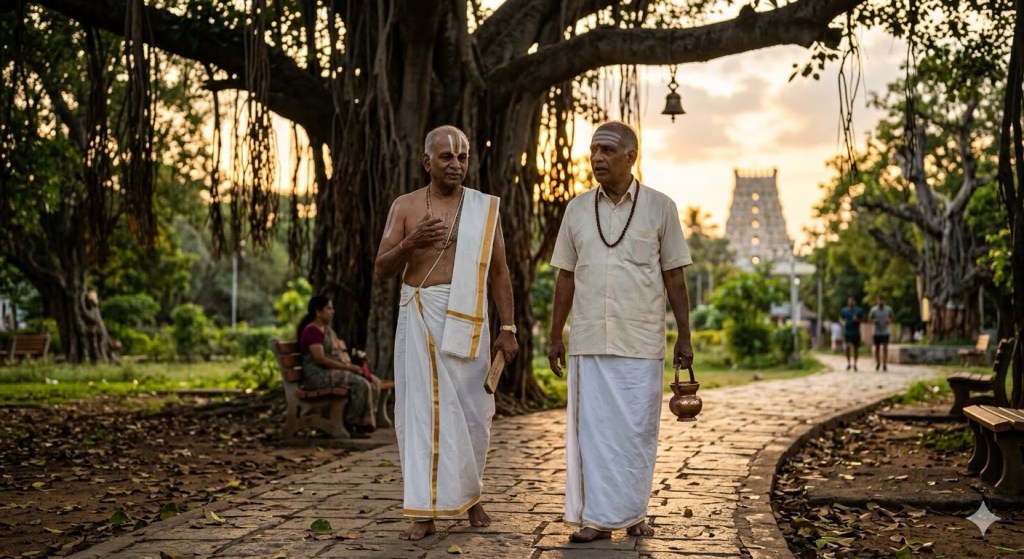
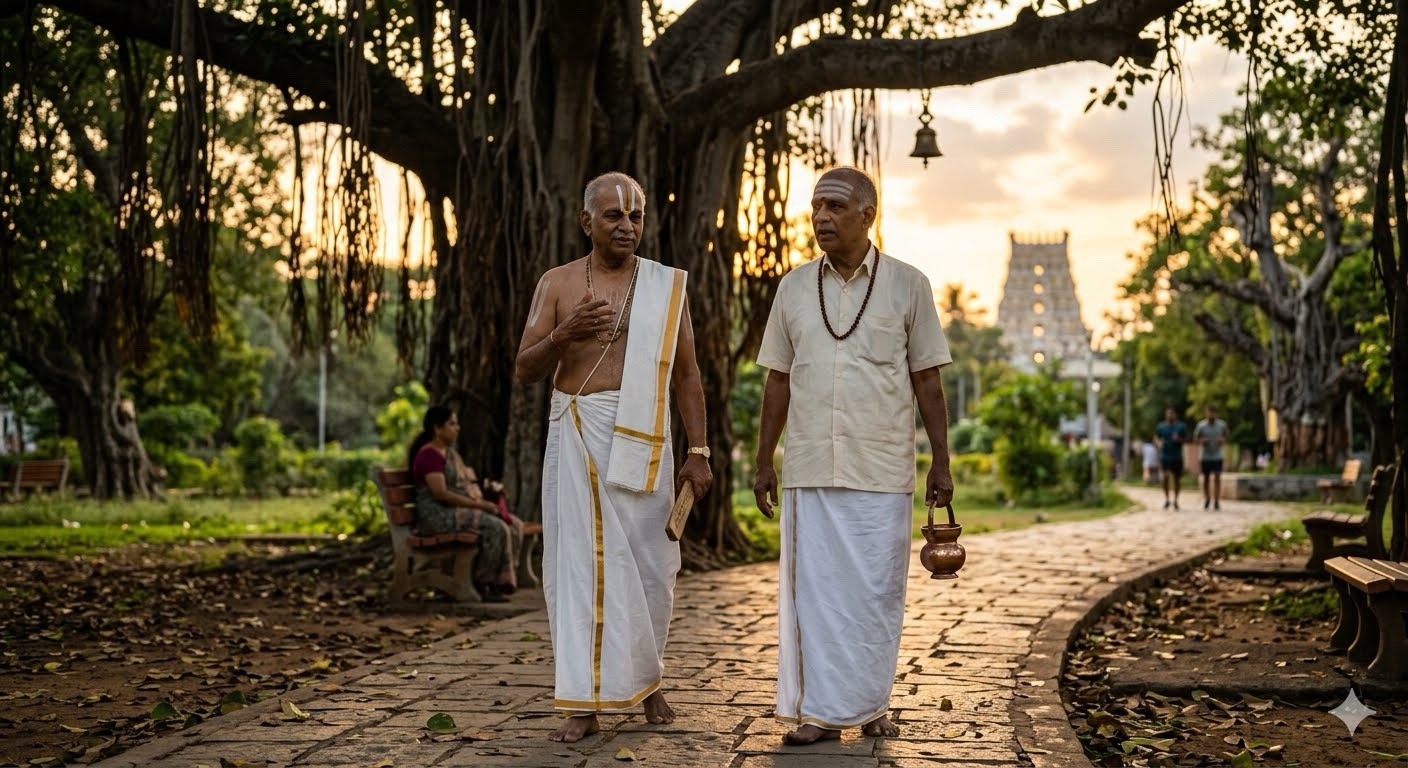
“Another cool evening,” Raghunathan said, drawing his shawl tighter as they rounded the old banyan. “The park’s the only place these days where people don’t ask you for your net worth or your latest column.”
Krishnamma laughed, the sound small and dry. “They ask me my blood pressure instead. ‘How’s the old ticker?’ Very flattering.” He stopped to watch a squirrel perform a graceless acrobatics.
“You know, Ragu, I met an old classmate last week — retired bank chief, very urbane — and he confessed he’s been reading everything he can find on ‘self-realization’ since he turned sixty. He wants the short-circuit. ‘Give me the essence,’ he said, ‘I haven’t the time for volumes.’”
Raghunathan’s eyes softened. “We all want the essence. I recall when we were younger, we swallowed long proofs in analysis without blinking, because we had to. Now the same effort for the Self feels…heavy. It’s odd.” He folded his hands behind his head, palms against the nape.
“But essence comes after discipline, not before it.”
Krishnamma nodded. “Yes. When I first heard ‘Who am I?’ from our guru, I expected a neat aphorism. I wanted a neat aphorism. Instead I got a question that kept returning like a tide. It took years — patient reading of Upanishads, disputations, nights of quiet inquiry — to see that it’s less a riddle and more a method. Without the method, the riddle is only a slogan.”
“People forget that,” Raghunathan said. “They equate Vedanta with consolation and forget its intellectual austerity. We respected theorems once. We respected steps in argument: premise, proof, inference. Atma-vichāra asks the same of the mind — attention, careful denial of false identifications, honest testing.”
He tapped the bench as if checking a rhythm. “That’s the work. Not the patchwork of quotations and feel-good stories one finds on late-night channels.”
Krishnamma’s face grew wry. “And the marketplaces of quick answers are well-stocked: pithy manuals, ecstatic videos, charismatic voices who promise sight by subscription. They sell awakening as if it were a weekend workshop. The language is simpler, the package attractive, and the price is psychological comfort.”
He put a hand over his heart and smiled ruefully. “Who would not be tempted?”
“Especially the newly urgent,” Raghunathan said. “When the calendar shortens, urgency sharpens into impatience. The mind asks for results, analogous to a man who learns calculus at twenty and expects to rewrite Newton at sixty. It’s unfair to expect the same mental agility without the preparatory work. The inner path requires rigorous practice just as academic work does — only the materials are different: discipline of attention, ethical clarity, discrimination.”
Krishnamma watched a group of young joggers pass, their laughter thinning into the distance.
“And there’s another strange fixation,” Raghunathan added, his voice sharp with gentle irony.
“Whatever these seniors study, they always want a scientific parallel. They ask, ‘Does science validate this?’ as if Vedanta is waiting for a lab report to confirm it.”
Krishnamma turned to him, surprised. “Yes — I’ve seen that too. They quote quantum physics or neuroscience like it’s scripture.”
Raghunathan nodded. “I ask them: ‘Why must Vedanta always find validation in science? Vedantic vichāra began centuries before the Age of Reason dawned on earth, before the Scientific Revolution was born! And by the way — does Science seek validation in Vedanta? No! So why this fixation on Science and scientific parallels while studying Vedanta?’”
Krishnamma chuckled dryly. “Usually I don’t get a ready or considered answer either. They just look puzzled, like I’ve asked them to solve an equation they forgot how to write.”
“Exactly,” Raghunathan said. “They’ve swapped one authority for another. Instead of the guru or the śāstra, now it’s the journal article. The mind is still looking for an external validator — it hasn’t yet learned to trust the inquiry itself.”
“There’s another barrier,” he said. “Language. Most of the sources sit in Sanskrit and Tamil. Our friend from the IIT who studies algorithms will pick up a new textbook and decode complex symbols in weeks. But the Upanishads speak in a kind of compressed poetry, not always easy to translate. Without that embedded familiarity, many rely on translations that smooth rough edges, or worse, commentators who interpret texts to fit modern appetites.”
Raghunathan nodded slowly. “Translations inevitably carry the translator’s breath. That is unavoidable. But a sincere seeker can do two things. First, cultivate a gradual reading practice — invest the same patience you once gave academic training. Second, find a trustworthy guide whose own practice and scholarship stand up to scrutiny. Not every teacher who speaks well is a teacher of the Self.”
Krishnamma picked up a fallen twig and rolled it between his fingers.
“There’s also the peril of vanity dressed as devotion. I meet seniors like you and I who want to be seen as ‘realized’ by society because it confers a certain respectability after careers that measured them by money and prestige. So they perform spiritual identity, post the right quotations, and attend satsangs for social currency rather than inward change.”
“Performing devotion is a curious vice,” Raghunathan agreed. “It looks like devotion from the outside but corrodes sincerity. The Self cannot be acquired as reputation. It is discovered by steady unmasking of false claims to identity.”
He smiled. “You might say it resembles correcting for bias in data — you audit your assumptions relentlessly.”
Krishnamma’s eyes crinkled at the analogy. “Exactly. The tools differ — meditation, sravana, manana, nididhyasana — but the intellectual spirit is the same as rigorous research: hypothesis, testing, and verification. And, unlike a paper that is discarded if the experiment fails, the worth of the seeker grows precisely by encountering failure and being honest about it.”
They sat for a while without speaking, listening to evening sounds: a distant temple bell, the soft murmur of children, the slow commerce of the world.
Then Krishnamma said, quietly, “I wished once I had learned Sanskrit earlier. I think of texts not as trophies but as living dialogues I am only now learning to enter. But regret is useless. One can start now — slowly, properly.”
Raghunathan inclined his head. “Start now, yes, but with expectations managed. We are not in a race. Small daily practices will shape the mind more profoundly than frantic reading binges. Also, learn to be suspicious of the glib. If someone sells awakening in three steps, he is either advertising or deluding himself.”
Krishnamma chuckled. “And there is humor in it, too. We are all vulnerable to the same snares: clever-sounding words, charismatic speech, the celebrity of gurus. Faith is not foolishness, but an unexamined faith is. We must apply the intellect as much to our devotions as we once applied it to our theses.”
Raghunathan’s face grew tender. “That is the point many miss: devotion and reason are friends, not adversaries. True devotion whitens in the crucible of discrimination — viveka. You cannot love rightly what you do not know. Likewise, knowledge without humility hardens into pride. The practices of Vedanta aim to reconcile heart and mind.”
Krishnamma rose slowly. “Perhaps the best counsel for our contemporaries is this: be earnest, be methodical, and be patient. Read slowly, reflect deeply, test what you understand in daily life. If language is a barrier, study with someone who knows the texts. If time is short, do not seek shortcuts; prefer small, sustained practices. Above all, be honest to yourself.”
Raghunathan stood as well, and together they resumed their walk beneath the banyan’s shadow.
“We once learned to solve problems by breaking them down,” he said. “So too with the Self: break identification into its pieces — body, mind, emotions, roles — and investigate each. It is tedious work. It is the work. But it yields a kind of liberation that no quick answer can simulate.”
They walked on, two steady steps in time, and Krishnamma touched his friend’s arm.
“One last thing,” he murmured. “Let them have their pulp and their pundits if that comforts them. People find solace where they can. We only owe them a steadier alternative: honest scholarship, patient practice, and a reminder that ultimate knowing rarely bows to impatience.”
Raghunathan smiled, the lines around his eyes deepening. “And when they come to us asking for the shortcut, we can tell them, gently: the path is not a product to be purchased, but a craft to be learned. Sit down, take up the tools, and begin.”
They passed under the lamplight, and the night deepened around them — quiet, steady, and full of the weight of old questions answered slowly, properly, and without hurry.
(Concluded)
***********************
This dialogue resonated with me deeply because it articulates something that is increasingly rare in contemporary discussions of spirituality: respect for patient inquiry. The two elderly scholars remind us that Vedanta is not a collection of inspirational quotations, nor a psychological comfort mechanism, but a demanding discipline of self-examination.
I also found their remarks about the search for scientific validation especially thought-provoking. The question is not whether science and Vedanta can engage in dialogue, but why so many modern seekers seem unable to trust a spiritual tradition unless it receives approval from an external authority. The observation that Vedanta developed its methods long before the rise of modern science is an important reminder of its intellectual independence.
Most of all, I appreciated the tone of the conversation. The speakers are critical without becoming bitter, traditional without becoming dogmatic, and intellectually rigorous without losing humility. Their final message — to proceed with sincerity, patience, and honesty — strikes me as wise counsel not only for students of Vedanta but for anyone pursuing genuine understanding.
Excellent and deep understanding of what the imaginary dialogue I wrote is about! Thank you 🙏
Thanks a lot.
An excellent, thought- provoking analysis on self- realisation and the eternal search to find an answer to the question-
“ Who am I?” The conversation between Raghunathan and Krishnamma highlights the impatience to seek awakening with quick- fix modern tools, which offer solutions which are superficial and half- baked.”Solving problems by breaking them down-so too with the Self- break identification into its pieces” succinctly summarises the need to be patient in trying to find an answer to this complex question. Very educative snd enlightening post.