By M. K. Sudarshan
Both the roads from Chidambaram and Kanchipuram lead to the exact same destination: the Supreme Court of India. It is an expanding, timeless cul-de-sac where litigation goes to be indefinitely preserved in the hope that, one day, the conflict will simply fall asleep.
In a previous essay posted the day before yesterday, the story of the Chidambaram Temple was narrated by me.
Read Part 1: The Chidambaram Rahasyam – How a Vaishnava Shrine Became a Proxy War Pawn
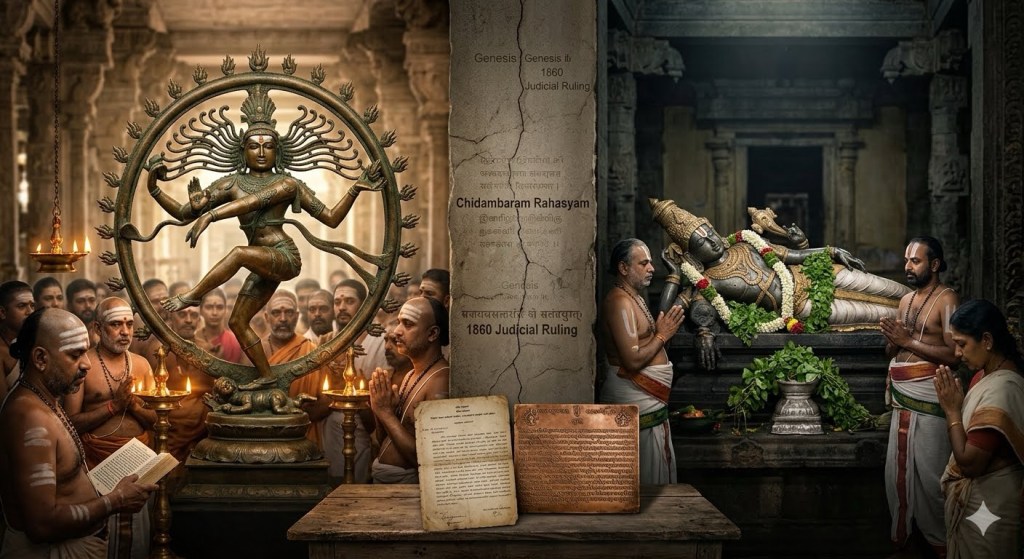
And now it is time to tell next the story of Kanchipuram.
Read Part 2: Kicking the Can to Heaven: Why the Supreme Court Will Never Solve the Temples of Tamil Nadu

To the modern, secular observer, the ancient temple towns of Tamil Nadu are places of static stone, quiet meditation, and timeless devotion. But step past the thresholds of the grand Nataraja Temple in Chidambaram or the Varadaraja Perumal Temple in Kanchipuram, and you enter a highly litigious universe. Here, centuries-old agamic traditions, hereditary privileges, and theological identities are locked in a state of permanent legal warfare.
The combined two-part series above thus deconstructs a magnificent theater of the absurd: the intractable, centuries-old liturgical disputes that divide Saivite from Vaishnavite in Chidambaram, and Vadakalai from Tenkalai within Kanchipuram.
On the surface, these battles appear to be driven by minor cosmetic and ritual choices—the astronomical timing of a festival procession, the exact syllable of an opening invocation chant, or whether a sacred mark painted on an elephant’s forehead resembles a “U” or a “Y”. In reality, however, these flashpoints are merely symptoms of a profound, systemic phenomenon: a secular constitutional quagmire of India’s own design. ┌──────────────────────────────────────────┐ │ THE GREAT TAMIL NADU TEMPLE AXIS │ └────────────────────┬─────────────────────┘ │ ┌──────────────────────────┴──────────────────────────┐ ▼ ▼ ┌───────────────────────────────┐ ┌───────────────────────────────┐ │ PART 1: CHIDAMBARAM │ │ PART 2: KANCHIPURAM │ ├───────────────────────────────┤ ├───────────────────────────────┤ │ The Inter-Sectarian Battle │ │ The Intra-Sectarian Battle │ │ Saivite vs. Vaishnavite │ │ Vadakalai vs. Tenkalai │ │ Timeline & Spatial Warfare │ │ Liturgical Branding Warfare │ └───────────┬───────────────────┘ └───────────────────┬───────────┘ │ │ └──────────────────────────┬────────────────────────────┘ │ ▼ ┌───────────────────────────────────────────────────────┐ │ THE SUPREME COURT TERMINUS │ ├───────────────────────────────────────────────────────┤ │ An expanding, timeless cul-de-sac where the judiciary │ │ plays "Accidental Theologian" to freeze the conflict. │ └───────────────────────────────────────────────────────┘
Because Hinduism lacks a central, papal-style institutional authority capable of arbitrating internal schisms, these feuds inevitably march down the legal highways of the state. There, secular, Western-educated judges are forced to play the role of “accidental theologians”—interpreting medieval Sanskrit commentaries and agamic manuals to issue legal dictums that function as a new body of de facto scripture.
Yet, as both the essays reveal, neither the litigants nor the courts truly desire a final, absolute resolution. A definitive verdict would create an absolute loser, threatening public order and exposing the deep structural contradictions of state-regulated secularism.
Instead, the litigants find a strange comfort in maintaining their existential battle lines under the prestigious cover of constitutional law, while the courts adopt a sagacious “do-nothing” strategy. By kicking the can down the road through slow-moving mediation windows and endless procedural loops, the judiciary keeps a firm lid on volatile passions.
If you found the previous essay on Chidambaram Temple to be an eye-opener — you should now turn the page and go read its sequel and you will find yourself rubbing your eyes in disbelief : “Kicking the Can to Heaven: Why the Supreme Court Will Never Solve the Temples of Tamil Nadu”
M. K. Sudarshan