Bhakti as “Seed, Flower, and Fruit”: An Imaginary Dialogue on the Psychology and Theology of Devotion
Prelude
This is an imagined conversation between a psychology student and an unknown Sri Vaishnava elder. It is not a formal thesis, but a reflective inquiry into the inner life of devotion.
The student wants to understand whether bhakti begins in something more basic than religion itself, whether it can be seen as a human capacity before it becomes devotional life, and whether it may finally ripen into surrender. The elder answers from within the Sri Vaishnava world of meaning, with its scriptural memory, theological depth, and inward poise.
Together, they explore a simple but profound possibility: that the human heart may contain a devotional seed, that bhakti may be its flower, and that prapatti may be its fruit.

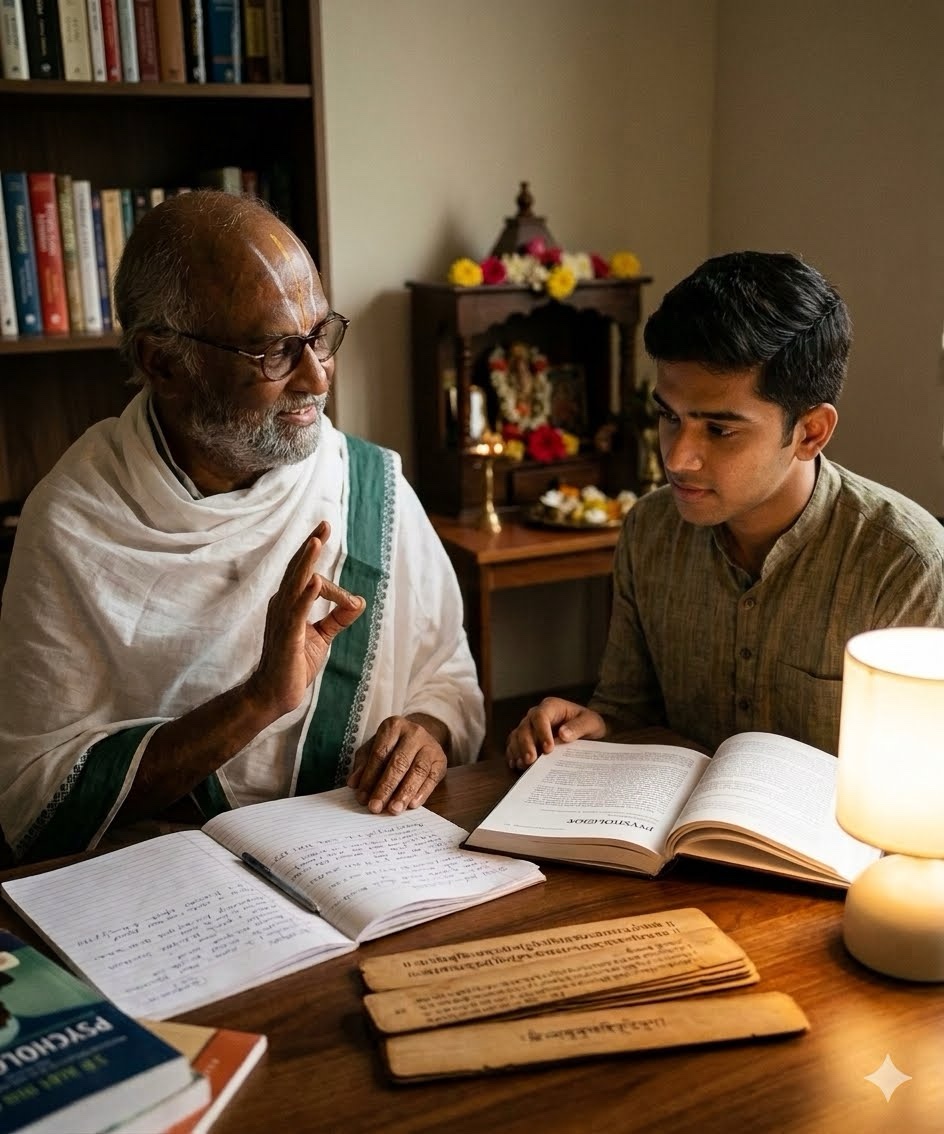
The library was quiet in that particular way old libraries are quiet — not empty, but listening. At a side table sat a psychology student, notebook open, brow furrowed with questions. Opposite him sat an older man, serene and unassuming, whose speech carried the cadence of tradition without the stiffness of doctrine.
Student: I have been thinking about bhakti. Is it only a religious emotion, or is there something more basic underneath it?
The Unknown Sri Vaishnava: There is something more basic underneath it, yes. Bhakti in its religious fullness does not arise from nowhere. Before devotion to the Divine, there is the human capacity for attachment, admiration, trust, longing, surrender, and a desire to be claimed by what one recognizes as supreme.
Student: So bhakti has a psychological seed?
The Unknown Sri Vaishnava: That is a good way to put it. The seed is not yet bhakti in its completed form. It is the latent capacity for devotion. A person may feel awe before beauty, fidelity toward a teacher, loyalty toward a noble ideal, or yearning toward a beloved presence. These are not yet religious bhakti, but they prepare the soul for it.
Student: Then devotion is rooted in ordinary human inwardness?
The Unknown Sri Vaishnava: Yes. Human inwardness is the soil in which devotion grows. What begins as attachment or longing may, under the right conditions, become reverence. What begins as admiration may become worship. What begins as surrender to a finite good may become surrender to the Infinite.
Human and Animal
Student: Does that mean animals have the same kind of bhakti?
The Unknown Sri Vaishnava: Not in the full sense. Animals have attachment, dependence, bonding, and loyalty. These are real and important. But bhakti requires more than attachment. It requires reflection, recognition, inward turning, and the conscious giving of oneself to an object seen as worthy.
Student: So the human being is different because he can consciously orient himself?
The Unknown Sri Vaishnava: Exactly. The animal may cling; the human may adore. The animal may seek protection; the human may surrender. The animal may recognize its benefactor; the human may consecrate the benefactor into the center of his life.
Student: So bhakti is more developed in humans than in animals?
The Unknown Sri Vaishnava: Certainly. The human heart has a greater range of reflective devotion. Yet even in ordinary life, the human capacity for love and reverence may remain scattered, unripe, or half-awakened. It must often be cultivated before it becomes bhakti.
Seed into Flower
Student: Cultivated into what?
The Unknown Sri Vaishnava: Into a flower. That is the best image. The seed is hidden inward possibility; the flower is the visible and fragrant blossoming of that possibility. Bhakti is the flower of the soul’s devotional capacity. It is not a denial of the seed, but its unfolding.
Student: Then “transfiguration” is a better word than “sublimation”?
The Unknown Sri Vaishnava: Much better. Sublimation sounds too mechanical, as though raw energy were merely diverted into a socially acceptable channel. Transfiguration suggests something more holy: the same human longing is lifted, clarified, and made luminous. The soul remains itself, but in a transformed mode.
Student: So bhakti is not just emotional intensity, but transformed emotional life?
The Unknown Sri Vaishnava: Precisely. It is affection sanctified, longing refined, attachment purified, surrender made radiant.
Tirumangai Azhwār
Student: Can this be seen in the Azhwārs?
The Unknown Sri Vaishnava: Very clearly. Listen to Tirumangai Azhwār’s opening of the Periya Tirumozhi:
வாடினேன் வாடி வருந்தினேன் மனத்தால்
பெருந்துயர் இடும்பையில் பிறந்து,
கூடினேன் கூடி இளையவர் தம்மோடு
அவர்தரும் கலவியே கருதி,
ஓடினேன் ஓடி உய்வதோர் பொருளால்
உணர்வெனும் பெரும்பதந்தெரிந்து,
நாடினேன் நாடி நான் கண்டுகொண்டேன்
நாராயணா என்னும் நாமம்.
“I was worn out, exhausted, and distressed in my mind; born into great sorrow and suffering.
I kept seeking companionship with the young, desiring only the pleasures they gave.
I ran and ran in search of some means of escape and, discerning the great treasure called understanding,
I sought and sought, and at last I discovered the Name called Narayana.”
Student: It feels like the testimony of someone exhausted by every ordinary pursuit.
The Unknown Sri Vaishnava: Yes. He begins with weariness, sorrow, and restless seeking. He has run after many things, hoping they might save him. Then comes the turning: he discovers the saving Name of Narayana. The verse is a dramatic reorientation of life.
Student: So the old longing is not destroyed?
The Unknown Sri Vaishnava: No. It is gathered, purified, and directed toward the Lord. That is the flower. The human capacity that once wandered among transient pleasures now blossoms into devotion.
Nammāzhwār
Student: And Nammāzhwār?
The Unknown Sri Vaishnava: Nammāzhwār’s opening of the Tiruvāimozhi is even more inward:
உயர்வற உயர்நலம் உடையவன் யவன் அவன்
மயர்வற மதிநலம் அருளினன் யவன் அவன்
அயர்வறும் அமரர்கள் அதிபதி யவன் அவன்
துயரறு சுடரடி தொழுது எழு என் மனனே
“He who possesses unsurpassed and supreme goodness,
He who grants the mind the knowledge that removes delusion,
He who is the lord of the ever-vigilant gods,
Rise, O my mind, and worship His sorrow-dispelling, radiant feet.”
Student: It is almost a command to the mind itself.
The Unknown Sri Vaishnava: Exactly. The mind is addressed, awakened, and directed. This is bhakti not as blind sentiment, but as inward knowledge becoming worship. The Lord is recognized in His supreme goodness, in His gift of clarity, in His sovereignty, and then the mind is told to rise and adore.
Student: So the flower is not merely emotional; it is conscious devotion.
The Unknown Sri Vaishnava: Very much so. The Azhwārs show that devotion is not less than emotion, but more than emotion. It is feeling illumined by vision.
(Continued in Part II)