by M.K.Sudarshan
July 4, 2026: Chennai, India
An exploration of civilization’s hidden dependence on energy, the warnings of Robert J. Gordon, and the possibility that the future will be more advanced yet less abundant than the age that came before.
The Hidden Axis of Civilization
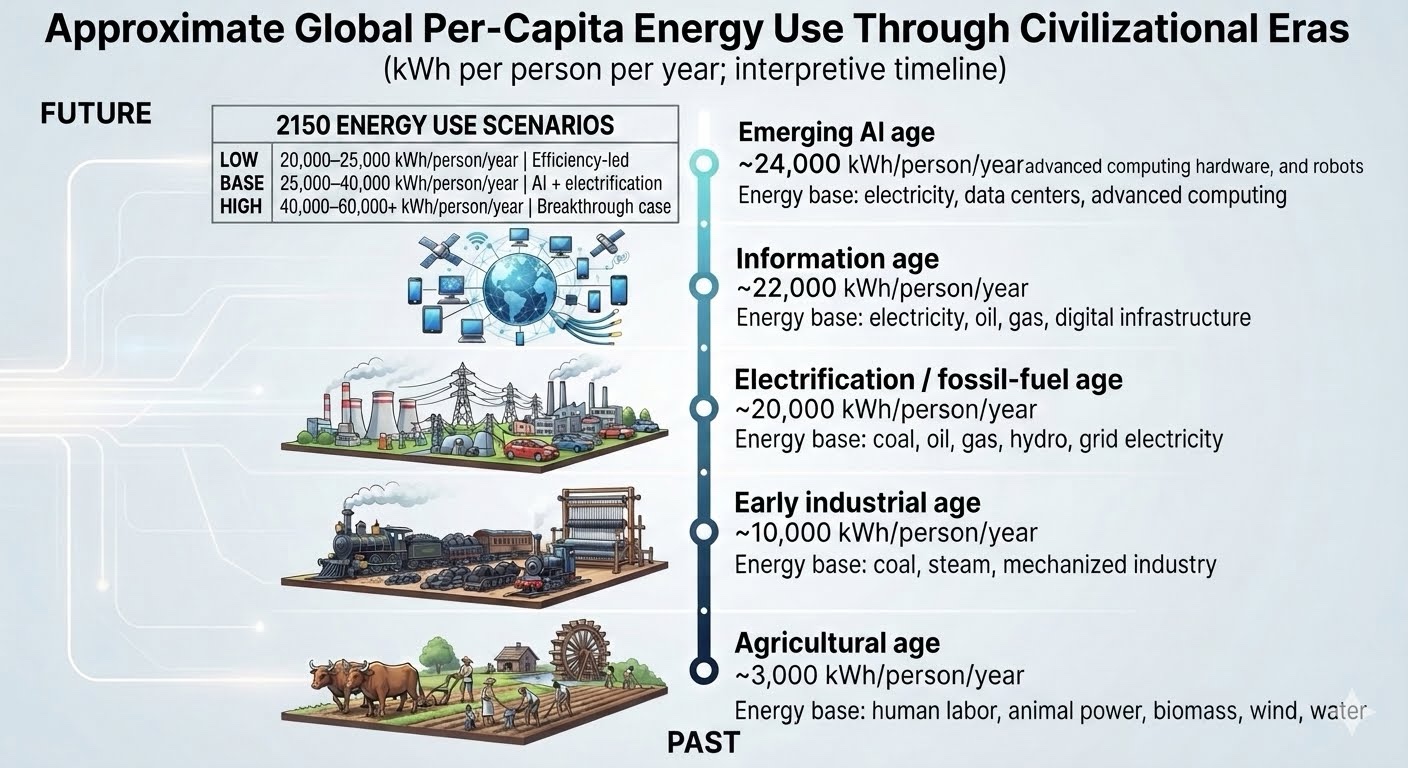
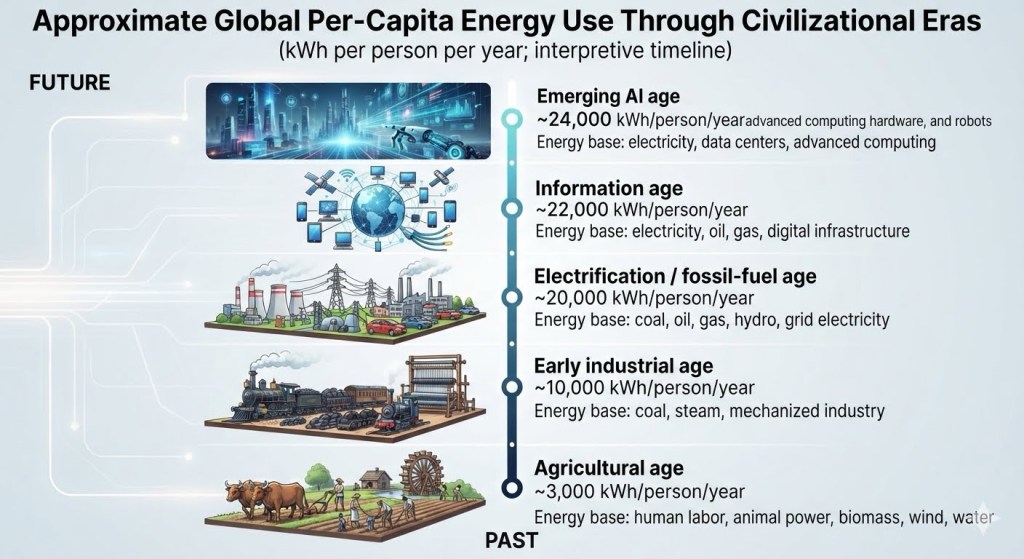
There is a strange and revealing fact about human civilization: its great ages are not merely named by ideas, institutions, or empires, but by the ways in which it learns to command energy. What appears, at first glance, to be a story of politics, invention, and culture is also, at a deeper level, a story of force harnessed, work multiplied, and matter compelled into service.
The agricultural age was bounded by muscle, animal power, and the narrow reach of biomass. The industrial age widened the human horizon through coal. The age of oil and electricity made motion, lighting, and manufacture vastly more fluid. The age of information, and now the age of AI, rests on a still more subtle architecture of power: invisible currents, dense computation, and continuous demand.
The Long Climb Upward
If one steps back far enough, the curve of history looks less like a parade of brilliant ideas than a long climb in per–capita energy use.
For most of human existence, that climb was almost imperceptible. Then, in the modern era, it steepened dramatically. The world did not merely become smarter; it became more energetically endowed.
Hospitals, railways, grids, refrigeration, global logistics, computation, and finally data centers are all downstream of that hidden abundance. What we call progress is very often the social expression of more energy becoming available per person.
Gordon’s Warning
Before turning to the argument itself, a word of introduction is useful. Robert J. Gordon is an American economist best known for his work on long-term economic growth, especially his book The Rise and Fall of American Growth. His central claim is that the period from roughly 1870 to 1970 was a special century of unusually transformative innovation.
Gordon does not argue that invention has stopped, nor that the modern world has become technologically inert. His argument is more subtle: it is a mistake to assume that technological progress is always cumulative, always accelerating, and always capable of producing the same scale of civilizational leap.
Applied to energy, his warning becomes especially pointed. It is entirely possible that the next generations of energy technology will be cleaner, more intelligent, more distributed, and more secure, yet still fail to produce the same explosive abundance that coal and oil once delivered. History may continue, but not in the ecstatic manner of the fossil age.
The Weight of Physics
This is not because innovation is exhausted. It is because energy is not a purely digital or conceptual domain. A software platform can spread with astonishing speed; an energy system cannot. It must be mined, fabricated, transported, regulated, financed, stored, transmitted, and defended.
Every kilowatt has an infrastructure behind it. Every transition has material costs. Every promise of abundance eventually meets the stubborn fact of the physical world. That is why energy innovation often feels slower than technological rhetoric would suggest. The future may indeed become more advanced, but advancement does not abolish friction.
What the Institutions Foresee
The great institutions of energy policy-thought and policy-making understand this ambivalence. The IAEA has long treated sustainable energy planning as a central problem, and the wider energy-policy consensus does not imagine that the world can simply continue along a fossil-heavy path indefinitely.
Nor do these institutions believe energy demand will disappear. Their vision is subtler and more demanding: future growth must be cleaner, more efficient, and far more carefully organized than the past.
Nuclear power is often invoked in this context not as a magical solution, but as one of the few technologies capable of supplying dense, low-carbon electricity at scale. Renewables, grids, storage, efficiency, and electrification must all share the burden. The future, in this reading, is not an escape from energy politics but a reordering of it.
Energy as Power
And politics is precisely where the matter becomes hardest. Energy has never been merely technical. It has always been geopolitical. Coal transformed factories, oil transformed empires, and gas transformed bargaining power.
In the future, the strategic chokepoints may shift from fuel wells to patents, supply chains, advanced materials, semiconductor fabrication, grid software, and the mineral basis of clean technologies. One may no longer fight over oil fields alone; one may fight over the means of producing the next energy order itself.
The empire of the future may not be built on possession of fuel, but on ownership of the architecture that makes fuel usable.
Scarcity and Strategic Leverage
This raises a troubling possibility. If future energy systems do not produce overwhelming abundance, then scarcity itself becomes more politically precious. A technology that is hard to reproduce, expensive to scale, or dependent on rare inputs will invite control.
Control invites leverage. Leverage invites conflict. And conflict, once it enters the energy domain, can slow the very innovation that all sides claim to desire. The future, then, may be caught in a vicious circle: technology becomes strategic, strategy becomes defensive, and defense retards diffusion.
A Future Not Without Hope
Still, it would be wrong to conclude that the future must therefore be bleak. A more sober conclusion is that it will be contested. It may well be more efficient, more electrified, more intelligent, and more capable than the present. But it may not be an age of easy abundance.
The world may grow richer in function while remaining constrained in form. That is perhaps the central lesson of the energy story: progress does not disappear, but its character changes. It becomes less like a miracle and more like a negotiation.
The Distant Horizon
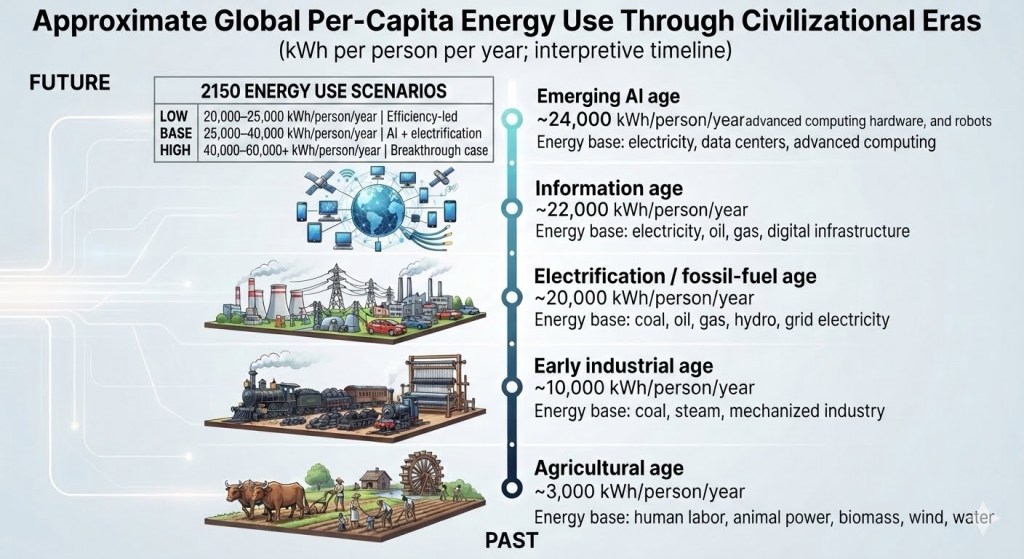
If one were forced to hazard a number, one might say that by year 2150 the world could average somewhere around 30,000 kilowatt-hours per person per year, with a plausible range above and below that figure depending on whether technological breakthroughs, political stability, and clean-energy diffusion proceed smoothly or stumble under their own weight.
Such a future would be materially more energetic than today’s, yet still far from the fantasy of infinite abundance.
The Real Test
And so this is where a more chastened view of civilization comes into focus. The future may not belong to those who merely believe most ardently in progress, nor even to those who possess the best technology in isolation. It may belong to those who understand that energy is power, that power is contested, and that the path from invention to abundance passes through institutions, geopolitics, and the moral discipline of restraint.
In that sense, the deepest question is not whether human beings can make more energy. It is whether they can govern the power they make without turning it into a new instrument of domination.
That, perhaps, is the real test of the AI age: not whether it will consume more energy, but whether it can do so without exhausting the world’s patience, its resources, or its peace.
(Concluded)