J. Raghunathan’s short story The Choice is compelling not merely because it stages a conflict between patriotic duty and domestic love, but because it leaves the moral structure of that conflict unresolved in a fruitful way. The story’s emotional power lies in the fact that the reader is never allowed the comfort of a simple verdict: Teju’s decision is at once admirable, costly, and tragic, while Simrat’s later life appears neither wholly voluntary nor wholly coerced.
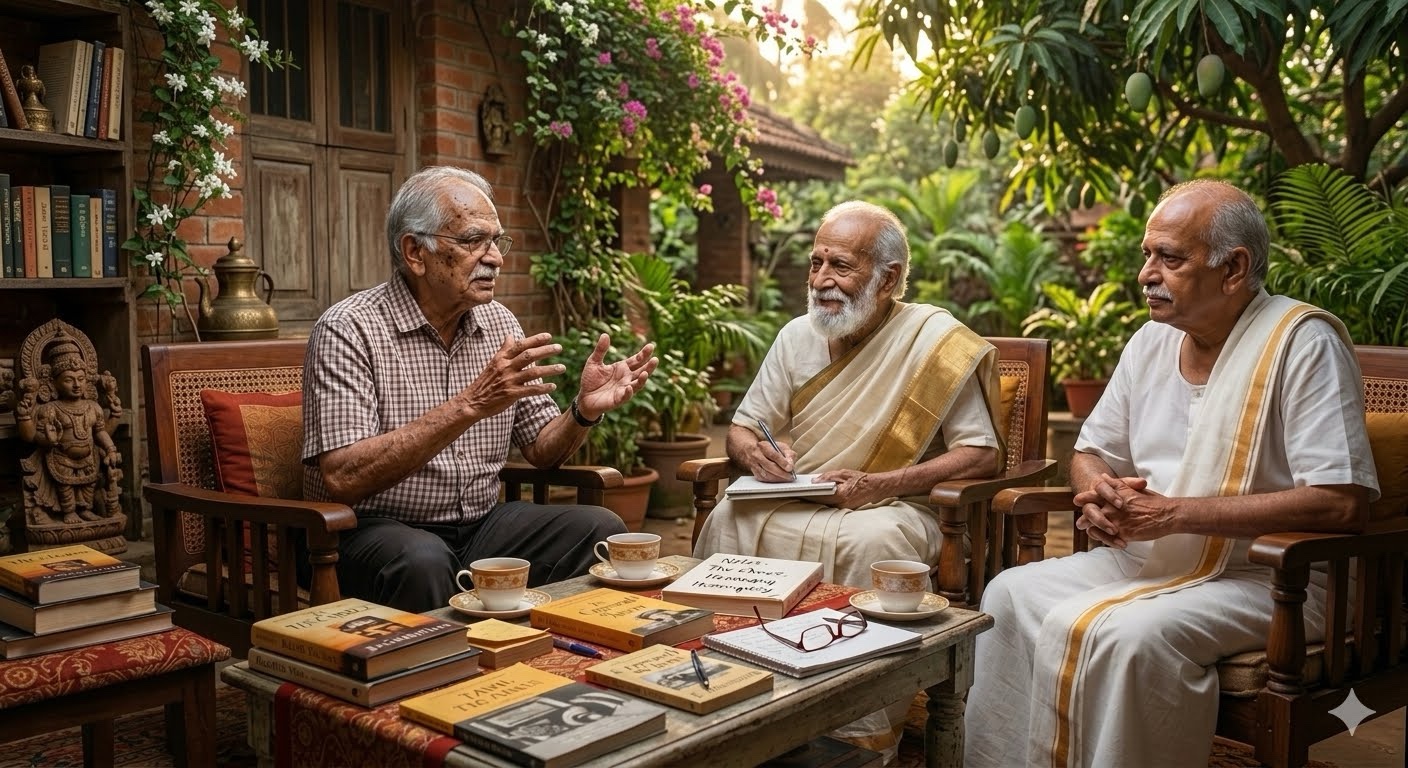
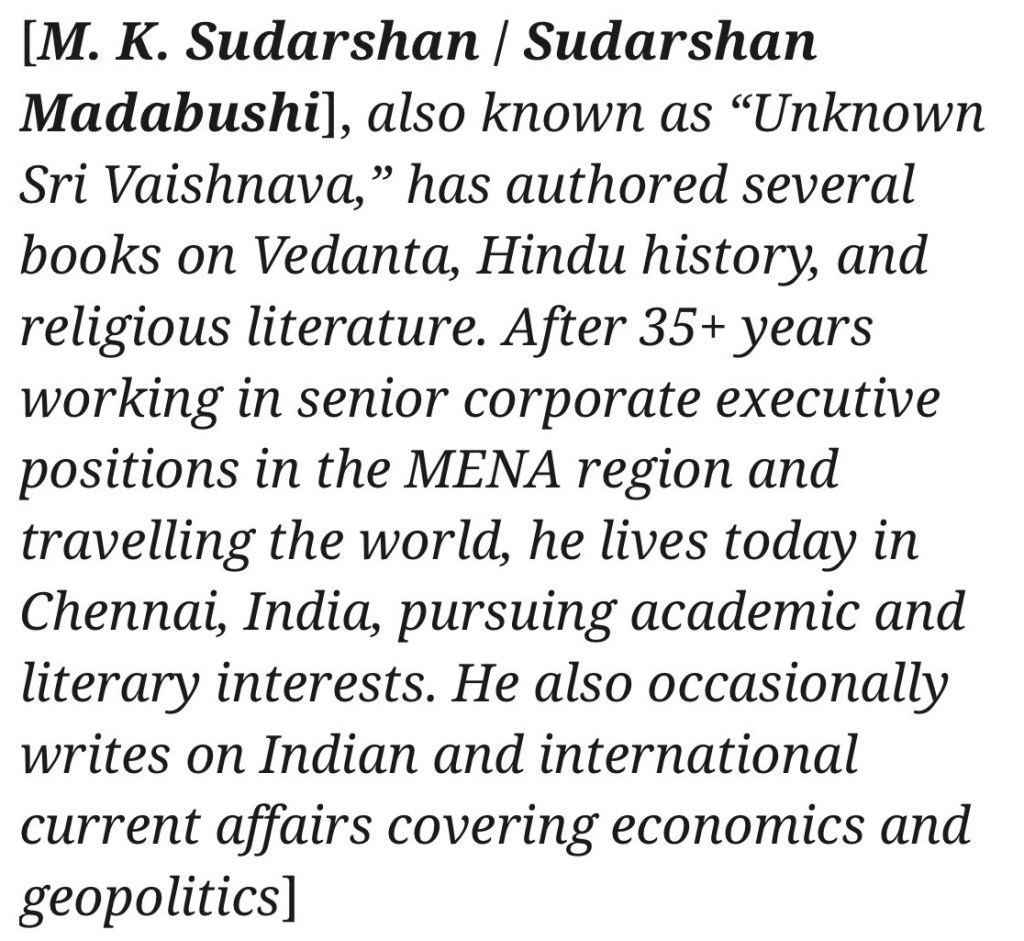
The present review places the story in a personal and literary frame. Its author, J.Raghunathan, is a valued personal friend; the distinguished novelist Indira Parthasarathy (Eepa) who appreciated the story as a tale of “existential choices” (and which the Kumudam magazine had earlier awarded a cash prize of ₹100,000) serves in this account not merely as a senior literary authority but as a nonagenarian companion and a mentor-like presence for me, a reviewer who in his own published works has written on Vedantic subjects. That triadic setting matters, because the review is not only an appreciation of a short story but also an inquiry into whether Indira Parthasarathy’s brief judgment fully captures the deeper metaphysical anxiety the story provokes.
Story and predicament
The story unfolds as a narrated recollection: the speaker meets Rajinder Singh Dhaneja in Mussoorie and learns, through him, the life of Tejinder Singh Dhaneja, a decorated military officer whose career in war and intelligence repeatedly takes precedence over married life. Teju survives catastrophic physical injury, falls in love with the nurse who tends him back to life, marries her almost immediately after recovery, and then gradually loses that marriage to the demands of secrecy, distance, and state service.
The title The Choice appears, at first glance, to name one dramatic decision: when Simrat asks Teju whether India’s security matters more than she does, he chooses the nation.
Yet the story is subtler than that. By the time the formal choice arrives, the conditions that make it nearly inevitable have already accumulated through temperament, vocation, honour, institutional command, and emotional drift.
Indira Parthasarathy’s remark
Indira Parthasarathy (Eepa) — a master story-teller and playwright himself — shared a comment with me in a terse message — “Existential choices: What you ultimately choose is the correct choice for you. Difficult to decide which is right and which is wrong. (This is a) Good story.” — identifies something real and central in the narrative.
The story does indeed resist moral simplification and makes judgment difficult, because both loyalty to vocation and loyalty to intimacy possess genuine ethical weight within it.
Even so, the comment may not be wholly sufficient as a final critical formulation. To say that what one ultimately chooses is the correct choice “for you” risks giving the impression that the story affirms sovereign individual freedom, whereas the narrative itself repeatedly shows choices being narrowed, preconditioned, and almost staged in advance by forces larger than conscious preference. The tale is existential, but its existentialism is under pressure.
Vedantic critique
A more nuanced reading emerges when the story is approached through a Vedantic framework, especially one attentive to the tension between agency, conditioning, and karmic inheritance.
The story does not straightforwardly deny free will; rather, it de-centres free will by showing that what is called a “choice” may already be shaped by svabhava, duty (Svadharma), prior commitments, and accumulated circumstance.
From this perspective, Teju does not simply stand as an autonomous chooser selecting one value over another. He appears instead as a man whose being has been formed in advance by military vocation, heroic self-understanding, patriotic obligation, and a temperament already fused with action and danger. When the decisive question is finally posed to him, the answer feels less like spontaneous invention than like the disclosure of what he already is.
This is where the story becomes philosophically rich. It neither explicitly invokes karma nor doctrinally endorses determinism, yet it invites a reading in which human decisions emerge from prior moral and existential formations rather than from unconditioned freedom alone. In that sense, the narrative is agnostic about karma at the level of overt statement, while being strikingly hospitable to a karmic interpretation at the level of structure.
Simrat and dharma
The most delicate question concerns Simrat, the nurse who marries Teju, is later divorced by him, and finally reappears in the father-in-law’s home as his caregiver.
A shallow reading might say that she has “no other choice,” but the story permits a more serious interpretation: what appears as compulsion from the outside may also be her own inward determination (Svadharma).
That distinction is crucial in Vedantic terms. If Simrat’s return is seen merely as submission to fate, she becomes a passive victim of circumstance; but if it is seen as the recognition and inhabiting of a karmically conditioned duty, then her action acquires moral and spiritual depth. She is not merely trapped in the aftermath of divorce; she consciously determines herself to continue caring, and that determination may be impelled by dharma without ceasing to be hers.
Thus the story’s deepest interest may lie not in Teju’s spectacular heroism but in Simrat’s quieter endurance. Teju’s life dramatizes the tragic grandeur of public duty, whereas Simrat’s later role reveals a different order of greatness: not conquest, not adventure, but the inward resolve to inhabit suffering as responsibility.
Final assessment
The Choice succeeds because J. Raghunathan in crafting the narrative faithfully follows the style of his own literary guru and idol , the late Tamil novelist Sujatha (Rangarajan) who excelled in this genre of Tamil short-stories.
Also, to me this story distantly or faintly echoes Ernest Hemingway’s “Farewell to Arms” — in the soldier–nurse nexus, Frederic Henry’s romance with Catherine Barkley, his nurse in hospital, and the way that unfolds against the backdrop of the devastation of war, and their relationship too is ultimately marked by separation, suffering, and tragic loss. In The Choice, Teju’s recovery is likewise bound up with the nurse who cares for him, and that care becomes the seed of love, marriage, and later estrangement. That is the deepest parallel: love is born in a space of injury and crisis, not in ordinary domestic calm. But Raghunathan’s story ultimately moves in a different moral and Vedantic register, as I saw it unfolding on reading it.
The tonal and philosophical worlds are very different. Hemingway’s novel is shaped by disillusionment, existential bleakness, and the collapse of romantic hope under war’s pressure, whereas The Choice is more morally narrative, more Indian, and essentially Vedantic in its concern with duty, service, and the visible claims of dharma-like obligation.
The story does not collapse into propaganda for patriotism, sentimental defense of marriage, or easy moral indictment of either. Its power lies in showing how persons become answerable to lives that seem, by the time crisis happens, already partly written.
Indira Parthasarathy’s one-line appreciation very correctly identifies the story’s moral ambiguity, but a Vedantic critique presses even further. The true question is not simply whether Teju chose rightly, or whether right and wrong are hard to separate; it is whether the very grammar of “choice” in the story has already been destabilized by karmic predisposition, svabhava, and dharmic compulsion.
Read in that way, The Choice becomes more than a story about an officer torn between wife and nation. It becomes a meditation on whether human beings ever choose in absolute freedom, or whether they mostly ratify, under the pressure of circumstance, the script that character, duty, and karma have already begun to write.
Well done, my friend Raghu 👍. And thank you Eepa, Sir 🙏💐
(Concluded)
One thought on “Reading the short-story “The Choice” (சாய்ஸ்) through a Vedantic Lens … with Indira Parthasarathy and J. Raghunathan”