The Setting:
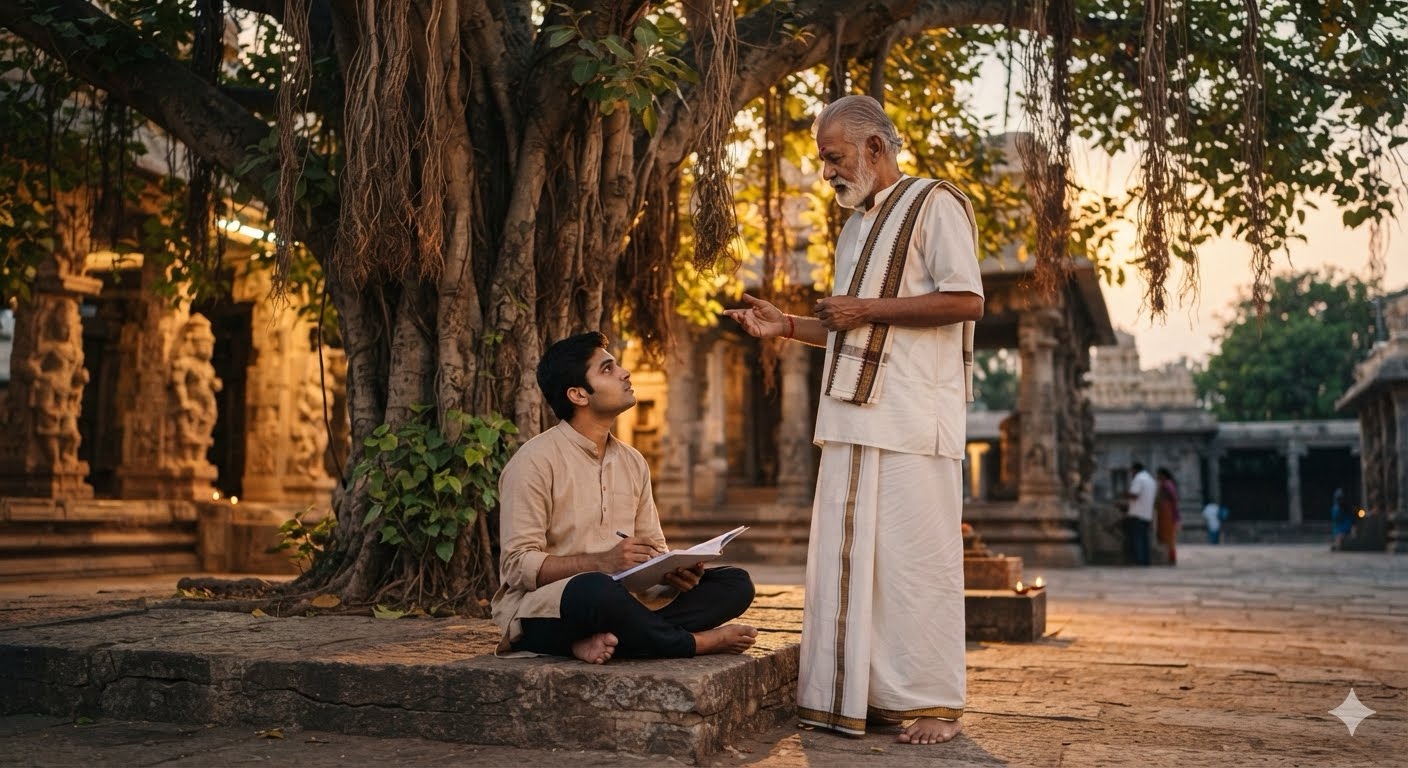
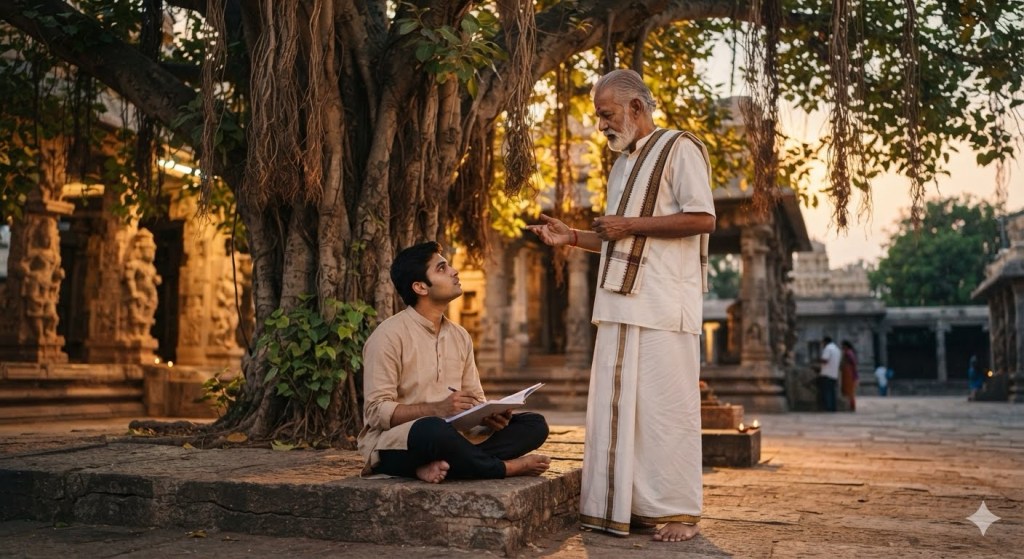
A quiet courtyard outside the temple hall, late afternoon. The golden light of dusk filters through the ancient banyan tree. Two figures emerge from the kalākṣepam hall — one elderly, silver-haired, standing erect and proud with a dignified bearing; the other young, bright-eyed, clutching a notebook. They have just attended a discourse on Śrīmad Rahasyatrayasāram.
The Speakers:
Unknown Sri Vaishnava (hereafter USV): A 70-year-old retired senior corporate executive , a lifelong devotee, well-read in Sri Vaishnava literature, but humble in demeanor. Though seventy, he stands tall, his spine straight, his bearing dignified — age has bent neither his body nor his spirit.
Vishnuchittan (hereafter VC): A 31-year-old postgraduate student of Indian Philosophy, sharp, inquisitive, trained in both Western and Indian philosophical traditions..
I. The Body-Mind Complex and Old Age
USV: (standing tall, adjusting his shawl with a dignified gesture) Vishnuchittan, that discourse today on the śarīra-śarīrī relationship… it struck me deeply. You know, at my age, every word about the body’s decay feels like a personal letter.
VC: (nodding respectfully) Yes, Swami. I could see how the Ācārya’s words about bodily deterioration resonated with you. But I must ask — you seemed troubled by something. What was it?
USV: It is this: the Ācārya said the ātma is separate from the body — eternal, unchanging, untouched by old age or disease. And yet, when I wake up each morning, my body aches, my joints creak, my eyes blur. I cannot help but dwell on this broken-down condition. My mind is constantly preoccupied with it. If the ātma is truly separate, why does it feel so entangled?
VC: (thoughtfully) That is a profound question, Swami. In Viśiṣṭādvaita, the answer lies in the distinction between the ātma’s substantive consciousness (svarūpa-bhūta-jñāna) and its attributive consciousness (dharma-bhūta-jñāna).
USV: Explain, please, by recapitulating what was learnt in the kalakshepam.
VC: The ātma’s essential nature is pure consciousness — it never changes, never ages, never suffers. That is the substantive consciousness. But in bondage, the ātma’s functional consciousness — how it knows, feels, and experiences — is contracted by karma. This is the attributive consciousness.
USV: So you are saying my ātma is pure, but my experience of it is limited?
VC: Precisely. The body-mind complex is entirely material — jaḍa. It has no consciousness of its own. But because the ātma inhabits it, the body-mind complex appears conscious. And because the ātma’s attributive consciousness is contracted by karma, it identifies with the body’s experiences — hunger, pain, old age, grief.
USV: (nodding slowly, his posture erect) So the problem is not that the ātma is affected by the body — it is that the ātma’s consciousness is drawn into the body’s preoccupation through the mind?
VC: Exactly. The mind is like a colored lens. The ātma’s light shines through it, but the lens is colored by karma — so the light appears colored. Similarly, the ātma is pure, but the mind is karmically conditioned — so the ātma’s consciousness appears identified with the body.
USV: (quietly but firmly) That explains why I cannot simply “make the distinction” — my mind is programmed by karma to dwell on bodily decay
II. Is Bodily Deterioration Independent of Karma?
VC: But Swami, may I ask — do you believe your bodily decay is independent of karma?
USV: (pauses, standing proud) That is what troubles me. It feels like the body’s deterioration is a natural process — like a tree growing old, like a river drying up. It seems to have nothing to do with my past actions. It is just… nature.
VC: (gently) In Viśiṣṭādvaita, nothing about the body is independent of karma. The type of body you take, how long it lasts, how it ages, what diseases it suffers — all are determined by your past karma. This is prārabdha-karma — the fruits of past actions that must be experienced in this lifetime.
USV: (frowning, his bearing still dignified) But surely, Swami, not all old age is karmic? Some people age gracefully, others suffer terribly. Is that not just… chance?
VC: No, Swami. In Viśiṣṭādvaita, there is no “chance.” Everything is orchestrated by karma. The body’s aging and decay are precisely designed to give the ātma the exact experiences it needs to exhaust its past karma.
USV: (sighing, but still erect) That is hard to accept. It means my suffering is not random — it is… intentional?
VC: Not intentional in the sense of punishment — but karmically necessary. You must experience these things to exhaust your past karma. But the key is: the ātma itself is untouched. It is only the body-mind complex that undergoes decay.
USV: (softly, with quiet pride) Then why does it feel so personal?
VC: Because the ātma’s attributive consciousness is contracted by karma — so it cannot fully discriminate between itself and the body. The mind is karmically fashioned to identify with the body — so when the mind dwells on bodily decay, the ātma’s consciousness is drawn into that preoccupation.
III. Is There a Cosmic Struggle Between Spirit and Body?
USV: (leaning forward slightly, his eyes intense, his posture still proud) Now, Vishnuchittan, this leads me to another question. All this talk of karma contracting the ātma’s consciousness, of the mind being programmed to identify with the body… it sounds like there is a constant struggle between Spirit and Body — each trying to triumph over the other. And karma… is it not the formidable ally fighting alongside the body against the ātma?
VC: (shaking his head gently) No, Swami. That is a common misunderstanding. In Viśiṣṭādvaita, there is no cosmic battle between Spirit and Body.
USV: (surprised, but still dignified) No battle? But it feels like one!
VC: It feels like one because of karmic identification. But the body-mind complex has no will of its own. It is inert matter — jaḍa. It cannot act, cannot choose, cannot fight. It is like a machine — it functions only because the ātma’s consciousness illuminates it.
USV: Then what is karma? Is it not an ally of the body?
VC: Karma is not an ally — it is a law, like gravity. It does not “side with” the body against the ātma. It simply operates automatically according to past actions. It determines the type of body-mind complex the ātma takes, and the experiences it undergoes — but it has no will, no intention, no allegiance.
USV: (thoughtful, standing tall) So the struggle is not between Spirit and Body… but within the ātma itself?
VC: Yes, Swami. The real struggle is between the ātma’s true nature (eternal, pure, conscious) and its karmic conditioning (identification with the body, attachment to bodily experiences). The body is just the instrument — the battlefield is within the ātma.
USV: (nodding slowly, his bearing proud) That makes sense. The body is not my enemy — my karmic conditioning is.
IV. Free Will and Liberation
VC: But Swami, there is hope. The ātma is not helpless. It has free will — ātma-svātantrya — though it is limited by karma in bondage.
USV: (his eyes brightening, his posture still erect) Free will? But if karma determines everything, how can there be free will?
VC: Karma determines the circumstances — the type of body, the experiences, the challenges. But the ātma can choose how to respond. It can choose to transcend karmic identification through spiritual practice — bhakti, prapatti, jñāna.
USV: (nodding with quiet dignity) So I am not a victim of karma?
VC: No, Swami. You are not a victim. You can choose to surrender to Bhagavan, to dwell on His names, to study the scriptures, to seek the guidance of an Ācārya. These are acts of free will — and they can transcend karmic conditioning.
USV: (softly, but with pride) That is liberating to hear. I have felt so… trapped by this aging body.
VC: The body will age, Swami — that is prārabdha-karma. But the ātma can choose to not identify with it. That is the essence of liberation — not the defeat of the body, but the transcendence of karmic identification with the body.
V. The Role of Devotion and Surrender
USV: (reflective, standing tall and proud) You know, Vishnuchittan, all this philosophy is profound — but for an old man like me, it comes down to this: in my final years, what should I hold onto?
VC: (gently) Hold onto Bhagavan, Swami. Hold onto His names. Hold onto the Ācāryas’ teachings. Hold onto prapatti — total surrender. That is the essence of Viśiṣṭādvaita — not just intellectual understanding, but loving surrender.
USV: (smiling with dignity) Yes. The Ācārya today said that after prapatti, one should not become complacent. One must continue to study, to seek clarity, to avoid spiritual sloth.
VC: Exactly, Swami. Prapatti is not the end — it is the beginning of a new life. A life of grateful dependence on Bhagavan, of steady learning, of humble service.
USV: (nodding, his bearing still proud) And in that life, even an old, broken body can be a vessel for devotion.
VC: (smiling) Yes, Swami. The body may decay, but the ātma can abide in its true nature — eternal, pure, conscious, blissful. And that is the goal — not to escape the body, but to transcend identification with it.
VI. Closing Reflections
USV: (standing tall, his dignified bearing unwavering) Thank you, Vishnuchittan. This conversation has been a blessing. I came out of the kalākṣepam with questions — and I leave with clarity.
VC: (standing respectfully) The blessing is mine, Swami. Your questions have deepened my understanding. Philosophy is not just for the young — it is for anyone who seeks truth, at any age.
USV: (smiling with quiet pride) And truth, I think, is not just in the scriptures — it is in the living of them. Even in an old, broken body.
VC: (bowing) Especially in an old, broken body, Swami.
(They walk slowly towards the temple entrance, the golden light fading into twilight. The sound of evening prayers begins to drift from the sanctum. USV walks with a dignified, erect bearing — age has not bent his spirit, even if his body bears the marks of time.)
Epilogue
This conversation, though imagined, reflects the timeless dialogue between generations — between experience and inquiry, between devotion and philosophy, between the aging body and the eternal ātma. In Viśiṣṭādvaita, as in life, the journey is not from body to spirit, but from identification with the body to realization of the ātma’s true nature — eternal, pure, conscious, and blissful in service to Bhagavan. And for the old, the Rahasyatrayasāram offers not just philosophical clarity, but a path of loving surrender that transcends the body’s decay.
(Concluded)
