By Sudarshan Madabushi
September 10, 2026, Chennai, India
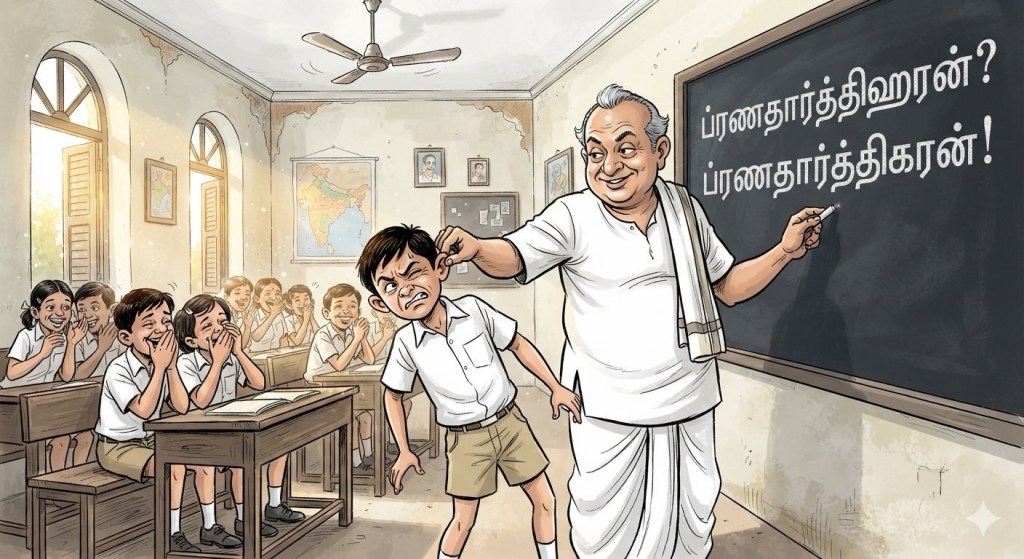
“நீ ப்ரணதார்த்திஹரனோடா? நீ ப்ரணதார்த்திகரனாக்கும்.”
“Are you with the Lord who removes devotees’ distress?
No—you’re the one who causes distress to those around you!”
This was a Sanskrit teacher’s favourite way of reprimanding a naughty classmate while tweaking the boy’s ears — And the incident was narrated to me with nostalgic mirth by my good and very respected email-friend, Sri Ramamurthy Swaminathan (USA) reminiscing about his schooldays.
On the surface, it was a classroom scolding. Beneath that, it was a miniature masterpiece of bilingual wit—a śleṣa (சிலேடை), a pun that lives only where Sanskrit and Tamil breathe together.
To hear the joke, you must know that praṇatārtihara (ப்ரணதார்த்திஹரன்) is a classic Sanskrit epithet for God: “the remover of the distress of those who bow.” The punchline swaps hara (“remover”) for a Tamil-sounding kara (“doer, causer”), turning a divine savior into a classroom menace. The laughter depends on two linguistic worlds colliding in one sentence.
That is sangha Tamizh: not a political slogan, but a lived reality in which Tamil and Sanskrit enrich each other in vocabulary, meter, rhetoric, and devotion.
A hybrid heritage, not a colonial imposition
Long before Dravidian parties made language a battlefield, Tamil authors chose—freely, creatively—to write in Sanskrit, in Tamil, or in a blend.
- The Alvars (6th–9th centuries) composed their hymns in Tamil, yet freely used Sanskrit words and concepts, embedding Vishnu’s pan-Indian theology in local idiom.
- Their commentaries later evolved into manipravalam—literally “ruby-coral”—a register where Sanskrit and Tamil words share the same sentence, sometimes even the same word, with Tamil suffixes on Sanskrit stems.
- Poets and philosophers like Vedāntadeśika wrote parallel treatises in both languages, harmonizing Tamil devotional poetry with Sanskrit Vedānta.
This was not “imposition.” It was choice: a confident Tamil culture absorbing, adapting, and re-expressing Sanskritic ideas without losing its own voice.
The rise of taṉittamiḻ: purity as politics
In the early 20th century, a different vision took hold.
Maraimalai Adigal, often called the father of the taṉittamiḻ iyakkam (Pure Tamil Movement), argued that Tamil’s liberation required purging Sanskrit—seen as the linguistic arm of Brahminical and “Aryan” domination. He even changed his own name from Vedhachalam to Maraimalai to embody this ideal.
The movement’s logic was clear:
- Sanskrit = northern, Brahminical, oppressive.
- Tamil = Dravidian, indigenous, oppressed.
- Therefore, true Tamil pride demands de-Sanskritization.
This ideology seeped into party rhetoric, education, and temple politics. Inscriptions were reinterpreted, rituals were “Tamilized,” and Sanskrit words were stripped from public speech wherever possible.
What gets lost in the purge
The cost of this linguistic nationalism is not just political; it is literary and aesthetic.
- Literary impoverishment
Much of medieval and early modern Tamil literature—Śaiva, Vaiṣṇava, Jain, and courtly—relies on Sanskrit frameworks, meters, and vocabulary. To deny that link is to flatten the tradition. - Rhetorical narrowing
Figures like śleṣa / siḷeḍai thrive on dual etymologies and cross-lingual resonance. In a strictly “pure Tamil” frame, such wordplay becomes ideologically suspect, even unintelligible. (Arthur Koestler defined this brilliantly as “two strands of thought (or linguistics) tied together by one acoustic knot”) - Historical distortion
The long record of Tamil authors consciously choosing Sanskrit, Tamil, or a blend is recast as a simple story of oppression and resistance. Nuance gives way to polemic.
When a student hears Sri. Swaminathan’s teacher’s pun today, the first response from a Dravidianist purist might not be laughter, but suspicion: “Why is a Tamil classroom echoing with Sanskrit compounds?” The beauty is overshadowed by ideology.
Sangha Tamizh as cultural confidence
“Sangha Tamizh” is not a call to replace Tamil with Sanskrit. It is a reminder that Tamil has always been porous, adaptive, and self-assured.
- It absorbed Persian and English terms without losing its identity.
- It hosted Jain, Buddhist, Śaiva, and Vaiṣṇava traditions in multiple languages.
- It produced devotional poetry that could quote the Vedas and sing in village dialects within the same breath.
To deny the Sanskrit strand in this tapestry is to deny part of Tamil’s own history. A language confident in its roots need not fear foreign branches.
A small plea
Next time you hear a Tamil speaker use a Sanskrit word—ārādhana, saṅgama, kṣetra, or even praṇatārtihara—pause before calling it “impure.” Ask instead:
- Does this word carry a meaning or resonance that enriches the thought?
- Does it connect this moment to a longer literary and devotional conversation?
- Does it allow for a śleṣa, a spark of sparkling wit that only bilingual ears can catch?
If the answer is yes, then what you have is not linguistic servitude, but sangha Tamizh: a Tamil that is wide enough to host multiple traditions without losing its soul.
Sri Swaminathan’s memory of his old teacher’s Sanskriti-Tamil or Manipravalam pun survives today not because it is politically correct, but because it is beautiful. And beauty, unlike ideology, does not need a party flag to stand.
(Concluded)