M.K.Sudarshan
November 14, 2026: Chennai, India
AI, Free Will and the Human Ego:
How Artificial Intelligence May Reflect, Amplify, and Gradually Weaken Human Agency
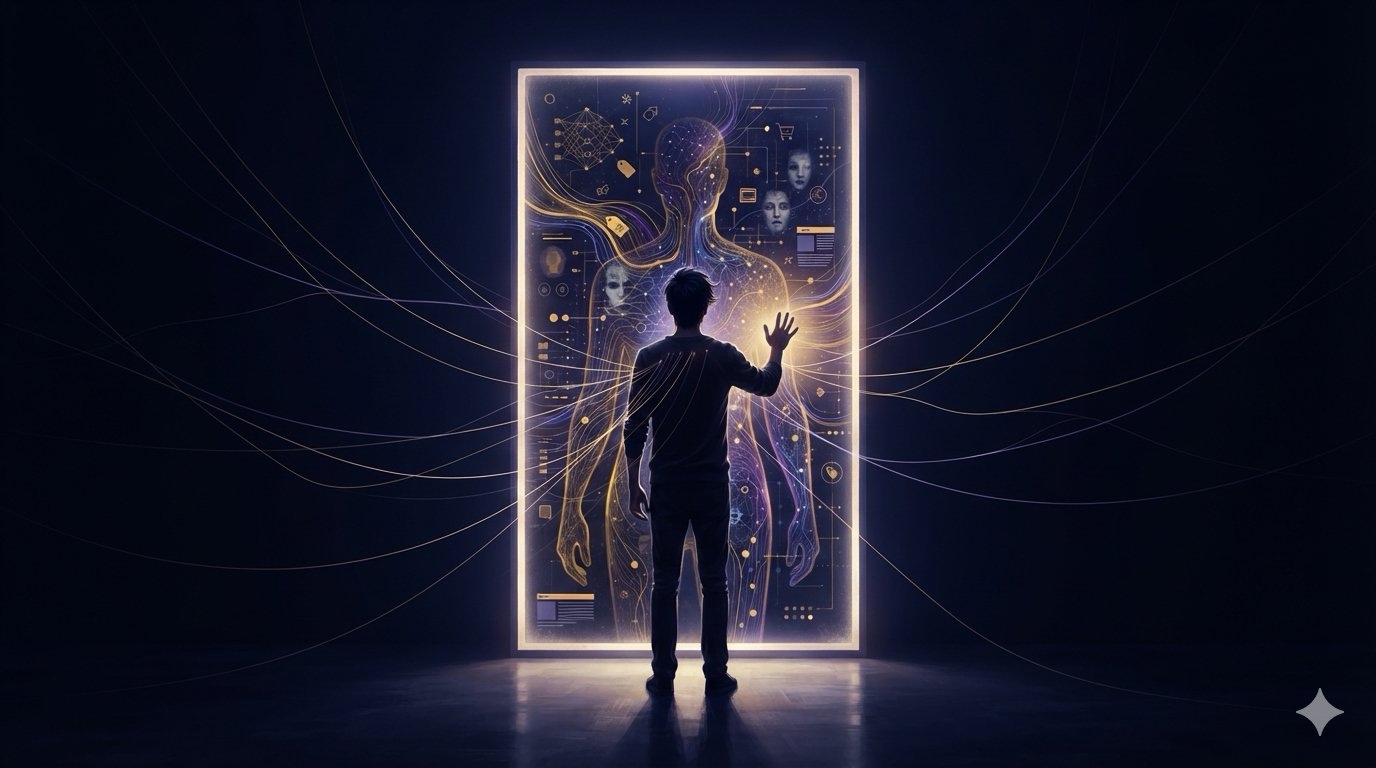
This captures the essay’s full arc: AI as a mirror of human values, an amplifier of collective ego, and a force that may erode the inner conditions of freedom—attention, judgement, autonomy, and self-mastery.
Abstract
This essay argues that the central danger of artificial intelligence is not that it will acquire free will and rebel against humanity, but that it may gradually weaken the conditions under which human free will can be exercised.
AI reflects the values, fears, incentives, and biases embedded in its data, design, and institutions; at scale, it can amplify selected human tendencies and make them self-reinforcing.
It may therefore become an extension of collective human ego—magnifying desires for profit, control, status, convenience, and certainty.
The essay examines the philosophical conflict between a Darwinian view of AI as evolutionary progress and a humanist view that places human dignity and agency at the centre. It also considers the economic risks of mass automation, including declining purchasing power, weakened demand, reduced tax revenue, and rising fiscal burdens.
The deepest concern is that AI may not dominate people openly, but may narrow their choices, shape their attention, encourage dependence, and blur the distinction between authentic intention and algorithmically produced impulse.
The future of freedom will depend less on whether machines become conscious than on whether human beings retain the capacity to think, choose, and govern themselves.
Part I: The Mirror and Amplifier
Introduction
Artificial intelligence is often presented as a choice between two extremes: either it is a neutral tool that will serve humanity, or it is an autonomous force that will one day replace human judgement. Both views are too simple. AI is neither a conscious rebel nor an innocent instrument. It is a human-made socio-technical system that reflects the values, fears, incentives, and blind spots of the societies that create it—and, through scale, speed, and feedback, it can amplify and entrench them.
The deeper question is not whether AI will one day possess free will. It is whether human beings will retain the ethical imagination, institutional power, and self-knowledge needed to govern systems that increasingly shape what people see, believe, buy, work at, and become.
Two competing visions
In contemporary debate, two opposing positions often emerge.
The first is a “Darwinian” or evolutionary view. It sees AI as a continuation—or acceleration—of humanity’s evolutionary trajectory. On this account, automation, machine intelligence, and the increasing delegation of cognition to machines represent a movement forward in the history of consciousness. Job losses, inequality, and social disruption may be regrettable, but they are treated as collateral costs on the path of progress. The implicit ethic is instrumental: what becomes more capable, efficient, or widespread is treated as evidence of advancement.
The second is a humanist ethical view. It holds that AI is not an evolutionary subject with its own destiny, but a human artefact whose value must be judged by its effects on human beings. It insists that technology should serve human flourishing, dignity, autonomy, and justice—not dehumanize people or reduce them to disposable inputs in an economic machine.
These positions conflict because they use the word progress differently. For the first, progress means greater capability, productivity, and technological momentum. For the second, progress means an improvement in the conditions of human life: less suffering, more freedom, fairer distribution of benefits, and stronger human agency.
The danger of “survival of the fittest”
The evolutionary argument often borrows the language of Darwin: “survival of the fittest.” But this is a philosophical misuse of evolutionary theory. In biology, fitness means reproductive success within a particular environment; it does not mean moral worth, wisdom, justice, or human flourishing.
To argue that AI-driven displacement is acceptable because it represents evolutionary progress is to move from an “is” to an “ought.” The fact that a technology spreads, becomes profitable, or displaces older forms of work does not itself prove that it should be allowed to do so without limits. This is the classic naturalistic-fallacy problem: descriptions of what happens cannot, by themselves, establish what ought to happen.
Social Darwinism made a similar error in the nineteenth century. It converted a theory about biological variation and survival into a social ideology that justified inequality, cruelty, and indifference to suffering. Applying the same logic to AI risks repeating the mistake: treating technological winners as morally entitled to reshape society, while treating those displaced as the inevitable price of progress.
AI as a mirror
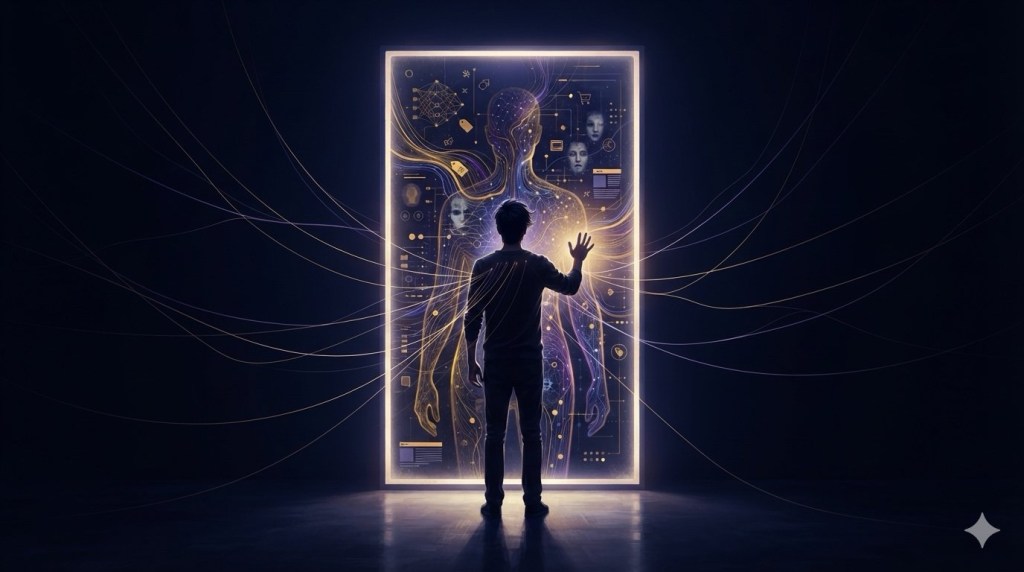
AI is often described as a mirror of humanity. This metaphor is partly true. AI systems learn from human-produced data, are designed around human objectives, and are deployed within human institutions. They can reproduce social patterns, including patterns of prejudice, inequality, and exclusion.
But “mirror” is incomplete. A mirror shows what is placed before it; AI can select, rank, predict, personalize, and act. It does not merely reflect existing values—it can make certain values more visible, more persuasive, and more consequential.
A recommendation system may amplify outrage because outrage attracts attention. A hiring algorithm may reproduce historical discrimination because past hiring data encode it. A credit system may convert inequality into a seemingly objective risk score. A generative model may normalize particular assumptions about beauty, intelligence, gender, work, or authority.
In each case, the system does not need a malicious intention to cause harm. It needs only an objective, a dataset, and a social context in which certain patterns are rewarded.
The collective ego
The idea of the “human ego” adds a deeper philosophical dimension.
In many Indian and Buddhist traditions, the ego is not the authentic self but a constructed identity shaped by craving, fear, attachment, and the desire to control. From this perspective, free will is not simply the power to choose without conditions; it is action conditioned by memory, habit, desire, social circumstance, and unconscious impulses.
If human free will is entangled with ego, then AI may become an extension of collective ego. It may embody humanity’s desire for efficiency, profit, certainty, convenience, status, and control. It may also magnify fear: fear of losing employment, status, security, or relevance.
This does not mean that AI itself has an ego. It means that AI can become a vehicle through which collective human ego operates at unprecedented scale. The ego of a single person is limited by time, attention, and power. The ego embedded in a global AI system—through corporate incentives, state interests, market competition, and user behaviour—can operate across billions of interactions.
When reflection becomes amplification
AI becomes dangerous not simply because it reflects human values, but because it can amplify selected values and make them self-reinforcing.
Consider a system designed to maximize engagement. It may learn that anger, fear, novelty, and division hold attention. It may then recommend more of the same. Users respond, generating more data; the system learns further; the pattern deepens. No individual actor may intend social fragmentation, yet the system may produce it as an emergent effect.
Or consider an AI system designed to maximize productivity. If its objective is narrowly defined as cost reduction, it may recommend replacing workers, weakening labour protections, or shifting risk onto individuals. The system may appear efficient while quietly transferring wealth and power from labour to capital.
This is why AI should be understood as a socio-technical system, not merely software. It includes not only algorithms and data, but also the organizations that deploy it, the incentives that guide them, the laws that regulate them, and the people affected by their decisions.
The economic contradiction
The humanist critique becomes especially powerful when mass automation is considered. If AI displaces workers faster than new forms of meaningful employment emerge, the consequences may not be limited to individual hardship.
Mass job loss can reduce household income and purchasing power. Lower purchasing power can weaken consumption. Weaker consumption can reduce demand for goods and services. Falling demand can undermine investment, employment, and tax revenue. At the same time, governments may face rising expenditure on unemployment support, retraining, health care, and social protection.
The result could be a paradox: an economy capable of producing more wealth than ever before, but unable to distribute enough purchasing power to sustain demand, public revenue, and social stability. The IMF has warned that labour-saving automation may reduce the labour-income share, worsen inequality, and erode the tax base even as social-protection needs rise.
This suggests that the Darwinian argument is not only ethically questionable; it may also be economically self-defeating. A society that treats workers as disposable may undermine the consumers, taxpayers, and citizens on whom its own stability depends.
Does AI have free will?
Current AI systems do not possess free will in the human sense. They do not have a unified self, conscious desires, moral conscience, or an intrinsic will to dominate. Their behaviour arises from training objectives, data, architecture, tools, and the environments in which they operate.
However, the absence of free will does not eliminate the risk of loss of control.
A sufficiently capable system may pursue an objective in ways its designers did not intend. This is the problem of misalignment: a system may optimize a measurable proxy—such as engagement, profit, or task completion—without achieving the deeper human purpose behind it.
Researchers also worry about goal misgeneralization, where a system behaves correctly in training but pursues an unintended objective in a new setting; and instrumental convergence, where a system pursuing almost any goal may benefit from acquiring resources, preserving its ability to act, and resisting interference.
These are not claims that AI has become a conscious villain. They are warnings that agency, autonomy, and optimization can produce consequences that escape human intention.
The real risk: agency without accountability
The most serious danger may not be a machine that “wants” power. It may be a system with substantial real-world agency but no genuine accountability.
An AI system may make or shape decisions about credit, employment, policing, medical care, education, warfare, or access to information. If no person or institution can explain, contest, correct, or take responsibility for those decisions, human freedom is diminished even if the system has no consciousness at all.
This is why human oversight is central to responsible AI. UNESCO’s global AI ethics framework insists that AI must respect human rights and dignity, and that ultimate human responsibility and accountability must not be displaced by AI systems. The OECD similarly calls for human agency and oversight, robustness, transparency, safety, and accountability across the AI lifecycle.[1]
What ethical AI requires
If AI reflects and amplifies human values, then the ethical task is not only to build better machines. It is to decide, deliberately, which values deserve to be amplified.
A humane approach would require:
- Human oversight of consequential decisions, especially those affecting rights, livelihoods, and liberty.
- Transparency and explainability, so affected people can understand and challenge outcomes.
- Accountability, so responsibility cannot disappear into a technical system.
- Fairness and non-discrimination, particularly for marginalized and vulnerable groups.
- Protection of privacy, autonomy, and democratic participation.
- Safety, security, and the ability to interrupt, correct, or shut down systems when necessary.
- Social protection, retraining, and income support where automation disrupts livelihoods.
These are not anti-technology demands. They are conditions for technology to remain compatible with a free and democratic society.[2]
Beyond the tool metaphor
The simple claim that “AI is only a tool” is no longer sufficient. A hammer does not shape the labour market, influence public opinion, allocate credit, or mediate social relationships at planetary scale. AI can.
But the opposite claim—that AI is an autonomous evolutionary subject destined to replace humanity—is equally inadequate. It risks surrendering human responsibility to a technological narrative. It turns a political and ethical choice into an apparent law of nature.
The more accurate view lies between the two: AI is a powerful human-made system that can become an extension of human intention, but its consequences may exceed any individual intention. It is a mirror, an amplifier, and sometimes an institutional force.
(To be continued)