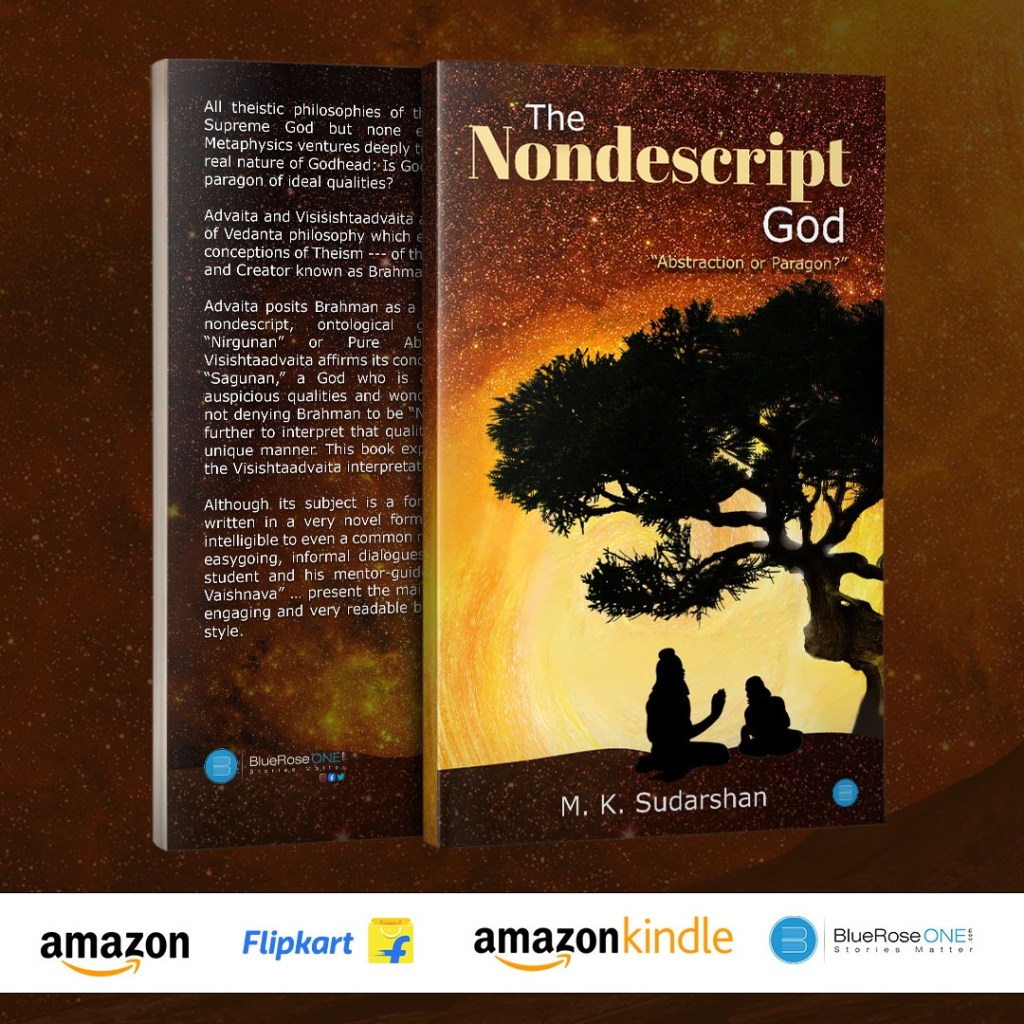
“THE NONDESCRIPT GOD”
Abstraction or Paragon?
Author : M. K. Sudarshan
NEW BOOK ON SRI VISISHTAADVAITA NOW AVAILABLE FOR SALE ON :
BLUEROSE STORE
https://bluerosepublishers.com/product/the-nondescript-god-abstraction-or-paragon/
AMAZON
https://www.amazon.in/dp/9356112355?ref=myi_title_dp
FLIPKART
https://www.flipkart.com/nondescript-god-abstraction-paragon/p/itm98169bce23411?pid=9789356112353
Price Rs. 430/- only. *******************
Read below :
Srimate Srivan Satakopa Sri Ranganatha Yatindra Mahadesikaya nama:
Preface to the Book
At a time when both authors and readers of serious topics are rather scarce, Sri M.K. Sudarsan has chosen a subject of substantial significance to discourse on. In the humdrum of our daily lives, misplaced priorities are the order of the day and the time devoted to spiritual thought and practice has dwindled to five or ten minutes in the morning before we rush off to our “more productive” endeavours. Further, the attention span of the modern reader has shrunk to such an extent that he prefers “capsules” and snippets, rather than read with patience a few full pages of text, however profound they are. Days are such that if Sri Krishna were to revisit us, the “busy” reader would perhaps ask Him to condense the Gita to a single page.
However, there is a difference between the ordinary author whose intentions are commercial and who hankers after his five minutes of fame and the serious author who is prompted by the desire to learn and to pass on to posterity the lamp of enlightenment which he himself received from his preceptor. The latter is more gratified if his words strike a chord in the heart of even a few of his readers who are prompted to embark on a journey of seeking in the spiritual realm. Hence, we can understand the motive behind Sri Sudarshan’s present endeavour.
Another modern thought is that we should emphasize harmony and not dwell on divisions, be they spiritual, philosophical, social or economic. Whether it is the difference between Smarthas and Vaishnavas, Advaitis, Dvaitis and Visishtadvaitis or between religions, we are supposed to ignore them and adopt a common denominator, which ultimately results in no one following the path trodden well by their forebears. Little do people realise that religions and philosophies will have differences and the wise man doesn’t ignore them but is tolerant towards tenets different from his own. People remember only too well what happened to Emperor Akbar’s Din Ilahi. What people need is faith in their own religions while not looking down or up at others. “Vanangum turaigal pala pala aakki”says Sri Nammazhwar and “Naatinaan deivam engum nallador arul tannaale”
says Sri Tondaradippodi, emphasising that the plurality in all the above is part of the good Lord’s Creation. Hence, while what Sri Sudarshan has set out to do may not win him the hearts of the modern-day ‘secularists’, it is nonetheless essential. The honest author must always remember that he is not running for a popularity contest by penning what people want to read most, but to tell the truth, as he sees it, whether or not it is palatable to the proletariat, adhering to the credo of Sri Nammazhwar of calling a spade a spade, whether or not it endears him to most (“sonnaal virodham idu, aagilum solluvan kenmino”).
The question Sri Sudarshan has attempted to address is, so to say, as old as the hills. Contrary to popular misconception, Visishtadvaitis had differences with Advaitis much before Sri Ramanuja, who, in the prologue to his commentary on the Brahma Sutras, says he is toeing the path of his predecessors like Tanka, Dramidacharya, Guhadeva, Kapardi, Baruchi, et al. With our Purvacharyas, it was not a question of engaging in polemics for displaying their erudition but emphasising that the glorious Brahman should not be reduced to the status of a colourless, odourless, formless, shapeless and inert substance, much like a gaseous element. They were keen to assert, based on the Shruti, that the Supreme Brahman is an ocean of auspicious attributes with none equal to or higher in glory, beauty or magnificence (yasmaat param naaparam asti kinchit). The so-called sectarian differences did not however degenerate to name-calling or derogatory references, as they are wont to nowadays. Healthy philosophical differences and debates have been an integral part of Sanatana Dharma, to which the Brahma Sutras stand as eloquent testimony. There have never been attempts at papering over differences and presenting a false façade of hypocritical unity.
Now, one would imagine that all that needs to be said on the subject has already been said and eloquently too. Both Advaitis and Visishtadvaitis have been prolific in authoring works upholding their own tenets and decrying the other’s. Where then is the need for one more book on the subject? Is it not pishta peshanam or grinding the flour repeatedly? Yes, it is indeed true that there is almost nothing left unsaid in the matter. However, all that exists is arguments and counterarguments between scholars, couched in a highfalutin language comprehensible only to them, that too in chaste Sanskrit or Manipravalam, both of which are beyond the reach of the modern reader, who is barely conversant with his mother tongue, but proficient in the international lingua franca, English. It is to cater to this segment of readers, who are serious enough about philosophy to ask questions and would like to embark on a journey of spiritual enquiry, but for being handicapped by the non-availability of books that clearly and honestly deal with this thorny issue in a comprehensible style, without resorting to bewildering jargon and a display of erudition that is of little benefit to the reader. This, then, is the laudable object of this book.
The two great works Sri Sudarshan has based his monograph on, the “Satadushani” of Swami Vedanta Desika and the “Bhagavad Guna Darpanam” of Swami Parasara Bhattar, are acclaimed works of the Sri Vaishnava tenet. The former is a transcript of the debate Swami Desikan had with Advaitis in Srirangam and is considered a seminal work incorporating the arguments of Puravacharyas and developing on them. Unfortunately, only 66 of the original 100 arguments are extant, but what is available is quite adequate to serve the author’s intended purpose. “Satadushani’s” importance can be gauged by philosopher and Sanskrit scholar Sri Surendranath Dasgupta devoting no less than 40 pages to this particular work, in his History of Indian Philosophy. The English introduction of Sri R. Kesava Iyengar to the commentary of Mahavidvan Chetlur Srivatsankacharya Swami on Satadushani is indeed excellent and exhaustive.
And the “Bhagavad Guna Darpanam” is the only commentary on Sri Vishnu Sahasranama Stotra to adopt an innovative, thematic approach to the thousand glorious names of the Lord. Each of these wonderful sobriquets represents a particular attribute (“yaani naamaani gounaani”) thus denying prima facie the notion of a nirguna Brahman.
Having such strong guide rails as the “Bhagavad Guna Darpanam” and the “Satadushani” is a great advantage of Sri Sudarsan’s work and helps him stay focussed on the issue, bringing out the nuggets embedded in both and offering them in an easy-to-understand format.
It is always an object of wonderment for the uninitiated as to how two scholars of renown could differ about the essential nature of Brahman, its relationship with its adjuncts-the sentients and the non-sentients- what salvation represents, etc. And differ so much as to offer diametrically opposite interpretations to many of the Upanishadic texts which are apparently straightforward!
However, as Sri Alavandar says, it is possible for even giant intellects to fall prey to delusion, leading to the perception of existing things as non-existent and vice versa. One man’s food could be another man’s poison, we hear; however, here is a case of Visishtadvaitis regarding the Advaitis as those with skewed perception (“kudrishtis”) and the latter returning the ‘compliment’ to the former in stronger terms, all based on the same Veda vakyas both swear by. Answers to these and other questions are to be found in the following pages, answers that shed light, provoke curiosity and the desire for further exploration and are couched in a logical, coherent and smooth-flowing narrative.
Presenting in English the complex concepts of philosophy, especially those advanced by the “Satadushani”, is no easy task. And to present them in good, readable English bereft of jargon is still more difficult. The author has succeeded in doing these in good measure. Sri Sudarshan has a way with words, making them dance to the lilting tunes he sets, intended and unintended alliterations serving as an adornment to the text.
K. Sadagopan Iyengar
Editor
Sri Nrsimha Priya (English)
Journal of the Sri Ahobila Mutt