Vishnu , the Supreme Godhead of the Upanishads called Brahman or Sriman Naaraayana, is transcendent and beyond mere mortal perception or comprehension. He is also the supreme paragon of limitless virtues and perfections … “Anantha kalyaana gunaan”.
While it is impossible to apprehend the Supreme Brahman wholly through the senses, Vishnu’s “gunas”, or multitudes of virtues and perfections, can be easily perceived through the senses since they are seen and felt to be exhibited in his multifarious manifestations in the mortal world .
Those manifestations are conceived as four in number.
The ancient Agama scriptures describe the 5 manifestations or Vishnu-emanations. There is “Para”, “Vyuha”, “Vibhava” , “Antaryaami” and “archa”.
The last mentioned is the most palpable of all divine manifestations. It refers to the consecrated forms of Deities enshrined in the ancient temples of our land in accordance with the systems laid down by the Agama Sastra.
The first mentioned manifestation is a transcendental one and impossible to perceive , conceive or comprehend .
The third mentioned is manifested in the avatars of Vishnu which occurred in the mortal realms at various points in time in different ages of the earth’s existence . The avatars are 9 in number and are described in the Vedic , itihaasa and Purana literature as Matsya , Kurma … Varaaha … etc . The tenth avatar is yet to take place in time. The “vibhava” manifestations, although they happened actually in some very distant past, they still can be apprehended clearly through collective memory.
The 4th mentioned Vishnu manifestation cannot also be apprehended by the physical senses but only through the spiritual faculty within the heart. Vishnu is resident inside the deepest crevices of the human heart and the Vedas clearly testify that through meditative practice (Dhyaana) the presence and reality of the Deity can be experienced within as a powerful but benign presence.
Now, many people, while they are able to only vaguely grasp the concept of the second mentioned Vishnu manifestation in “vyuha” form , they ordinarily still struggle to fully understand their full significance because other than the “archa” manifestation which is seen worshipped in the temple sanctum, all the other 4 manifestations defy human imagination and comprehension.
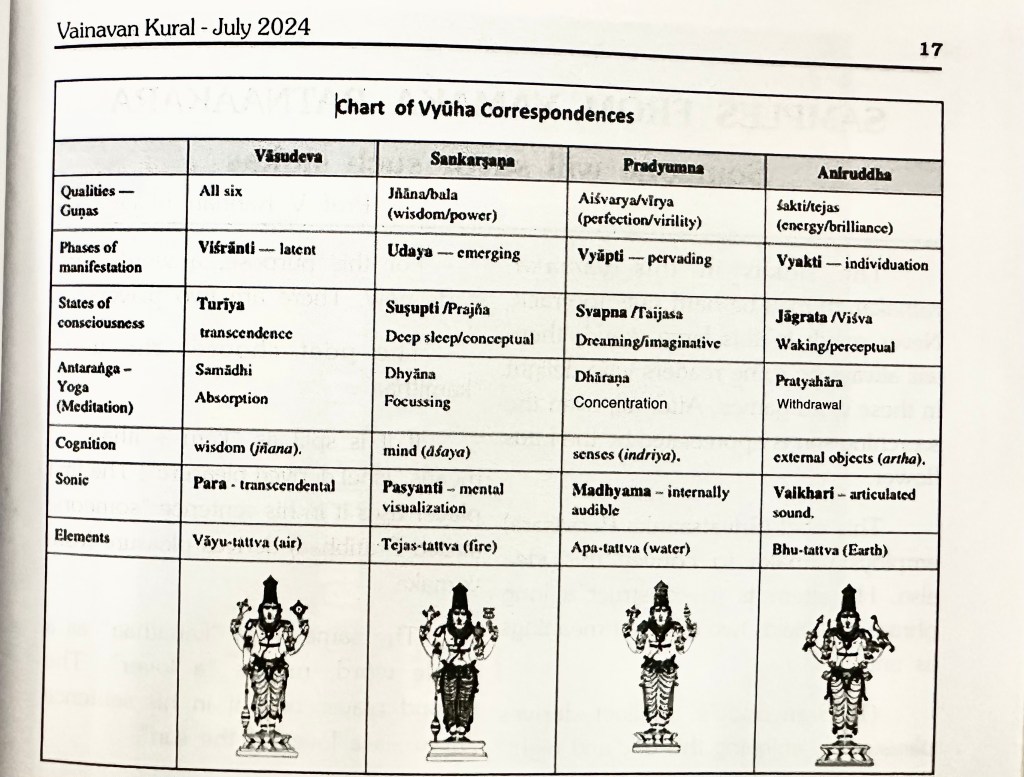
To help in understanding the esoterica of “vyuhas”, it becomes necessary to be able to map each “vyuha” to the “gunas” of Vishnu. Through a firm understanding of “guna”, it becomes possible to intuit the nature of “vyuha”.
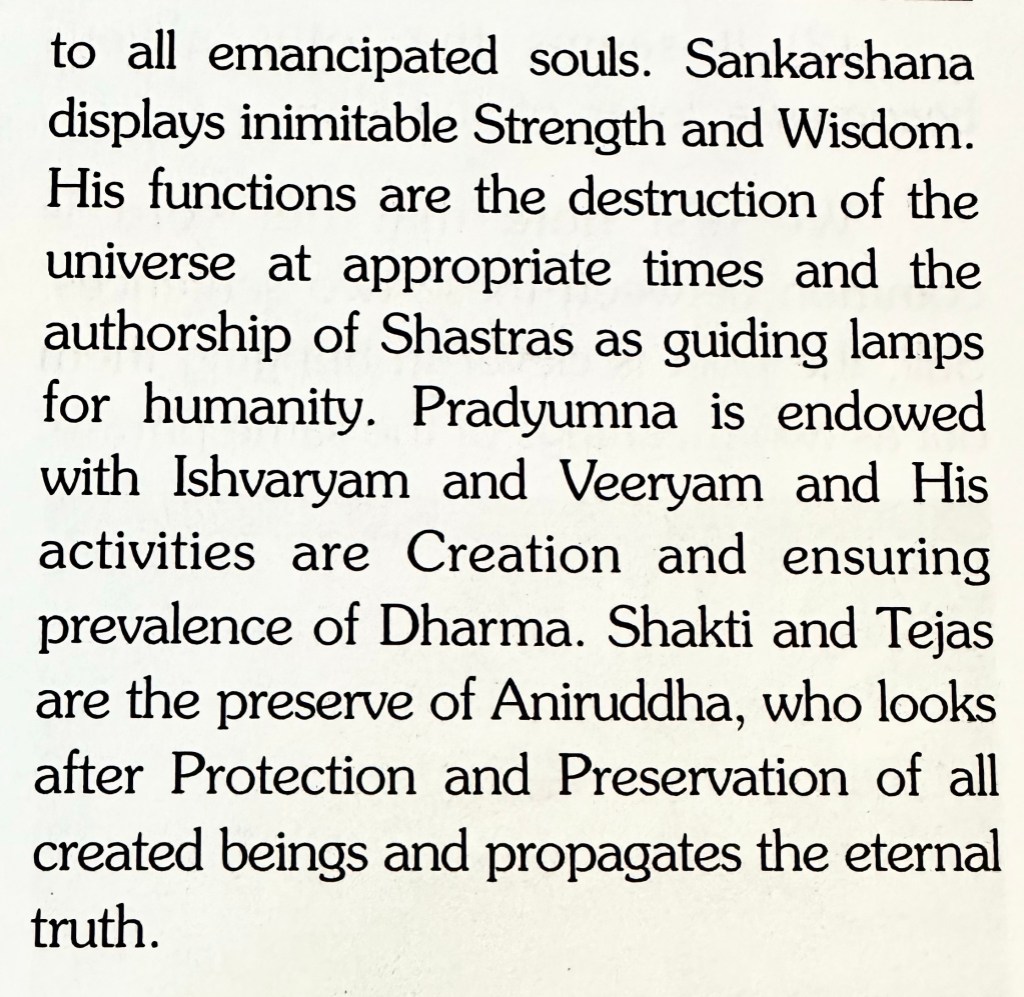
Gunas of Vishnu are infinite in number … albeit a thousand of them are well known to us thanks to the Vishnu Sahasranamam found in the Mahabharata. Of those, 6 are said to be the principal ones and are verily the supersets of every other “kalyana guna”. They are Gnyaana , Bala, Aiswarya, Veerya, Shakthi and Tejas.
Each of the 6 “Guna” of Vishnu above are said to inhere in 4 “vyuhas” or cosmic forces, namely Vasudeva, Sankarshana, Pradyumnya and Aniruddha. Each “vyuha”, in turn, serves the purpose of establishing and sustaining cosmic order and natural functions and phenomena.
Thus, it becomes possible for Man to be able to conceive the Supreme Brahman as Sriman Narayana, if one one grasps the reality of the “4 vyuhas”. And to be able to understand the “vyuhas”, it is necessary to map them with the principal “attributes” or “Gunas” of Vishnu.
It is precisely this process of mapping that has been well portrayed in one illuminating chart shown below ⬇️ that has appeared in an article in the July 2024 issue of the Vedic spiritual magazine , “VAINAVAN KURAL” under the title Srimad Rahasya Traya Saram of Swami Desikan (and explained well by the author Sri K. Sadagopa Iyengar). I’m sharing it here below ⬇️ for the benefit of all whose who may be feeling that their comprehension of the “vyuha” conception of Godhead might be a little sketchy or shaky.


Namo Naaraayana! 🙏
Sudarshan Madabushi
One thought on “The 4 “vyuhas” of Vishnu explained in one chart”