Mudrārākṣasa (मुद्राराक्षसम्): The Classical Indian Drama of Intrigue, Intelligence, and Statecraft

A Sanskrit political thriller
Viśākhadatta’s Mudrārākṣasa is one of the most arresting works in the Sanskrit dramatic tradition. Unlike many classical plays that dwell on love, courtly sentiment, or aesthetic refinement, this drama is driven by politics, strategy, deception, and the struggle to consolidate power. Its subject is the rise of Chandragupta Maurya and the extraordinary campaign by Chanakya to bring the brilliant minister Rakshasa over to the new regime. The result is a literary work that feels at once ancient and strikingly modern, a play of intelligence rather than swords.
The playwright and his world
Viśākhadatta was not a contemporary of Chanakya. He is generally placed much later, most often in the Gupta or post-Gupta period, though his exact date remains debated. He also does not neatly coincide with Kalidasa, though both are commonly associated with the broad cultural horizon of classical Sanskrit literature. This distance from the Mauryan age is important: Mudrārākṣasa is not eyewitness history but a later literary reconstruction of an earlier political world. That gives the play a distinctive character, because it turns historical memory into dramatic imagination.
Chanakya and the logic of power
At the center of the play stands Chanakya, the master strategist. He is not merely a political adviser but the true architect of the action, a mind that thinks in terms of leverage, misdirection, and long-term consolidation.
Chanakya understands that regime change is incomplete unless the old order’s most capable minds are either neutralized or incorporated. His efforts are directed less toward annihilating Rakshasa than toward making him politically useful to Chandragupta’s state.
Read against the long American record in Iran — from the 1953 CIA-backed coup against Mohammad Mossadegh to the recurring modern fantasy of regime change — the contrast is striking. Iranian political society, especially its clerical order, has proved far harder to erase, co-opt, or domesticate than outside strategists have imagined. That suggests the limits of force when it is divorced from political legitimacy. Chanakya’s success in the play depends on precisely the opposite insight: power must be able to absorb as well as destroy.
Rakshasa as worthy opponent
Rakshasa is one of the drama’s most compelling features because he is neither a fool nor a caricature. He is loyal, intelligent, and resourceful, and that makes him difficult to defeat. The play respects his integrity even as it gradually traps him within Chanakya’s web of information control and deception. That matters because regime change becomes far more futile when the opposing order is treated with contempt rather than seriousness.
The American posture toward Iran has often been marked by just such disrespect, which helps explain why coercive designs have so often produced defiance rather than compliance.
Spies, seals, and misdirection
The drama is saturated with espionage. False identities, forged letters, planted rumors, intercepted messages, and covert agents all drive the action forward. The signet ring of Rakshasa — the mudrā of the title — becomes a symbol of how legitimacy can be stolen, copied, redirected, and used to create confusion. It is perhaps the most telling metaphor for the role that modern Western media can play in intelligence environments: not merely reporting events, but helping circulate frames, legitimations, and distortions that serve covert power. In that sense, the ring is not just a token of identity but a reminder that narrative authority is itself a form of political force.
Intelligence and statecraft
This is why the play invites comparison with modern intelligence traditions. If one reads the CIA through imperial literature and Hollywood, one could just as plausibly read RAW through Chanakya and Viśākhadatta.
The play presents covert action not as sensational spectacle but as disciplined political craft, and that makes it unusually apt for anyone thinking about the deeper logic of intelligence work. It offers a classical Indian vision of state power as something that operates in the shadows as much as in public.
Why the play still matters
What makes Mudrārākṣasa enduringly relevant is its understanding that power operates not only through open force but through hidden channels of persuasion, surveillance, and narrative control.
The drama anticipates modern intelligence thinking in startling ways, though it does so within the idiom of classical Indian statecraft rather than modern bureaucracy.
For readers interested in the history of political thought, the play offers a concentrated vision of how state formation depends on the management of minds as much as the deployment of armies.
English translations and access
For readers who want to engage the original text in English, there are several useful editions and scans.
M. R. Kale’s The Mudrarakshasa of Visakhadatta is available via Internet Archive.
A Sanskrit text with English translation and notes is also available through Sanskrit eBooks.
Another full-text copy can be found in the Digital Library of India scans on Internet Archive.
These are useful starting points for anyone who wants to read the play directly rather than through secondary summaries.
Closing personal reflections
In the end, Mudrārākṣasa is not merely a Sanskrit drama. It is one of the great classical texts of political intelligence, a work that turns statecraft into theatre and theatre into a theory of power.
Its fascination lies in the fact that victory is achieved not by brute destruction but by the slow, careful reordering of allegiance. That is what gives the play its lasting force: it understands that the most effective rulers are often those who can govern the unseen.
For modern readers, especially in India, the play has an additional resonance. It suggests that the strategic imagination has native classical roots, long before modern intelligence agencies emerged. If the CIA can be read through Kipling, Greene, and Hollywood, then RAW too must and can be imagined through Chanakya, Arthaśāstra, and Mudrārākṣasa.

Yet someone like me is left wondering why, despite the fecund cultural alliance between the CIA and Hollywood over the last half-century, no comparable Bollywood exploration of Mudrārākṣasa has yet truly taken shape in the cinematic idiom. The text seems to cry out for that treatment.
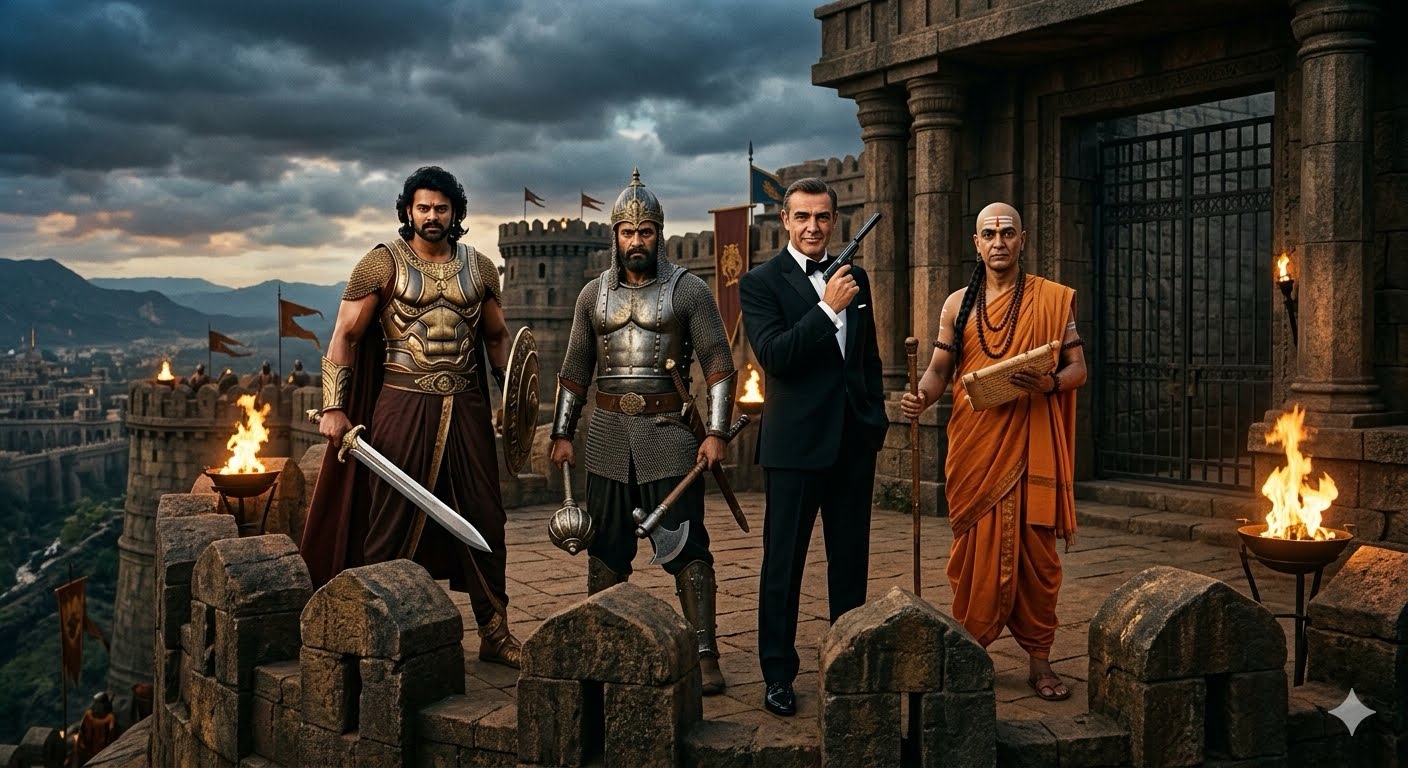
Why “Bahubali” and “Dhurandar”, but no Mudrārākṣasa? Why, is Chanakya less cinematic than the CIA?
Sudarshan Madabushi