
MAY 26, 2026
Dear Reader, Two Class 8 children wanted me to re-write my original review in a simpler form so that they could understand in full. Hence this.
Who are the Vadakalais and Thenkalais? Where do they come from? Why do they fight in Indian courts on completely insignificant matters? From when did they begin to have their differences? Are the differences significant enough to warrant the Indian judiciary’s time and efforts for more than 300 years?
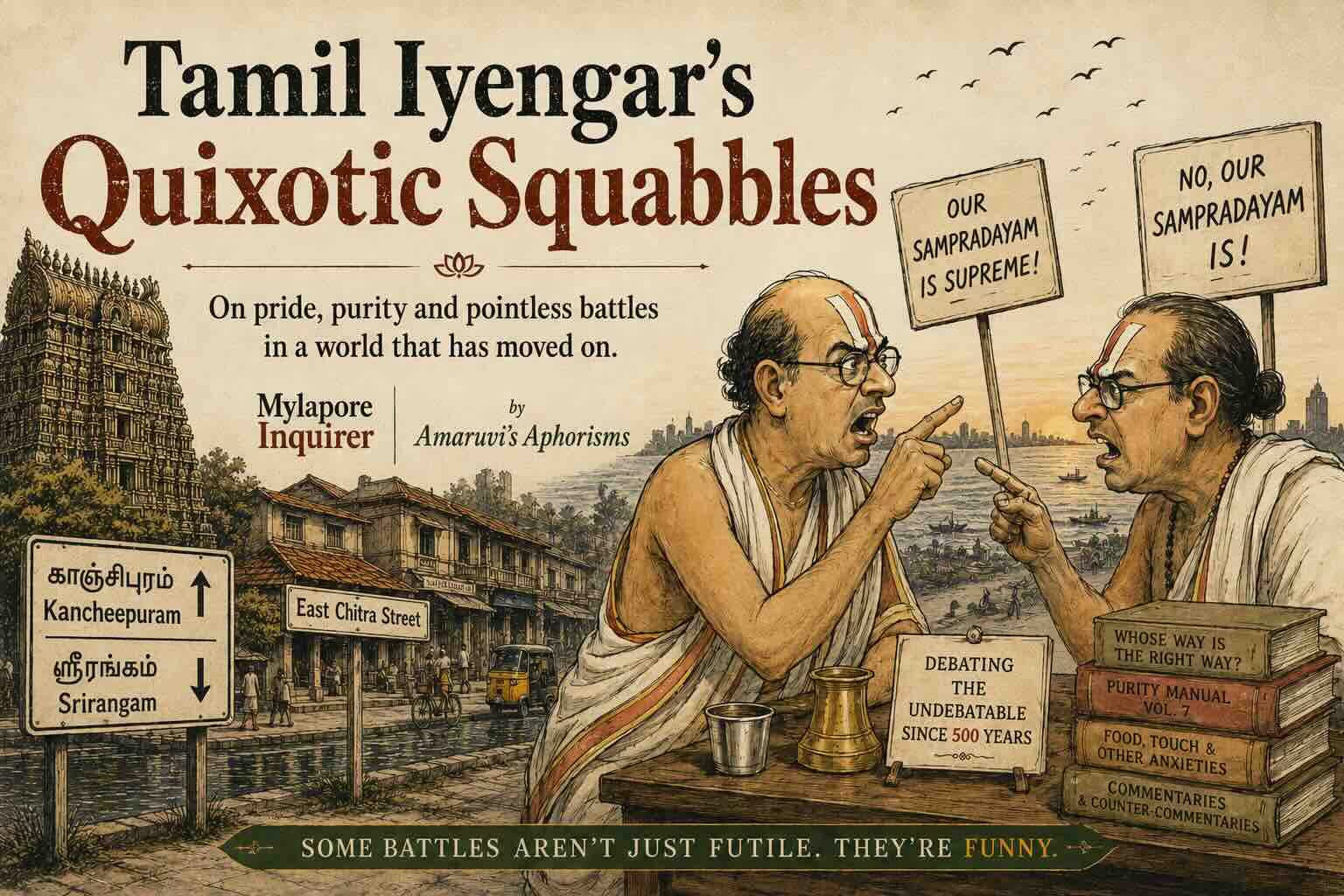
These and many other aspects of the Iyengar rivalries are dealt with in this book, ‘A Tale of Two Cities’, by author and researcher M.K. Sudarshan.
For the normal (secular) eye, the book and its contents and the presentation could appear unnecessary and detailed. But to someone interested in knowing the truth, this book serves its purpose. Ask any cosmopolitan Iyengar—”what is the difference between Vadakalai and Thenkalai?” He would point you to the “U”, “Y” symbolism only. Such is the ignorance and apathy in the Srivaishnava community, especially among the GEN-Z and their parents.
Sudarshan has sought to enlighten these minds on the key differences between the sects from philosophical, historical, and hagiographical contents. Added to that is the exploitation at the hands of the British. Subscribe
Historical Divisions and Legal Battles
Detailing from the times of Ramanujacharya, the author traces the schisms, dissonances, and the narratives that have been set, exemplified, and later exploited by the British and courts. The machinations resorted to by the Thenkalai sect are matched in equal measure by those of the numerically weaker Vadakalai sect. Both get to be treated with historical rigor and their contributions noted.
Though this multi-century old vexatious litigation appears to be gargantuan in proportions, for all practical purposes, in current times, it comes down to just the liberty of the litany of the legendary Acharyas—Vedanta Desika and Manavala Mamuni. Does this then merit expansive court’s time in anybody’s view, that too in current times?
The Role of Patronage and the British
Copious notes on the historical background during the Vijayanagara reign explain how Kanchipuram Thathacharyas made way, through royal munificence, to the betterment of the Kanchi Varadaraja Swami Temple and other temples in the region. They became the de facto authorities of the Northern Seat of Vaishnavism, while the Southern Seat was headed by the Pillai Lokacharya’s follower Uthama Nambi’s clan from Srirangam. Their efforts to win royal patronage and thus further the cause of the Srirangam Temple et al are explained in lucid detail with abundant evidence.
The dubious role played by the British in widening the cleavage and making the split as gargantuan as it appears today, the courts and their judgments that aided this partition, and the monumental wastage of human and material wealth (post-independence) in chasing this mirage of a “divine inspired” division are all detailed in an understandable chronological order.
Conclusion
Are these court cases worth the salt? In the age of AI, should we ever prime these valuable national resources on these cases and waste them? The new-age Srivaishnavas would need to ponder after reading this detailed book by M.K. Sudarshan.
Here is the original review.