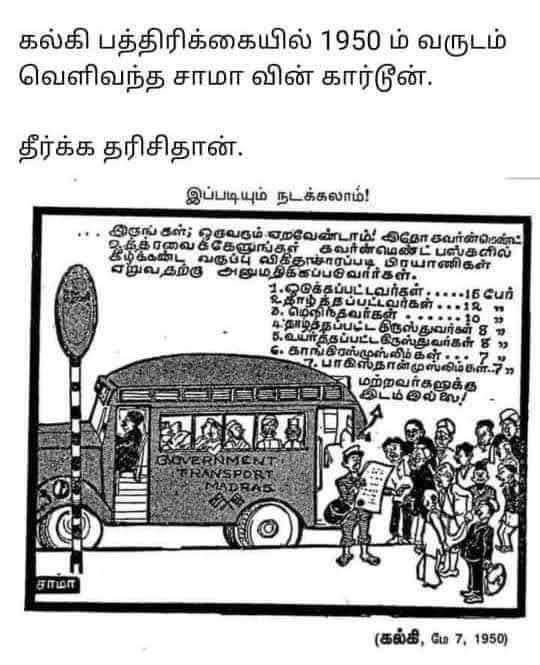

This vintage cartoon in Tamil language is a political satire targeting the caste-based reservation (quota) system in India.
The cartoon was drawn by the prominent artist Sama and originally published on May 7, 1950, in the popular Tamil weekly magazine Kalki.
The scene portrays a crowded bus stop labeled “Government Transport Madras”. Instead of allowing passengers to board normally, a bus conductor stands at the door reading a restrictive government mandate to an astonished crowd.
To mock how extreme state-enforced communal reservation could theoretically become, the conductor announces a rigid proportional breakdown of who is permitted on the vehicle:
- Oppressed classes (Odukkapattavargal): 15 people
- Depressed classes (Thazhthapattavargal): 12 people
- The emaciated/lean (Melinthavargal): 10 people
- Backward Christians: 8 people
- Forward Christians: 8 people
- Congress Muslims: 7 people
- Pakistan/(Bangladeshi!) Muslims: 7 people
The final line on his paper states: “No room for anyone else!” (Matravargalukku idam illai!). Through this absurd setup, the cartoon humorously critiqued the post-independence administrative rush to section public services into strict communal segments.
What deeper meaning can be read today in 2026 into this 1950 cartoon ?
*****************************
Part 1: The Asymmetry of Empowerment
How a Policy Designed for Social Inclusion Became a Tool for Political Representation Rather Than Wealth Equality
Seventy-five years ago, India embarked on one of history’s most ambitious social engineering experiments: the caste-based reservation system. Spearheaded by Dr B.R. Ambedkar, the policy aimed to dismantle centuries of systemic oppression by providing Scheduled Castes (SCs) and Scheduled Tribes (STs) a guaranteed foothold in higher education and public sector employment. Today, evaluating this project reveals a striking paradox—a phenomenon sociologists call “the asymmetry of empowerment.”
If measured purely by political representation, the policy has achieved a historic democratic revolution. Reservations acted as a battering ram, fracturing old monopolies on power. They facilitated the rise of powerful regional parties led by Lower Caste and Backward Class leaders, and diversified the visible face of Indian bureaucracy. For millions, the presence of these leaders provided an indispensable shield of representation.
However, a critical disconnect emerges when looking beneath the political surface. Affirmative action was designed as a tool for social inclusion, but successive governments treated it as a cure-all for deep structural poverty. Because formal government jobs account for only a tiny, shrinking fraction of total employment in India, the vast majority of the population remains trapped in the informal, unregulated economy.
According to data from the UNDP Global Multidimensional Poverty Index, five out of every six multi-dimensionally poor individuals in India still belong to lower-caste groups. While the policy successfully put marginalized leaders into legislative assemblies, it lacked the economic reach to pull their broader communities out of agrarian distress. This stark division between political triumph and material stagnation forms the foundation of modern skepticism regarding the ultimate success of the program.
Part 2: The Logic of “Social De-Engineering”
When Competitive Backwardness Hardens Tribal Identities and Fuels a Zero-Sum Struggle for Scarce Resources
When a corrective policy is overused or driven entirely by electoral calculus, it risks reversing societal progress. Instead of dissolving caste barriers to build a unified, merit-based society, the unchecked expansion of quotas can trigger a process of “social de-engineering.”
This fragmentation occurs through a systematic cycle:[Fixed Public Resources] + [Expanding Quotas] ──> [Zero-Sum Conflict] ──> [Hardened Tribal Identities]
First, the system requires individuals to permanently assert their backwardness to access state benefits. Instead of eroding caste consciousness, the policy legalizes and institutionalizes it, passing these rigid identity labels down through generations.
Second, because elite university seats and formal public jobs are fixed and scarce, reservations turn public opportunities into a fierce, zero-sum struggle. This dynamic naturally breeds resentment among non-beneficiary groups, who feel penalized for historical wrongs they did not commit. Simultaneously, it sparks bitter internal conflicts among marginalized subgroups competing for their share of the quota pool.
The most visible sign of this de-engineering is the competitive “race to the bottom.” Traditional social mobility involves communities striving to climb upward economically and socially. Today, powerful, historically dominant agrarian communities regularly stage disruptive agitations to be officially classified as “backward” by the state to claim a share of government patronage. When the primary currency of state support becomes a group’s certified disadvantage rather than objective economic need, the very fabric of social cohesion begins to unravel.
Part 3: The Ultimate Gamble and the Turchin Trap
Private Sector Pressures, Elite Overproduction, and the Implosion of Institutional Cooperation
The latest frontier in this debate is the growing push to mandate reservation quotas within the private sector. Driven by a shortage of government jobs, politicians are attempting to force corporate capital into the quota framework, often using local “domicile” laws as a proxy for caste engineering. Economists view this as an exceptionally high-risk gamble. Forcing rigid quotas onto the private sector risks disrupting the merit-driven efficiency required to survive in a competitive global market, potentially threatening the very economic engine that generates jobs and tax revenue.
This trajectory mirrors the structural warnings laid out in evolutionary anthropologist Peter Turchin’s Structural-Demographic Theory. Turchin warns that societies enter dangerous cycles of instability when they suffer from Elite Overproduction and the Wealth Pump.
In India’s context, expanding quotas create a surplus of credentialed, ambitious individuals who expect matching administrative power or corporate status. When the shrinking job market cannot absorb them, it produces two competing factions of frustrated elites: qualified quota-holders who are underemployed, and high-scoring non-quota applicants who feel structurally excluded. Turchin’s model shows that these surplus contenders do not disappear; they become radicalized counter-elites who use their education to organize polarization and street agitations.
Simultaneously, the system acts as an internal “wealth pump.” The benefits of reservations are frequently captured by a wealthy “creamy layer” within marginalized groups, while the poorest rural segments remain stagnant. The state uses the illusion of expanding quotas to mask its failure to provide fundamental economic equalizers—like quality primary education, healthcare, and industrial job creation.
Seventy-five years of data prove that affirmative action can be a powerful tool for initial democratic inclusion. However, when treated as a permanent tool for competitive electoral mobilization, it risks transforming a policy of social justice into a highly volatile engine of long-term civic instability.
Join the Conversation
What are your thoughts on the future of social justice policies? Has the reservation system outlived its original intent, or does it simply need structural reform—like strict economic criteria—to succeed?
Let me know your perspective in the comments section below, and don’t forget to share this post with your network to keep the discussion going!
**********************
M.K.Sudarshan