
by M. K. Sudarshan
15 Jun 2026
Preamble: What You Will Read
This essay in 4-Parts explores the profound ontological divergence between Abrahamic and Dharmic civilizational frameworks.
At its core lies a fundamental question: how does each tradition conceive Evil?
Abrahamic religions personify evil as Satan—a singular entity of pure malevolence engaged in cosmic dualism with God.
Dharmic traditions reject this entirely, viewing evil as adharma—moral disequilibrium rooted in ignorance (avidya).
This ontological distinction shaped divergent literary and political traditions: Western imperialism justified through “white man’s burden” versus Dharmic wars of cosmic preservation.
The essay traces a 3,000-year historical arc from religious binary to modern secular imperialism, concluding with the contemporary collision between Dharmic Asia and Asuric Abrahamic forces.
Part I: The Ontological Foundations — Personified Evil vs. Moral Disequilibrium
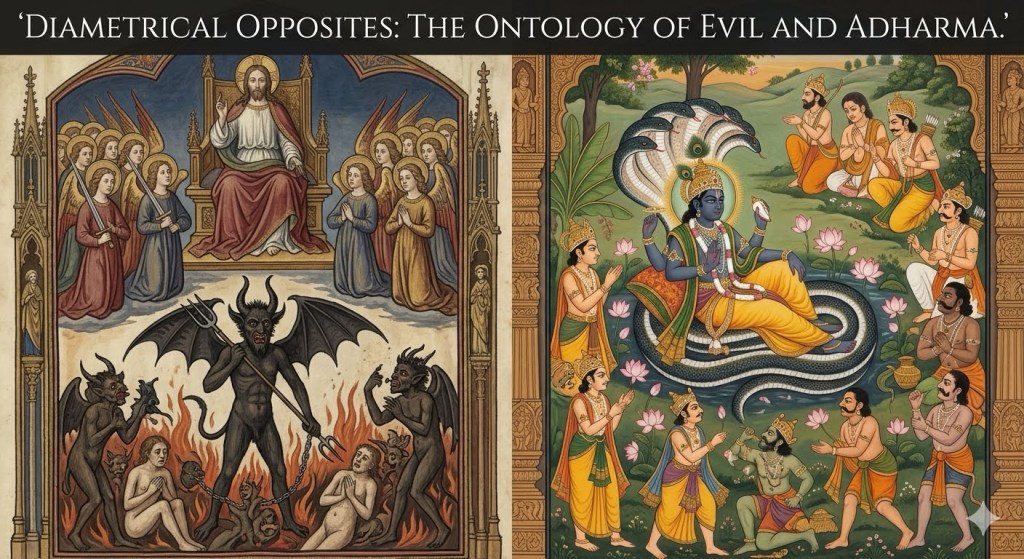
The Abrahamic Binary: God versus Satan
In the Abrahamic religions—Judaism, Christianity, and Islam—evil is personified as a singular ontological entity of pure, universal malevolence. This entity bears different names across the traditions: Satan in Christianity and Judaism, Shaitan or Iblis in Islam, the Anti-Christ in Christian eschatology. Yet the theological function remains identical: Satan represents an adversary of near-equal or equal power to God, engaged in cosmic dualism.
This personification carries profound implications. Satan is ontologically fixed in evil with no redemption possible; cosmically powerful with divine-level authority; externally adversarial, tempting humanity from outside rather than from within human ignorance; and a binary absolute representing pure Evil in opposition to pure Good (God).
This framework creates a dualistic cosmos—a battleground where two ontological powers contest eternally. The world becomes the theater of this primordial struggle, and human beings are either caught in the middle or enlisted as combatants.
The Dharmic Alternatives: Adharma as Disequilibrium
In stark contrast, the Dharmic worldview—encompassing Sanatana Dharma (Hinduism), Buddhism, Jainism, Shinto, and Sikhism—rejects the personification of evil entirely. There is no Satan-equivalent in Hindu theology. Evil is recognized only as a baleful force in mortal realms, not as a divine principle of equal or near-equal power to God.
Instead, Dharmic traditions conceive evil as Adharma—a term that does not mean “evil” in the Abrahamic sense but rather displaced virtue (a state where virtue has been moved from its proper place), moral disequilibrium (cosmic imbalance, not binary opposition), or ignorance-based conditions rooted in Avidya (ignorance), Moha (delusion), and Asura-predispositions.
The malevolent forces in Hindu cosmology—Asuras, Rakshasas, Daityas, Danavas—are terrestrial rather than divine (mortal beings, not ontological principles); redeemable (even infamous figures like Ravana and Hiranyakashipu can achieve liberation through penance and devotion); species rather than demons (distinct categories of beings, some benevolent like Prahlāda, Bali, Vibhīshana); and corrigible (their condition results from ignorance, not eternal fixedness).
The Metaphysical Ramifications
This distinction reveals why Hinduism lacks a Satan-equivalent. First, non-dual metaphysics: in Hindu philosophy, there is ultimately only one Truth (Brahman). As one scholar notes: “There cannot be any opposite to God, i.e., Truth. It is one only. There can’t be opposite to one.”
Second, karma rather than adversary: evil arises from karma (intentional action) and ignorance, not from an external devil. Suffering is typically the result of one’s own actions, not Satan’s temptation.
Third, God’s supremacy: in Sri Vaishnava theology specifically, Vishnu/Nārāyaṇa is the supreme, all-pervading principle (parabrahman) with no ontological equal—making the concept of a “pure evil” counter-God impossible within that framework.
This theological structure reveals that the Abrahamic binary is not universal but civilizationally specific—a particular way of conceiving reality that became dominant in Western thought but remains foreign to the Dharmic traditions of Asia.
Part II: From Worldview to Literature and Political Philosophy — The Divergent Intellectual Traditions
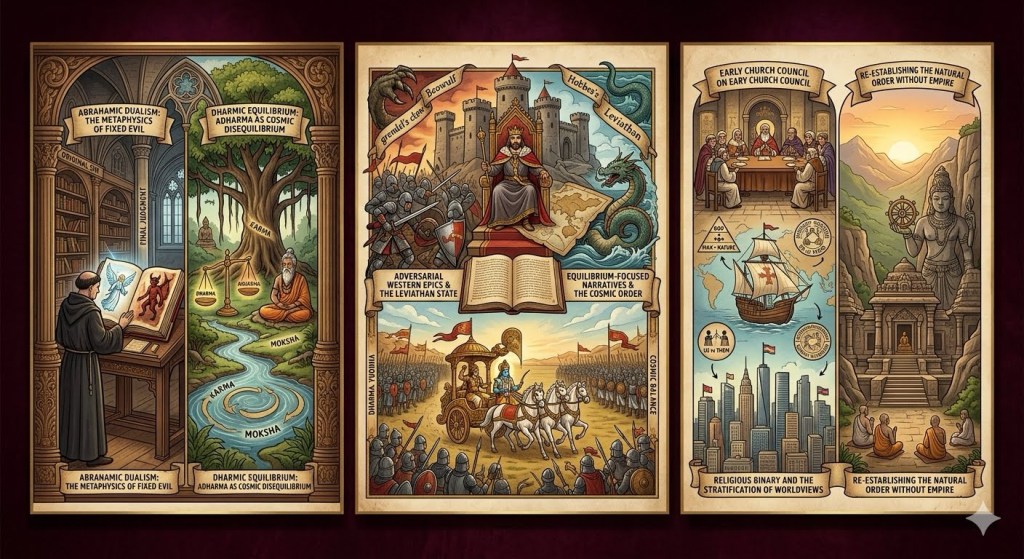
Abrahamic Literature: The Drama of Adversarial Tension
Western literature, born from Abrahamic religious foundations, finds its primary inspiration in an Avenging God Almighty who punishes sin and battles Satan. This creates a literary tradition characterized by biblical literature establishing the God-Satan binary as the central cosmic drama; Dante’s Inferno mapping this binary onto a literal geography of eternal punishment; and the Devil becoming a central character, tempter and adversary.
Milton’s Paradise Lost (1667) reflects the political and religious turmoil of seventeenth-century England, exploring themes of freedom, power, and authority amidst civil wars and republicanism. The poem symbolizes the struggle between divine power and human desire, warning against the dangers of pride and disobedience through Satan and Adam. Milton’s Satan is not merely a character but the ontological embodiment of Evil—the adversarial force that must be defeated.
Hobbes’ Leviathan (1651) used biblical frameworks to forward political theory for authoritarianism. Hobbes conceived the state as necessary to prevent humanity from collapsing into chaos—a secularized version of the Satan-God struggle. The “Leviathan” (the state) becomes the divinely-authorized power that crushes the satanic forces of civil war.
Even Nietzsche’s Thus Spoke Zarathustra (1883-85), ostensibly anti-Christian, remains within the Abrahamic binary framework. He attempts to overthrow Christian morality but retains the Good vs. Evil structure, merely attempting to invert it. The “death of God” does away with the Christian deity but leaves the moral dualism intact.
Dharmic Literature: The Triumph of Dharma over Adharma
Hindu religious epics, embodied in the Purāṇas and Itihasa (Mahabharata and Ramayana), exemplify a fundamentally different literary paradigm. The Mahabharata’s definition of dharma as a relative, comparative, and context-dependent norm—rather than as an eternal moral principle—is one of its greatest intellectual virtues. Bipolar moral dichotomies like good and evil are absent.
The Kurukshetra battle is not a victory of “Good over Evil” but a correction of disequilibrium. The Kauravas committed adharma (moral imbalance); the Pandavas’ victory established Yudhishthira’s righteous rule; the outcome corrected wrongdoings, not destroyed an ontological evil.
Dharma is not a rigid code. The triumph signals that adherence to moral law leads to positive outcome, in contrast to the destruction that adharma brings. This reveals adharma as corrigible disequilibrium, not eternal fixedness.
The Avatar’s Primary Mission: Restoring Dharma
The term avatar in Hinduism refers to various gods taking form to perform a particular task which in most cases is bringing dharma back. Vishnu’s avatars descend to empower the good and fight evil, thereby restoring Dharma.
The fundamental purpose of an avatar is to restore dharma, guide spiritual seekers, and protect the righteous: “To protect the virtuous, destroy the wicked, and reestablish dharma, I appear age after age” (Bhagavad Gita 4.7-8).
Crucially, destruction of evil is secondary to the primary mission of restoring virtue or Dharmic order. The avatar descends when dharma-samprāpta-kṣāma (dharma declines), not to battle an equal opponent but to restore cosmic equilibrium.
Krishna’s obligation is “to restore such equilibrium to the world”—not to annihilate ontological evil.
The Political-Philosophical Consequences
These literary traditions encoded different political philosophies. Abrahamic political philosophy derives authority from divine mandate (God’s will against Satan), purposes rule to punish evil and evangelize good, justifies war to destroy “Satanic” enemies, demands universalism (one true path: Christian/Islamic), and offers binary redemption (saved or damned).
Dharmic political philosophy derives authority from cosmic order (rita/dharma), purposes rule to restore equilibrium and protect the virtuous, justifies war to correct adharma and preserve dharma, accepts pluralism (multiple paths to same Truth), and offers universal redemption (all beings redeemable).
The Abrahamic framework produces universalizing, imperialistic political thought: one true God, one true path, one true morality that must be imposed universally. The Dharmic framework produces equilibrium-based, preservative political thought: restore balance, protect the righteous, allow multiple paths.
Second, universal redemption: even Asuras/Rakshasas are redeemable, making conversion-by-conquest meaningless.
Part III: The Historical Arc — From Religious Binary to Imperial Metastasis
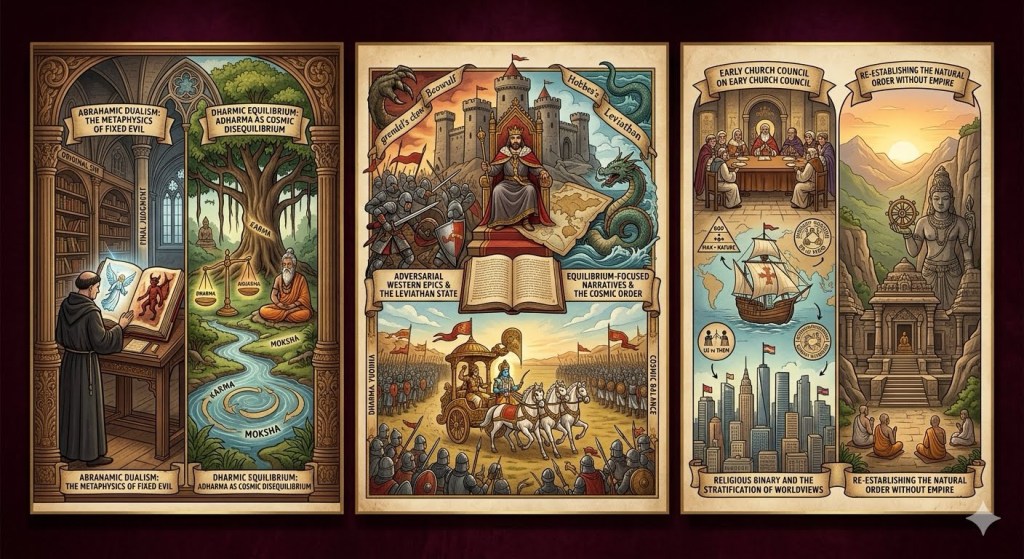
The Three-Thousand-Year Arc of Imperial Warfare
Abrahamic civilisational worldview has been the main cause of over 3000 years of brutal imperialistic wars and bloodshed and human tragedy all across the world. This is no sweeping or exaggerated observation because it aligns with much of documented historical evidence.
Early Christian Imperialism (4th-15th centuries): Constantine’s 313 CE conversion marked the beginning of Christian imperialism. The Roman Empire’s adoption of Christianity transformed it from persecuted minority to imperial ideology, justifying conquest of “heathen” territories as divine mandate.
Colonial Missionaries (15th-20th centuries): European missionaries were “intimately involved in colonial process” in Africa; Christianity was “a disguise for Western colonization to take valuable resources.” Missionaries declared: “Dark Continent is a cursed land, almost entirely in the power of the devil“—justifying “forcibly and violently converting them.”
The binary worldview enabled complete dehumanization: if Africa is Satan’s territory, its people are half-devil and half-child, requiring colonization and conversion.
The “White Man’s Burden” (19th-20th centuries): Rudyard Kipling’s 1899 poem explicitly framed imperialism as “Divine Burden to reign God’s Empire on Earth“; Filipinos described as “half-devil and half-child.” The “White Man’s Burden” combined evangelical Protestantism with white supremacy and paternal mission of uplift; beliefs were “paternal, chauvinist, intolerant, and often degrading to other religions.”
Islamic Jihad and Jahiliyya (7th century-present): Jahiliyyah, in Islam, means “ignorance” or “barbarism“—a state of “spiritual darkness, unenlightened by submission to God.” Sayyid Qutb framed contemporary nations as jahiliyya requiring jihad to destroy jahiliya. The Islamic binary mirrors the Christian: pre-Islamic Arabia (or modern secular nations) = jahiliyya (barbarism); Islam = divine illumination.
Modern Secular Imperialism (20th-21st centuries): “The Abrahamic world… spawned the great secular ideologies of scientific empiricism, liberal democracy, and Marxism.” Western liberal democracy is “grounded in principles of the Abrahamic faith.” The ideology of liberal democracy justifies “western interventions and warfare in Muslim countries.”
The secularization of Abrahamic imperialism did not eliminate its religious foundations. Liberal democracy remains grounded in Abrahamic principles while justifying contemporary interventions.
The Mechanism of Metastasis
How did religious binary metastasize into imperial ideology? Every empire from Rome to America requires a legitimizing narrative (American Exceptionalism) and a legitimizing religion (White Evangelicalism) to sanction its activity. The God-Satan binary provides the narrative: empire = God’s work against Satan.
European governments saw Christian Missions would “create social conditions favourable for the pacification of Africa” and promote European commercial and colonial interests. Missionaries preceded soldiers, converting populations to accept colonial rule as divine mandate.
Imperialism is no more than the exporting of a secular epistemological and ethical paradigm from the western world. There is a close link between these philosophies and the imperialist vision. Secular ideologies (liberal democracy, Marxism) are not departures from religious imperialism but continuations in secularized form.
Notions Birthed by Binary Worldview
My above broad enumeration does capture the ideological vocabulary of Abrahamic imperialism:
“White man’s burden” (divine duty to colonize “half-devil” peoples); “Duty to evangelise and bring Light into the world” (eradicate “Satanic darkness“); “White supremacy” (biological justification for religious hierarchy); “The harvest of the faithful to be reaped” (salvation as conquest); “To gather the flock unto the Kingdom” (imperial expansion as divine gathering); “Jihad to destroy jahiliya” (military conquest as spiritual purification).
Each notion rests on the same foundation: binary worldview (Christian/Islamic Good vs. Satanic/Heathen Evil) that justifies empire-building wherever “Abrahamic Good perceived primitive or heathen Evil, the work of Satan that needed to be undone.”
Part IV: The Dharmic Counter-Narrative — Wars of Preservation, Not Empire
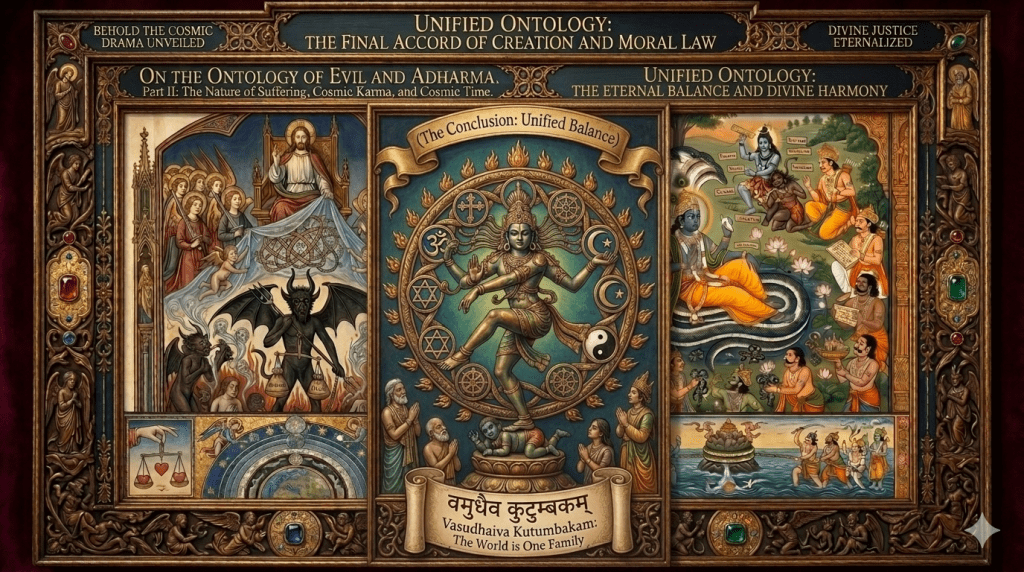
The Dharmic Weltanschauung: Disequilibrium, Not Dualism
Throughout the history of mankind, the world view of non-Abrahamic religious world views — the Dharmic Weltanschauung that spawned Sanatana Dharma, Buddhism, Jainism, Shinto and Sikhism— far from projecting the world as a continuous drama of adversarial tension between God and Satan, between whiteness of the Good versus the blackness of Evil, or between the era of Jahiliya and its opposite — looked at all strife in the world as no more than a state of disequilibrium of natural Dharma or cosmic order.
The above statement seems to capture the essential distinction:
— Abrahamic faiths see continuous adversarial tension while Dharmic sees state of disequilibrium;
— Abrahamic faith sees God vs. Satan while Dharmic sees Dharma vs. Adharma (imbalance);
— Abrahamic faith sees whiteness of Good vs. blackness of Evil while Dharmic sees displaced virtue vs. natural order;
— Abrahamic faith sees era of Jahiliya vs. Islamic illumination while Dharmic sees moral disequilibrium vs. cosmic equilibrium.
The Dharmic Mechanism: Avatar as Restorer
This natural cosmic order was disturbed by Adharmic deeds of Man of Asura-predispositions who were afflicted by Ignorance, Delusion or Avidya. There was no conception of the world as a battleground between Pure Evil or Pure Virtue or between Satan and God.
Whenever Adharma rose in strength and Dharma weakened, divine intervention in the form of avatar restored the latter and Dharmic equilibrium. The forces of Dharma and the Devas in the world, with divine aid that came to assist them, beat back the forces of Adharma and the Asuras/Rakshasas of the world to usher in cosmic order again.
Key distinctions here to be noted are:
— not destruction (the goal is restoring equilibrium, not annihilating evil);
— not eternal (Asuras/Rakshasas are corrigible, not eternally fixed);
— not binary (Adharma is disequilibrium, not ontological opposite);
— not universal (multiple paths to same Truth, not one true path).
The Teleology of Dharmic Religions: Free from Pure Good/Evil
The teleology of Dharmic religions thus was free of notions of pure Good and Evil personified in God and Satan. Such a de-personified worldview thus ensured that wars fought were not imperialistic in the Abrahamic sense but were simply wars of “preservation of Dharma and Cosmic” (not just world order)
This is the crucial insight:
A. Dharmic wars were preservative, not imperialistic. Abrahamic war aims to destroy “Satanic” evil, imposes universally, justifies through evangelizing “heathens,” builds empire, and offers binary redemption.
B. Dharmic war aims to restore cosmic equilibrium, preserves locally, justifies through correcting adharma, restores order, and offers universal redemption.
The Mahabharata battle exemplifies this: “The Kurukshetra battle was ‘a victory of dharma by… establishing Yudhisthira’s righteous rule… correcting the wrongdoings of the Kauravas’ — not destroying Satan.” The battle’s purpose was not to annihilate the Kauravas as ontological evil but to correct their disequilibrium and establish righteous rule.
Why Dharmic Traditions Did Not Produce Imperialism
The Dharmic worldview’s structural features prevented imperial metastasis.
First, no ontological enemy: since adharma is disequilibrium (not Satan), there’s no eternal enemy to destroy universally.
Third, non-binary morality: Dharma is context-dependent, not universal absolute, preventing imposition of “one true path.”
Fourth, cosmic vs. worldly order: wars preserve cosmic order (not merely worldly domination), limiting scope.
Fifth, avatar’s secondary destruction: killing is secondary to restoration, not primary purpose.
The above explains why, despite possessing powerful empires (Maurya, Gupta, Mughal-influenced Hindu kingdoms), Dharmic traditions did not produce the same imperialistic pattern as Abrahamic civilizations.
Part V: The Contemporary Collision — Dharmic Asia Engages Asuric Abrahamic Forces
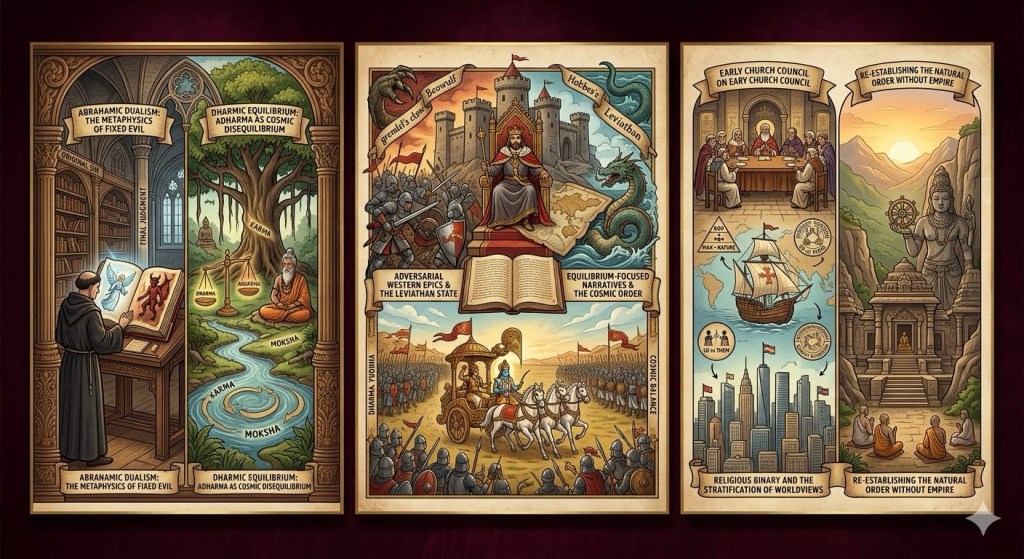
The Contemporary Configuration
Today the non-Abrahamic Dharmic worldview is forced to engage and clash with Asuric Abrahamic forces in Asia and elsewhere in the rest of the world.
The “Asuric Abrahamic forces” include:
— Western liberal democracy (“grounded in principles of the Abrahamic faith,” justifying “western interventions and warfare in Muslim countries”);
— secular universalism (“exporting of a secular epistemological and ethical paradigm” as universal imposition);
— religious proselytization (“universal brotherhood of Islam” continuing missionary patterns);
— and ideological judgmentalism (“marginalization and ‘disciplining’ of Muslims in western societies”).
Dharmic Asia’s Response against this onslaught includes India’s civilizational self-understanding against Western ideological imposition;
— Buddhist nations (Sri Lanka, Myanmar, Thailand) resisting Christian missionary expansion;
— Islamic nations (Pakistan, Indonesia, Middle East) resisting Western secular imperialism;
— and Jainist and Sikh communities preserving non-binary traditions.
The Dharmic Judgment: Abrahamic Worldview as Asuric
From a Dharmic standpoint today, Abrahamic civilisational worldview seems Asuric indeed since it has been the main cause of over 3000 years of brutal imperialistic wars and bloodshed and human tragedy all across the world.
Such a judgment as above is logically consistent within Dharmic framework. Asura-Predisposition is defined as afflicted by Avidya (ignorance), afflicted by Moha (delusion), characterized by adharma (moral disequilibrium).
Abrahamic Binary as Asuric Expression: projecting dualistic avidya onto cosmos (God vs. Satan); creating moha through false binary (Good vs. Evil); generating adharma through 3,000 years of imperial warfare.
The evidence is stark and incontrovertible:
“Over 3000 years of brutal imperialistic wars and bloodshed and human tragedy all across the world”—including early Christian imperial conquests (4th-15th centuries), colonial missionaries and “White Man’s Burden” (15th-20th centuries), Islamic jihad against jahiliya (7th century-present), and modern secular imperialism (liberal democracy, Marxism) (20th-21st centuries).
From the Dharmic standpoint, this is not “Good Vs Evil” but Asuric disequilibrium—the very condition avatars descend to correct.
The Global Implications
This collision represents more than geopolitical conflict. It is civilizational:
— Abrahamic universalism (one true path) vs. Dharmic pluralism (multiple paths);
— binary morality (Good vs. Evil) vs. Non-binary equilibrium (dharma vs. adharma);
— imperial imposition vs. Preservative restoration.
It is also philosophical:
— dualistic metaphysics (God vs. Satan) vs. Non-dual metaphysics (one Brahman);
— external adversary (Satan tempting) vs. Internal ignorance (Avidya);
— eternal fixedness (Satan irredeemable) vs. Universal redemption (all beings redeemable).
It is very much political too:
— empire-building through “white man’s burden” vs. Order-preservation through dharma;
— universal imposition of “one true path” vs. Local correction of disequilibrium;
— secularized religious imperialism vs. Authentic civilizational self-understanding.
The Dharmic Alternative for Contemporary Discourse
The purpose of this essay is to offer the outline of a very different perspective on how the Dharmic framework provides an alternative civilizational model that does not justify empire-building through “good vs. evil” binary; views all beings as potentially redeemable (even Asuras/Rakshasas); emphasizes restoring dharma rather than destroying “Satanic” enemies; and could counter contemporary Western ideological imposition.
This is precisely the kind of nuanced scholarly integration needed in the world today that integrates theological hermeneutics, political philosophy, and historical analysis that this essay delineates.
The Path Forward
From a Dharmic standpoint, the contemporary collision requires:
Civilizational Self-Understanding (India and Dharmic Asia must articulate their own philosophical frameworks; resist Western ideological imposition as Asuric disequilibrium; preserve non-binary traditions against universalizing pressures);
Philosophical Critique (expose Abrahamic dualism as civilizationally specific, not universal; offer Dharmic disequilibrium model as alternative; challenge “one true path” universalism);
Political Resistance (reject “white man’s burden” and secular imperialism; assert local dharma over universal imposition; preserve multiple paths to same Truth);
and serious, genuine Scholarly Contributions from traditional Hindu and Dharmic Acharya and Guru Parampara that aim to synthesise theological hermeneutics, integrate political philosophy, provide historical analysis, and offer coherent Dharmic counter-narrative to Abrahamic dualism).
Conclusion: The Cosmic Significance of This Collision

This discursive contemplation reveals that the contemporary global confrontation is not merely geopolitical but cosmological. It represents the collision of two fundamentally different ways of conceiving reality.
The Abrahamic Cosmos is dualistic battleground (God vs. Satan); binary morality (Good vs. Evil); universal imposition (one true path); imperial justification (destroy “Satanic” enemies); 3,000 years of bloodshed and tragedy.
The Dharmic Cosmos is equilibrium-based order (dharma vs. adharma); non-binary morality (displaced virtue vs. natural order); pluralistic paths (multiple paths to Truth); preservative restoration (correct disequilibrium); universal redemption (all beings redeemable).
The Dharmic judgment—that the Abrahamic worldview is Asuric—is not mere insult but philosophical diagnosis: the Abrahamic binary represents Avidya (ignorance) projected onto cosmos, generating adharma (disequilibrium) through 3,000 years of imperial warfare.
From this standpoint, the contemporary collision is not “Democracy vs. Tyranny” or “Freedom vs. oppression” (Abrahamic binaries) but cosmic equilibrium vs. cosmic disequilibrium—the very condition that divine avatars descend to correct.
This essay offers a Dharmic counter-narrative to challenge Western moral universalism by exposing its Abrahamic dualistic foundations, and offers instead an Indic alternative based on disequilibrium/correction rather than destruction/conquest, and provides critical tool for analyzing contemporary imperialism as Asuric expression of cosmic disequilibrium.
This indeed is part of the work of civilizational self-understanding—precisely the kind of nuanced intellectual and religious discourse that ought to be undertaken today in India by the champions and religious ambassadors of Sanatana Dharma — a discourse that integrates historical, theological, and philosophical perspectives outlined here in this essay.
The framework articulated here may prove essential for Dharmic Asia’s engagement with contemporary global challenges, offering not merely resistance but philosophical alternative to the Abrahamic imperial legacy.
— CONCLUDED—
********************
DISCLOSURE NOTE:
1. This essay synthesizes 40+ distinct sources spanning comparative religion, theology, literature, political philosophy, colonial history, and contemporary scholarship to construct the comprehensive argument about Abrahamic-Dharmic civilizational divergence.
2. This essay was composed with AI assistance but solely for structural organization and drafting. All ideas, thesis arguments, historical allusions, and intellectual framework are my very own. I have verified all content and retain full responsibility for the essay’s arguments.