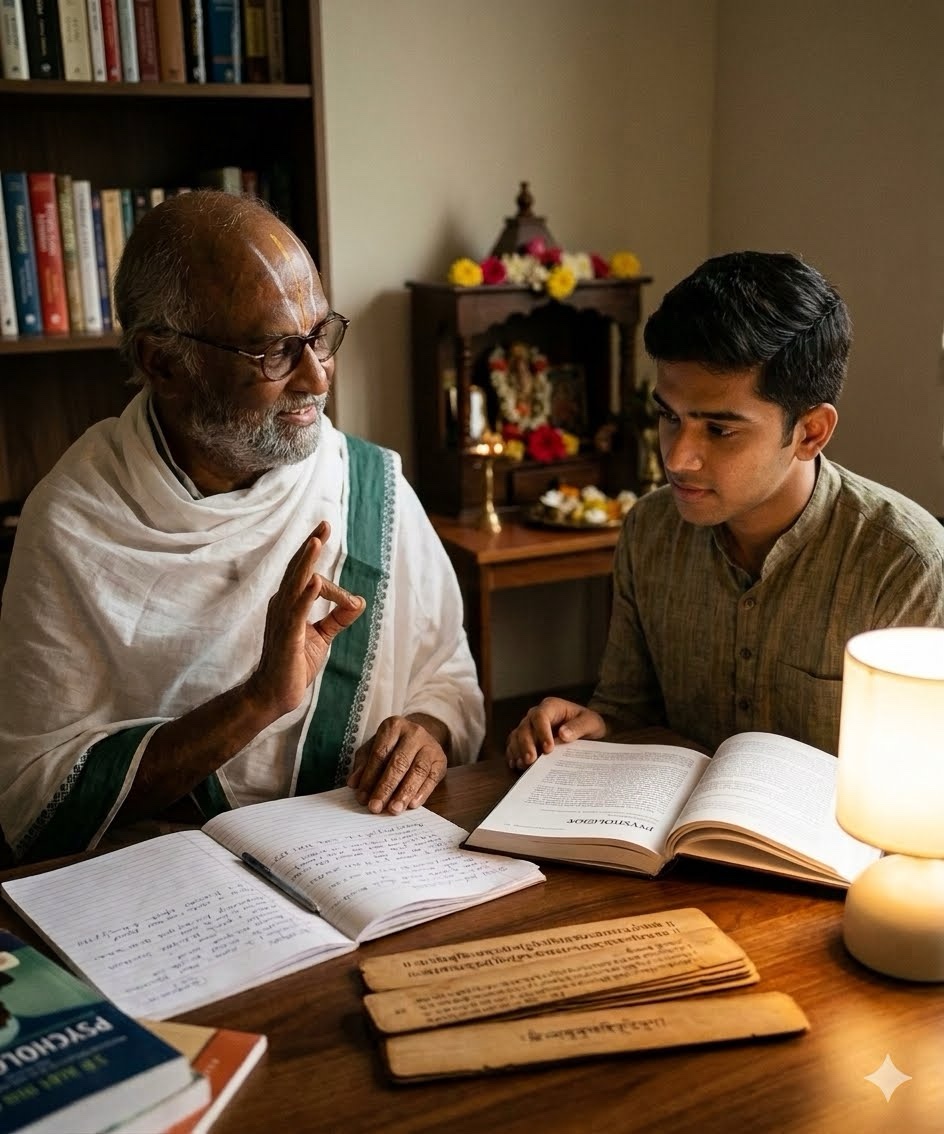
A few days later, the student returned. He had been turning the earlier conversation over in his mind, and now a new distinction had begun to form within him.
Student: If bhakti is the flower, then what is prapatti? Is it just a more intense bhakti?
The Unknown Sri Vaishnava: Not merely more intense. More ripened. If bhakti is the flower, prapatti is the fruit.
Student: Why fruit?
The Unknown Sri Vaishnava: Because fruit is the matured fulfillment of the plant’s life. The flower opens into beauty, fragrance, and promise. But fruit is what ripeness becomes. In the devotional life, bhakti is the flowering of the heart, while prapatti is the complete surrender that follows from full ripeness.
Student: So prapatti is the final stage?
The Unknown Sri Vaishnava: It is the stage in which the self no longer holds itself apart. Bhakti may still contain movement, longing, tenderness, even ecstasy. Prapatti is where the soul entrusts itself wholly to the Lord, without reservation.
Student: That sounds like the end of striving.
The Unknown Sri Vaishnava: It is the end of self-assertion, not the end of grace. In Sri Vaishnava thought, prapatti is not self-completion. It is the soul’s utter opening to divine saving mercy.
The Question of Sequence
Student: Then the path is seed, flower, fruit?
The Unknown Sri Vaishnava: That is the most fitting image. The seed is the pre-religious capacity for devotion. The flower is bhakti, the devotional blossoming of that capacity. The fruit is prapatti, the ripened surrender that completes the movement.
Student: Is that progression inevitable?
The Unknown Sri Vaishnava: I would avoid that word. It is not mechanical. Not every seed flowers, and not every flower bears fruit. Yet the sequence expresses an organic possibility of the soul. It is a pattern of growth, not a law of uniform inevitability.
Student: So grace is still essential?
The Unknown Sri Vaishnava: Always. In the Sri Vaishnava world, devotion is never merely human achievement. The Lord draws, sustains, clarifies, and fulfills. The soul opens, but grace completes.
The Challenge of Animals
Student: But what about animals? If bhakti is so rooted in human reflection, how should we understand stories like Gajendra Moksham?
The elder nodded as if the question had been waiting for him from the beginning.
The Unknown Sri Vaishnava: That is a profound question. Gajendra does not show that animals possess bhakti in the full reflective sense that humans do. Rather, he shows that divine grace is not bound by human categories. The elephant’s cry becomes the occasion for surrender, and the Lord responds.
Student: So the point is not that the animal has human bhakti?
The Unknown Sri Vaishnava: No. The point is that helpless dependence itself can become a form of surrender. Gajendra cannot compose a hymn like Nammāzhwār, but his cry is nevertheless received by the Lord. The episode is less a claim about animal psychology than a revelation of divine compassion.
Student: Then the theology is bigger than the psychology.
The Unknown Sri Vaishnava: Exactly. Animal life may not contain bhakti as consciousness-reflection, but it can still become a site where grace appears. The story enlarges the horizon of surrender without collapsing the difference between animals and humans.
William James Again (1842-1910)
Student: And William James?
The Unknown Sri Vaishnava: James is most interested in the fruit of experience — the transformation that religious life produces in character and conduct. He asks what kind of person emerges after the inward experience. Your inquiry is older in the process: you are asking what hidden seed makes such transformation possible.
Student: So James looks at the result, while my interest is in the beginning?
The Unknown Sri Vaishnava: Yes. He asks about fruits; you are asking about seeds. The Azhwārs give you the flower in between — the devotional blossoming of the human heart.
Student: Then the whole picture becomes: seed, flower, fruit.
The Unknown Sri Vaishnava: Precisely.
Final Summation
Student: Then let me see if I can state it clearly. Human beings possess a deep capacity for attachment, longing, reverence, and surrender. In ordinary life that capacity remains like a seed. In devotional life it blossoms into bhakti. And in the Sri Vaishnava path it ripens into prapatti, the fruit of complete surrender.
The elder smiled.
The Unknown Sri Vaishnava: Yes. That is well said. And the Azhwārs sing this movement in music, not theory. Tirumangai shows the turning from restless seeking to the Name of Narayana. Nammāzhwār summons the mind itself into worship. Together they reveal how the human inward life, once transfigured, becomes devotion; and devotion, once ripened, becomes surrender.
Student: So the movement is not simply from psychology to religion.
The Unknown Sri Vaishnava: No. It is from seed to flower to fruit. From capacity to devotion to surrender. From human inwardness to divine fulfillment.
Epilogue
This dialogue is not meant to settle the mystery of bhakti once and for all. It is meant to show that bhakti can be seen from more than one angle at once: as a human capacity, as a cultivated devotion, and as a theological surrender.
William James helps us think about the fruit of religious experience. The Azhwārs help us hear the flowering of the heart. And Sri Vaishnava theology gives the final horizon in which bhakti becomes prapatti — not merely love, but self-offering; not merely devotion, but entrusted surrender.
If the seed is human longing, the flower is bhakti, and the fruit is prapatti, then the whole spiritual life may be imagined as the soul’s passage from inward possibility to sacred ripeness.
Saint Thyagaraja of Tiruvaiyaru
(1767–1847)
As they rose from the table and prepared to part, the Unknown Sri Vaishnava seemed for a moment to withdraw into an inward hush.
Then, almost under his breath, he sang the opening line of Saint Tyāgarāja’s kriti: “తెలియలేరు రామ భక్తి మార్గము” — “People do not truly know the path of Rama-bhakti.” He explained that this was not a confession of defeat, but an act of reverence before mystery.
One may observe the seed becoming flower and the flower yielding fruit, just as one may trace the human movement from inward longing to bhakti and from bhakti to prapatti; yet the deepest secret of how and why this awakening occurs in one life and not another remains inaccessible to analysis. No psychological grammar, no philosophical scheme, no theological metaphor can fully unlock that hidden passage. What opens it, Sri Vaishnava theology would say, is not argument but Bhagavath anugraha — divine grace. Their little dialogue, then, was not a definitive unraveling of bhakti’s mystery, but only a reverent circling around it, an attempt to name its stages without pretending to possess its final key.
(Concluded)
Sudarshan Madabushi