Not every novelist writes within a Vedantic framework, yet many works of Indian fiction do lend themselves remarkably well to Vedantic rereading. This is especially true when a novel or short story is shaped by inwardness, moral conflict, duty, renunciation, suffering, attachment, or the search for a stable self. In such cases, the Vedantic lens does not claim the author’s original intention; rather, it reveals a deeper philosophical resonance already latent in the narrative. The authors listed below vary greatly in style, temperament, and historical position, but each has produced fiction that can be fruitfully tested against the grammar of Vedantic reflection.
A few days ago, I wrote a brief review of J. Raghunathan’s short story The Choice. https://mksudarshans.blog/2026/07/04/reading-the-short-story-the-choice-%e0%ae%9a%e0%ae%be%e0%ae%af%e0%af%8d%e0%ae%b8%e0%af%8d-through-a-vedantic-lens-with-indira-parthasarathy-and-j-raghunathan/
What began as a literary response soon opened into a larger philosophical exchange. Indira Parthasarathy, whose literary judgment I have long valued, responded in a private message with a terse but suggestive remark: “Existential choices. What you ultimately choose is the correct choice for you. Difficult to decide which is right and which is wrong. Good story.”
My reply came instinctively: “Do we really have our choices in life already made for us? Sounds a bit fatalistic, doesn’t it?” I then added what has since stayed with me as a guiding thought: “Every human story has a Vedantic flavouring that is often missed or overlooked.” And more fully: “Every human story can often be read through a Vedantic lens, because it inevitably involves questions of self, attachment, duty, and suffering.”
That exchange became more than a comment on one short story. It opened up a larger question: why do so many Indian novels and fictional works, even when not written with any explicit Vedantic intention, nevertheless seem so readily amenable to retrospective reading through a Vedantic frame?
What the Vedantic themes mean
Before proceeding, it may help to clarify what is meant here by the Vedantic themes of self, attachment, duty, and suffering.
Self refers not merely to personality or ego, but to the deeper question of what a human being really is beneath roles, relations, and social identity. Vedanta repeatedly asks whether the self is the body, the mind, the agent, the witness, or something beyond all these.
Attachment refers to the binding force of emotional and worldly investment. In narrative terms, attachment is what ties characters to relationships, ambitions, possessions, reputations, and outcomes. Vedanta is deeply interested in how attachment creates vulnerability, confusion, and bondage.
Duty is the moral and existential demand placed upon a person by vocation, family, society, and circumstance. In Indian thought, duty is never merely external obligation; it often becomes the arena in which one’s deepest nature is tested.
Suffering is not only pain or loss, but the experience of incompleteness, contradiction, and the inability to make life cohere. Vedanta sees suffering as revelatory: it exposes limitation, dislodges illusion, and pushes the seeker toward self-knowledge.
These four themes recur in most serious literature, but they assume a particularly resonant form in Indian fiction because Indian civilization itself has long lived within a conceptual world where dharma, karma, renunciation, illusion, and liberation are familiar categories.
Why Indian novels invite retrospective Vedantic reading
This leads me to the question I increasingly ask myself: How and why do so many novels and fictional works by eminent Indian authors become amenable to retrospective reading that reveals a Vedantic grammar and mould?
The answer lies partly in the civilizational inheritance out of which these works emerge. Even when an Indian novelist writes in English or in a modern realist idiom, the moral imagination often remains shaped by older Indian concerns: the instability of worldly success, the burden of family obligation, the struggle between desire and renunciation, and the tension between social role and inward truth.
The novelist may not be consciously writing Vedanta. Indeed, most do not. But the plot, characterisation, and emotional structure may still carry a reticent Vedantic hue by default rather than by design. That is what makes retrospective rereading so rewarding. One is not imposing Vedanta arbitrarily upon the text; one is uncovering philosophical possibilities already latent within it.
Major Indian works and their Vedantic resonance
A number of Indian novels and fictional works stand out in this regard. What follows is not an exhaustive canon, but a suggestive ranking based on how closely they lend themselves to Vedantic rereading.
1. Raja Rao – The Serpent and the Rope
This is perhaps the most naturally Vedantic novel in Indian English fiction. The novel’s philosophical texture, its concern with illusion, identity, spiritual search, and the tension between worldly life and metaphysical inquiry, make it especially suited to Vedantic interpretation. The story of the narrator’s marriage, intellectual restlessness, and search for meaning unfolds less as ordinary plot than as a long meditation on selfhood and reality.
Vedantic themes: self, attachment, suffering.
2. Indira Parthasarathy – select novels and Ramanujar
Indira Parthasarathy occupies a special place because his work often stands close to philosophical and cultural argument, and his engagement with Ramanuja directly places him in the larger Vedantic conversation. His fiction and drama are morally serious, intellectually alert, and frequently preoccupied with social conflict, inner tension, and competing visions of duty. The Vedantic connection is therefore not merely latent but often structurally visible.

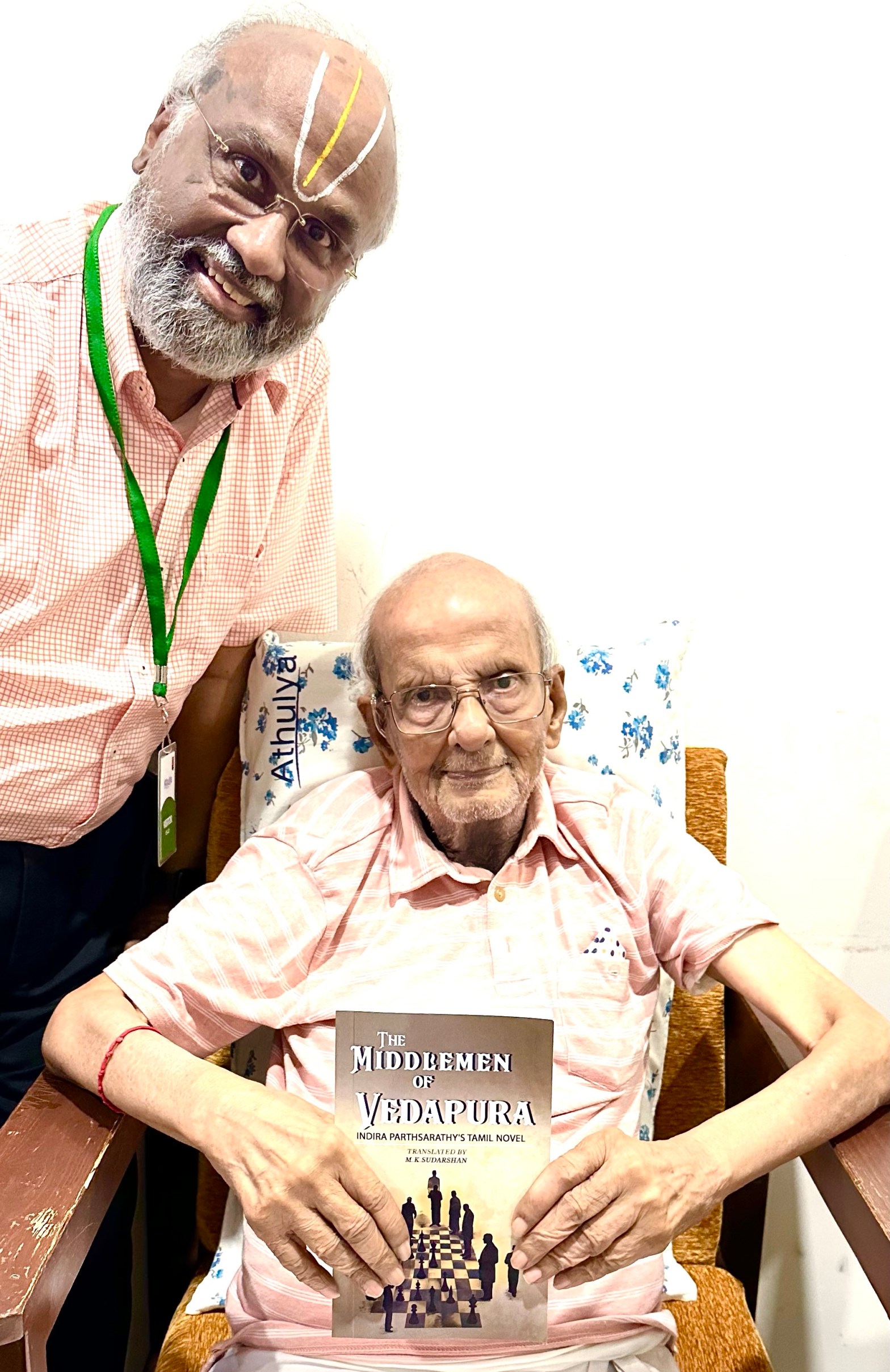
In 1995 Indira Parthasarathy wrote a novel savagely satirising the political landscape of Tamil Nadu: Vedapuratthu Vyaabaarigal. In 2025, the novel was translated into English by M. K. Sudarshan as The Middlemen of Vedapura. Although there is virtually nothing that is explicitly Vedantic in the original Tamil novel, nevertheless in Sudarshan’s English translation one can discern — vaguely and fleetingly — the most fundamental of Vedantic questions: what is Real and what is Illusion? And why is it that it is Illusion that so often shapes the Reality of the hurly-burly, roller-coaster, utterly rotten, venal, and feral world of Indian politics? Here, one can sight Vedantic streaks appearing in flashes within the chiaroscuro of the play of Tamil regional rough-and-tumble variety of Party politics.
Vedantic themes: duty, self, suffering, attachment, illusion.
3. R.K. Narayan – The Guide
R.K. Narayan’s fiction is deceptively simple, but its simplicity often hides deep philosophical resonance. The Guide in particular invites a retrospective reading in terms of transformation, role reversal, moral responsibility, and the uncertainty of selfhood. Raju’s movement from guide to lover to reluctant holy man makes the novel especially rich for thinking about identity and the forms of duty that arise unexpectedly.
Vedantic themes: self, duty, attachment, suffering.
4. U.R. Ananthamurthy – Samskara
Samskara is one of the strongest Indian novels for retrospective Vedantic reading, though its philosophical orientation is not doctrinally orthodox. Its concern with ritual, moral corruption, social duty, and existential collapse makes it deeply resonant with Vedantic questions about selfhood and bondage. The novel’s central crisis becomes a crisis of inner meaning as much as social obligation.
Vedantic themes: duty, self, suffering.
5. S.L. Bhyrappa – Parva
Parva reimagines the Mahabharata with philosophical seriousness and extraordinary attention to dharma. Although not Vedantic in a narrow doctrinal sense, it is deeply concerned with the burden of action, the ambiguity of moral choice, and the tragic dignity of suffering. Its epic scale gives it a particularly strong metaphysical density.
Vedantic themes: duty, suffering, self.
6. Anita Desai – Journey to Ithaca
Among modern Indian English novels, Anita Desai’s Journey to Ithaca is especially apt for retrospective Vedantic reading because it directly engages spiritual searching, disillusionment, and inward transformation. Her fiction more generally is intensely interior, often tracing the erosion of the self under domestic and emotional pressure.
Vedantic themes: self, attachment, suffering.
7. Jhumpa Lahiri – The Lowland and Interpreter of Maladies
Jhumpa Lahiri’s fiction is not Vedantic in explicit idiom, but it is rich in attachment, estrangement, duty, grief, and family burden. Her characters are often suspended between emotional loyalty and personal rupture, making her work surprisingly fertile for a Vedantic rereading of modern diasporic life.
Vedantic themes: attachment, duty, suffering.
8. Kiran Desai – The Inheritance of Loss
Kiran Desai’s novel is deeply concerned with displacement, loss, inherited injury, and the fragility of worldly success. It is perhaps less obviously Vedantic than Raja Rao or Indira Parthasarathy, but its atmosphere of disinheritance and existential instability makes it suitable for a philosophical rereading.
Vedantic themes: suffering, attachment, self.
9. Arundhati Roy – The God of Small Things
Roy’s fiction is more political, historical, and formally insurgent than Vedantic in tone. Yet it is saturated with suffering, family fracture, desire, and the consequences of forbidden attachments. The novel may not invite Vedantic reading as immediately as some others, but it certainly rewards it.
Vedantic themes: attachment, suffering, duty.
10. Asokamitran – select fiction
Asokamitran’s fiction is quieter, more observant, and less overtly philosophical, but it nonetheless offers subtle reflections on the pressures of ordinary life, memory, and the shaping of the self. His work is not strongly Vedantic in texture, yet it has a reflective restraint that can be read philosophically.
Vedantic themes: self, suffering, duty.
11. Sujatha – select fiction
Sujatha is perhaps the least naturally Vedantic among the authors named here, since his fiction is more associated with wit, technology, modernity, and urban life. Still, even his fiction occasionally opens into questions of identity, desire, and illusion, which can be reread in broader philosophical terms.
Vedantic themes: self, attachment.
Ranking the authors by Vedantic relatability
If one were to rank these authors according to how closely they may be related to Vedanta through retrospective rereading, the order might be as follows:
1. Raja Rao
2. Indira Parthasarathy
3. R.K. Narayan
4. U.R. Ananthamurthy
5. S.L. Bhyrappa
6. Anita Desai
7. Jhumpa Lahiri
8. Kiran Desai
9. Arundhati Roy
10. Asokamitran
11. Sujatha
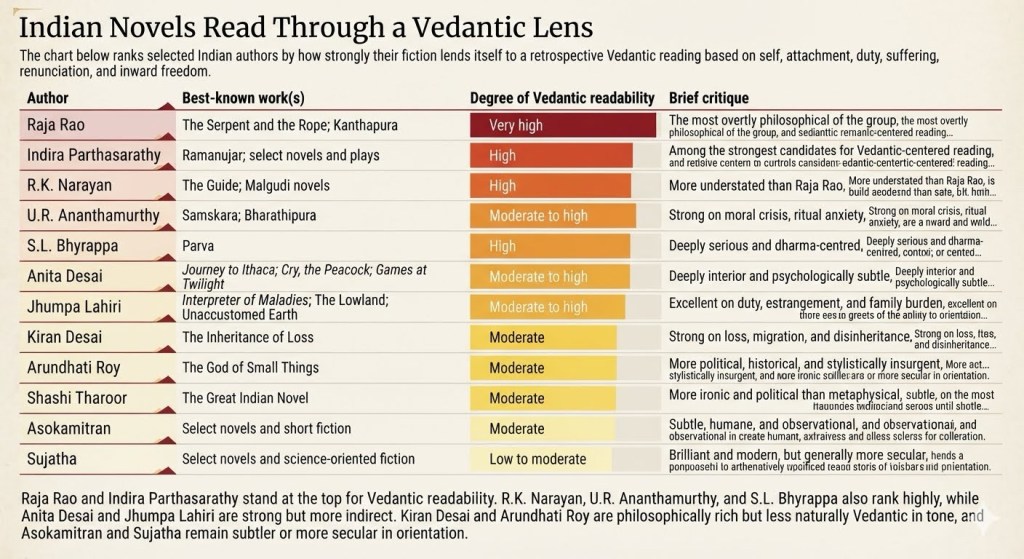
This ranking is not meant to diminish any writer’s literary merit. It simply reflects the degree to which their fiction lends itself to Vedantic retrospective reading. Some writers are more doctrinally proximate, others more existentially suggestive, and still others more indirectly resonant.
Closing reflection
What began with a short story called The Choice ultimately opened onto a larger literary and philosophical insight. Indira Parthasarathy’s brief appreciation of the story as a case of existential choice helped trigger a deeper reflection on human agency, fatalism, and the Vedantic structure of narrative life. The more one looks at Indian fiction, the more one sees that even where Vedanta is not explicitly named, it often remains quietly present as underlying grammar.
That is why I continue to believe that every human story has a Vedantic flavouring that is often missed or overlooked.
P.S: The following day after having read this piece, Eepa sent me a WhatsApp message that read: “Yes. Any serious novel or shortstory (has to be) within the framework of Vedanta.”
(concluded)
