by M.K. Sudarshan
July 8, 2026 : Chennai, India

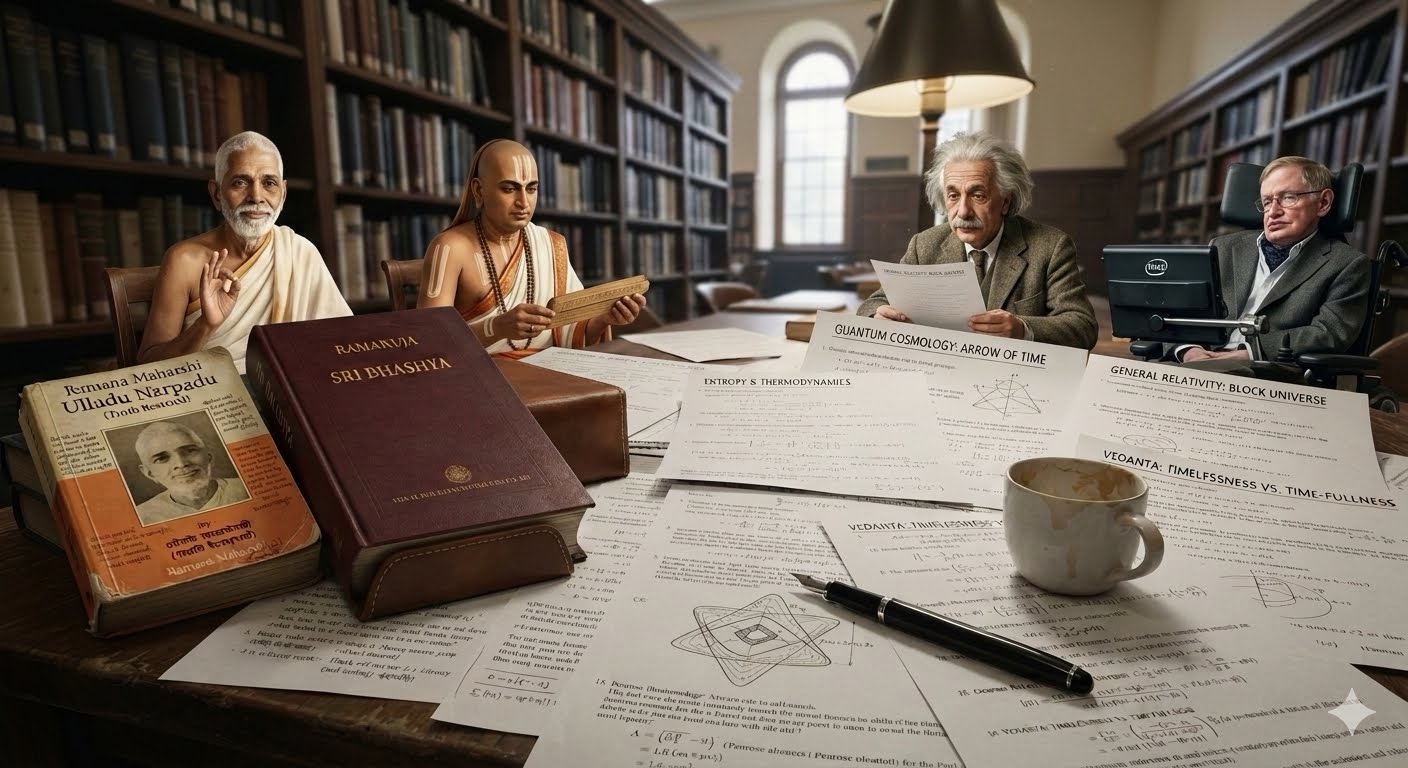
Setting: A quiet corner of a university library. On the table sit copies of Ramana Maharshi’s Ulladu Narpadu and Ramanuja’s Sri Bhashya, now buried under papers covering general relativity, quantum cosmology, and thermodynamics.
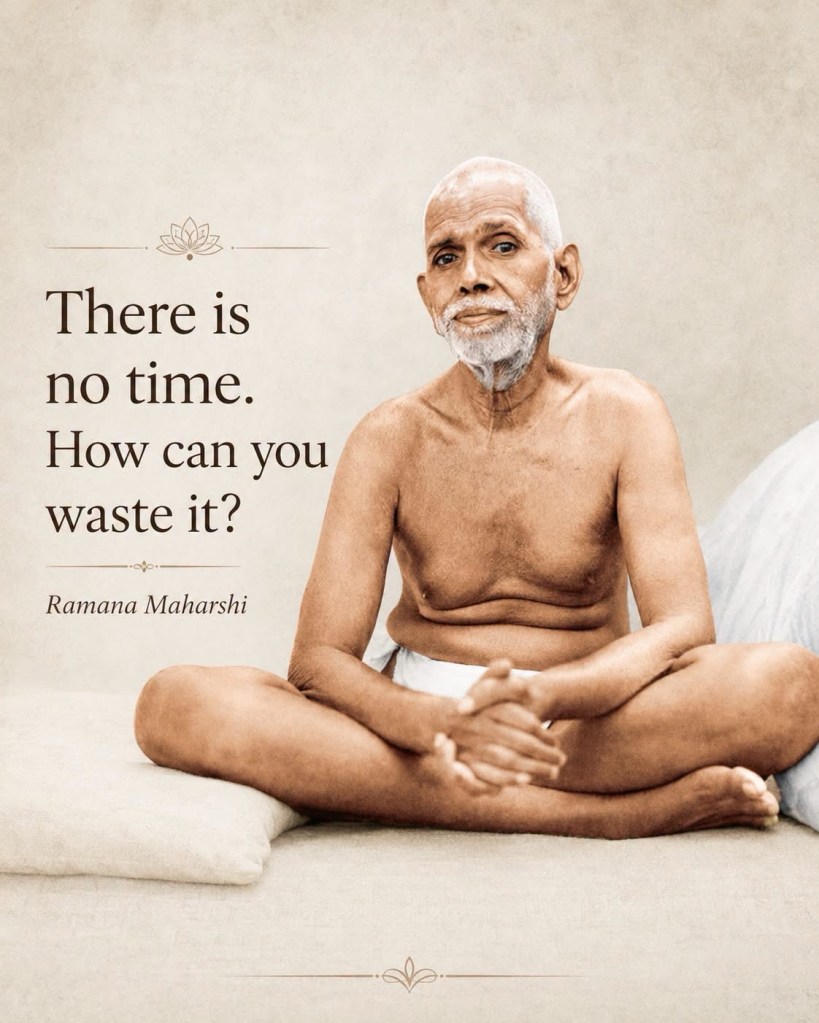
Student: Look at this quote from Ramana Maharshi. It’s devastatingly simple: “There is no time. How can you waste it?” It completely shatters the linear grid we live in. If time is an illusion, the entire engine of human anxiety collapses.
The tantalising question posed here with the image of Ramana Maharishi :
If there is no such thing as Time , how can anyone be wasting it? And if there is inside your consciousness the idea that there is such an ontological entity called Time … and that it is finite … then you better not waste it.
Which one of the two questions does one want to answer ? Both are philosophically so daunting. In Vedanta , Time is clearly postulated as an infinite, ontological reality in the cyclical sense, not linear. Ramana Maharishi was a Vedantin. So, which sense of Time was he really alluding to ? Or, was he simply leaving it for his disciples to figure it out all by themselves ?
The Unknown Sri Vaishnava: It’s an excellent rhetorical trap. But let me ask you: who is reading that quote? A timeless entity, or a student who is currently worried about a semester deadline?
Student: Obviously, the mind reads it, but the inquiry shifts the focus. Ramana is pointing to the absolute standpoint—Paramarthika Satya. In Advaita, time only exists in the relative world (Vyavaharika). By questioning who experiences time, the ego dissolves, and you are left with the timeless screen of pure Consciousness.
The Unknown Sri Vaishnava: Ah, the classic two-tier escape hatch. Tell me, isn’t this Paramarthika-Vyavaharika binary just a convenient conceptual rug? Whenever Advaita cannot convincingly explain the gritty reality of physical existence, or why a timeless soul experiences suffering, it simply shoves the whole universe under that rug and calls it a “relative illusion.”
Student: That’s a harsh reading. It’s a pedagogical tool, a thorn to remove a thorn. Language is inherently dualistic; it can’t express the absolute directly. The binary is meant to be transcended, not defended.
The Unknown Sri Vaishnava: But look where it leaves you while you are trying to transcend it! It leaves you stranded in a psychological twilight zone. You are told the world around you is a mere sensory projection, a mirage. Yet the “Me” you are searching for is defined as being completely beyond the senses. If everything you can perceive or infer is part of the illusion, then the tools of your inquiry are also illusions. You’ve built a syllogistic prison: All existence is conditioned; I am here; therefore, I exist conditionally and freedom is mathematically impossible. How does a mirage quench a real thirst?
Student: Atma-Vichara isn’t about the mind grasping the absolute. It’s about turning the attention around. When you trace the “I-thought” back to its source, the mind grows quiet. You don’t need to understand timelessness; you just see that thoughts arise and fall within an unconditioned awareness.
The Unknown Sri Vaishnava: But why must that awareness be a blank, isolated screen? This is where Vishishtadvaita provides the precision that Advaita evades. The “Me” is not an unreachable phantom; it is a real, eternal, monadic point of consciousness—a Jivatman. And it possesses two dimensions of consciousness that solve your twilight zone paradox completely.
Student: Two dimensions? Explain.
The Unknown Sri Vaishnava: There is Dharmi-Jnana, your substantive consciousness—the core “I am.” And then there is Dharmabhuta-Jnana, your attributive consciousness. This is the awareness that flows outward through your mind and senses to perceive the world.
Student: How does that fix the binary?
The Unknown Sri Vaishnava: In your state of bondage, your Dharmabhuta-Jnana is contracted by karma. When you look at the world, you see fragmentation, limits, and finite time. The world isn’t a fake illusion swept under a rug; your aperture is just narrowed. Atma-Vichara isn’t the annihilation of the world; it is the expansion (vikasa) of this attributive consciousness.
Student: So you are saying the inquiry doesn’t dissolve the “Me” into a void?
The Unknown Sri Vaishnava: Exactly. It reveals your true Svarupa (nature). Through the doctrine in Visishtadvaita of Aprathaksiddhi, you realize you are inseparably dependent on the Divine Whole. You are a Dasabhuta—an integral, atomic part of Brahman. Your conditioning isn’t a cosmic mistake; it’s your constitutional reality.
Student: This is fascinating. If I follow Ramana’s arc to its logical conclusion, the investigation into the “Me” actually lands right into your Visishtadvaita epistemology. Ramana strips away the ego’s false timeline—the empty Timelessness—but Ramanuja gives the structural reality of the soul’s place in the universe.
The Unknown Sri Vaishnava: Precisely. Ramana clears the field by dismantling the arrogant, independent ego. But once the field is cleared, Ramanuja shows that the unconditioned awareness you found is actually a participant in a magnificent, real universe. You move from an empty timelessness to a sacred, Time-fullness. But look at what happens when you step out of philosophy entirely and look at modern physics. Albert Einstein and Stephen Hawking spent their entire lives trying to mathematically pin down this exact entity called Time.
Student: Let’s look at Einstein first. Before him, everyone assumed time was a universal clock ticking uniformly. But with relativity, Einstein showed that time is relative, stretching and warping depending on speed and gravity. He merged space and time into a single, four-dimensional fabric called spacetime, leading to the concept of the Block Universe. In it, past, present, and future all exist simultaneously in a fixed geometry. Einstein famously wrote that the distinction between past, present, and future is nothing but a “stubbornly persistent illusion.”
The Unknown Sri Vaishnava: Einstein’s Block Universe is the mathematical equivalent of Ramana Maharshi’s absolute standpoint. When Ramana says “There is no time,” and Einstein says the flow of time is an illusion, they are looking at the exact same architectural feature of reality. They are standing outside the cinema-projector booth, looking at the entire film reel laid out at once.
Student: Yes! But Einstein’s physics strips time of its flow without explaining why the mind experiences that flow. It leaves the conscious observer completely stranded in an unaccounted-for experience of change. That is where Stephen Hawking stepped in. He focused on the Arrow of Time—the undeniable direction in which we experience reality, driven by the Thermodynamic Arrow where entropy always increases, and the Psychological Arrow by which we remember the past but not the future. Hawking argued that our psychological perception of time is dictated by the expenditure of energy and the increasing sense of disorder in the brain.
The Unknown Sri Vaishnava: Look at what Hawking just did. By tying the psychological experience of time directly to the physical expenditure of energy and the expansion of the cosmos (Cosmological Arrow of Time), Hawking completely validated the relative reality of time. He didn’t dismiss our experience of time as a cheap illusion; he anchored it to the structural, evolving mechanics of the universe. This is the exact physical counterpart to Ramanuja’s Dharmabhuta-Jnana! Your outward-flowing awareness is structurally integrated with the physical universe. Bound by biology, it must experience time sequentially.
Student: So it aligns perfectly: Ramana’s radical Timelessness aligns with Einstein’s Block Universe, while Ramanuja’s Time-fullness aligns with Hawking’s Arrows of Time.
The Unknown Sri Vaishnava: But do not miss the ultimate dissimilarity. Einstein and Hawking treated consciousness as a secondary byproduct—a passive spectator trying to understand a dead, mechanical universe. The Ramana-Ramanuja darsana flips the entire pyramid. It shows that both the static, timeless background and the dynamic, thermodynamic flow are dimensions of Awareness itself. The physicists found only the architecture of the house, but it was Vedanta that found the Resident.
Student: So the “Me” is conditionally dependent as an inseparable part of the whole, yet absolutely free because the foundational awareness illuminating that entire spacetime block is its ultimate Svarupa. The paradox resolves without needing the rug.
The Unknown Sri Vaishnava: Exactly. The debate was never about whether time exists; it was about how deeply you are willing to look at the one standing within it. To stretch this discussion any further would only stray from Ramana’s original proposition. Let us therefore, instead, seal this dialogue here and now where the insights of the poets match the absolute horizon of our inquiry.
“To see a World in a Grain of Sand,
— William Blake
And a Heaven in a Wild Flower,
Hold Infinity in the palm of your hand
And Eternity in an hour.”
“The Moving Finger writes; and, having writ,
— Omar Khayyam
Moves on: nor all thy Piety nor Wit
Shall lure it back to cancel half a Line,
Nor all thy Tears wash out a Word of it.”