By Sudarshan Madabushi
October 16, 2026: Chennai, India
“This essay is not an argument against temples or the consecrated image; it is a plea to recover their deeper purpose”.
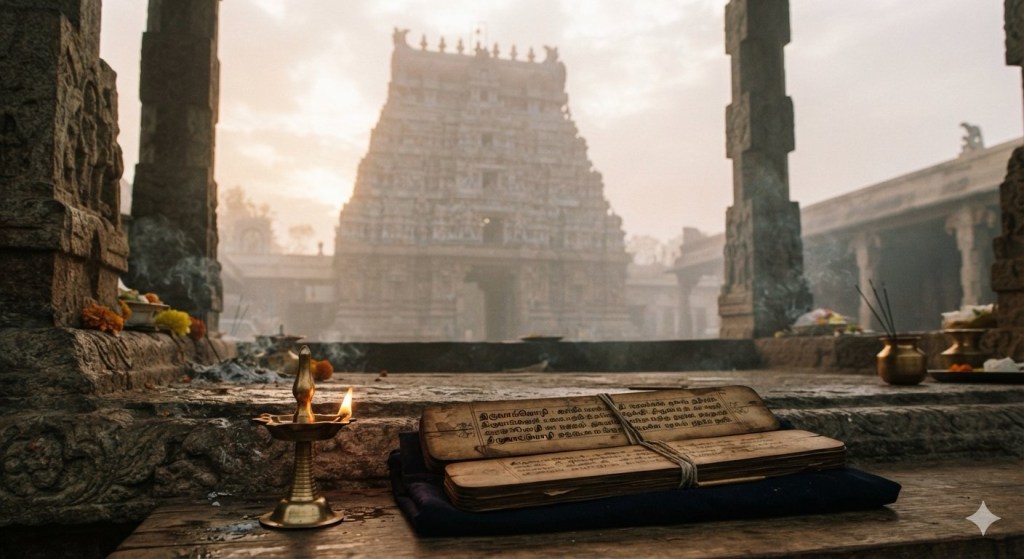
The consecrated image—archa murthy—has become, for millions, the most immediate face of the Divine. Yet the deepest wisdom of Sanatana Dharma asks us not to mistake the face for the whole reality: the murti is a sacred threshold, not the final destination.
This is not an argument against temples or the consecrated image. It is a plea to recover their deeper purpose.
A Faith of Visible Divinity
Few religious traditions have made the visible, touchable, worshippable form of God so central to daily life as Sanatana Dharma has. Across India, temples rise in villages and cities; household shrines receive daily puja; festival processions, hymns, dance, sculpture, and music all gather around the consecrated deity. The image is not merely an object of devotion but a focus of memory, community, art, and inherited faith.
This is especially true in the Agama-based traditions. Saiva worship follows the Saiva Agamas, Shakta worship the Shakta Agamas, and Vaishnava temples draw upon the Pancharatra and Vaikhanasa systems. In Sri Vaishnavism, the Lord is worshipped in five modes: Para, the transcendent Absolute; Vyuha, the cosmic emanations; Vibhava, the avatars; Antaryamin, the indwelling presence; and Archa, the consecrated form accessible to human worship.
The archa is therefore not a theological afterthought. It is the form in which the infinite becomes available to finite devotion: something that can be seen, garlanded, sung to, fed, and loved.
Nammazhvar’s First Word: The Mind Must Rise
Yet even within a tradition so richly devoted to the archa, its greatest Tamil devotional voice begins not with temple, idol, or ritual, but with an inward summons. Nammazhvar opens his Tiruvaymozhi—the crown of the Tamil Prabandham—by turning not outward toward an image but inward toward his own mind:
உயர்வு அற உயர் நலம் உடையவன் எவன் அவன்
மயர்வு அற மதி நலம் அருளினன் எவன் அவன்
அயர்வு அறும் அமரர்கள் அதிபதி எவன் அவன்
துயர் அறு சுடர் அடி தொழுது எழு என் மனனே!
“O my mind, rise and worship the radiant feet that end sorrow—the feet of the One whose excellence has no higher limit, who grants unclouded understanding, and who is the tireless Lord of the deathless ones.”
The Azhvar does not say, “Go to the temple”; he says, “Awaken, O mind.” The first movement of Bhakti in the Tiruvaymozhi is thus an ascent of consciousness: from distraction to clarity, from ignorance to grace-bestowed wisdom, from sorrow to the luminous feet of the Lord. The devotional act begins as an interior awakening.
This is not a rejection of the murti. It is a reminder of what the murti is for. The visible form is meant to summon the mind upward; it is meant to make the worshipper capable of recognizing a Divinity that exceeds every form.
From Image to Inner Purification
In the very next verse, Nammazhvar makes the inward orientation even more explicit. He asks his mind to inscribe the Lord’s feet upon itself, so that ignorance may be cleansed and the self may be freed from dependence on the senses:
மனன் அகம் மலம் அற மலர்மிசை எழுதரும்
மனன் உணர்வு அளவு இலன், பொறி உணர்வு அவை இலன்
இனன் உணர், முழு நலம், எதிர் நிகழ் கழிவினும்
இனன் இலன் எனன் உயிர், மிகுநரை இலனே.
“O mind, inscribe upon yourself His lotus feet, so that the impurity within may be removed; the mind’s understanding is boundless, while the senses cannot grasp it; know the fullness of that One, who remains even when all that stands opposite passes away.”
Here the devotional imagination becomes contemplative. The “lotus feet” are not merely an object before the eyes; they are to be written into the mind. Worship becomes a discipline of remembrance, purification, and inner transformation. The senses, the Azhvar suggests, cannot finally measure or contain the Divine; the mind itself must be lifted beyond their reach.
This is the profound balance at the heart of Sri Vaishnava Bhakti: the Lord is worshipped in form, but the purpose of that worship is to free the devotee from the tyranny of form-bound consciousness.
Yet Sri Vaishnava Bhakti does not speak with only one voice on the murti. If Nammazhvar begins by asking the mind to rise beyond its dependence on the senses, Tiruppaan Alvar ends his Amalanadipiraan by declaring that his eyes, having seen Ranganatha in the Srirangam sanctum, will look at nothing else:
கொண்டல் வண்ணனைக் கோவலனாய் வெண்ணெய்
உண்ட வாயன் என் உள்ளம் கவர்ந்தானை
அந்தர் கோன் அணியரங்கன் என்ன முதினைக்
கண்ட கண்கள் மற்றொன்றினைக் காணவே.
“My eyes, having seen the cloud-hued Lord—the cowherd boy whose mouth tasted butter, the radiant Lord of Srirangam who has captured my heart—will see nothing else.”
Here the archa is no longer merely a discipline for the mind. It is the overwhelming presence that fulfils the eye, captivates the heart, and renders every other vision unnecessary.
Read literally, the two poets seem to pull in opposite directions: Nammazhvar says, “Let the mind rise beyond the senses”; Tiruppaan Alvar says, “My eyes have seen, and need see nothing else.”
Tiruppaan Alvar’s claim that he will not look even upon the Lord of Paramapada is not a denial of the transcendent; it is the language of a love that has found its Beloved and seeks no replacement.
The tension, then, is not between Nammazhvar and Tiruppaan Alvar so much as between two different moments of Bhakti. The reconciliation lies in recognizing that the two Alvars are speaking from different points in the devotional journey. It lies also in seeing these not as rival theologies but as successive movements of Bhakti. Nammazhvar speaks to the seeker who must be lifted from distraction into remembrance; Tiruppaan Alvar speaks from the summit of darshan or revelation where the form has become transparent to the Divine presence it reveals. The murti is a threshold for the beginner; for the perfected devotee, it may become the very place where the Infinite consents to be seen.
What the Vedas Point Toward
It is worth saying, gently and without disparagement, that the earliest Vedic vision does not place temple idols at the centre of spiritual life. The Vedic hymns are overwhelmingly directed to powers and presences—Agni, Varuna, Indra, Ushas, the cosmic order—rather than to consecrated images in shrines. The later Agamic traditions gave Hindu worship much of its temple liturgy, ritual precision, and murti-centred devotional culture.
This does not make the murti illegitimate. It makes it historically and spiritually secondary to something more radical: the realization that the Divine is not confined to stone, metal, paint, or ritual. The Upanishadic teaching moves relentlessly beyond external forms toward the innermost reality—Brahman, described as sat-chit-ananda: being, consciousness, bliss. The Brihadaranyaka Upanishad famously identifies Brahman with knowledge and bliss.
If Bhakti is the heart’s movement toward God, its highest fulfilment is not possession of an image but absorption in that bliss—Brahmanandam. The murti may awaken love; it cannot substitute for the transformation love is meant to accomplish.
Nammazhvar’s opening hymn belongs naturally to this larger Vedic-Upanishadic movement. His “radiant feet that end sorrow” are a devotional symbol; but the command is to the mind—en manane. The true sanctuary is consciousness itself.
The Uses and Limits of the Image
A sacred image performs indispensable work. It gives the mind a point of concentration; it makes abstract truth emotionally real; it gathers together families and communities; it preserves myth, poetry, music, architecture, and ritual memory. For most devotees, the archa murthy is not a limitation but a mercy—a divine condescension to the human need for Grace.
But every sacred aid carries a risk: that the aid becomes the end. When temple-building becomes competitive, when devotion is measured by the number of shrines raised, when religious identity hardens around images, processions, and institutional prestige, the murti may begin to obscure the very Reality it was meant to reveal.
History has also shown the shadow side of image-centred religion: plunder, iconoclasm, sectarian rivalry, litigation, communal suspicion, and inherited resentment. These are not arguments against the murti itself; they are warnings against allowing the symbol to become a battlefield for ego, power, and identity.
Bhakti Beyond the Shrine
The tradition itself offers the corrective. Japa, dhyana, kirtana, bhajana, seva, study, ethical living, and surrender are all recognized paths of Bhakti. Even where an image is present there, its purpose is only to turn the worshipper inward—toward remembrance, humility, compassion, and ultimately toward the Divine presence in all beings.
The Antaryamin is as much a form of God as the Archa. Indeed, the fivefold Vaishnava scheme quietly teaches a profound lesson: the Lord who stands before the devotee in the sanctum also dwells within the devotee and within every creature. A faith that honours the image but forgets the indwelling Lord has honoured only half its own theology.
Nammazhvar’s first verses give this doctrine its most beautiful devotional expression. The Lord’s feet are to be “inscribed in the mind”; ignorance is to be removed; the senses are to be transcended; the soul is to rest in the fullness of the One who endures when all else passes away. That is Bhakti matured into contemplation.
A Gentler Future for Sanatana
If Sanatana Dharma is to preserve what is most distinctive in it, it may need not more temples, but deeper temples—not necessarily in stone, but in consciousness.
This is not a call to abandon Archamurthy aradhana. It is a call to restore proportion.
Let the murti remain what it has always been at its best: a doorway, a teacher, a beloved form through which the formless is approached. Let new temples be built where they answer genuine spiritual and communal need, not merely as assertions of visibility, prestige, or numbers.
And let the tradition give renewed prominence to the contemplative essentials of the Vedic inheritance: silence, self-inquiry, ethical discipline, service, meditation, and the recognition of the same Divine light in all beings. A civilization that builds fewer monuments but produces more compassionate, inwardly awake human beings will have honoured its tradition more profoundly than one that multiplies shrines while neglecting the soul.
The paradox of Sanatana is not that it worships images; it is that it worships images while knowing, at its highest level, that the Ultimate is beyond all images. Nammazhvar teaches this not by argument but by invocation: he begins with the Lord’s glorious feet, yet addresses the human mind and asks it to rise.
Perhaps that is the quiet counsel Sanatana offers today: worship the murti, but do not stop at the murti. Let the visible Divine lead the devotee, step by step, into the bliss that no sculptor’s hand can make and no temple wall … or “Integrated Pilgrim Township” … can contain.
(Concluded)