M.K. Sudarshan
November 21, 2026: Chennai, India
“If the 1945 Yalta Conference was the brutally honest Realist’s Manifesto of global partition, the Shenzhen summit is the supreme Manifesto of Westphalian Subterfuge.
In an unstable great-power triad governed by theatre and unspoken containment, India’s calculated doctrine of strategic elusiveness—playing a masterfully uncommitted game of ‘hide and seek’—is not indecision. It is the non-negotiable geometry of survival as a sovereign swing power that refuses to be cornered.”
History does not repeat itself, but it does follow a strict, unforgiving structural geometry.
Whenever absolute global power condenses into a three-player game, the international order enters its most deceptive, volatile, and deeply dangerous phase.
The modern world is currently witnessing the birth of such an era. The recent trilateral summit in Shenzhen—where the leaders of the United States, China, and Russia converged to declare a new system of “mutual redlines” and “respect for sovereignty”—has been hailed by its architects and naive commentators alike as a contemporary Treaty of Westphalia. They tell us a new global architecture has been born. In reality, it is a masterclass in theatrical subversion. To understand why this grand bargain is systemically built to fail, and why India’s maddening, calculated elusiveness is the only rational response to it, one must look past the flashing cameras and dive into the cold, historical mechanics of the great geopolitical triads.
The Mathematics of the Triangle: Lessons from Imperial Triads
When the world remembers great imperial triumvirates, popular imagination often conjures images of powerful individuals: Caesar, Pompey, and Crassus carving up the dying Roman Republic, or the dark, conspiratorial machinations of the Soviet troikas managing the transition of absolute power behind the iron curtain. But the true, deeper lesson for the 21st century lies not in trios of men, but in the triumvirates of states—the specific historical epochs when three rival sovereign empires held the known civilizational world in a tight, suffocating grip.
Look back at the Hellenistic triad of the Ptolemies, Seleucids, and Antigonids that fractured out of Alexander’s broken empire. Observe the early medieval partition of Europe and the Mediterranean among the Carolingians, the Byzantines, and the Abbasid Caliphate. Study the early modern hegemony of the Three Gunpowder Empires—the Ottomans, the Safavids, and the Mughals—who monopolized the wealth of Eurasia.
In every single instance, these three-player systems suffered from a fatal structural flaw: the permanent, exhausting paranoia of the “two-against-one” trap. In a triad, a pure balance of power is a mathematical impossibility over a long timeline. Any state that grows a fraction too fast or pushes a fraction too hard instantly forces the other two into a shotgun alliance of convenience, regardless of their ideological or cultural contradictions.
The early medieval triad perfectly demonstrated this systemic cynicism. The Catholic Emperor Charlemagne formed a highly calculating, pragmatic alliance with the Islamic Abbasid Caliph Harun al-Rashid for no other reason than to trap, pressure, and squeeze their mutual rival, the Orthodox Byzantine Empire. Because these triadic systems require an immense amount of internal energy, intelligence, and military positioning just to keep the three-way balance from collapsing, they eventually bleed themselves dry in peripheral buffer zones. The Hellenistic empires ultimately collapsed because they exhausted their treasuries and decimated their populations fighting six successive, grueling wars over a single strip of Syrian land. By the time they realized they were locked in an internal stalemate, the gates had been left wide open for an external outsider—the Roman Republic—to march in and swallow them whole.
From Yalta’s Realism to Shenzhen’s Smoke and Mirrors
It is this exact historical trap that explains the true, deceptive nature of the modern US-China-Russia triangle.
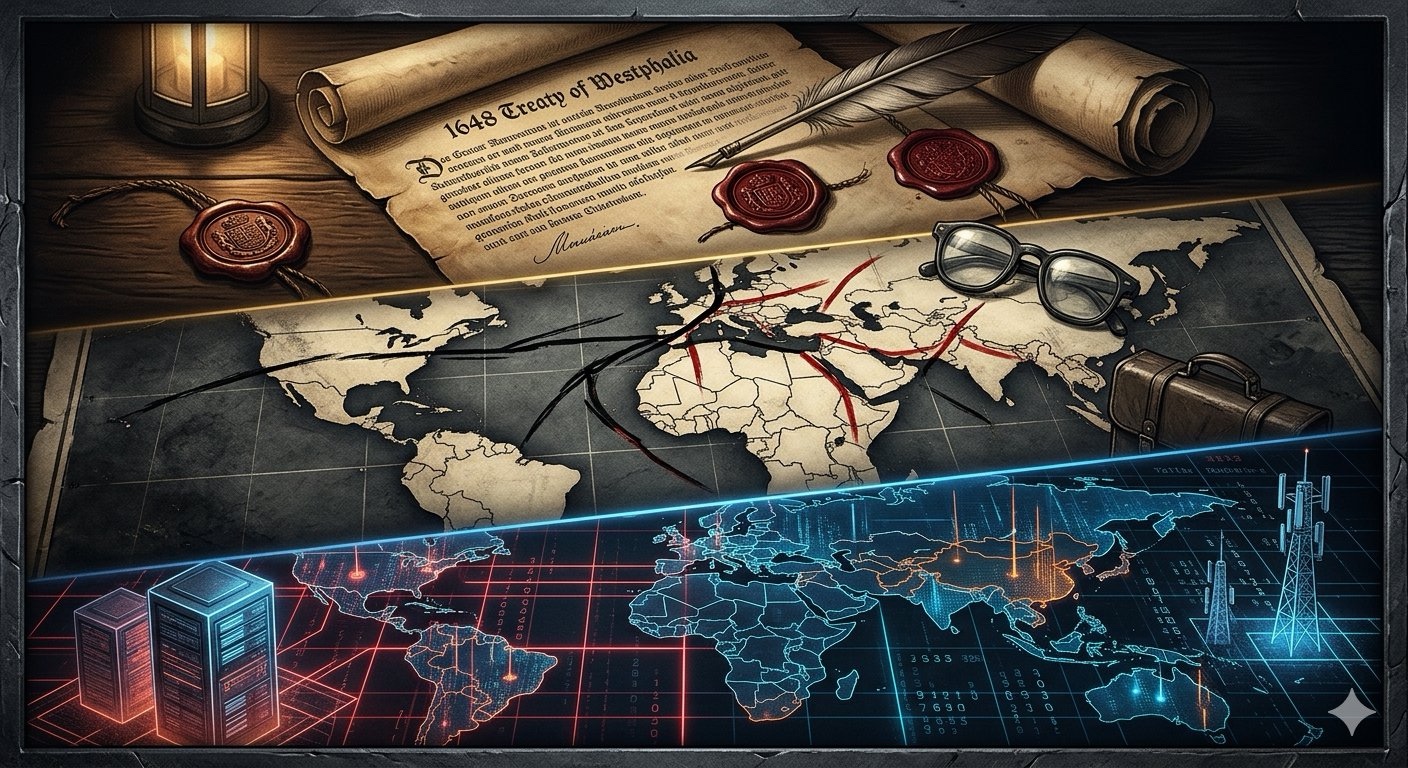
To understand the profound fraudulence of what just occurred in Shenzhen, one must contrast it with the standard-bearer of great-power divisions: the 1945 Yalta Conference. If Yalta was the Realist’s Manifesto of geopolitics, the Shenzhen summit is the Manifesto of Westphalian Subterfuge.
Yalta was a brutal, unvarnished exercise in spatial reality. Reflecting on the conference, Winston Churchill famously remarked, “Poor Neville Chamberlain believed he could trust Hitler. He was wrong. But I don’t think I’m wrong about Stalin.” It was a statement packed with the tragic, baseline realism of the era.
Yalta was an honest transaction between armed titans who looked at where their boots were physically on the ground and explicitly carved up the human race with a knife. There were no illusions, no flowery lectures on global harmony, and no pretend friendships. It was deeply cynical, but it possessed the dignity of baseline honesty. The lines on the map meant exactly what they said: cross this, and the tanks roll.
Contrast that with the nauseatingly lofty rhetoric emanating from Shenzhen today. Following the signing of the joint “Declaration toward Peace,” the Chinese Foreign Ministry proudly proclaimed that the meeting “charted a new course for global stability, replacing the obsolete cold-war mindset with a community of shared, inviolable redlines.”
The Illusion of Symmetry: A Con Artist’s Mirror
What a spectacular, breathtaking piece of fiction. Where Yalta was a realist’s map, Shenzhen is a con artist’s mirror. It is competitive subterfuge clumsily masquerading as great-power statesmanship. The three leaders sat at a round table, smiled for the global media, and signed a document that uses the archaic, 17th-century language of absolute sovereignty as a smoke screen for a deeply fluid, 21st-century grey-zone conflict. It requires a truly heroic, almost pathological amount of cognitive dissonance to believe that three hyper-suspicious superpowers, armed to the teeth with nuclear warheads and algorithmic cyber-weapons, have suddenly discovered a shared moral compass.
The Shenzhen declaration is a calculated illusion of symmetry. It pretends that Washington, Beijing, and Moscow are suddenly playing by a unified, stable set of geographic rules, even as all three actors actively prepare to violate them through cyber warfare, economic coercion, supply-chain weaponization, and technological containment—arenas where lines on a traditional map simply do not apply.
For Beijing and Moscow, the sudden, passionate invocation of “Westphalian sovereignty” and “state consent” is not a commitment to global peace. It is a highly strategic legal shield. It is designed to freeze their regional gains, defang international legal institutions, declare their immediate vicinities as closed spheres of influence, and trick a transactionally-minded United States into a voluntary retreat from its global alliances.
For Washington, signing the document is not an abdication of hegemony, but a tactical truce. It is a diplomatic release valve meant to temporarily lower the immediate risk of a peer-to-peer nuclear conflict and stabilize global energy markets, thereby buying critical domestic time to restructure its economy, secure its semiconductor supply chains, and rearm for the next round. It is a theatrical peace, a temporary high-water mark of geopolitical exhaustion. The ink on the declaration is structurally designed to fade the exact moment the internal balance of money, demography, or technology tilts once more.
India’s Playbook: The Art of Strategic Elusiveness
In the midst of this treacherous, three-sided minefield stands India. To Western analysts and policymakers accustomed to the rigid, binary alliance structures of the Cold War, New Delhi’s behavior during this triadic summit is often viewed with deep, vocal frustration. It is routinely labeled by commentators in Washington and Brussels as hesitation, chronic indecision, or rank opportunism.
This is not just a profound misreading; it is an analytical failure to recognize a masterclass in strategic survival.
In an era governed by an inherently unstable great-power triad, India is playing the game it has always done best: keeping its cards pressed tightly against its chest, embracing a doctrine of calculated ambiguity, and carefully, meticulously buttering every single edge of the geopolitical bread slice.
Consider the cold, brilliant pragmatism of New Delhi’s current positioning in the wake of the Shenzhen summit. By quietly endorsing the conference’s stated focus on stabilizing global energy flows, India reaps an immense domestic economic dividend. The cooperative, diplomatic tone of the trilateral declaration ensures that the United States cannot easily or justifiably penalize New Delhi with secondary sanctions for its ongoing imports of Russian crude oil.
India effectively secures its vital, long-term energy security and its decades-old defense architecture with Moscow, while simultaneously acting as an indispensable, irreplaceable anchor of the West’s Indo-Pacific strategy through the Quad.
New Delhi refuses to be trapped by the moralizing dictates of any single power, choosing instead to convert the friction between the three giants into economic and diplomatic leverage for itself.
Hard to Get: Survival in a Dance of Wolves
This is not a vacuum of policy, nor is it a legacy of archaic non-alignment; it is the deliberate, aggressive execution of multi-alignment as an art form.
India understands the fundamental, mathematical rule of the triad: to firmly align with any single corner of the triangle is to instantly forfeit your strategic autonomy and surrender your diplomatic leverage.
If India were to completely throw its weight behind a volatile, transactionally-minded Washington, it would isolate itself within its own Eurasian geography, cutting off ties with Russia and inviting uninhibited pressure from China. Conversely, if it were to capitulate to the anti-Western rhetoric of the Beijing-Moscow axis, it would find itself trapped as a junior partner in a continent structurally dominated by a rising, territorially aggressive China.
Therefore, India’s choice to play a perpetual game of “hard to get“—if not outright “hide and seek“—is not a luxury born of diplomatic vanity, but a stark, non-negotiable geopolitical compulsion.
By refusing to step onto the stage of the three-player grand illusion, New Delhi ensures it never becomes a passive casualty when the modern Westphalian subterfuge inevitably cracks.
In a world where three giants are locked in a deceptive dance of wolves, the state that masters the art of strategic elusiveness isn’t being indecisive. It is ensuring that it remains the ultimate, courted swing power that no single empire can ever afford to alienate, and no paper treaty can ever truly bind.
(CONCLUDED)