M.K.Sudarshan
November 27, 2026: Chennai, India
Is global statecraft a lawless game of “Machiavellian leverage” or an interconnected cosmic system governed by self-correcting laws?
Read this captivating philosophical duel between a Passionate Advocate of Western Realism and the Unknown Sri Vaishnava, using Chapter 16 of the Bhagavad Gita and the ancient Vedic concept of Ṛtam to dissect the ultimate fate of Donald Trump’s transactional governance.
The recent essay, “History is a Patient Creditor, and Trump’s Bill is Due,” ignited a fascinating intellectual duel in our correspondence logs. What began as a historical critique of a modern transactional leader transformed into a profound debate over the nature of power, statecraft, and the universe itself.
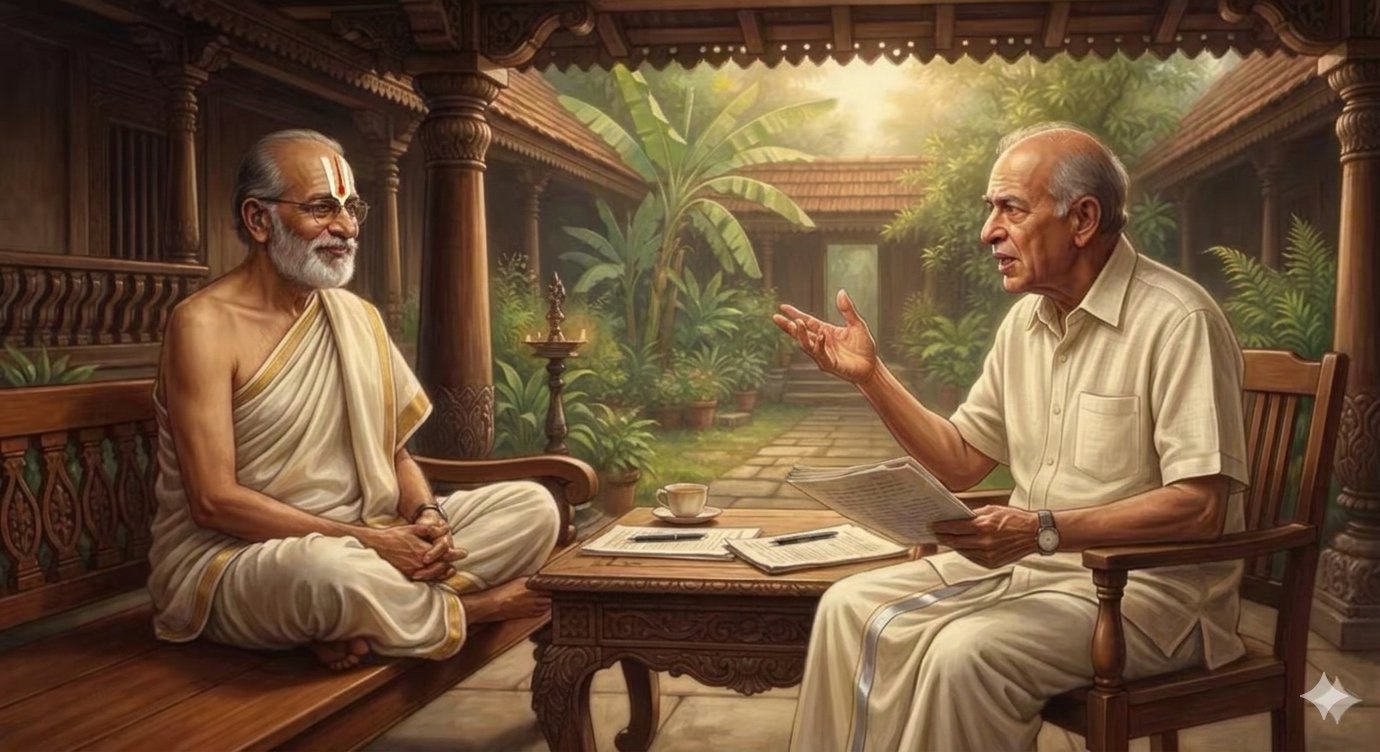
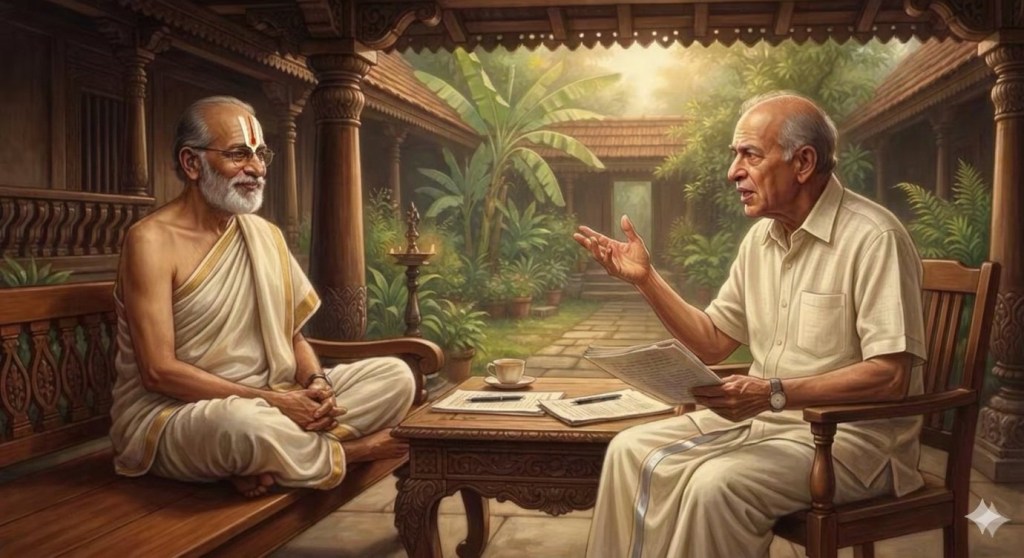
Below is the transcript of an imaginary joust between two good friends—The Passionate Advocate of Realism and Unknown Sri Vaishnava—sitting on a veranda, debating whether the world is merely a lawless theater of survival or a meticulously self-correcting cosmic engine.
The Passionate Advocate of Realism:
(Leaning back, holding up a copy of the previous blog post)
My dear friend, your essay is a masterfully written moral and historical critique, but it views the world from a selective elevation. You look down from the pulpit of a moralist, whereas I am merely trying to understand the competing arguments advanced by both critics and defenders of disruptive statecraft. Let us be entirely candid about the world we actually inhabit. Allow me to state my case as I see it:
It seems to me that we are viewing the same landscape from different elevations. Your essay is, fundamentally, a moral and historical critique of a particular style of leadership. My comment, by contrast, was an attempt to understand and articulate the competing arguments advanced by both its critics and its defenders.
At the heart of the matter lies a question as old as political philosophy itself: Do the ends justify the means, or do the means determine the legitimacy of the ends? From Machiavelli to the present day, the question has stubbornly resisted resolution. Every generation inherits it, wrestles with it, and bequeaths it, unanswered, to the next. In this regard, I am reminded of Winston Churchill’s celebrated observation on Russia: ‘I cannot forecast to you the action of Russia. It is a riddle wrapped in a mystery inside an enigma: but perhaps there is a key. That key is Russian national interest.’
Political conduct often presents itself in much the same fashion. Beneath every visible event lies a labyrinth of motives, interests, calculations, fears, ambitions, convictions, necessities, and rationalizations. What one observer condemns as opportunism, another defends as realism. What appears to some as recklessness may appear to others as strategic audacity. The key, if there is one, is seldom obvious to contemporaries.
It was in that sense, and only in that sense, that I referred to a ‘deliberate strategy to extract leverage.’ I was not endorsing the conduct under discussion; I was describing the reasoning advanced by those who support it. To explain is not to excuse. To understand is not to endorse. The responsibility of the analyst is first to comprehend competing interpretations before deciding whether judgment is warranted, and even then, whether he is the proper person to render it. Mine is a mirror, not a gavel. I reflect; I do not adjudicate.
History repeatedly cautions us against premature certainties. John Milton believed posterity would not willingly let his works die, and time vindicated his confidence. Adolf Hitler, too, imagined that he was reshaping history and founding a Reich that would endure for a thousand years. Posterity pronounced a very different verdict. Human ambition authors its own narrative; history retains editorial control.
Nor has history been consistent in its treatment of statesmen and rulers. Lord Clive and Warren Hastings were architects of empire, only to find themselves later subjected to impeachment proceedings. Charles I ascended the scaffold at the hands of forces led by Oliver Cromwell; yet Cromwell’s ascendancy was followed by the Restoration and the return of Charles II. The verdict of one age is often merely the opening argument of the next.
Leaning further into this, look at the disproportionate influence of seemingly minor events. Whether or not Marie Antoinette ever uttered the famous phrase, ‘Let them eat cake,’ matters less than the symbolic power that phrase acquired. It became the lightning rod for grievances that had long preceded it. Likewise, the assassination of Archduke Franz Ferdinand at Sarajevo did not create the tensions that culminated in the First World War; it merely supplied the spark to a powder keg already prepared by history.
Such examples abound. A shrine, a temple, a mosque, a monument, a survey stone, a deepa-stambha, a sacred precinct, or a disputed boundary may appear trivial to detached observers. Yet these often become repositories of memory, faith, identity, and grievance. Jerusalem continues to evoke profound passions among the Abrahamic faiths. Similar disputes elsewhere demonstrate how that which appears insignificant in itself may acquire immense emotional and civilizational significance in the public imagination.
William Shakespeare captured this truth with unforgettable clarity in Julius Caesar. After Antony’s funeral oration, having unleashed forces beyond recall, he declares: ‘Mischief, thou art afoot; take thou what course thou wilt.’ Once popular passions are awakened, events frequently acquire a momentum independent of the intentions of those who set them in motion.
This is why I hesitate to assign definitive motives to political actors. Around every major event gather competing narratives: accusations of profiteering, strategic maneuvering, ideological conviction, geopolitical necessity, commercial advantage, national security concerns, personal ambition, or insider influence. Some allegations are ultimately substantiated; others dissolve upon scrutiny. I neither certify nor dismiss them. I merely acknowledge their existence as part of the political theatre through which contemporary events are interpreted. Indeed, history suggests that public actors frequently cloak interests in the language of ideals. Nations invoke liberty, justice, democracy, faith, security, civilization, or prosperity. Their critics reply that beneath such noble rhetoric lies a more elemental force: self-preservation.
For my own part, I have long suspected that much of individual and collective behaviour can be traced to that primal instinct. Whether in a person, a corporation, a political party, a nation-state, or an empire, one frequently encounters some version of the enduring doctrine of ‘I, me, myself.’ It is the law of survival expressed in different vocabularies. One may admire it, condemn it, romanticize it, or fear it, but it remains an inescapable feature of the human condition.
This does not reduce history to a simplistic contest between heroes and villains. More often, it is a collision of competing interests, competing fears, competing loyalties, and competing visions of the future. In such a world, moral certainty is rarely as absolute as we imagine. Unlike the laws of physics or chemistry, human values do not operate according to universally measurable constants. They arise from assumptions, experiences, circumstances, priorities, and beliefs.
For that reason, I draw a distinction between the politician, the moralist, the historian, and posterity. The politician acts. The moralist approves or condemns. The historian seeks to understand and explain. Posterity, armed with consequences invisible to contemporaries, renders the final account. Accordingly, my earlier comment sought neither acquittal nor conviction. It merely attempted to illuminate the different lenses through which the same events are viewed. The purpose was not to defend a conclusion but to understand the arguments that produce it.
History, after all, remains the most patient of creditors. Its accounts are settled neither in the headlines of the day nor in the passions of the moment, but in the long and often unpredictable court of time. ‘Men act, partisans applaud or condemn, historians interpret, but posterity alone renders the judgment from which there is no appeal.'”
Unknown Sri Vaishnava:
(Listening intently, a serene smile unfolding as he adjusts his upper garment)
My brilliant friend, your words are spectacular. They are a masterclass in Western secular realism. You have built a fortress out of Thucydides, Machiavelli, and geopolitical pragmatism. You look at the political stage and declare: “Mine is a mirror, not a gavel. I reflect; I do not adjudicate.”
But from where I stand, your realism—for all its sophisticated vocabulary—suffers from a profound structural blindness. You treat the moral chaos of the world as a permanent, unresolvable fog. You look at Trump’s brazen tactics—humiliating allies, kidnapping foreign leaders, and declaring that “the victor takes the spoils”—and you see a “labyrinth of motives” where “moral certainty is rarely absolute.”
Western Realism treats human values as volatile, shifting sands, disconnected from any absolute anchor. It is blind to Vedantic Realism, which posits that while human rationalizations are relative, human consequences operate under a systemic architecture as rigid and predictable as the laws of physics.
What you call the chaotic, unpredictable momentum of Shakespeare’s “mischief,” the Vedic rishis recognized as Ṛtam (ऋत)—the immutable, self-stabilising cosmic matrix of truth, rhythm, and moral equilibrium. You believe human actors can author their own narratives unchecked. The Bhagavad Gita explicitly counters that when a leader operates purely out of the unconstrained doctrine of “I, me, myself,” they are not executing an audacious strategy; they are sleepwalking into a cosmic immune response.
Lord Krishna addresses your exact description of the primal law of survival. In Chapter 16, He classifies mankind into two distinct cosmic humours—the Daivi (Divine, that which sustains the order) and the Asuri (Demoniac, that which plunders it). Listen to how perfectly Krishna maps the inner monologue of the transactional ruler who treats the world as a personal playground to extract leverage:
इदमद्य मया लब्धमिमं प्राप्स्ये मनोरथम् ।
इदमस्तीदमपि मे भविष्यति पुनर्धनम् ॥ १६-१३॥
idam adya mayā labdham imaṁ prāpsye manoratham
idam astīdam api me bhaviṣyati punar dhanam“They think: ‘This wealth has been gained by me today; this desire I shall satisfy. This wealth is mine now, and more will be mine in the future.'”
And look at how he describes the mindset that justifies kidnapping presidents, assassinating rivals, and weaponizing tariffs to gloat over neighbors:
असौ मया हतः शत्रुर्हनिष्ये चापरानपि ।
ईश्वरोऽहमहं भोगी सिद्धोऽहं बलवान्सुखी ॥ १६-१४॥
asau mayā hataḥ śatruh haniṣye cāparān api
īśvaro ’ham ahaṁ bhogī siddho ’haṁ balavān sukhī“They think: ‘That enemy has been destroyed by me, and I will destroy others too! I am the lord and master; I am the enjoyer; I am successful, powerful, and happy.'”
You argue that this is merely one of many “competing visions of the future.” But Vedantic Realism warns that this mindset is an ontological delusion. The universe is governed by Ṛtam, which translates into human society as Dharma—the systemic guardrails that prevent the world from degenerating into Matsya Nyaya (the law of the fish, where the large devour the small).
When a leader proudly asserts, “I follow my own morals,” they are explicitly violating the structural laws of the cosmos. Krishna defines the exact end point of this path:
यः शास्त्रविधिमुत्सृज्य वर्तते कामकारतः ।
न स सिद्धिमवाप्नोति न सुखं न परां गतिम् ॥ १६-२३॥
yaḥ śāstra-vidhim utsṛjya vartate kāma-kārataḥ
na sa siddhim avāpnoti na sukhaṁ na parāṁ gatim“But he who discards scriptural injunctions—the established ethical laws and constitutional guardrails of life—and acts according to his own whims, attains neither perfection, nor happiness, nor the supreme destination.”
Your Western Realism attempts to remain neutral, holding up a mirror to this chaos. But in a universe ruled by Ṛtam, neutrality is an illusion. When you look at the systematic dismantling of global trust and class it merely as “audacious leverage,” your mirror becomes an enabler of distortion. You pull the cosmic elastic band further out.
You concluded beautifully that “history remains the most patient of creditors,” and that “posterity alone renders the judgment.” My friend, what you call “posterity” is not a vague, fickle human jury sitting centuries from now. Posterity is simply the execution of Karma, which is the currency through which Ṛtam balances its books.
When Charles I ascended the scaffold or when Governor Harvey was deposed by his own cabinet, it was not the unpredictable pendulum of history swinging at random. It was the elastic snapback of Ṛtam. The Asura always mistakes a delay in the invoice for a free ride. But as Krishna warns:
दैवी सम्पद्विमोक्षाय निबन्धायासुरी मता ।
daivī sampad vimokṣāya nibandhāyāsurī matā“The divine qualities lead to systemic liberation, whereas the demoniac qualities are the absolute guarantee of eventual bondage and collapse.”
You and I do not see a different landscape from different elevations. We see the exact same theater of power. The only difference is that your Western Realism records the sound and fury of the actors, while Vedantic Realism measures the immutable laws of gravity that govern the stage. Trump’s bill is due because Ṛtam never misplaces a ledger.