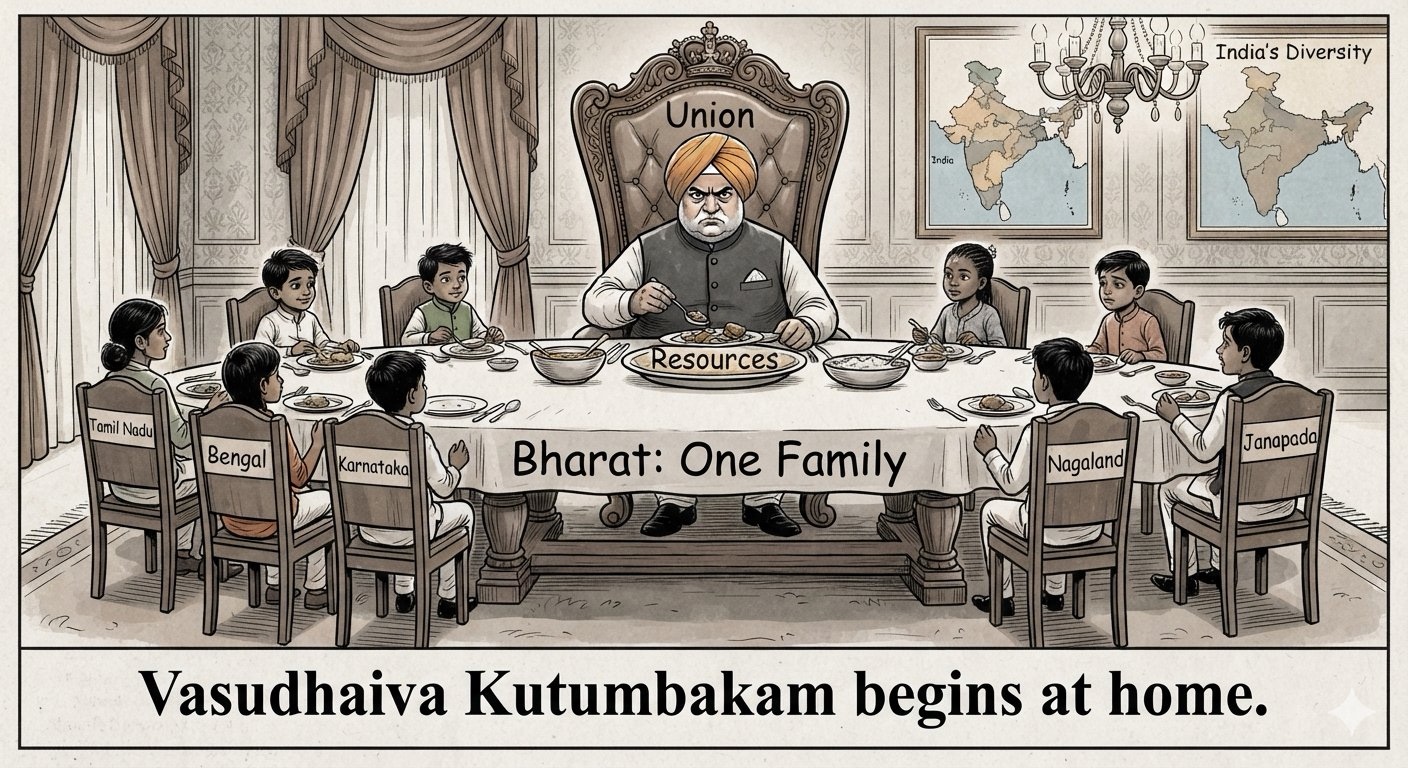
India’s Constitution calls itself a “Union of States”—but its states can be divided, renamed, or extinguished by Parliament, while the Union cannot be broken.
That is the Ambedkar Paradox: an indestructible Union of destructible States.
The result? A system that is neither a classic federation nor a unitary state:
• States have governments, legislatures, and identities.
• But the Centre controls the biggest taxes.
• States deliver schools, hospitals, police, and welfare.
• So states depend heavily on Delhi for money.
The fiscal asymmetry is structural—not an accident. But structural does not mean states must stay silent. In a democracy, they may demand fairness, consultation, and reform—without secession or hysteria.
The real question: Can India become a true Rashtra-Sangha—a family of janapadas—rather than a Centre that calls the shots and states that foot the bill?