M.K.Sudarshan
November 5, 2026: Chennai, India
An imaginary interview between Dr. Arvind Menon, a left-liberal political scientist at a Delhi university, and Raghav Sharma, a Sanatanī Hindu PhD scholar at Banaras Hindu University.
Raghav: Professor, let me begin with the first irony. The Constitution calls India a “Union of States,” yet the states are not really partners in that Union.
Parliament can create, divide, merge, rename, enlarge, diminish, or even extinguish them by ordinary legislation. Their views may be sought, but they need not be obeyed.
How is that a union of states?
Dr. Menon: It is a union in the specific sense Ambedkar intended: an indestructible Union composed of destructible states. The states are constituent units, but their territorial existence is not constitutionally sacrosanct. Article 3 allows Parliament to redraw them; the affected legislature is only entitled to express its views.
Raghav: So the absurdity is not merely that Parliament may alter boundaries. It is that the Constitution calls the units “States”—a word that ordinarily implies political personality—while denying them the most basic attribute of statehood: secure territorial existence.
Dr. Menon: That is indeed a real tension. In the American model, both the union and the states are indestructible. In India, Ambedkar deliberately inverted it: the Union is indestructible, the states are destructible. The purpose was to prevent secession and preserve national unity after Partition and princely-state integration.
Raghav: But then why call them “States” at all? If their boundaries, names, and very existence can be altered by a simple parliamentary majority, why not call them “Provinces”? At least “province” would be honest. It would say: you are an administrative division of the Centre.
Dr. Menon: Because “province” would have been even more centralising in its implications. It would have reduced states to colonial administrative units. The framers wanted states to have elected governments, legislative competence, and political identity, while retaining the Union’s power to reorganise them. So they chose a hybrid: states in dignity, provinces in vulnerability.
Raghav: “States in dignity, provinces in vulnerability.” That is exactly the semantic knot. The Constitution gives the states the costume of statehood but keeps the key to the wardrobe in New Delhi.
Dr. Menon: I would put it less theatrically. India was not formed by sovereign states surrendering part of their sovereignty; it was formed by integrating territories into one republic. Hence “Union,” not “Federation.” The framers feared that a compact-based federation might legitimise secessionist claims.
Raghav: But that historical explanation contains a second absurdity. If the states did not come together as sovereign units, why call them “States”? And if they did not retain sovereignty, why call India a “Union of States” rather than simply a unitary republic divided into provinces?
Dr. Menon: Because the framers wanted both things at once: federal self-government and an unbreakable national frame. They gave states legislative lists, assemblies, ministries, and a share in the federal structure; but they gave Parliament residuary powers, emergency powers, All-India Services, Governors, and Article 356. The result is neither a classical federation nor a unitary state.
Raghav: “Neither-nor” is precisely the problem. It is a constitutional structure that speaks federalism but practises centralism whenever convenient. The language says partnership; the architecture says hierarchy.
Dr. Menon: I would say: the language describes a strong-centre federation, and political practice has often made that strength feel like domination. The absurdity is not that the Constitution contains both federal and unitary features. Every federation contains some unitary features. The absurdity, if one may call it that, is that the unitary features are so much easier to activate than the federal safeguards.
Raghav: Let me give you a third absurdity. The Constitution bans secession, but it cannot ban the desire for self-respect. By calling states “destructible,” it tells every regional people: your identity may be recognised, but your territory is ultimately disposable. Does the Constitution not thereby manufacture the very insecurity it claims to prevent?
Dr. Menon: It may intensify insecurity when used insensitively. But the alternative—giving states a constitutional right to secede—was politically impossible in 1950 and would have been dangerous in a country emerging from Partition. The framers chose to make the Union invulnerable and the states flexible. The tragedy is that flexibility has often been experienced by states as fragility.
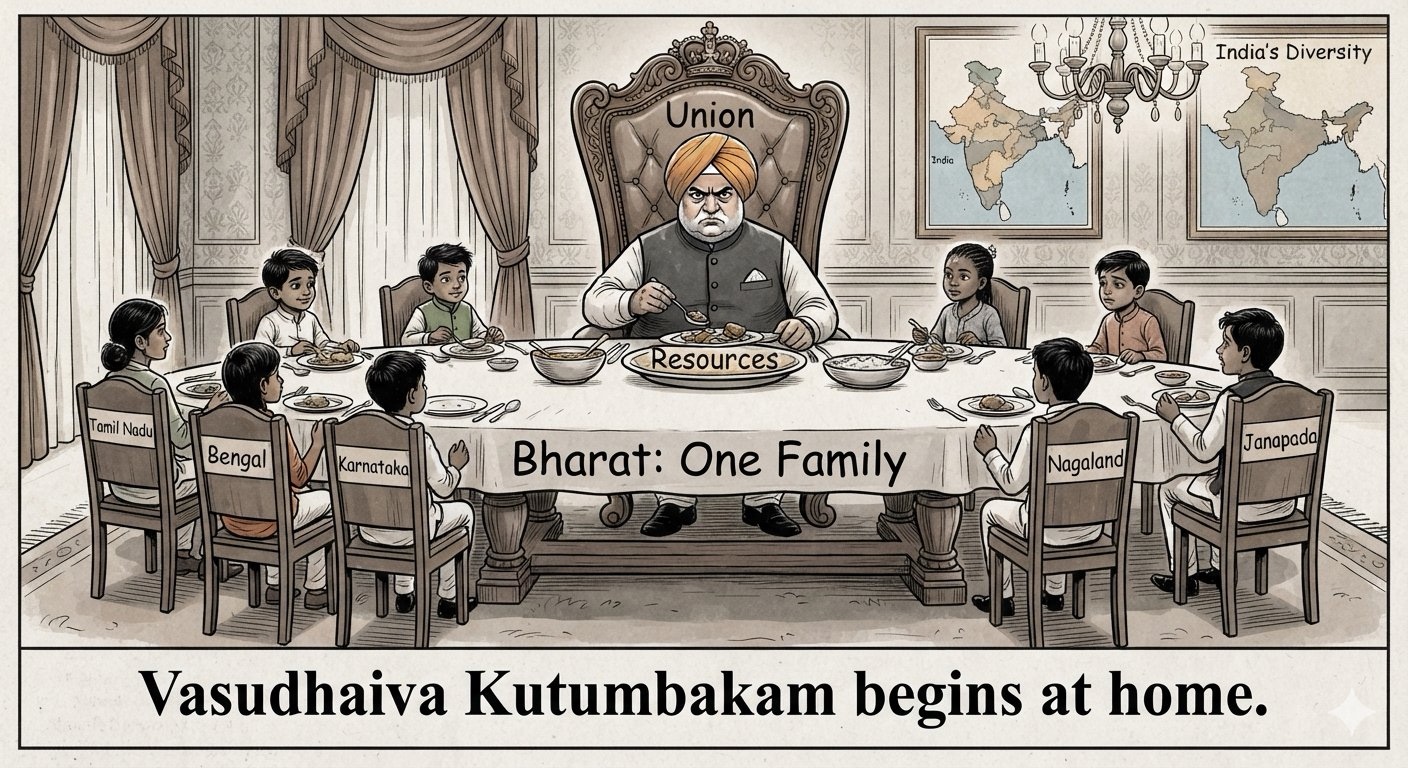
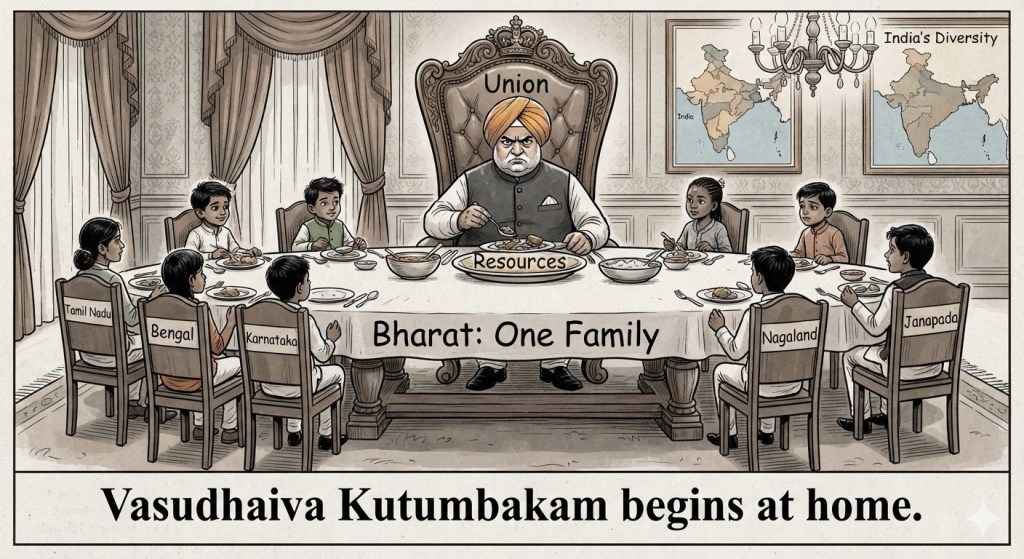
Raghav: And a fourth absurdity: we call the relationship “Centre–State relations,” as though the Centre were a parent and the states children. Yet the states carry most of the everyday burdens—schools, hospitals, police, agriculture, welfare—while depending heavily on the Centre for money. Is that not a strange family: the children do the housework, while the parent controls the purse?
Dr. Menon: That is one of the sharpest criticisms of Indian federalism, and it is not merely rhetorical. The RBI describes India’s vertical fiscal imbalance as rooted in the constitutional allocation of revenue powers: the Centre has the major taxes, while states have higher spending responsibilities. States collect only about one-third of total government tax revenue, but account for roughly three-fourths of social expenditure and more than half of economic-services expenditure.
Raghav: But surely the Union’s spending on defence, national security, communications, space, and research justifies its larger revenue share. Does that not neutralise the states’ complaint?
Dr. Menon: Partly, yes. Defence, external security, currency, foreign affairs, and nationwide infrastructure are legitimately Union functions. Defence alone is a vast commitment, and it is one reason the Union needs substantial revenue. But communications, space, atomic energy, and civilian research are comparatively small parts of the Union Budget. They do not erase the fact that states deliver health, education, policing, agriculture, and welfare—the services citizens encounter daily.
Raghav: So the asymmetry is not a temporary administrative inconvenience. It is built into the constitutional design.
Dr. Menon: Exactly. It is structural. The RBI calls it a vertical fiscal imbalance: a mismatch between the revenue-raising capacity and expenditure responsibilities of different tiers of government. The Finance Commission exists precisely to recommend transfers from the Union to the states to correct or manage that imbalance.
Raghav: Then perhaps the “Ambedkar Paradox” has become fiscal reality. The Constitution calls India an indestructible Union of destructible states; the fiscal system makes states politically prominent but financially dependent. The semantics did not merely describe reality—it helped create it.
Dr. Menon: I would put it carefully. The words did not create the imbalance by themselves. The imbalance arises from the assignment of taxes and functions. But the language of “Union of States” gave that centralising settlement a respectable constitutional grammar. It made a hierarchy of powers sound like a natural national arrangement rather than a contested political choice.
Raghav: Then comes the linguistic absurdity. We use English words—Union, State, Federation, Province—that carry the baggage of Western constitutional history. Meanwhile, India already had a rich vocabulary: rashtra, janapada, pradesha, sangha, samvada. Why did we borrow a foreign political grammar to describe an ancient civilisation?
Dr. Menon: Because the Constitution was written in a multilingual country with no single shared political vocabulary. English was neutral among Indian languages, even though it was colonial in origin. Sanskrit could have supplied dignity, but it could also have appeared partisan. The framers chose administrative clarity over civilisational symbolism.
Raghav: But that choice has consequences. “Union” and “State” are cold, legal, adversarial terms. Vasudhaiva kutumbakam, rashtra-sangha, janapada, rashtra-pradesha-samvada—these speak of belonging, dialogue, and shared destiny. Why should India’s constitutional imagination remain imprisoned in colonial semantics?
Dr. Menon: I accept the aspiration, but not the simple equation of Sanskrit with neutrality. Sanskrit is a magnificent classical inheritance, but it is not the ancestral tongue of every Indian people. Tamil, Telugu, Kannada, Malayalam, Santali, Meitei, and many Naga languages are not Sanskritic in origin. If Sanskrit becomes the sole constitutional idiom, some citizens will hear not “home,” but exclusion.
Raghav: Yet vasudhaiva kutumbakam is not sectarian. It says the world is one family. Surely that is the highest Indian contribution to political language.
Dr. Menon: It is—but only if we do not shrink it. Its original meaning is universal: the whole world is one family. If we use it to mean “India is one family, and Sanskrit is the family’s only sacred language,” we turn a universal ethic into a domestic hierarchy.
Raghav: But charity begins at home. If India cannot treat Tamil Nadu, Kashmir, Nagaland, and Bengal as members of one household, how can it credibly speak of the world as one family?
Dr. Menon: Completely agreed. But a family is not a patriarchal household. In a genuine family, the Tamil speaker need not become Sanskritised to belong; the Naga Christian need not become Hinduised to belong; the Muslim need not surrender Urdu to belong. The test is whether the constitutional language makes room for many inheritances, not whether it elevates one.
Raghav: Then let me ask the hardest question. If the asymmetry is structural, should states simply accept it as the price of national unity? Should they stop railing against the Union?
Dr. Menon: No. “Structural” does not mean “beyond criticism.” In a democracy, states may accept the constitutional framework while still contesting how its asymmetric powers are used. They may demand better fiscal sharing, challenge central overreach in court, seek reform of the Seventh Schedule, or press for constitutional amendment. That is not anti-national; it is federal politics operating inside the Constitution.
Raghav: But there is a difference between legitimate federal contestation and political tantrum. Some state leaders convert every disagreement into a civilisational insult, a linguistic war, or an existential grievance. That does not strengthen federalism; it poisons the Republic.
Dr. Menon: I agree. A state government may say: “This policy is unfair; we will challenge it; we will negotiate; we will seek constitutional change.” That is democratic. It crosses a line when it appeals to violence, ethnic exclusion, or secession. The Constitution bans secession, but it does not require states to be silent about injustice.
Raghav: So you are saying: states must live with the asymmetry, but not lie down before it.
Dr. Menon: Precisely. They must live with it as a constitutional fact, but treat it as a continuing democratic question. The Union, in turn, must treat state objections not as tantrums or disloyalty, but as claims requiring institutional response.
Raghav: And how should that response work in practice?
Dr. Menon: Through real intergovernmental machinery. Article 263 provides for an Inter-State Council to investigate and discuss subjects of common interest to the Union and states, and to recommend better coordination of policy and action. But its recommendations are advisory, and the Council has often been criticised as underused. When it is inactive, central policies are made without meaningful consultation with chief ministers.
Raghav: So the remedy is not to rename India a “Federation of States,” but to make the existing Union behave federally?
Dr. Menon: That is my view. Rename the relationship Rashtra-Sangha if you wish; call the states janapadas; speak of rashtra-pradesha-samvada. But unless the Union accepts binding consultation, predictable fiscal transfers, restrained use of Governors and Article 356, and genuine respect for linguistic diversity, a beautiful Sanskrit name will merely decorate the same centralising reality.
Raghav: Then perhaps our final disagreement is this. You say: fix the institutions first; the language will follow. I say: change the language and the imagination together, because a republic that speaks only in borrowed legal terms will struggle to feel like a family.
Dr. Menon: And I say: a family is created not by naming itself poetically, but by how it treats its members. India needs both: an Indian constitutional vocabulary and a genuinely federal practice. Without the first, the Republic remains culturally alienated. Without the second, it remains politically hierarchical.
Raghav: Then let us end with a shared formulation: India should be neither a brittle federation nor an overbearing union, but a Rashtra-Sangha of living janapadas—a commonwealth in which the Centre is not the owner of the household, but its elder trustee.
Dr. Menon: And where vasudhaiva kutumbakam begins at home: equal dignity for every people, language, faith, and region; strong enough to defend the whole, humble enough never to treat the parts as disposable.
(Concluded)
