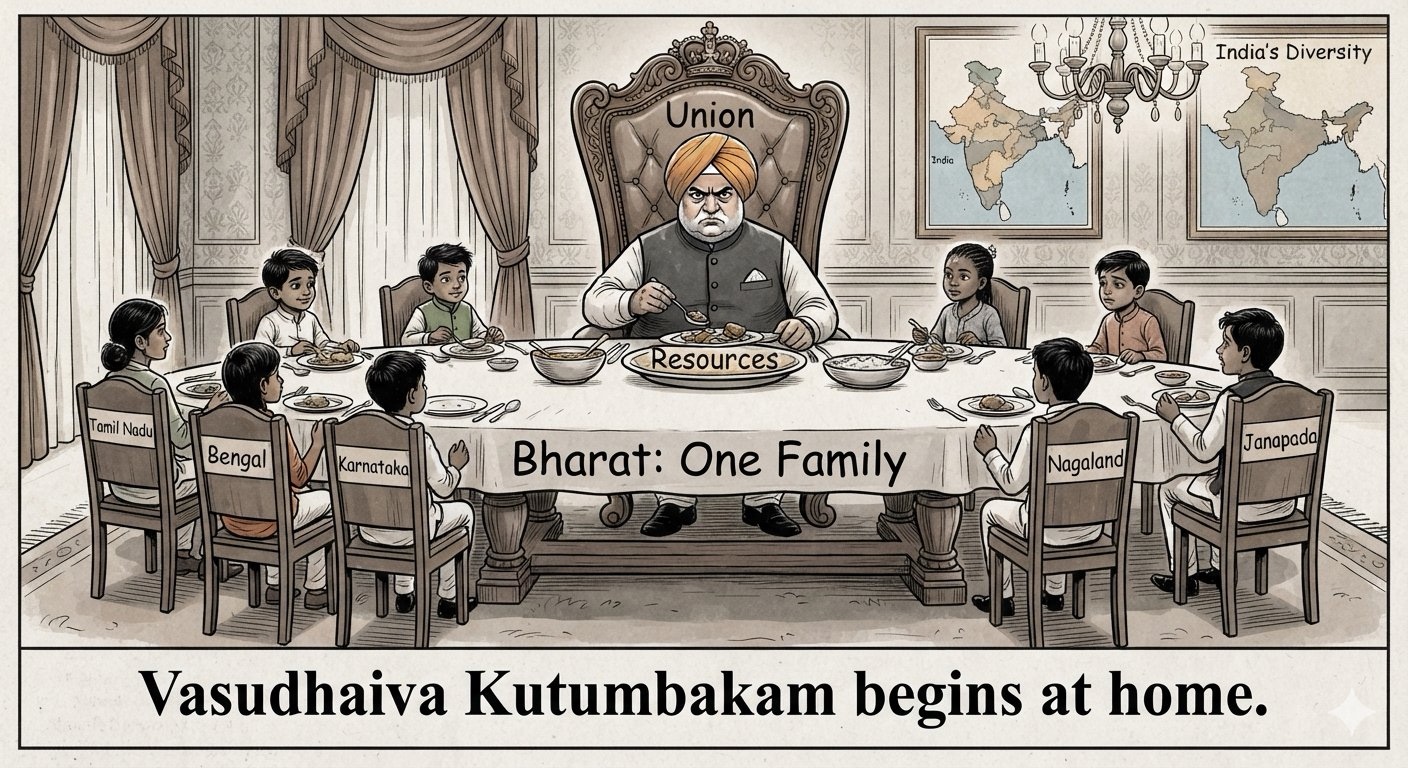
“The Ambedkar Paradox: INDIA: An Indestructible Union of Destructible States” — and Adult Politics?

India’s Constitution calls itself a “Union of States”—but its states can be divided, renamed, or extinguished by Parliament, while the Union cannot be broken.

That is the Ambedkar Paradox: an indestructible Union of destructible States.

The result? A system that is neither a classic federation nor a unitary state:

• States have governments, legislatures, and identities.
• But the Centre controls the biggest taxes.
• States deliver schools, hospitals, police, and welfare.
• So states depend heavily on Delhi for money.

The fiscal asymmetry is structural—not an accident. But structural does not mean states must stay silent. In a democracy, they may demand fairness, consultation, and reform—without secession or hysteria.

The real question: Can India become a true Rashtra-Sangha—a family of janapadas—rather than a Centre that calls the shots and states that foot the bill?

Bypassing the Tyrant: The 6th Mode of Transcending Workplace Friction — a Visishtadvaita therapy

Ever feel trapped in a cycle of silent resentment toward a toxic manager or a flawed institutional system? 💼

Standard advice tells us to “set boundaries” or “exit,” but modern clinical psychology often struggles to heal the underlying friction.

What if the solution isn’t to build higher walls around your ego, but to change the very source of authority you answer to?In our latest piece, we explore a fascinating dialogue between a practicing psychiatrist and a Vedantic philosopher.

Together, they map a revolutionary “Sixth Mode” of human behaviour derived from ancient Vishishtadvaita Vedanta—showing how true mental liberation in the workplace comes from an unexpected, vertical shift in perspective.

Read the full conversation here.