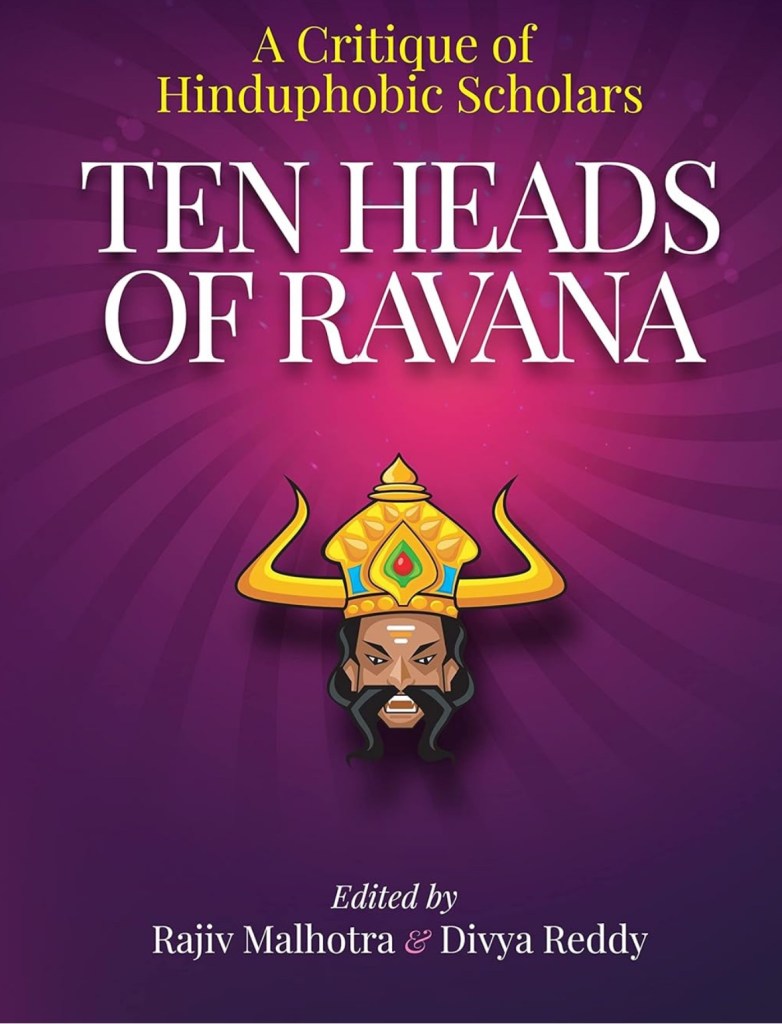
In the book Ten Heads of Ravana edited by Rajiv Malhotra, the well-known Hinduism scholar and historian, and his co-author, Divya Reddy, compiled ten excellent essays portraying ten prolific and very influential contemporary Hinduphobic writers in India and abroad. Shashi Tharoor finds a place of pride in the pantheon of those notorious ten who are likened to Ravana, the “dasagriva”, the ten-headed rakshasa villain in Valmiki Ramayana.
Tharoor thus is an Intellectual Ravana.
To make my own point that the Tharoorian view of Hinduism is indeed balderdash, I shall do nothing more than merely quote in extenso from passages from the essay on Tharoor penned by Divya Reddy in Malhotra’s book. Here are those select passages below.
I rest my case .
Sudarshan Madabushi
************ ********** **********
Tharoor has a humungous presence on social media with more than eight million followers on Twitter and he remains an influential personality in the media today.
Some of his best-selling books are Inglorious Empire: What the British did to India, An Era of Darkness: The British Empire in India, The Great Indian Novel, India Shastra: Reflections on the Nation in our Time, Why I am a Hindu, The Hindu Way (excerpted from the bestseller Why I am a Hindu) and the latest The Battle of Belonging: On Nationalism, Patriotism, And What It Means to be Indian.
Tharoor is also celebrated for his mastery over English and is popular for using unique (often unpronounceable) English words in his everyday parlance. His recent book Tharoorosaurus is a testament to his popularity in the world of English vocabulary and lexicon. For an average modern Indian, who views mastery over English as the most important mark of intellectual credibility, Tharoor is viewed as an intellectual giant par excellence.
In academia, popular media and for most aspirational urban Indians, Tharoor is also seen as a modern and perhaps the most eloquent interpreter of Hinduism for the twenty-first century.
Through his books, Tharoor explains what he believes is the essence of Hinduism and counters the ‘narrow-minded’ narratives by the ‘Hindu Right’ popularly referred to as the ‘Hindutvavadis.” He also claims to have written books focusing on Hinduism to counter the growing “intolerance” by the ‘Hindu Right’.
The books are seriously well-written, well-presented and but will mislead uninformed naive readers, especially those eager to know the Hindu story. He has managed to get enough credibility as an insider by masquerading as a patriotic Hindu through his books, especially the ones critiquing and questioning the British rule in India. Much of his critique is nothing new and has always been in the public domain by some serious and well-meaning historians of India.
With his impeccable credentials, one might wonder what makes Tharoor an ‘Intellectual Ravana’. Ravana was an intellectual giant, his strength and valor matchless. Through rigorous tapasya, he had obtained enormous blessings and scholarship which made him unconquerable. However, Ravana used all these powers for adharmic deeds which were harmful for mankind, and he was later vanquished by the forces of dharma.
Tharoor uses his eloquence and impressive public persona to propagate his views on dharma and India. However, his position on dharma is counter-productive to the unity and integrity of India.
********** ********* *************
Tharoor’s work on Hinduism is majorly an assortment of theories drawn from colonial Indologists and historians whose aim was to conjure a history of India which denies the indigenous origin of the country’s mainstream culture, instead giving credit to foreign invaders while devaluing India’s cultural heritage by trivializing her contribution towards the betterment of humanity at large. There are also many instances where Tharoor has taken extensive liberties in his interpretation of Sanskrit words and Hindu ideas, leading to manipulated and loaded narratives.
Tharoor claims to interpret Hinduism through the prism of a pluralistic, liberal Hindu. Given his wide popularity, his work influences the civilizational idea of India and subverts the native cultural identity for the modern Indian. However, a true understanding of something seminal like Hinduism needs to be broad-based and reflect fidelity to the tradition’s own self-perceptions, while not being colored by subjective prejudices. A factual and unbiased analysis of his books, articles, and thoughts is therefore very much … in order to counter some of the biases implicit in his works. (Discerning readers do) not … take his books and narratives at face value, but … delve deeper (to) understand the underlying motives behind such narratives.
********* ************* *********
A careful reading of Tharoor’s work will help one deduce that not only does he aspire to create a class of subservient and submissive Hindus, but also strives to instil a sense of shame by deliberately misinterpreting the sacred scriptures to bring out issues such as misogyny, superstitions, animal cruelty, alcoholism and so forth.
Young Hindu readers, especially those who are reading these books in their attempts to address yearnings for identity, who are subconsciously seeking to understand their place in the world, will be manipulated and their Hindu identities weakened. Reading the books will confuse and, in some cases, even cause damage to the sense of self-worth. This probably is Tharoor’s goal and he is mostly successful.
********* ************ **********
Tharoor claims to be a passionate follower of Swami Vivekananda and credits notable personalities like Dr. Sarvepalli Radhakrishnan, Ananda Coomaraswamy, Ramakrishna Paramahamsa, Paramahansa Yogananda, A.L. Basham, R.C. Zaehner, Raimon Panikkar and Dr. Karan Singh, for his wisdom on Hinduism. He also credits his contemporany fellow ‘intellectual Ravana’, Devdutt Pattanaik, for guiding him on hís book Why I am a Hindu.
Tharoor argues that Hinduism is a religion with no boundaries or barriers of entry, or fundamentals, or defined rituals or prescribed books or a specific place of worship. He emphasizes the fact that it is a faith that accommodates every belief and therefore there is no need to choose some and reject others. He also points out that Hinduism is a faith without dogma and consequently there is no particular framework from which one can deviate.
Hindus can choose from a variety of rituals, deities, customs and practices as per their needs and wishes. An inherent trait of every true Hindu is therefore, to accept and tolerate every worldview. In short Tharoor believes that every way of life is the Hindu way”.
********** ************** *********
Hinduism seemingly embraces myriad forms of beliefs and worship and thus Tharoor wholeheartedly agrees with India’s first Prime Minister, Jawaharlal Nehru, who had famously said that ‘being a Hindu means all things to all men’.
Tharoor concludes by saying: “As a Hindu I subscribe to a creed that is free of the restrictive dogmas of holy writ, one that refuses to be shackled to the limitations of a single volume of holy revelation.”
********* *********** *********
Tharoor asserts that Hinduism stands for ‘universal tolerance and acceptance as emphasized by Swami Vivekananda”. It is therefore, important for every adherent of the faith to tolerate and accept every other religion as their own irrespective of how the other faith treats Hinduism.
“Hindu legends have the gods manifesting themselves in so many shapes and forms that the notion of one agreed image of God would be preposterous. Thus one can imagine God as a pot bellied man with an elephant head, and also as a ten-armed woman with a beatific smile; and since both forms are equally valid to the worshipper, why not also imagine God as a bleeding man on a cross? All are acceptable to the Hindu; the reverence accorded to each representation of the unknowable God by worshippers of other faiths is enough to prompt similar respect from the Hindu. Acceptance is always the name of the game.” (Tharoor 2019:47-48)
********** *********** *********
Thus, as per Tharoor, it is perfectly acceptable for an artist, a filmmaker, an actor or an author to interpret Hinduism in whichever way they deem fit. To counter or defend such interpretations, which many within the Hindu tradition may perceive as distortions, is for Tharoor, no less than an act of intolerance and against the ethos of Hinduism.
Tharoor feels a book needs to be respected, even if it derides a Hindu Goddess, for a book is a sacred item. Therefore, as far as Tharoor is concerned, those who had protested against Wendy Doniger’s (a contemporary ‘Intellectual Ravana’) book on Hinduism and dubbed the book as being anti-Hindu are all intolerant bigots!
Tharoor is also a strong critic of the Rashtriya Swayamsevak Sangh (the RSS) and its ideologues. He alleges that the proponents of Hindutva ignore the concept of tolerance embedded in Hinduism. He criticizes the RSS for its idea of India as a ‘khichdi’ as opposed to his ‘thali‘ theory.
Below is an excerpt from his article where he is critical of the current RSS chief Mohan Bhagwat’s idea of India:
“The first idea assumes that there are various kinds of Indians, with very different views of their own identity, including religious assumptions that differ markedly from each other. Yet, we all belong together and share a common allegiance to India. I have described this for many years now, in various speeches and writings, as my “thali” theory of Indian nationalism. Like a thali, we are a collection of different items in different bowls; since we are in different dishes we don’t necessarily flow into each other, but we belong together on the same platter and combine on your palate to give you a satisfying repast.
Bhagwat’s idea of India is not that of my thali. It is, instead, a khichdi theory of nationalism: We are one dish, with many ingredients all mixed up and cooked together. Thus for him, all true Indians are Hindus; there might be a “Muslim Hindu” here and a “Christian Hindu” there, but they must acknowledge that they are part of the mixed khichdi and have no identity separate from it. Their diversity, in other words, is subordinate to their common role as a part of the larger unity.” (Tharoor: 2018)
********* *********** **********
Tharoor on Religious Conversion
Tharoor quotes Swami Vivekananda and Mahatma Gandhi, to point out that religious conversion is unwarranted. But for a Hindu like himself, he feels that every individual’s spiritual needs are different, and if some wish to find salvation through a different faith, that is entirely their prerogative.
He also feels that a self-confident faith like Hinduism, secure in its own broad-minded liberality, has no need of violence in its defence. He insists that religious conversion is not a threat to society and is a non-violent activity.
Tharoor feels every Indian is entitled to change his faith if he is not happy in his current one, be it for spiritual or materialistic gains and therefore religious proselytizing is not an anti-national activity.
Conversion, according to Tharoor, is just merely trying a different item on the spiritual menu — (his metaphoric thaali). Hinduism, being the most tolerant faith, must also allow its adherents to freely convert to another faith without any apprehensions. Tharoor argues that preventing religious conversion is also against Indian nationalism and the ethos of dharma.
Tharoor also questions why a secure faith like Hinduism should worry about conversions. Religious conversion essentially stands for exclusivity. That is, to convince the adherent of a particular faith that his/her faith is simply not good enough.
To paraphrase it in Tharoor’s own terms —- to convert to a religion that says his/her way is the only way, we are reducing the number of paths to reach the Ultimate. For someone like Tharoor, who is one of the strongest proponents of Pluralism, it is an irony that he supports an act of reducing diversity.
When Tharoor says it is one’s individual freedom to convert, it is also important to point out that, it is every individual’s right to know what he/she is getting into, just like the terms and conditions of an organization that one would agree to, to opt for their product/service. However, going by the data of mass conversions happening in India in contemporary times, it is mostly through deception.
For instance, one must be educated enough to distinguish between Hindu good news and Christian good news. Freedom to proselytize also comes with a moral responsibility. One cannot have unlimited freedom. That would be a level playing field. No other form of conversion can ever be justified, for it is a gruesome violation of human rights, to exploit the vulnerable status of an individual be it due to innocence/poverty/personal problems and so on. It is the pinnacle of religious intolerance that is against achieving world peace. The issue of religious proselytization highlights the fact that Abrahamic faiths are unable to accept the differences of other paths to God and live-in harmony. This goes against the norms of peaceful co-existence. It is ironical that Tharoor lectures a faith with no history of religious conversion on ‘tolerance‘ and acceptance of other religions.
******* ************* **********
The flexibility and the openness of Hinduism does not mean that it is not worthy of expecting the same respect and acceptance from other religions. There is a fine line between accepting and submitting, which Tharoor fails to highlight. Religious conversions are one such example of Hindus being deprived of mutual respect.
As mentioned earlier the pluralistic inherent unity and acceptance of dharmic faiths need to be reciprocated with mutual respect, which is a two-way path. When mutual respect is compromised, whenever it is under siege, dharma needs to be defended or protected, for that is the true essence of dharma. This fact has been constantly emphasized in our puranas, itihasa and the Bhagavad Gita.
However, it is evident through the work of Tharoor that he constantly tries to subdue this Kshatriya spirit of the Hindus. This is one of the major reasons why Tharoor’s work is against the ethos of Hindu philosophy, as not only is his interpretation in contradiction to the fundamental ethos of dharma, but also mentally conditions a Hindu to become submissive and slavish.
********* *********** **********
Tharoor selectively quotes Swami Vivekananda, prompting one to question the integrity and credibility of Tharoor’s interpretation of not only the sage’s work, but of his other sources as well.
One knows of “Cafeteria Christians” (a non-scriptural term used to refer to the practice of choosing for oneself the parts of the Bible to either accept or reject) but one might as well coin ‘Cafeteria Hindu’ to describe Tharoor, due to his selective use of data, inferences, whitewashing historical facts and causes — one can pick and choose one’s use of rationality in his world.
Tharoor’s Chronology of Hinduism
Tharoor’s chronology is based on the Aryan Invasion/Migration Theory. Accordingly, he believes that the Aryans migrated to India sometime before 1500 BCE and thereafter composed the Veda-s.
The four Vedas are believed to have been created between 1500 BCE and 500 BCE. He also believes that the first eight Upanisad-s to have been written between the eighth century BCE to the fourth century BCE, which is congruent to the age of Buddha. The next three Upanisad-s are post-Buddhist and date from 300 BCE to 200 CE and that the remaining ninety-seven Upanisad-s belong to the Puranic period ie., second century CE to the tenth century CE. He believes the Smriti-s were composed between 300 BCE and 200 CE, Ramayana around 200 BCE to 200 CE and the Mahabharata between 400 BCE and 400 CE. He dates the Purana-s to 250 CE and 1000 CE.
This artificial chronology that was created by colonial scholars to serve various purposes, has been challenged and countered time and again over the last century. Yet, it continues to hold sway over academia, and the Western baselining of Indian history still continues in several forums. While, many Indian scholars have begun to challenge the dates and chronological structures framed by colonial Indologists, the silver lining is that, there are increasingly vibrant discussions in public space and awareness amongst the younger generations, as to the logical fallacies in their narrative.
******** ************ **********
Tharoor’s work analyzing Hinduism’s important texts is replete with serious misinterpretations and factual errors. Tharoor believes that Hinduism is not absolved of gender bias and quotes Manusmriti and excerpts from the Anusasana Parva of Mahabharata to substantiate his claims on misogyny.
Firstly, Manusmriti does not define Hinduism. There are few modern Hindus who wake up in the morning and read the Manusmriti to guide their actions, because, fundamentally, smritis are codified law: which are context, time and place driven and not eternal truths or the last word.
Manusmriti cannot be compared to the Bible/Quran which transcend time, place and context. Moreover, Manu’s code is explicit in stating that it is not universal. It calls for updates, amendments and rewrites in order to suit different circumstances.
Tharoor also refers to the Manusmriti as the ‘Hindu Law’ even though it has never been enforced as the divine and all-encompassing “law of all Hindus”. It was the British who referred to the Manusmriti as the ‘Hindu law’ to show that they were ruling in accordance with the laws of the Hindus, albeit with colonial motives.
Indian spiritual texts have traps for the uninitiated, therefore it is of prime importance to rely on a Guru or the one who has the adhikara to interpret the esoteric texts. Tharoor neither has the adhikara nor has he made any attempt whatsoever to learn from the right people and his ignorance shines through his misinterpretations.
******** *********** **********
Some unanswered questions raised by Tharoor have been:
What makes Hinduism flexible and open?
How ‘elastic’ is Hinduism?
Does Hinduism have no boundaries at all? Can any book be thought of as the sacred text? Can anything and everything be part of Hinduism?
Implications of Tharoor’s Work
~anything-goes Hinduism, myth of sameness , relativism, hostile
~forces making way into the system, confused Hindu and a faith that is prone to disintegration
~gateway for digestion eventually leading to extinction
~serves as a narrative for the Breaking India forces
~passivity/complacency toward defending dharma, which leads to adharma
******** ************ **********
While Tharoor is right in understanding Hinduism as a faith that does not have a rigid entity with dogmas enforced by a centralized authority equivalent to a church, nor a single founder, linear history, ‘one truth’ and so forth, it is his muddled understanding of Hinduism’s clear distinction between valid and invalid religious claims which is the cause of concern.
The traditional Hindu teachings make a clear distinction between dharma and adharma, sat (truth) and asat (falsity), daivika and asuric, and so on. Hinduism has certain definitive boundaries that are non-negotiable, for instance the concepts of karma and reincarnation are fundamental to explaining the philosophy of Hinduism.
The Vedas form the basis of dharma, and are fundamental to an “astika”.
As the title of one of Tharoor’s books The Hindu Way suggests, indeed Hindus have a definitive way and not ‘every way’ is a ‘Hindu Way’ as the content of the book seems to suggest. The quote below is from Tharoor’s book The Hindu Way and substantiates our analysis of his thesis:
“Indeed the term “the Hindu way” is in itself a fallacy as there is no one Hindu way.” (Tharoor : 2019)
When Tharoor makes an audacious statement as above notwithstanding the fact that he is paving the way for ‘anything goes’ Hinduism. (Or is that his intent?)
In the realm of pop culture or ‘new age spirituality‘ it is fashionable to interpret Hinduism as infinitely elastic or as vaguely as one pleases. If every way of life counts as the ‘Hindu Way, then the natural question of what defines a Hindu arises.
Although the Hindu dharma provides great flexibility as well as enormous freedom to adapt and evolve, at the same time, the dharma has a boundary and excludes hostile elements that do not reflect this unity. If all religions were the same as Tharoor portrays them to be, then what good is it to remain a Hindu?
When Hinduism is loosely defined, without definitive boundary markers, Tharoor is opening it up for digestion. The term ‘digestion‘ in this context essentially means that the predator religion separates the desirable elements of a particular faith, then ‘scrubs‘ the elements to remove the dharmic context in order to make it more acceptable to appropriate to the predator faith, thereby making the predator religion more robust and stronger. For eg: Christian Yoga.
The threat of such a process is that, it may eventually lead to extinction of a weaker civilization, because the predator religion keeps becoming stronger and what is left of a civilization after the predator is done with it, is waste material to be removed and destroyed. For example, as in the case of pagans of Europe, many of their rituals were appropriated by Christianity eventually leading to the extinction of the faith.
******** ************* *********
Rajiv Malhotra uses the term ‘open architecture’ to explain the flexible, hard to define quality of Hinduism. The term ‘open architecture‘ refers to a framework that can be populated by a range of ideas, practices, symbols, rituals, and so on. He draws an analogy between Hinduism and the functioning of the internet, as explained in the book Indra’s Net:
“The internet is not infinitely open but only relatively so: its boundaries are defined by what it rejects— for example, viruses or abusive elements.
Despite these rejections, the internet has abundant flexibility for the future. Similarly, Hinduism does not comprise all conceivable kinds of spirituality and religious claims, because it must exclude those that would destroy its underlying principles of integral unity, openness and flexibility.”
Swami Vivekananda defined Hinduism with three essential features— belief in God, in the Vedas as revelation, and in the system of karma and transmigration. While Tharoor represents Hinduism as a faith that is infinitely open to embracing everything unconditionally— such extremism is counter-productive because the survival of the entire system is compromised.
As stated above, just as the Internet is hostile to viruses or abusive elements that would hamper its productivity, Hinduism must also be guarded against elements that would threaten its philosophical unity.
Tharoor fails to identify such elements (perhaps deliberately?) and draw a definitive boundary against what is not Hinduism.
********* ************ *********
The question of whether to accept Shashi Tharoor’s perspective on Hinduism—as opposed to a more traditional or orthodox view—is fundamentally a matter of how one interprets Hinduism’s history, diversity, and evolving identity.
Ultimately, whether to accept Tharoor’s or a more traditional one is a matter of personal conviction, scholarly inquiry, and lived experience. In summary, Tharoor’s interpretation is one among many, but it draws on deeply rooted aspects of Hinduism’s history and philosophy. Accepting or rejecting it depends on how one values tradition, reform, and the ongoing dialogue within Hinduism itself.
Tharoor however has and does take enormous liberties to distort and misinterpret the notion of ‘liberalism‘ and ‘pluralism‘ inherent in Hinduism to convince a Hindu into cowardice and inaction.
[Divya Reddy calls Tharoor as “Macaulay-Putra”.]
For an average ‘Macaulayized’ English-speaking Hindu youth, who has no deep moorings in Hindu thinking, it is easy to get swayed by his eloquence, public persona and his well-articulated writings. He positions himself as an insider and leads Hindus on a self-implosive trajectory. If Tharoor had genuinely wanted to discuss Hinduism’s openness and flexibility, there would have been clarity in his explanations of many of Hinduism’s vaunted characteristics.
Other than deliberate misplaced characterizations, the genuine reader, looking for logical and plausible explanations will most likely feel cheated after reading Tharoor.
******* ************** **********
Finally, my submission is this :
Tharoor may be a great elocutionist in English, a great writer and historian, but on his views on Hinduism, he cannot be allowed to go unchallenged. Why ? Because he is such a popular figure that his polluting influence on the minds of educated and young Indian minds can be very very profound.
His writings are considered to be the ‘new-age’ authority on Hinduism, especially in urban India. His works serve as a ‘handbook’ on Hinduism for many modern Hindus, making it important to factually counter his erroneous positions.
For instance, at a marriage ceremony, the Bhagavad Gita was replaced by Tharoor’s book Why I am a Hindu, and the groom’s mother shared this ‘proud revolutionary’ moment on social media. She was also quoted saying that Tharoor’s book was a ‘more meaningful and relevant text’.
I rest my case .
Sudarshan Madabushi