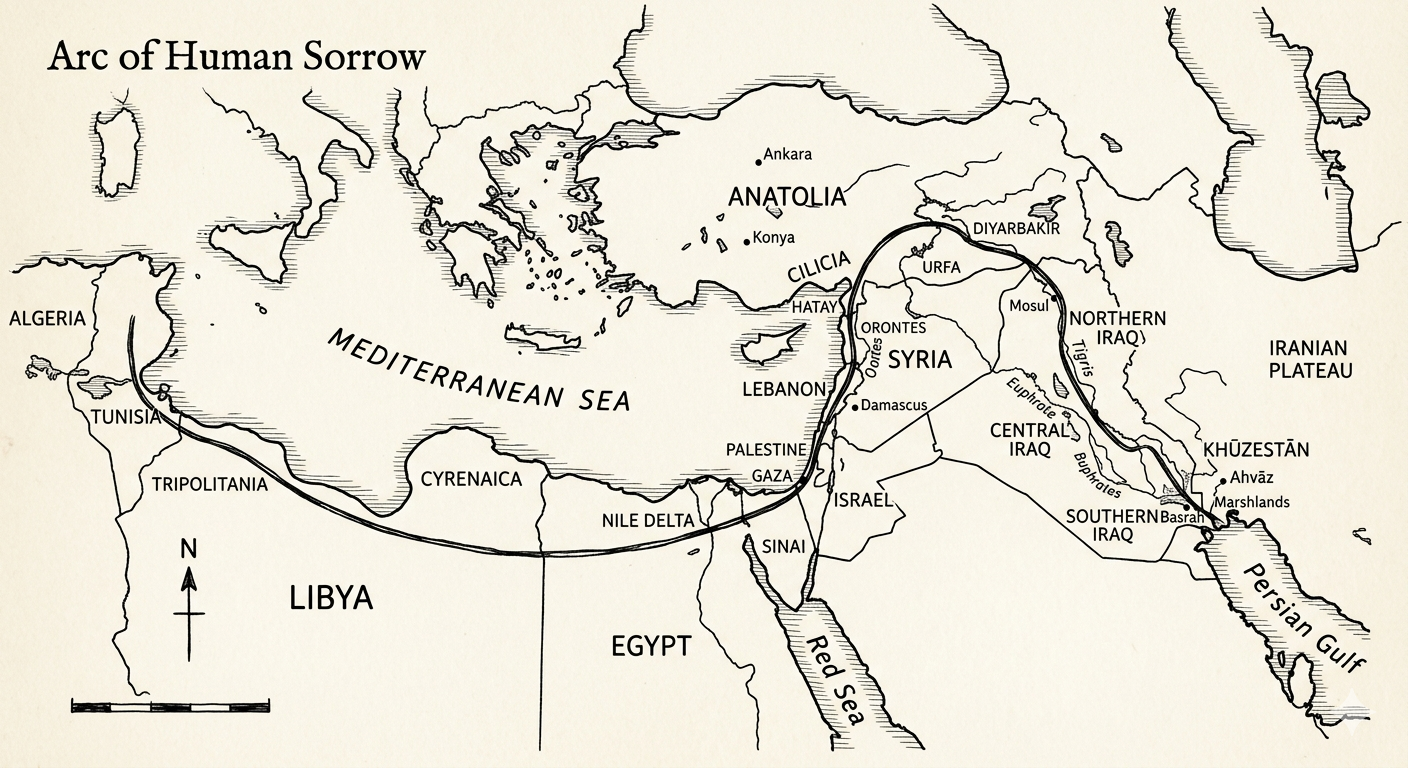
If the arc can be read as a product of resources and strategic geography, it can also be read as a mirror of power asymmetry.
Throughout most of human history, the making of the arc’s fate has been reserved for what I call the “One‑Tenthers”—the small minority of great‑power states, imperial elites, and ruling‑class networks who have, time and again, decided which wars would be fought, which borders drawn, and which resources exploited.
The Nine‑Tenthers, by contrast, have been largely reduced to the role of participants‑in‑suffering rather than participants‑in‑decision.
The rise of Western imperialism, driven by the industrial and military fruits of the Enlightenment‑era revolutions, only intensified this asymmetry. The cartography of the modern world—especially in the arc stretching from Libya to Persia—was not drafted by the people who lived there, but by foreign diplomats, generals, and corporate agents whose interests were, at first remove, surprisingly distant.
The choices in politics, ethics, and imagination that mankind, at large, made in the annals of its history were, in practice, choices made by the One‑Tenthers for the Nine‑Tenths, often under the rhetoric of civilization, stability, or development.
The arc, in this sense, became the outer edge of an imperial imagination, where the human cost of that imagination could be conveniently deflected.
The One‑Tenth has long perfected the art of “ethical camouflage”: wars undertaken in the name of “stability,” “order,” or “development” become palatable to the conscience of their own populations, even as they deepen the arc of suffering abroad. Humanitarian discourse, technocratic language, and claims of “civilizing missions” or “strategic necessity” are repeatedly used to insulate the powerful from the moral gravity of their choices.
The Nine‑Tenths, meanwhile, are often reduced to the role of moral witnesses—of victims, martyrs, or “case studies”—rather than co‑authors of an ethical world order. Their suffering is visible; their ethical agency is systematically marginalized.
The choices in imagination are perhaps the most subtle conquest. For centuries, the dominant global narratives—about progress, modernity, civilization, and even “what is realistic”—have been authored by the One‑Tenth. This means that the Nine‑Tenths are often forced to refashion their own dreams within frameworks drawn from elsewhere: nationalism, capitalism, secularism, and “development” as defined by the center.
When the Nine‑Tenths do imagine radically different futures—non‑imperial, non‑militarized, non‑extractive—their visions are routinely dismissed as “idealistic,” “unrealistic,” “utopian” or “irrational,” while the One‑Tenth’s own fantasies of endless growth, security, and power are treated as normal.
Yet history is not static. The arc, too, may move. If the current arc of sorrow is rooted in access to oil, gas, and strategic transit routes, the depletion of these resources—or the discovery of richer veins elsewhere—could shift the locus of imperial hunger.
The Arctic, now emerging as a new frontier of energy‑rich shelves, rare earths, and minerals, already bears the hallmarks of a nascent “moving arc.” As the ice melts and the old hydrocarbon‑frontier of the Middle East begins to wane, one can imagine the centers of great‑power competition migrating northward, repeating the same cycle of surveillance, militarization, and extraction, but now along the rim of the Arctic Ocean instead of the rim of the Mediterranean.
In this light, the arc of human sorrow is less a permanent feature of a single region than a pattern that migrates wherever the One‑Tenthers find concentrated value. The Nine‑Tenths, caught in one arc after another, remain structurally disempowered, their agency constrained by the very systems that define the arcs themselves.
The crucial question is not whether the arc will ever vanish, but whether the Nine‑Tenths can, in time, seize enough moral, political, and economic ground to force the One‑Tenths into a new kind of coexistence—one in which the arc of suffering is not simply displaced, but dismantled.
The arc’s movement also exposes a deeper irony: the very technologies that promised to liberate humanity from scarcity and toil now enable the One‑Tenthers to track, exploit, and militarize ever more remote frontiers. The same satellites, drones, and surveillance networks that could, in theory, connect the world in solidarity, are instead used to secure extraction‑zones and choke‑point routes.
The arc of sorrow is no longer confined to the warm, old‑world deserts; it is already stretching into the cold, newly navigable oceans of the far north, ready to become the next textbook‑boxed theatre of great‑power competition, while the Nine‑Tenths once again stand on the margins, watching power‑decisions made in distant capitals, boardrooms, and security councils.
(To be continued)
Sudarshan Madabushi