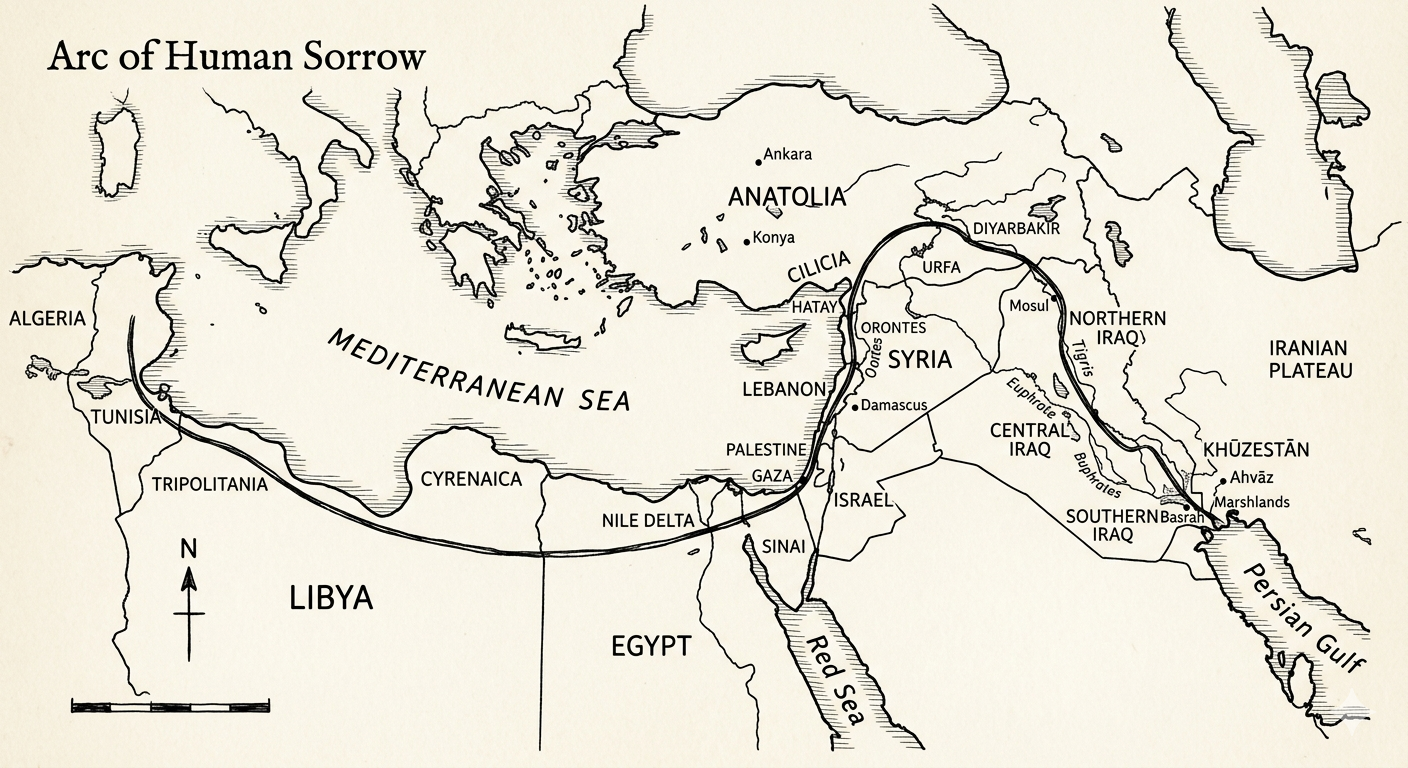

I. The Arc of Human Sorrow in the World
If one were to trace, on a single map, the heaviest concentration of war, pillage, and displacement across human history, the line would run from Libya through Anatolia, the Levant, Mesopotamia, and Persia—an arc that has, for millennia, been less a geographical accident than a structural fault‑line of empire.
From the dawn of recorded history, this corridor has served as the spinal column of empires: Assyrian, Babylonian, Persian, Macedonian, Roman, Byzantine, Islamic caliphal, Seljuk, Mongol, Ottoman, and, in the modern age, the overlapping regimes of European and American imperial power.
From at least the late Bronze Age onward, this corridor has been the main east–west corridor between the Mediterranean and the Iranian plateau, so it repeatedly became the spinal battlefield for competing empires. The Levant and Mesopotamia in particular were frontier zones between Mediterranean powers and Iranian‑heartland empires, so wars between Rome‑Byzantium and Persia, then between Ottoman and Safavid empires, passed repeatedly over the same towns and populations, amplifying cycles of pillage and displacement.
Each of these powers, in turn, has marched, bargained, and bled over the same towns, river‑crossings, and trade‑routes, repackaging the same hunger for territory, tribute, and control in new ideological cloaks.
What we might call the “Arc of Human Sorrow” is not merely a belt of suffering, but the visible imprint of a deeper pattern: the insatiable appetite of the powerful for strategic advantage and concentrated wealth.
When the Industrial Revolution equipped Western states with the technology and capital to project force across oceans, this arc became the primary theatre for resource‑driven expansion. The old prizes of silk, spices, and gold were gradually replaced by the far more potent magnets of oil, gas, and minerals. The arc did not suddenly become a zone of pain; it became the privileged zone where the logic of empire could be most lucratively enacted.
Thus, the wars of the last century—the two World Wars, the Cold‑War alignments, the post‑1979 upheavals, and the post‑2003 invasions and interventions—have all left their deepest scars precisely along this ancient spine of conflict.
To stand in this recognition as a historian is to see both tragedy and continuity: the same lands, repeatedly, have been conscripted not as protagonists in their own story, but as terrain for the ambitions of others. The arc is not a metaphysical curse, but the historical reward of possessing what others covet. And yet, because the coveters are always ready to fight among themselves, the arc becomes a perpetual battlefield, where the Nine‑Tenths of humanity—those who live, sow, build, and mourn within it—are left to experience the consequences of decisions made far beyond their borders.
The arc of sorrow is not only a record of physical violence; it is also a record of moral erosion. Over generations, a rhythm of empire, resistance, and intervention has hardened into a habit: the One‑Tenthers assume that force and manipulation are the only realistic tools of order, while the Nine‑Tenths learn two contradictory lessons—that resistance is often crushed, and that even survival depends on navigating the machinery of extraction. This is how the arc becomes, in effect, a training‑ground in resignation and cunning, a place where lofty ideals of peace, justice, and dignity are repeatedly tested against the cold calculus of power.
(To be Continued)
Sudarshan Madabushi